GSDC Mentor Connect: Designing L&D Academics & Digitalization
Written by Matthew Hale
At GSDC, we combine our certification program with expert-led Mentor Connect sessions, enabling students to apply what they learn in the real world.
This post summarizes the useful advice given in a recent Mentor Connect class on how to create learning programs and utilize digitalization wisely.
Use it as a hands-on guide to create measurable learning paths that are both academically challenging and useful in the industry.
Why L&D matters: the strategic role
Learning and development is no longer just a support role; it's a key part of the business strategy.
The main answer to the question "What is the role of learning and development?" is simple: to help people perform.
That involves addressing skill gaps, making career paths, and getting results that are important to the business, like lower error rates, faster onboarding, happier customers, and demonstrable productivity increases. When L&D works strategically, it may help the organisation change and become more resilient.
Learning and development vs instructional design
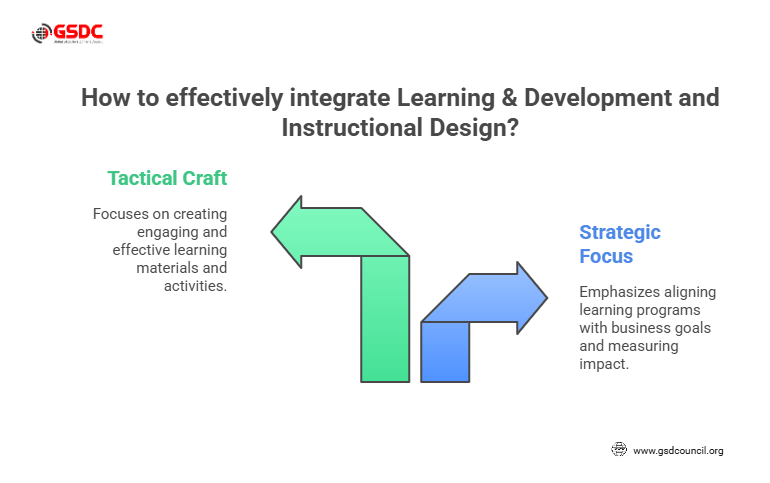
It helps to separate scope and craft:
- Learning & Development (L&D) is the strategic function. L&D defines outcomes, aligns programs to business goals, governs learning investment, and measures impact.
- Instructional Design: The Tactical Craft. Instructional designers create curricula, learning activities, assessments, and materials that deliver the outcomes L&D specifies.
Both perspectives are essential. Strategy without quality design fails in adoption; great design without strategic alignment becomes a cost center. Successful programs combine both.
A six-step end-to-end design process
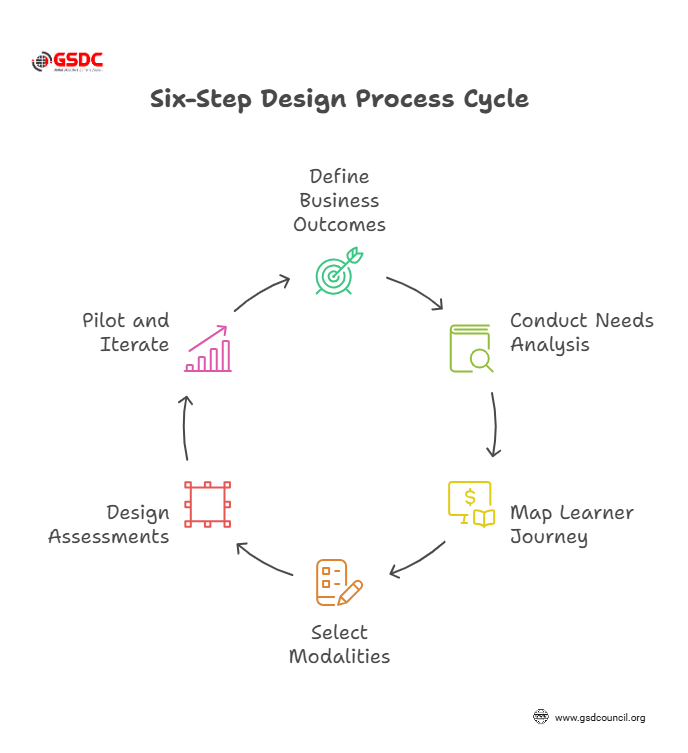
Use this practical sequence to move from problem to scalable program.
- Define business outcomes: translate a business need into measurable learning objectives (e.g., reduce first-contact resolution time by 15%).
- Conduct a targeted needs analysis, isolate the performance gap, and its root causes. Training is only one remedy; confirm that learning will solve the gap.
- Map the learner journey sequence modules from foundational knowledge to applied practice and on-the-job reinforcement.
- Select modalities, choose a blend (e-learning, cohort-based courses, workshops, on-the-job assignments, performance support) that fits the objective and learner context.
- Design assessments & evidence of capability build application-based evaluations (projects, simulations, work products) that mirror real work.
- Pilot, measure, iterate, scale, run a small cohort, capture leading indicators and business KPIs, refine, then roll out.
This structured approach turns ad-hoc training into a repeatable academic program that delivers results.
Learning and development examples (practical templates)
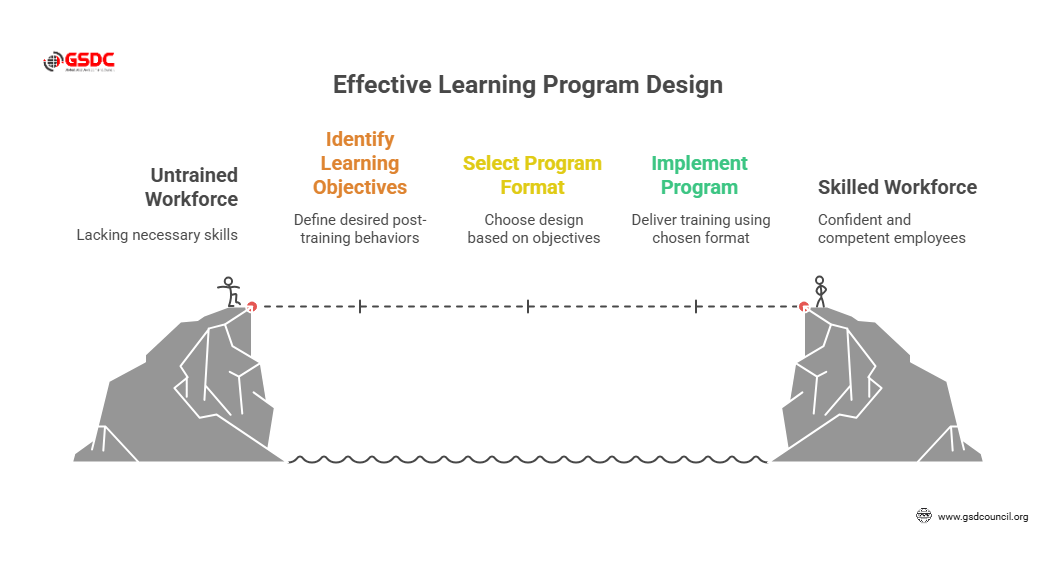
Here are replicable program types and when to use them:
- Sales Onboarding Academy blended e-modules for product knowledge + instructor-led role plays + 90-day mentored field assignments.
- Manager Acceleration Program cohort-based leadership curriculum with project assessments and cross-coaching.
- Compliance Refresher microlearning + scenario simulations + manager-led debriefs to ensure behavior change.
- Technical Upskill Path modular online labs, capstone projects assessed by SMEs, and a certification badge for internal mobility.
These learning and development examples show how format follows function: choose design based on what learners must do after training.
Academic development examples: bringing rigor to corporate L&D
Adapting academic structures raises credibility and transfer:
- Syllabi & Learning Outcomes: Publish clear module objectives and assessment criteria so learners and managers know expectations.
- Cohort Learning: Use cohorts to enable peer learning, mentoring, and accountability, especially useful for leadership or cross-functional programs.
- Project-Based Assessment: Replace multiple-choice tests with workplace projects that are reviewed by SMEs.
- Credit/Badge Systems: Map modules to micro-credentials to signal mastery and support career pathways.
These academic development examples help organisations create credible, lasting development pathways rather than one-off training.
Digitalization in learning and development: how to think about tools
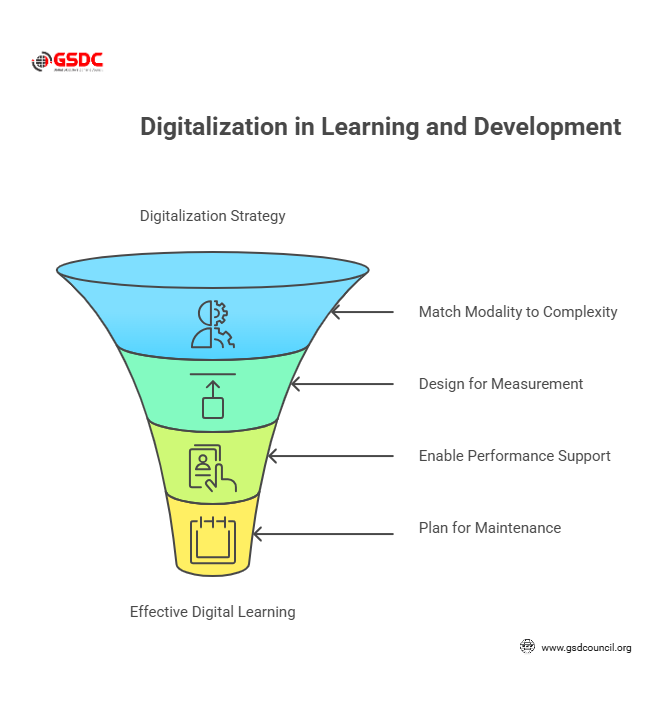
Digitalization is powerful when it amplifies sound design. Don’t digitize for its own sake; let objectives lead tool choice. Key principles:
- Match modality to complexity: Use microlearning for recall and automated tasks; use simulations, live coaching, and mentorship for complex judgment skills.
- Design for measurement: Instrument your digital modules with engagement metrics, mastery checkpoints, and performance proxies that link to business KPIs.
- Enable just-in-time performance support: Integrate job aids, searchable microcontent, and workflow tools (chatbots, knowledge bases) into employees’ daily systems.
- Plan for maintenance: Digital content drifts. Schedule content reviews and assign owners so materials stay current.
When you apply digitalization in learning and development with intent, you gain scale without sacrificing efficacy.
Measurement: make the business case
Move beyond completion metrics. Use a blended evaluation approach:
- Learning outcomes: pre/post assessments, project rubrics, and mastery checkpoints.
- Behavioral change: manager observations, 30-60-90 day work samples.
- Business impact: operational KPIs like cycle time, error rate, revenue per employee, and customer satisfaction.
Frame L&D impact in the language of the business. That’s how L&D becomes a strategic partner in organizational development and learning.
Common pitfalls and how to avoid them
- Over-digitizing complex skills uses blended methods for soft skills and judgment.
- Manager disengagement: secure manager roles in reinforcement and coaching.
- Neglecting accessibility and inclusion design for diverse learners and ensuring materials are adaptable.
- No maintenance plan treats digital content as living assets that require stewardship.
To avoid these problems, make a simple risk register for each program that keeps track of problems, who is responsible for fixing them, and when they need to be fixed.
Look at it every week during pilots. Use modest tests and success criteria (not opinions) to figure out how big something should be. If a design piece keeps failing, change it immediately instead of sticking with it.
Quick-start recipe: a 90-day pilot plan
- Pick one business problem and define a metric.
- Run a 4-module blended path (two microlearning modules, one live workshop, one workplace assignment).
- Pilot with one team (10–20 learners).
- Measure learning outcomes and one business KPI.
- Iterate and prepare a 6-month scale plan.
Add a light governance rhythm: meet with stakeholders for 30 minutes once a week to talk about problems, keep track of the risk register, and make quick decisions.
Get both quantitative data and qualitative input (such as short interviews with learners or open-ended survey responses) so you can make changes with empathy and proof.
Final thoughts
Modern L&D sits at the intersection of academic rigor and digital enablement. When you design programs that combine clear outcomes, strong instructional craft, practical assessment, and intentional digital support, the result is a learning ecosystem that advances both people and business.
GSDC Mentor Connect sessions are part of that learning journey, practical, expert-led touchpoints that complement certification learning and help practitioners apply these approaches immediately.

Related Certifications
Stay up-to-date with the latest news, trends, and resources in GSDC
If you like this read then make sure to check out our previous blogs: Cracking Onboarding Challenges: Fresher Success Unveiled
Not sure which certification to pursue? Our advisors will help you decide!