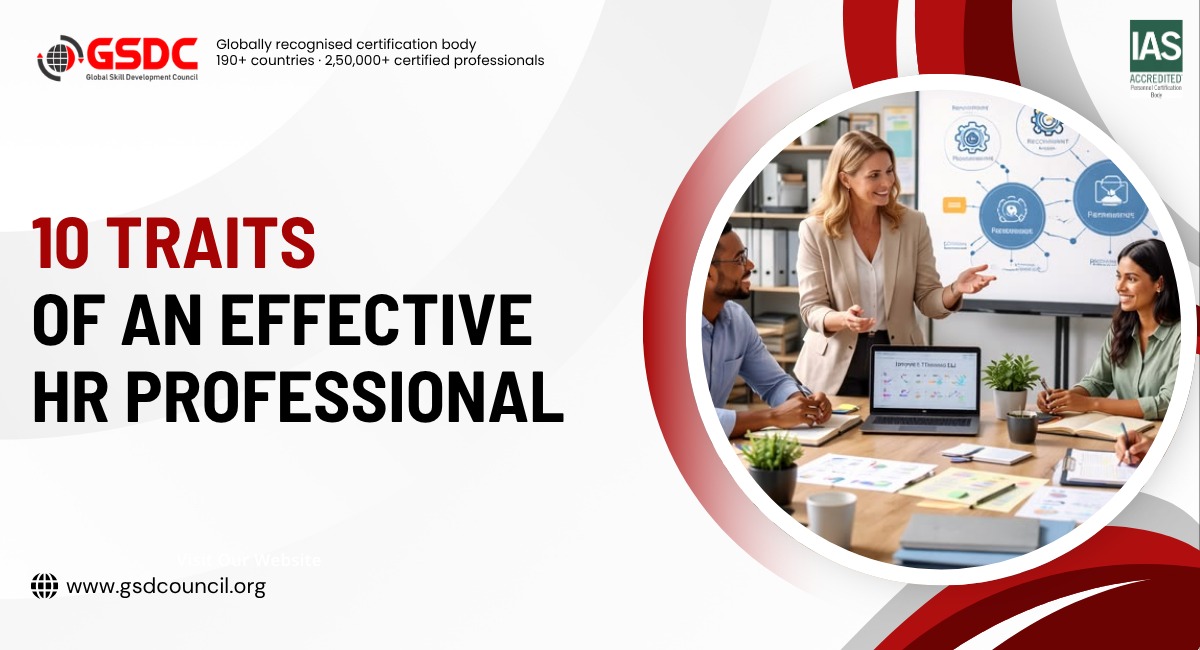
10 Traits of an Effective HR Professional
Written by Emily Hilton
- 1. Strong Communication Skills
- 2. Emotional Intelligence and Empathy
- 3. Problem-Solving and Decision-Making
- 4. Adaptability and Willingness to Learn
- 5. Organization and Time Management
- 6. Ethical Judgment and Confidentiality
- 7. Conflict Resolution and Negotiation
- 8. Business Understanding and Strategic Thinking
- 9. Technical Knowledge and HR Analytics
- 10. Leadership and Employee Development
- How to Improve HR Skills and Competencies
- HR Career Paths: From HR Generalist to Human Resource Manager
- How to Choose the Best HR Certification
- Conclusion
Human resources (HR) professionals play an important role in building a positive workplace, supporting employees, and helping organizations achieve their goals. From hiring the right people to managing employee concerns, HR professionals handle responsibilities that directly affect both business performance and employee satisfaction.
However, being successful in HR requires more than understanding company policies or managing employee records. Professionals need a combination of communication, problem-solving, decision-making, leadership, and organizational abilities. Developing the right HR skills and competencies helps them manage workplace challenges, build trust, and support employees at every stage of their careers.
Whether you are starting your career, working as an HR generalist, or planning to become a human resource manager, understanding these qualities can help you grow professionally.
Let's explore the 10 important traits of an effective HR professional and how you can develop them.
1. Strong Communication Skills
Communication is one of the most important HR skills because HR professionals interact with employees, managers, job candidates, and senior leaders every day.
They must explain company policies, discuss performance expectations, communicate organizational changes, and handle sensitive conversations. Clear communication helps prevent misunderstandings and ensures that employees understand their responsibilities and available support.
Effective HR professionals also know how to listen. When an employee raises a concern, they give the person time to explain the situation before responding. This helps them understand different perspectives and find suitable solutions.
How to develop this trait:
- Practice active listening during employee conversations.
- Write clear and professional emails, announcements, and policy documents.
- Learn to communicate difficult information respectfully.
- Adjust your communication style according to your audience.
Strong communication is one of the top HR skills that can help professionals build trust and maintain positive workplace relationships.
2. Emotional Intelligence and Empathy
HR professionals frequently deal with situations involving stress, disagreements, personal concerns, and workplace dissatisfaction. Emotional intelligence helps them understand their own emotions and recognize how others may be feeling.
Empathy allows HR professionals to consider an employee's perspective before making decisions. For example, an employee struggling with workload may need a discussion about priorities, additional support, or available workplace policies.
However, empathy does not mean ignoring company rules or treating every situation identically. Effective HR professionals balance understanding with fairness, consistency, and professional judgment.
How to develop this trait:
- Listen without making immediate assumptions.
- Stay calm when conversations become difficult.
- Recognize your emotional reactions and manage them professionally.
- Consider different perspectives before concluding.
These HR competencies are particularly useful when handling employee grievances, performance discussions, and workplace conflicts.
3. Problem-Solving and Decision-Making
HR professionals face different challenges, from employee disagreements and high turnover to recruitment delays and performance concerns. They need to identify the reasons behind these problems and choose practical solutions.
For example, if several employees leave an organization within a short period, an HR professional should investigate the possible causes. These could include limited career growth, poor management, salary concerns, or an unhealthy work environment.
Instead of relying on assumptions, effective HR professionals collect relevant information, identify patterns, and recommend actions based on evidence.
Good decision-making also requires understanding company policies, employment laws, business priorities, and the possible impact of each decision.
How to develop this trait:
- Learn to analyze problems before suggesting solutions.
- Use employee feedback and HR data to identify trends.
- Compare possible solutions and their consequences.
- Document important decisions and review their results.
Problem-solving is an essential part of HR manager skills because HR decisions can influence employee experience and organizational performance.
4. Adaptability and Willingness to Learn
The HR profession continues to change as organizations adopt new technologies, introduce flexible work arrangements, and respond to changing employee expectations.
HR professionals must be willing to learn new systems, understand updated workplace regulations, and adjust their processes when business needs change.
For example, recruitment teams increasingly use applicant tracking systems and AI-supported tools to organize applications and improve hiring workflows. HR professionals need to understand how these tools work while considering fairness, privacy, and the importance of human judgment.
Adaptability also means remaining open to feedback and learning from mistakes rather than following the same approach in every situation.
How to develop this trait:
- Follow current HR trends and workplace developments.
- Explore HR software and digital tools.
- Attend professional workshops and webinars.
- Ask for feedback and apply what you learn.
Regular HR skills training can help professionals stay updated and prepare for new responsibilities throughout their careers.
5. Organization and Time Management
HR teams manage multiple responsibilities, including recruitment, onboarding, payroll coordination, employee records, performance reviews, and compliance activities. Without effective planning, important tasks can be delayed or overlooked.
Strong organizational skills help HR professionals prioritize their work, maintain accurate records, and meet deadlines. Time management is especially important when handling confidential documentation, recruitment schedules, or time-sensitive employee concerns.
For example, an HR generalist may need to coordinate interviews, prepare joining documents, respond to employee questions, and support a performance review cycle in the same week.
A structured approach helps them manage these responsibilities without compromising quality.
How to develop this trait:
- Maintain a daily task list and prioritize urgent work.
- Use calendars and reminders for important deadlines.
- Create standard checklists for repetitive HR processes.
- Keep employee records organized and updated.
These habits help HR professionals become more reliable and improve the efficiency of HR operations.
6. Ethical Judgment and Confidentiality
HR professionals often have access to sensitive information, such as salary details, employee complaints, performance records, and personal information. Handling this information responsibly is essential for maintaining trust.
An effective HR professional understands the importance of confidentiality, fairness, honesty, and professional boundaries. They do not share private employee information with unauthorized people or allow personal relationships to influence workplace decisions.
Ethical judgment also involves recognizing conflicts of interest, applying company policies consistently, and raising concerns when workplace practices appear unfair or inappropriate.
Confidentiality does not mean keeping every issue secret under all circumstances. Certain matters may need to be reported or escalated according to company policy and applicable law.
How to develop this trait:
- Understand workplace policies and relevant employment laws.
- Follow data protection and information security practices.
- Avoid favoritism in recruitment and employee management.
- Seek appropriate guidance when facing ethical concerns.
Ethical behavior is one of the most important HR competencies because employees need to feel confident that their concerns will be handled responsibly.
7. Conflict Resolution and Negotiation
Workplace disagreements can arise because of communication gaps, different expectations, competing priorities, or misunderstandings between colleagues. HR professionals help employees and managers address these situations constructively.
Effective conflict resolution requires patience, neutrality, and the ability to understand different viewpoints. Instead of immediately blaming one person, HR professionals should gather relevant information and give the people involved an opportunity to explain their concerns.
Negotiation is equally important when discussing workplace arrangements, resolving disagreements, or helping managers and employees reach practical agreements.
However, serious allegations, harassment complaints, or other sensitive matters may require formal investigation and escalation rather than informal mediation.
How to develop this trait:
- Practice remaining neutral during disagreements.
- Ask clear questions to understand the underlying issue.
- Focus on facts rather than personal opinions.
- Learn workplace mediation and grievance-handling procedures.
These skills help HR professionals support a respectful work environment while protecting employee rights and organizational interests.
8. Business Understanding and Strategic Thinking
HR professionals are not responsible only for employee-related administration. They also need to understand how people, skills, and workplace practices contribute to business goals.
For example, a company planning to expand its operations may need to recruit new employees, train existing teams, and develop future leaders. HR professionals who understand business priorities can help create workforce plans that support these objectives.
Strategic thinking also involves using HR data to understand recruitment costs, employee turnover, absenteeism, engagement, and training outcomes.
A human resource manager may use this information to identify skill gaps, recommend employee development programs, or improve retention strategies.
How to develop this trait:
- Learn about your organization's products, customers, and goals.
- Understand how HR activities affect business performance.
- Develop basic data analysis and reporting skills.
- Connect HR initiatives with measurable outcomes.
Business understanding helps HR professionals move beyond administrative responsibilities and contribute to organizational planning.
9. Technical Knowledge and HR Analytics
Modern HR departments use technology to manage employee information, track recruitment, support performance reviews, and analyze workforce trends. Effective HR professionals should understand the tools relevant to their roles.
Common examples include human resource information systems (HRIS), applicant tracking systems (ATS), payroll platforms, learning management systems, and employee engagement tools.
HR analytics is another valuable area. It involves using workforce data to answer questions and support better decisions. For example, recruitment data can reveal which hiring channels produce suitable candidates, while turnover data can help identify teams that may need additional support.
Technical knowledge does not mean that every HR professional must become a data scientist. A basic understanding of spreadsheets, HR dashboards, and data interpretation can already be useful.
How to develop this trait:
- Learn spreadsheet tools and basic reporting techniques.
- Explore commonly used HR software.
- Practice interpreting recruitment and employee engagement data.
- Understand responsible data handling and privacy requirements.
Combining technical knowledge with people management can strengthen an HR professional's ability to make informed decisions.
10. Leadership and Employee Development
Leadership is not limited to senior HR positions. HR professionals at different career stages can demonstrate leadership by taking responsibility, supporting colleagues, and helping employees grow.
An effective HR professional understands that employee development benefits both individuals and organizations. They may help identify training needs, coordinate learning programs, support career planning, or assist managers with performance improvement.
Leadership also involves influencing people without relying on authority. For example, an HR professional may need to encourage a manager to improve feedback practices or help employees understand the value of a new workplace initiative.
How to develop this trait:
- Take ownership of projects and responsibilities.
- Support colleagues and share useful knowledge.
- Learn about coaching, mentoring, and performance management.
- Develop presentation and stakeholder management skills.
Strong leadership abilities prepare HR professionals for greater responsibilities, including HR business partner and human resource manager roles.
How to Improve HR Skills and Competencies
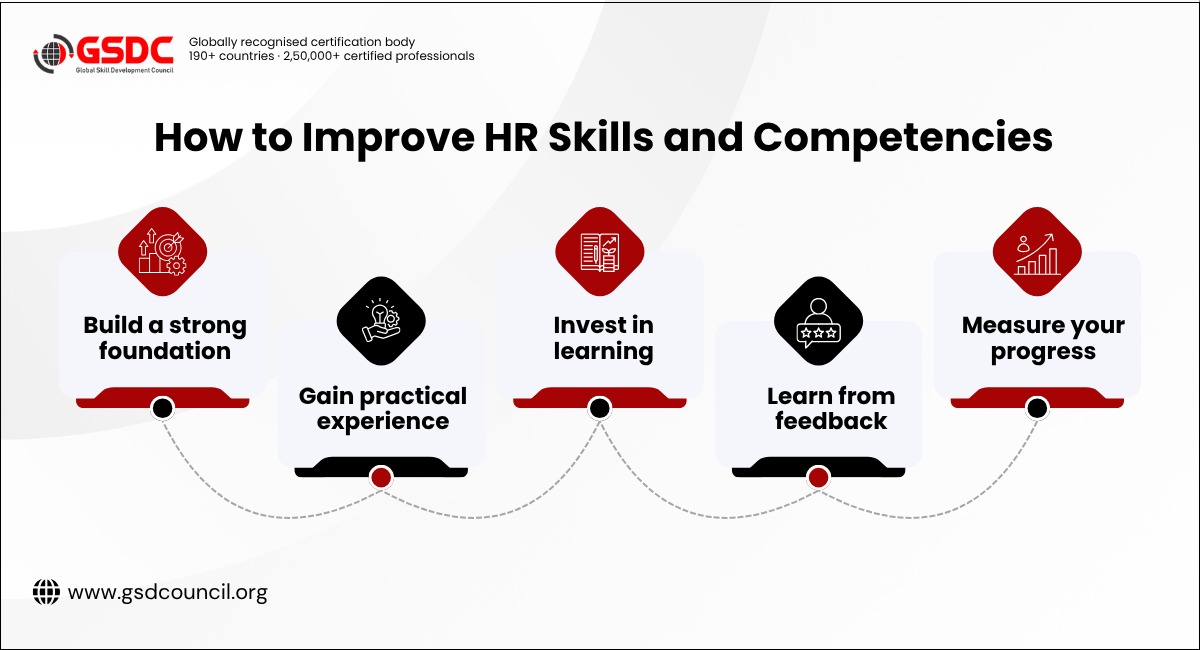
Developing HR capabilities is an ongoing process. You do not need to master every skill at once. Start by identifying your strengths and choosing the areas that need improvement.
Here are five practical steps to follow:
1. Build a strong foundation: Understand recruitment, onboarding, employee relations, performance management, compensation basics, and workplace compliance.
2. Gain practical experience: Volunteer for HR projects, support recruitment activities, participate in employee engagement initiatives, and learn from experienced professionals.
3. Invest in learning: Workshops, online courses, mentoring, and structured HR skills training can help you develop new capabilities.
4. Learn from feedback: Ask managers and colleagues for specific feedback on your communication, planning, and problem-solving abilities.
5. Measure your progress: Set clear goals, such as improving recruitment turnaround time, creating better onboarding resources, or learning to prepare an HR dashboard.
If you are wondering how to improve human resources skills for career advancement, focus on combining practical experience with continuous learning. Strong HR professionals understand people, follow sound processes, and adapt their approach to different workplace situations.
HR Career Paths: From HR Generalist to Human Resource Manager
An HR generalist handles multiple HR activities, including recruitment, onboarding, employee relations, and employee records. An HR generalist job description typically includes coordinating hiring, maintaining documentation, and supporting HR policies.
Professionals exploring HR generalist jobs should develop communication, organization, problem-solving, and technical skills. The HR generalist salary varies by experience, location, and organization.
With experience, professionals can progress into HR management, talent acquisition, or learning and development. If you want to learn how to become a human resource manager, focus on gaining practical HR experience, building leadership skills, and understanding business needs.
So, what does a human resource manager do? A human resource manager oversees HR operations, supports workforce planning, manages employee relations, and helps align people strategies with business goals.
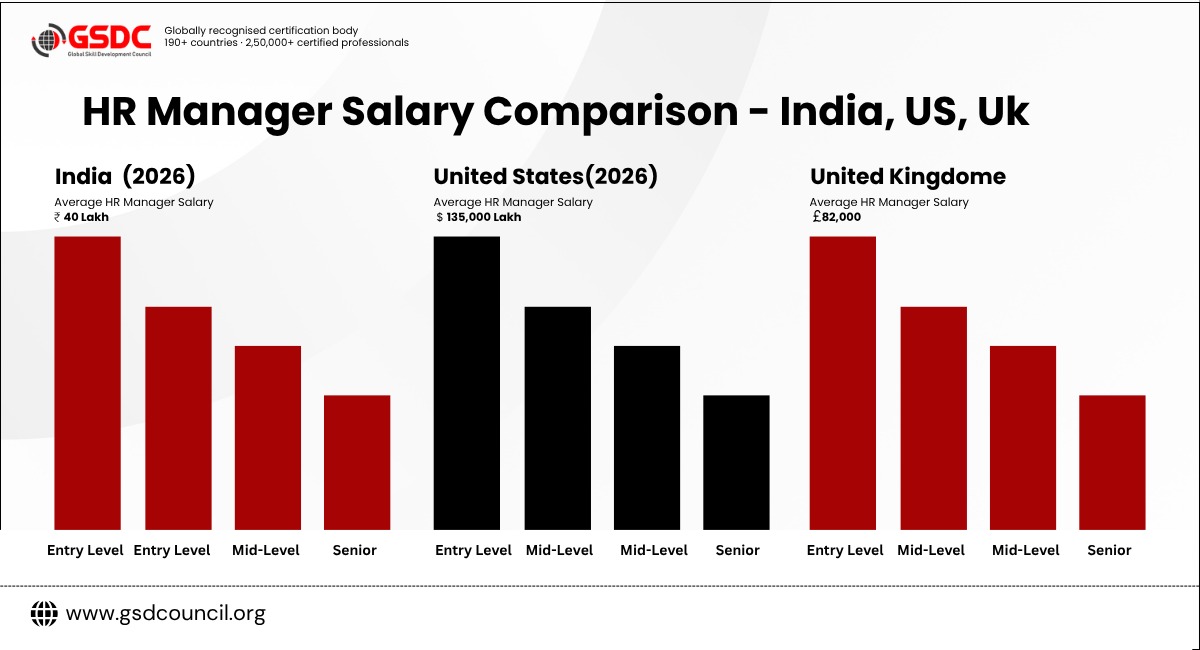
The following graph shows the salary structure of HR globally like India, USA and UK.
How to Choose the Best HR Certification
Professional certifications can help HR professionals structure their learning, demonstrate relevant knowledge, and prepare for career development. However, the best HR certification depends on your experience, career goals, location, and the type of HR role you want to pursue. Here you must go for GSDC’s Certified Human Resources (HR) Professional Certification.
The Certified Human Resources (HR) Professional Certification can help you develop essential HR skills, validate your knowledge, and strengthen your professional credibility to advance your career in human resource management.

A certification should complement practical experience rather than replace it. Combining structured learning with workplace exposure can help you develop stronger HR competencies and prepare for more advanced responsibilities.
Conclusion
An effective HR professional combines people skills, business understanding, ethical judgment, and practical knowledge. Communication, emotional intelligence, problem-solving, adaptability, organization, confidentiality, conflict resolution, strategic thinking, technical knowledge, and leadership all contribute to success in the profession.
These qualities are useful whether you are beginning your career, working as an HR generalist, or preparing for a human resource manager position.
The most important step is to keep learning and applying your knowledge. By developing the right HR skills, seeking feedback, gaining practical experience, and choosing relevant training, you can become better equipped to support employees and contribute to organizational success.

Related Certifications
Frequently Asked Questions
The most important HR skills include communication, emotional intelligence, problem-solving, conflict resolution, organization, ethical judgment, technical knowledge, and leadership. The skills required may vary depending on the role and organization.
Start by learning basic HR concepts, exploring recruitment and employee management processes, practicing professional communication, and taking relevant online courses. Internships, entry-level HR roles, and practical projects can help you gain experience.
An HR generalist needs broad knowledge of recruitment, onboarding, employee relations, HR documentation, policy administration, and performance management. Communication, organization, confidentiality, and problem-solving are also important.
Build a foundation in HR through relevant education or training, gain practical experience, and develop skills in employee relations, business understanding, leadership, and HR analytics. Progression usually depends on experience, performance, and organizational requirements.
An HR certification is not mandatory for every HR position, but it can help demonstrate knowledge and support professional development. Choose a certification that matches your career goals and combine it with practical experience.
Stay up-to-date with the latest news, trends, and resources in GSDC
If you like this read then make sure to check out our previous blogs: Cracking Onboarding Challenges: Fresher Success Unveiled
Not sure which certification to pursue? Our advisors will help you decide!