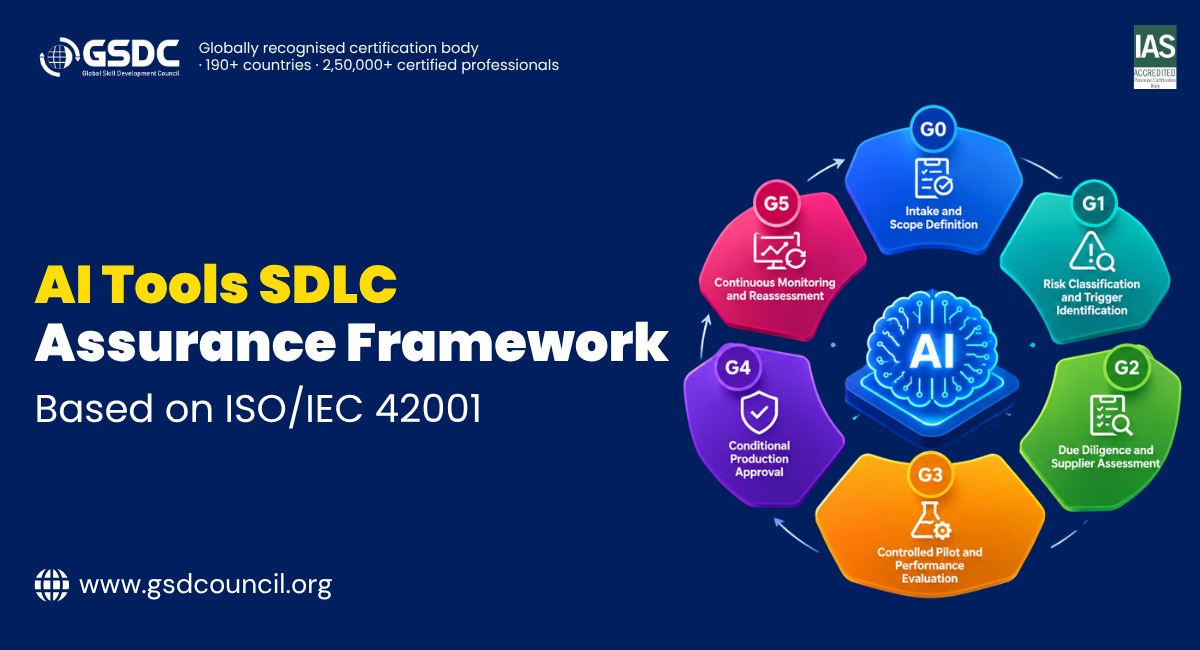
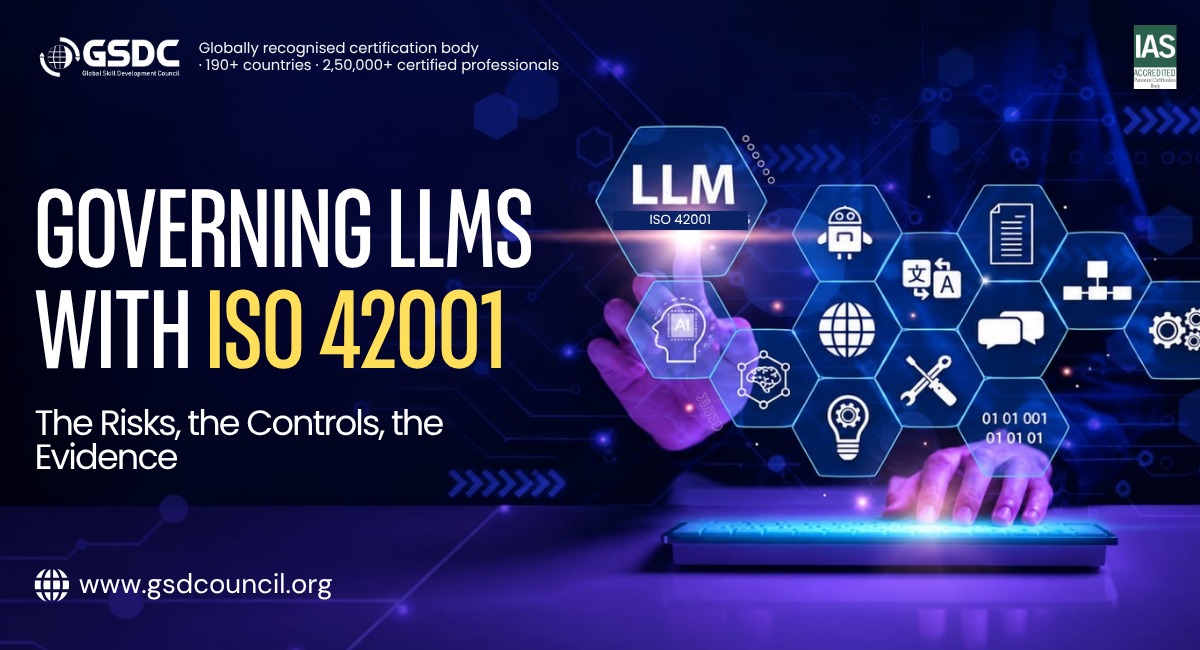
Governing LLMs with ISO 42001: The Risks, the Controls, the Evidence
Written by Owais N.
- Understanding the Growing Risks of LLMs in Production
- Building an AI Risk Management Framework for LLMs
- How ISO 42001 AI Governance Supports Responsible AI
- Conducting an AI Model Risk Assessment
- Strengthening Enterprise AI Compliance and LLM Security
- How GSDC’s Certified ISO 42001:2023 Lead Implementer Supports Career Growth
- Conclusion
Large language models (LLMs) are becoming an integral part of business operations, powering customer-facing chatbots, AI copilots, writing assistants, knowledge management systems, and automated workflows. While these technologies improve productivity and accessibility, they also introduce risks that organizations must identify, assess, and manage before and after deployment.
The webinar “Governing LLMs with ISO 42001: The Risks, the Controls, the Evidence” explored how organizations can establish effective AI governance using ISO/IEC 42001. It highlighted the importance of mapping LLM risks, understanding the limitations of existing controls, and maintaining evidence that demonstrates whether AI systems are governed responsibly.
The central message was clear: effective AI governance requires more than policies and certifications. It requires risk-based controls, continuous monitoring, and verifiable evidence.
Understanding the Growing Risks of LLMs in Production
Many organizations already use LLMs in production, sometimes without maintaining a complete inventory of their AI systems. This creates a governance challenge because organizations cannot effectively manage risks they have not identified.
A common misconception is that hallucinations are the primary risk associated with LLMs. Although inaccurate or fabricated responses can have serious consequences, the webinar highlighted a much broader risk landscape involving security, privacy, fairness, intellectual property, operational reliability, and societal impact.
For example, a customer-facing insurance chatbot might provide incorrect information about policy coverage, potentially creating financial or legal consequences. Similarly, employees entering confidential information into public AI tools could expose sensitive business data.
These scenarios demonstrate why generative AI risk management must cover the entire AI system, including its model, prompts, retrieved information, connected tools, external providers, and operational environment.
Building an AI Risk Management Framework for LLMs
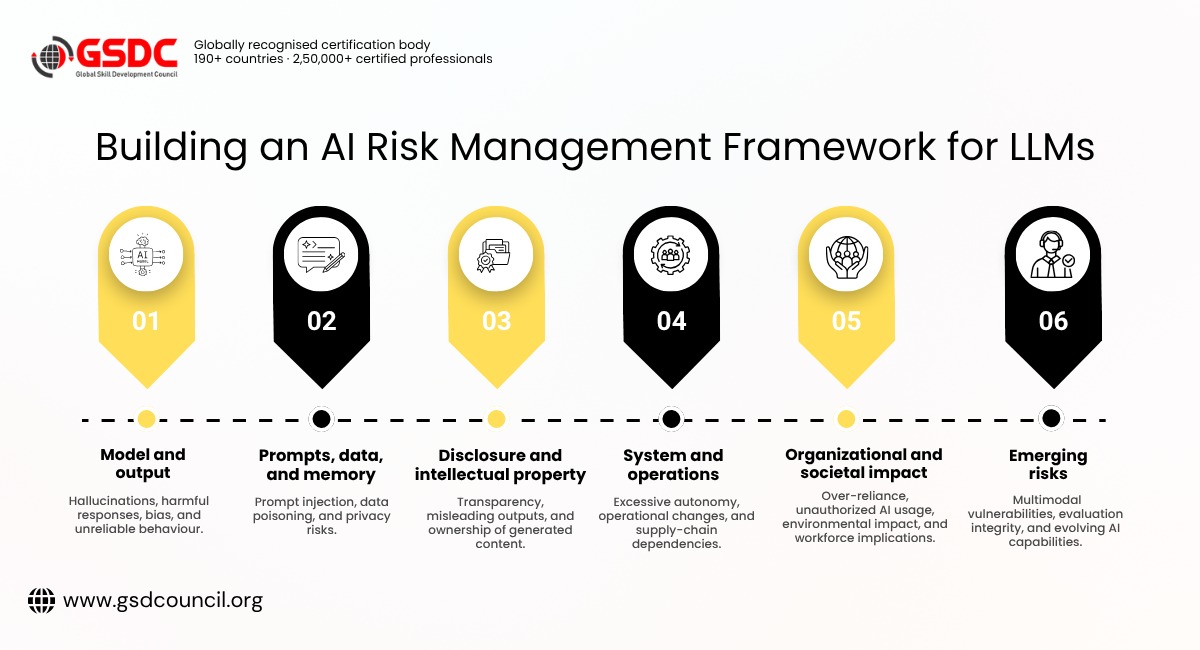
An effective AI risk management framework begins with comprehensive risk identification rather than focusing only on well-known issues. The webinar presented a taxonomy covering 20 risk domains across six tiers, with approximately 100 individual risks.
These domains were informed by established resources, including the OWASP Top 10 for LLM Applications, NIST's Generative AI Profile, and MIT's AI Risk Repository.
The six tiers cover different aspects of LLM risk:
- Model and output: Hallucinations, harmful responses, bias, and unreliable behaviour.
- Prompts, data, and memory: Prompt injection, data poisoning, and privacy risks.
- Disclosure and intellectual property: Transparency, misleading outputs, and ownership of generated content.
- System and operations: Excessive autonomy, operational changes, and supply-chain dependencies.
- Organizational and societal impact: Over-reliance, unauthorized AI usage, environmental impact, and workforce implications.
- Emerging risks: Multimodal vulnerabilities, evaluation integrity, and evolving AI capabilities.
This structured approach supports LLM risk management by helping organizations identify risks relevant to their specific use cases. It also enables teams to document why certain risks are applicable, what controls address them, and why others may be excluded.
How ISO 42001 AI Governance Supports Responsible AI
ISO/IEC 42001 establishes requirements for creating, implementing, maintaining, and continually improving an Artificial Intelligence Management System (AIMS). It provides a structured approach to managing AI-related risks, defining responsibilities, and establishing organizational accountability.
An ISO 42001 AI management system helps organizations integrate AI governance into their existing management processes rather than treating it as a separate technical exercise.
The webinar emphasized that ISO 42001 provides a foundation for governance, but it does not automatically resolve every technical risk associated with LLMs. Its Annex A contains a reference set of controls, and organizations are expected to determine which controls are applicable and introduce additional controls where their risk assessments require them.
Understanding Control Coverage and Its Limitations
The webinar's illustrative risk-to-control mapping classified the 20 risk domains into three categories:
- Direct coverage: 10 domains had direct control coverage under the present mapping.
- Partial coverage: Eight domains relied on broader mechanisms, such as impact assessments and verification and validation.
- Deferred coverage: Two domains required complementary standards, legal requirements, or other dedicated controls.
These figures represent the webinar's assessment, not a universal classification prescribed by ISO/IEC 42001.
The distinction is important because a certificate does not automatically prove that every LLM-specific risk has been adequately addressed. Organizations must examine their actual use cases, document their control decisions, and identify any remaining gaps.
For this reason, ISO 42001 controls should be evaluated alongside additional technical and organizational safeguards. The ISO/IEC 42001 AI management system controls provide a governance foundation, while complementary standards and tailored controls address risks that require more specialized treatment.
Conducting an AI Model Risk Assessment
An effective AI model risk assessment examines how a system behaves in its actual operating environment, not simply how the underlying model performs in isolation.
Consider a fictional insurance company operating a retrieval-augmented generation (RAG) chatbot that answers customer questions using policy documents. Although the chatbot retrieves information from approved sources, it could still generate an incorrect answer or misinterpret a policy clause.
To manage this risk, the organization should evaluate the chatbot's response accuracy, traceability, security, and potential impact on customers. It should also define measurable evaluation criteria appropriate to the consequences of incorrect responses.
The webinar illustrated this approach using a 95% groundedness threshold on a held-out test set. This was an example specific to the case study, not a requirement established by ISO 42001. Higher-risk applications may require stricter thresholds and additional safeguards.
Organizations should also consider how the system behaves when its underlying model changes, connected data sources are updated, or new tools are introduced. These changes may affect performance and risk even when the system's overall purpose remains unchanged.
Strengthening Enterprise AI Compliance and LLM Security
The webinar highlighted that ISO 42001 should not be treated as a replacement for information security and privacy management.
Security risks such as prompt injection and data leakage require dedicated technical safeguards. Depending on the organization's environment, complementary standards such as ISO/IEC 27001 for information security and ISO/IEC 27701 for privacy information management may be relevant.
Organizations should also verify supplier claims rather than relying solely on statements that a provider is “ISO 42001 aligned.” Important checks include certificate validity and scope, data retention policies, model training terms, processing locations, subprocessors, security testing, and the evidence available for the specific system being procured.
This is particularly important for enterprise LLM governance, where AI systems may access confidential records, interact with business applications, or perform actions with limited human intervention.
A practical ISO 42001 implementation guide should therefore include risk identification, impact assessment, control selection, supplier due diligence, testing, monitoring, and continual improvement. This approach supports enterprise AI compliance while allowing governance requirements to reflect the actual risks of each deployment.
How GSDC’s Certified ISO 42001:2023 Lead Implementer Supports Career Growth
GSDC’s ISO 42001:2023 Lead Implementer certification helps professionals develop the skills needed to implement AI management systems, establish governance frameworks, assess AI-related risks, and align organizational practices with ISO/IEC 42001 requirements. It provides a foundation for leading responsible AI initiatives, strengthening compliance practices, and promoting continuous improvement across AI-driven operations.
The Certified ISO 42001:2023 Lead Implementer can also support career development in AI governance, risk management, compliance, and information security. Professionals can build the capabilities needed to coordinate teams, develop AI policies, support audits, and encourage responsible AI adoption. By demonstrating their understanding of ISO/IEC 42001 implementation, they can strengthen their professional credibility and contribute to transparent, accountable, and trustworthy AI systems.
Conclusion
Governing LLMs requires a comprehensive understanding of how AI systems can fail, how those failures affect stakeholders, and what evidence demonstrates that appropriate safeguards are working.
ISO 42001 provides a valuable management-system foundation, but organizations must go beyond certification by assessing their full risk landscape, developing additional controls where needed, and integrating security and privacy requirements.
By combining structured risk assessment, proportionate controls, supplier verification, continuous monitoring, and auditable evidence, organizations can build more accountable and resilient AI systems. Ultimately, effective AI governance is not just about demonstrating compliance; it is about ensuring that AI remains trustworthy throughout its operational lifecycle.

Related Certifications
Frequently Asked Questions
ISO 42001 AI governance refers to the policies, responsibilities, processes, and controls organizations establish to manage AI responsibly. ISO/IEC 42001 provides requirements for an AI management system that supports risk management, accountability, and continual improvement.
No. ISO 42001 provides a governance framework, but some technical risks require additional controls and complementary standards. Organizations should specifically assess prompt injection, data leakage, privacy, and other risks relevant to their systems.
An AI model risk assessment identifies and evaluates potential risks arising from an AI model's outputs, capabilities, data access, integrations, and operational use. It helps organizations determine appropriate safeguards and testing requirements.
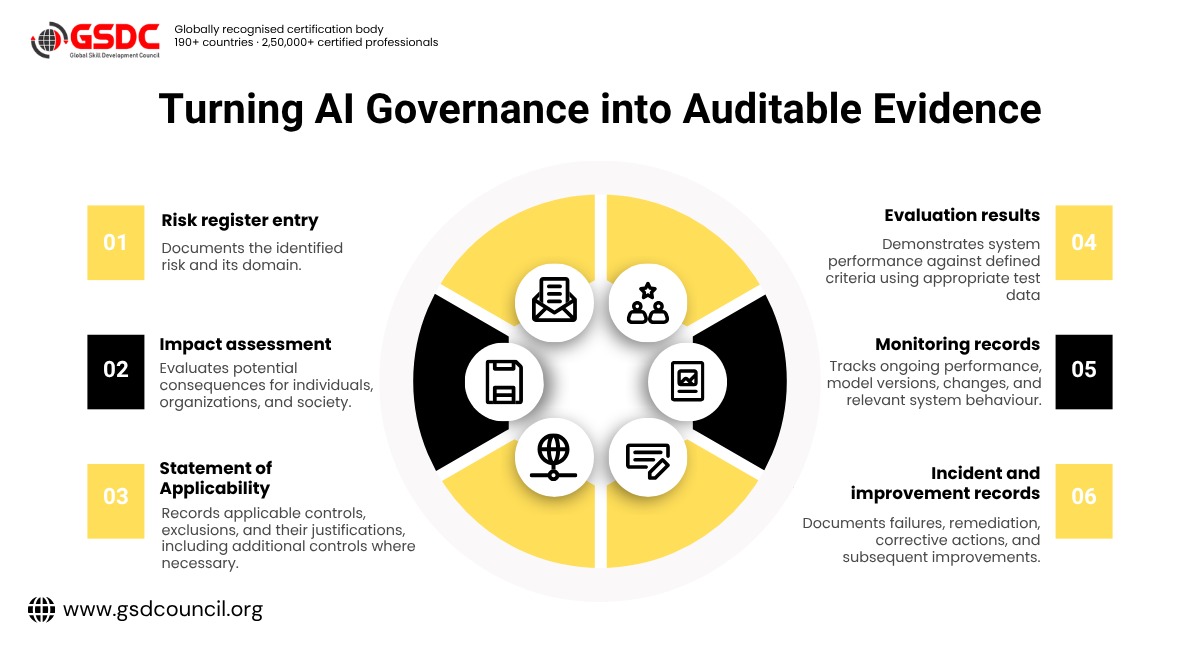
Evidence may include risk registers, impact assessments, a Statement of Applicability, evaluation results, monitoring logs, model-version records, supplier assessments, and incident-management documentation. The exact evidence depends on the applicable requirements and the system's risk profile.
Organizations should inventory their AI systems, map relevant risks, assess impacts, select applicable controls, document additional safeguards, evaluate suppliers, test system performance, and establish continuous monitoring and corrective-action processes. Security and privacy controls should be addressed explicitly through appropriate complementary standards and legal requirements.
Stay up-to-date with the latest news, trends, and resources in GSDC
If you like this read then make sure to check out our previous blogs: Cracking Onboarding Challenges: Fresher Success Unveiled
Not sure which certification to pursue? Our advisors will help you decide!