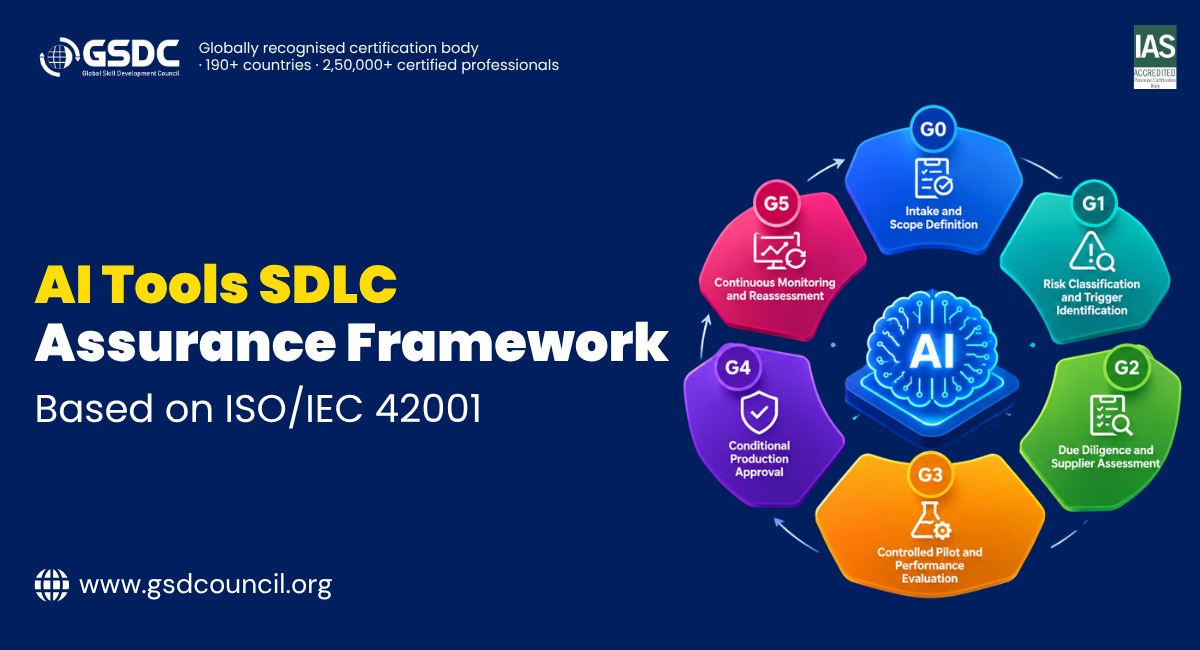
AI Tools SDLC Assurance Framework – Based on ISO/IEC 42001
Written by Owais N.
- Understanding ISO/IEC 42001 and AI Governance
- Why AI Tools Need Governance Across the Software Development Lifecycle
- The Six-Gate AI Tools SDLC Assurance Framework
- Matching Controls to AI Capability and Autonomy
- Evidence-Based Governance and Regulatory Alignment
- How GSDC’s Certified ISO 42001:2023 Lead Implementer Empowers Professionals
- Conclusion
Artificial intelligence is transforming software development by helping teams generate code, automate testing, identify potential issues, and improve productivity. However, adopting AI tools without appropriate oversight can introduce significant risks related to data privacy, intellectual property, security, regulatory compliance, and software quality.
The webinar “AI Tools SDLC Assurance Framework – Based on ISO/IEC 42001” explored how organizations can integrate AI tools into their software development lifecycle (SDLC) through a structured, risk-based governance approach. The session demonstrated how ISO/IEC 42001 can guide organizations in evaluating, approving, monitoring, and reassessing AI tools while maintaining accountability and transparency.
The central message was clear: AI adoption should not be treated as a simple technology decision. It requires a systematic framework that aligns tool capabilities, organizational risks, and appropriate controls.
Understanding ISO/IEC 42001 and AI Governance
ISO/IEC 42001 is an international standard that helps organizations establish, implement, maintain, and improve an Artificial Intelligence Management System (AIMS). It provides guidance for managing AI-related risks and ensuring that AI systems are developed and used responsibly.
An ISO/IEC 42001 AI management system helps organizations create clear rules and processes for using AI tools. Instead of relying only on a general AI policy, businesses can establish practical controls to manage AI activities and reduce potential risks.
Key areas covered by ISO/IEC 42001 include:
- Risk Assessment: Identifying potential risks related to AI, including data privacy, security, and unreliable outputs.
- Defined Responsibilities: Clarifying who is responsible for approving, managing, and monitoring AI tools.
- Control Implementation: Establishing rules for data access, human review, and the safe use of AI systems.
- Continuous Monitoring: Regularly checking whether AI tools remain safe, effective, and suitable for their intended purpose.
- Documentation and Evidence: Maintaining records of assessments, approvals, and decisions to support audits and demonstrate accountability.
The webinar highlighted that adopting an ISO 42001 AI governance framework does not automatically make an organization certified or guarantee compliance with every applicable regulation. Instead, it helps businesses establish consistent governance practices and prepare documented evidence for audits and assessments.
Organizations can also combine ISO/IEC 42001 with other frameworks and legal requirements to strengthen their AI governance practices. These may include:
- NIST AI Risk Management Framework: Helps identify, assess, and manage AI-related risks.
- Security and Quality Standards: Supports secure software development and reliable AI outputs.
- Privacy Regulations: Helps organizations address requirements for protecting personal and confidential information, depending on their jurisdiction.
The right combination depends on the organization's industry, location, data sensitivity, and intended AI applications. By applying these practices, organizations can manage AI more responsibly while supporting innovation, security, and regulatory alignment.
Why AI Tools Need Governance Across the Software Development Lifecycle
AI tools can introduce risks even when their initial purpose appears relatively simple. A coding assistant, for example, might recommend code changes without directly modifying a repository. However, granting that same tool permission to create pull requests, merge code, access confidential information, or trigger deployments significantly changes its risk profile.
Another important consideration is data handling. Prompts, source code, attachments, and other inputs may be transmitted to external services depending on the tool, configuration, and contractual terms. Organizations must understand where their data is processed, how long it is retained, whether it can be used for model training, and which third parties can access it.
These concerns make AI development governance essential throughout the AI software development lifecycle. Governance should cover more than the initial selection of a tool. It must address how the tool is configured, what information it can access, how its outputs are reviewed, and whether its continued use remains appropriate.
A robust AI governance framework also protects intellectual property, preserves software quality, and supports accountability. Organizations should maintain their existing secure SDLC practices and introduce AI-specific controls wherever necessary, rather than treating AI adoption as a replacement for established security processes.
The Six-Gate AI Tools SDLC Assurance Framework
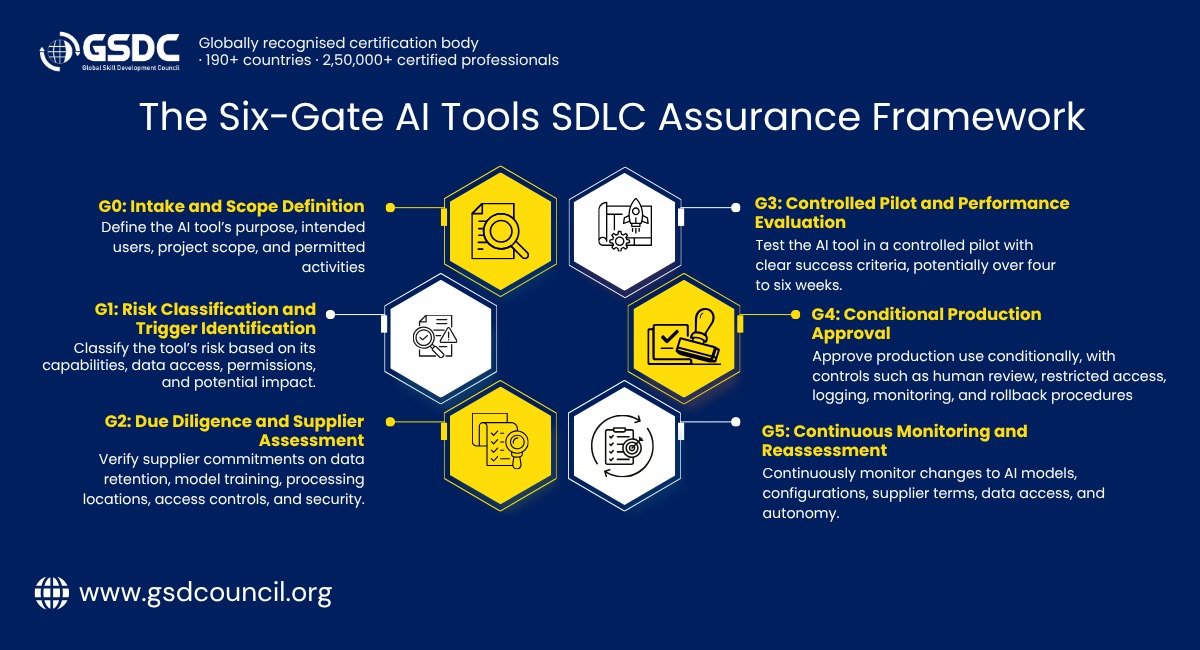
A key highlight of the webinar was a six-gate assurance framework designed to assess AI tools before and during their use in software development. Built around ISO/IEC 42001 principles, the framework combines risk assessment, due diligence, controls, evidence collection, and ongoing monitoring.
Its purpose is to provide a practical operating model rather than another checklist. Each gate establishes specific conditions that must be satisfied before the tool progresses to the next stage.
G0: Intake and Scope Definition
The first gate establishes why an AI tool is needed and how it will be used. Instead of approving a tool for unrestricted organizational use, the approval should define a specific purpose, team, project, and set of activities.
For example, an organization might approve a coding assistant for an internal development team working on test automation. That approval should not automatically extend to production deployments, confidential customer data, or unrelated projects.
Clear boundaries make it easier to identify the tool's intended benefits and assess the risks associated with its use.
G1: Risk Classification and Trigger Identification
The second gate evaluates the tool's risk level based on its capabilities, data access, permissions, and potential impact.
A low-risk example could be an isolated sandbox using synthetic data. A medium-risk scenario might involve read-only access to approved internal artifacts. A higher-risk application could include access to personally identifiable information (PII), production environments, or autonomous decision-making capabilities.
The framework uses this classification to determine the depth of assessment and the controls required. This is a practical application of an AI risk management framework, ensuring that governance requirements are proportionate to the potential consequences.
Certain conditions should trigger an immediate stop. These include unauthorized external data transfers, insufficient guarantees about data use, unexpected deployment permissions, or unavailable audit logs.
G2: Due Diligence and Supplier Assessment
The third gate examines the AI tool provider, contractual commitments, and technical safeguards.
Organizations should verify data retention policies, model training terms, processing locations, access controls, and relevant security assurances. Data sovereignty is particularly important when contractual obligations or local laws restrict where information can be processed.
The webinar highlighted the importance of obtaining written commitments rather than relying on informal assurances. Depending on the use case, organizations may also need to assess intellectual property protections, indemnity provisions, and mechanisms for filtering potentially problematic code suggestions.
These checks help organizations make informed decisions before exposing business information or development assets to external AI services.
G3: Controlled Pilot and Performance Evaluation
Before approving an AI tool for wider use, organizations should conduct a controlled pilot with clearly defined success criteria.
The webinar suggested that a pilot lasting approximately four to six weeks can provide a useful evaluation period for certain use cases. For example, when testing AI-generated automation scripts, teams should measure more than the time required to produce code.
They should also assess code quality, security vulnerabilities, technical debt, review effort, and downstream effects on the development process. Tools such as code-quality analyzers can help evaluate whether AI-generated outputs introduce additional problems.
This approach ensures that productivity claims are supported by measurable results rather than assumptions.
G4: Conditional Production Approval
After a successful pilot, the tool may receive conditional approval for use in its intended environment. This stage establishes the controls that must remain active during operation.
Depending on risk and autonomy, these controls may include mandatory human review, restricted credentials, limits on data access, logging, monitoring, and rollback procedures.
Approval is conditional because the tool must continue to operate within the agreed boundaries. It is also revocable: if the conditions are no longer satisfied, access can be restricted and the approval withdrawn.
G5: Continuous Monitoring and Reassessment
The final gate focuses on ongoing monitoring and reassessment. AI tools, models, configurations, and supplier terms can change over time, potentially creating risks that were not present during the original approval.
A material change might include introducing a new model, connecting another repository, expanding data access, increasing an agent's autonomy, or enabling automated merging and deployment.
Such changes should trigger a reassessment of the relevant gates. This makes AI lifecycle management a continuous process rather than a one-time approval activity.
Effective AI lifecycle governance ensures that controls evolve alongside the tool and that previous approval decisions remain justified.
Matching Controls to AI Capability and Autonomy
One of the webinar's most important principles was that controls should increase as an AI tool's capabilities and autonomy increase.
An assistant that only recommends code changes generally requires fewer controls than an agent that can modify repositories, execute actions, or deploy software independently.
As capabilities expand, organizations should consider stronger permissions management, scoped credentials, human approval checkpoints, detailed audit logs, deployment restrictions, and rollback mechanisms. Autonomous merging or production deployment should receive particularly careful scrutiny.
This risk-based approach makes an AI SDLC framework practical and scalable. It avoids imposing identical requirements on every tool while ensuring that higher-risk systems receive more rigorous oversight.
Evidence-Based Governance and Regulatory Alignment
The framework emphasizes that evidence is an essential deliverable of the governance process. Each gate should produce records showing what was assessed, which controls were selected, why decisions were made, and whether requirements were satisfied.
In the webinar's example, the organization adapted its control set to the specific use case. Of the controls considered, 24 were applicable, nine were tailored, and some were marked as not applicable with documented justification. This demonstrates how proportional governance can remain traceable without applying every control indiscriminately.
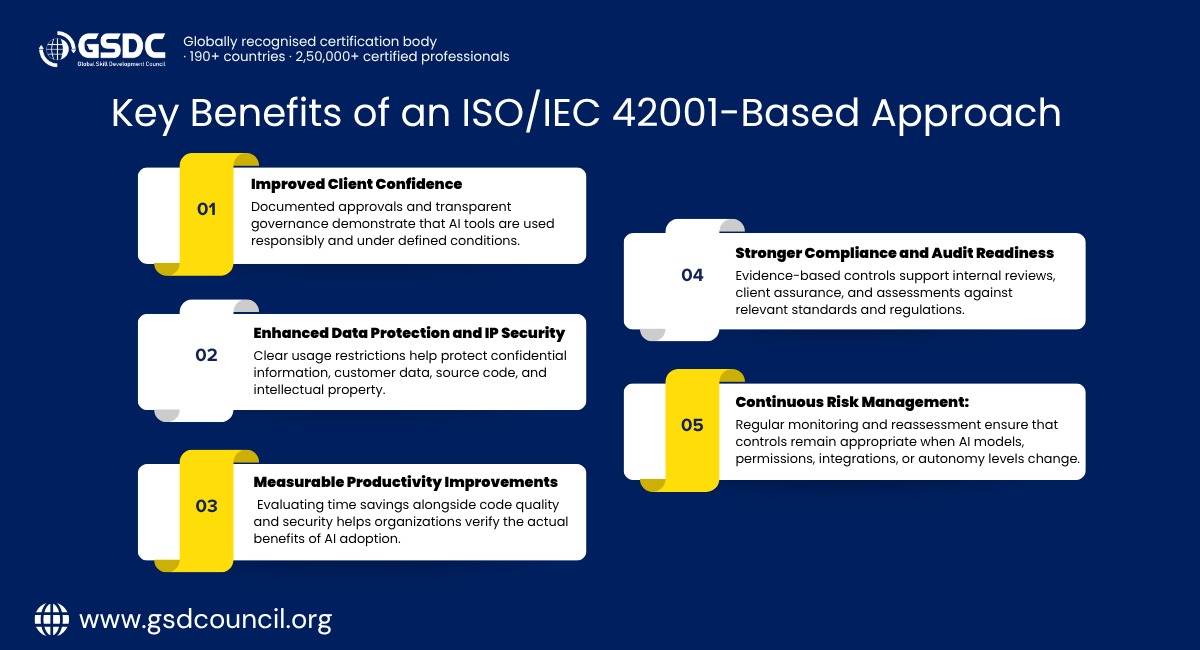
An evidence-based AI compliance framework supports internal reviews, client assurance, and external audits. Key benefits include:
- Traceability: Maintains records of assessments, approvals, and control decisions at each gate.
- Risk management: Documents how AI-related risks are identified, evaluated, and addressed.
- Client confidence: Provides evidence that AI tools are approved for specific purposes under defined conditions.
- Audit readiness: Simplifies internal reviews and supports external assessments through documented evidence.
Organizations can also map relevant controls to other frameworks and regulatory requirements, including the NIST AI Risk Management Framework and the EU AI Act, where applicable. This can help align governance practices with different compliance expectations.
However, alignment with ISO/IEC 42001 does not automatically establish compliance with every regulation. Organizations must evaluate their specific legal obligations and implement the controls necessary for their jurisdictions and use cases.
How GSDC’s Certified ISO 42001:2023 Lead Implementer Empowers Professionals
GSDC’s certification equips professionals with the knowledge and practical skills to implement AI management systems, strengthen AI governance, manage risks, and align organizational AI practices with ISO/IEC 42001 requirements. Certified ISO 42001:2023 Lead Implementer helps professionals build expertise in responsible AI implementation, regulatory compliance, and continuous improvement while preparing them to lead AI governance initiatives across their organizations.
Beyond technical expertise, the certification can enhance career opportunities for professionals in AI governance, risk management, compliance, and information security. It helps them develop the confidence to coordinate cross-functional teams, establish effective AI policies, support audits, and drive responsible AI adoption. By demonstrating knowledge of ISO/IEC 42001 implementation, professionals can strengthen their professional credibility and contribute to building trustworthy, transparent, and accountable AI systems.
Conclusion
Responsible AI adoption requires structured governance, risk assessment, and continuous monitoring. By applying ISO/IEC 42001 AI governance principles, organizations can protect data, maintain software quality, and ensure accountability. The six-gate framework supports controlled AI adoption, helping businesses balance innovation, security, and compliance throughout the software development lifecycle.

Related Certifications
Frequently Asked Questions
ISO/IEC 42001 provides a framework for managing AI-related risks, implementing controls, and ensuring responsible AI use.
It is a structured approach for assessing, approving, testing, and monitoring AI tools throughout software development.
It helps teams identify AI-related risks and implement appropriate controls based on the tool's capabilities and potential impact.
No. Certification requires formal assessment, and regulatory compliance depends on applicable laws and organizational requirements.
Reassessment is necessary when significant changes occur, such as new models, expanded data access, changed supplier terms, or increased autonomy.
Stay up-to-date with the latest news, trends, and resources in GSDC
If you like this read then make sure to check out our previous blogs: Cracking Onboarding Challenges: Fresher Success Unveiled
Not sure which certification to pursue? Our advisors will help you decide!