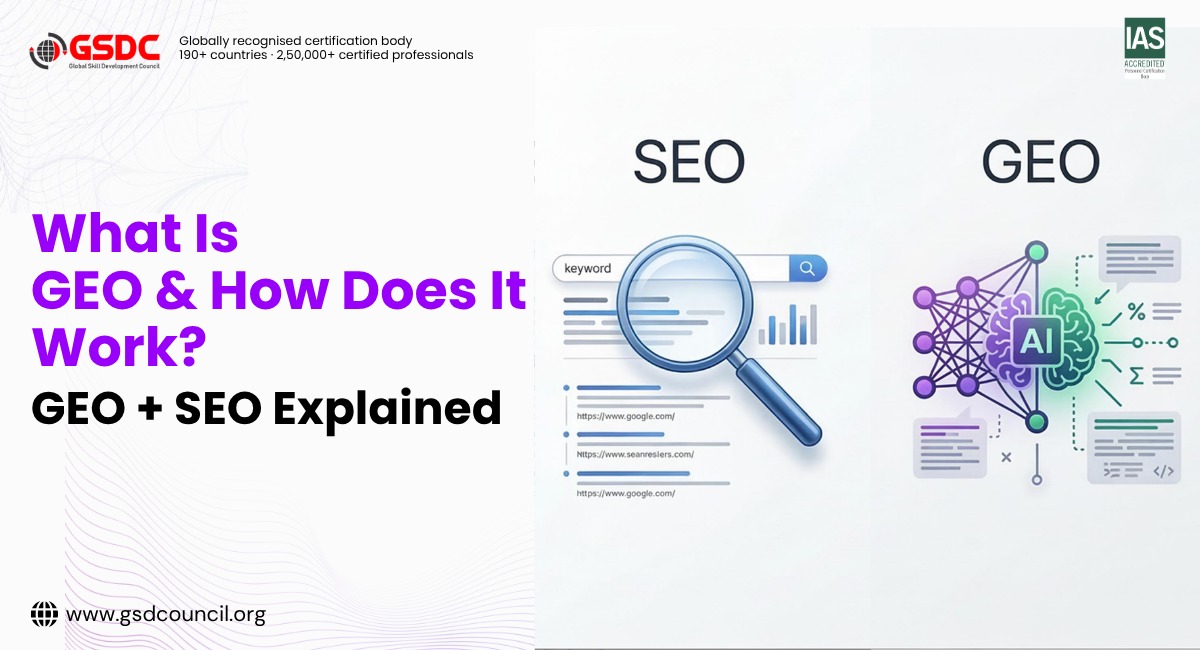
What Is GEO & How Does It Work? GEO + SEO Explained
Written by Emily Hilton
- The Shift from Traditional Search to AI-Powered Discovery
- What Is Generative Engine Optimization (GEO)?
- Key Differences Between GEO and Traditional SEO
- Why SEO Still Matters in a GEO-Driven World
- How AI Engines Decide What to Cite
- Data-Driven GEO: Why Measurement Tools Matter
- How GEO and SEO Work Best Together
- Practical First Steps to Improve GEO Visibility
- Build Your AI Search Skills with GSDC’s GEO Certification
- Conclusion
Search behavior is undergoing a fundamental shift. For years, traditional search engines dominated how users discovered information online, typing short keywords into Google and clicking through blue links. Today, that model is rapidly evolving. Users are increasingly turning to AI-powered platforms like ChatGPT, Google AI Overviews, Gemini, Perplexity, and Copilot to ask complex, conversational questions and receive synthesized answers.
This change has given rise to Generative Engine Optimization a new approach to visibility in AI-generated search results. GEO does not replace Search Engine Optimization (SEO); instead, it complements and extends it. To stay competitive, organizations must understand how GEO works, how it differs from SEO, and how both can be integrated into a unified strategy.
The Shift from Traditional Search to AI-Powered Discovery
Traditional SEO is built around keywords, short phrases such as “laptop,” “best CRM,” or “digital marketing certification.” GEO, on the other hand, is built around conversational prompts.
Instead of typing a single keyword, users now ask detailed questions like:
- “What is the best laptop for remote work under a specific budget?”
- “Which certification is best for learning AI-driven marketing in 2026?”
AI engines analyze these prompts, summarize information from multiple sources, and present a synthesized response, often without requiring users to click through to multiple websites. This makes AI platforms a new front door to the internet.
With billions of prompts being processed daily and a growing percentage of users relying on AI for research, brands and content creators must rethink how they earn visibility.
What Is Generative Engine Optimization (GEO)?
Generative Engine Optimization is the practice of optimizing content so that AI systems can understand it, trust it, and cite it in generated answers.
While SEO focuses on ranking pages in search results, GEO focuses on being:
- Referenced
- Quoted
- Cited
- Recommended
In short:
- SEO helps your content get listed
- GEO helps your content get recommended
The goal of GEO is not just traffic it is share of voice within AI-generated responses. Even if fewer clicks occur, being consistently cited strengthens brand authority, credibility, and long-term discoverability.
Key Differences Between GEO and Traditional SEO
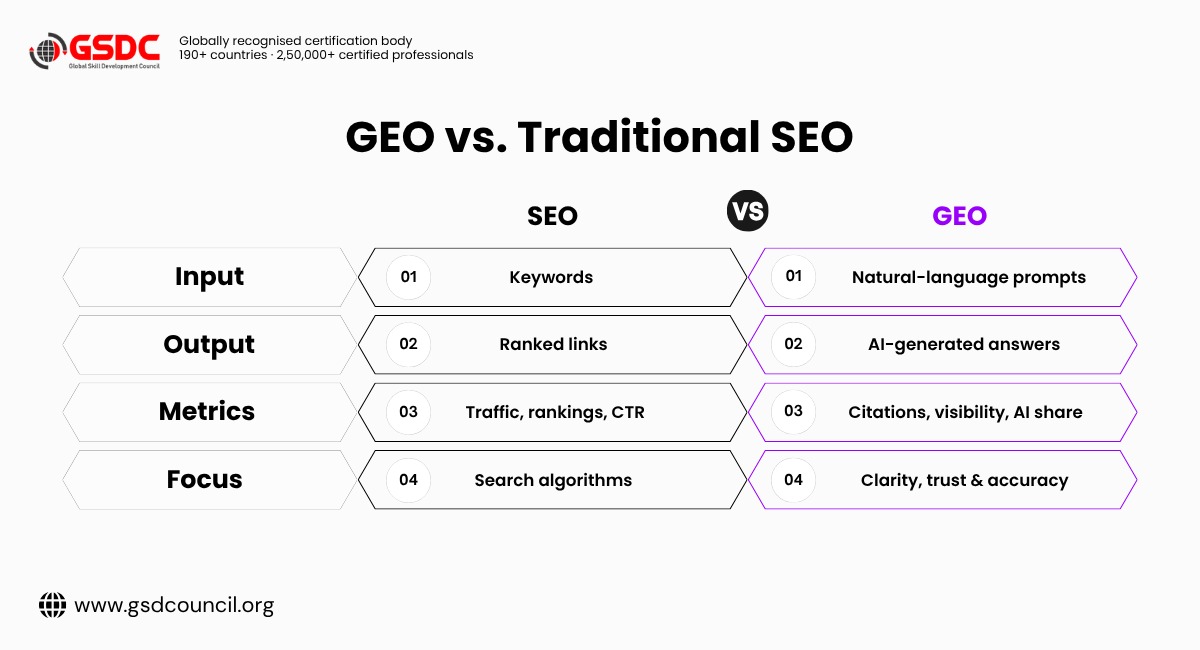
Although GEO builds on SEO foundations, there are critical differences in how visibility is achieved and measured.
1. Input Type
- SEO: Keywords (short-tail and long-tail)
- GEO: Natural language prompts and questions
2. Output Format
- SEO: Ranked links that users click
- GEO: AI-generated summaries with cited sources
3. Success Metrics
- SEO: Traffic, rankings, click-through rate
- GEO: Citations, visibility, and AI share of voice
4. Content Focus
- SEO: Optimization for algorithms
- GEO: Optimization for clarity, trust, and factual accuracy
Despite these differences, one principle remains unchanged: strong SEO is the foundation of effective GEO.
Why SEO Still Matters in a GEO-Driven World
AI platforms do not operate in isolation. They rely heavily on existing web infrastructure, trusted domains, structured content, and authoritative sources, many of which gained prominence through SEO.
Search engines like Google still deliver significantly more traffic than AI platforms. Losing SEO visibility while chasing AI citations can harm overall performance. The smarter approach is integration, not replacement.
In practice:
- Good SEO improves GEO performance
- Poor SEO limits GEO visibility
Organizations that have neglected technical SEO, content quality, or authority building will struggle to gain traction in AI-generated answers.
How AI Engines Decide What to Cite
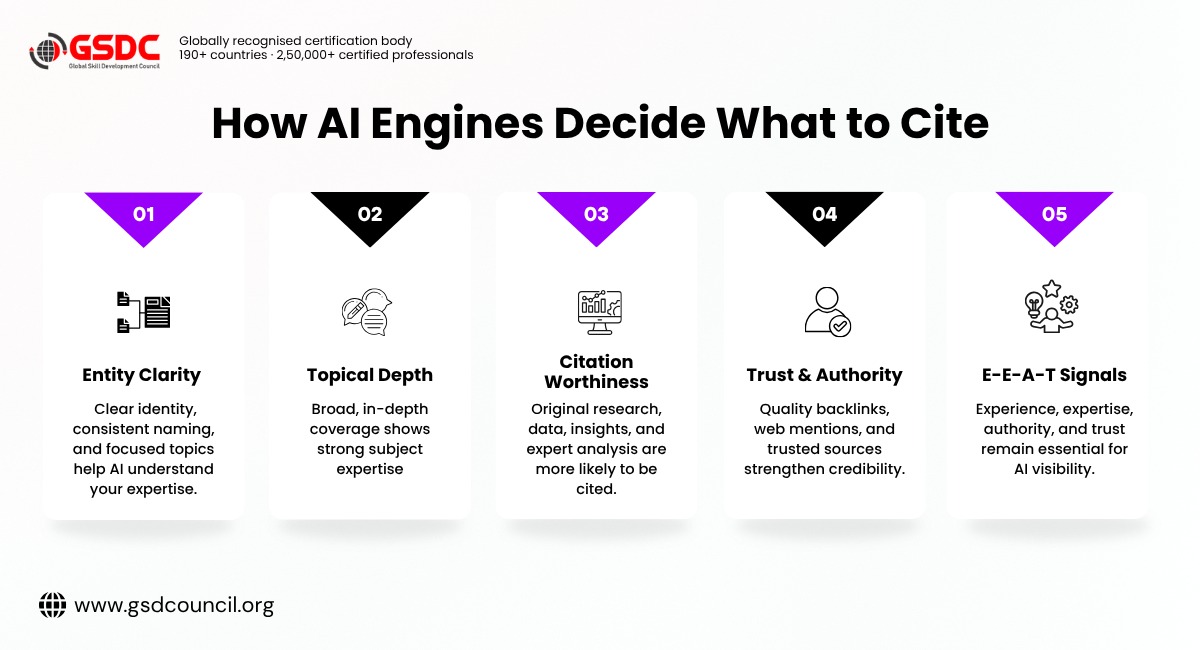
Understanding how generative engines select sources is central to GEO success. While each platform differs slightly, common evaluation signals include:
1. Entity Clarity
Clear identity, consistent naming, and well-defined topical focus help AI understand who you are and what you specialize in.
2. Topical Depth
AI engines prefer sources that demonstrate broad and deep expertise not just isolated pages optimized for a single query.
3. Citation-Worthiness
Original research, proprietary insights, real data, and expert analysis are far more likely to be cited than generic content.
4. Trust and Authority
Signals such as reputable backlinks, mentions across the web, and alignment with established knowledge sources strengthen credibility.
5. E-E-A-T Signals
Experience, expertise, authority, and trust remain critical just as they were in traditional search.
Data-Driven GEO: Why Measurement Tools Matter
GEO decisions should be guided by data, not assumptions. AI visibility varies by region, platform, and industry. Understanding which generative engines dominate a market is essential before prioritizing optimization efforts.
Traffic and visibility analysis tools help organizations:
- Identify which platforms matter most in their region
- Understand referral and citation behavior
- Measure AI share of voice against competitors
- Track brand mentions across AI responses
Without data, GEO efforts risk becoming fragmented and ineffective.
How GEO and SEO Work Best Together
The most effective strategy is a GEO + SEO integration model. This approach ensures visibility across both traditional search engines and AI-powered discovery.
Key Integration Principles
1. Structured, High-Quality Content
Well-organized content with clear headings, logical flow, and structured data benefits both SEO and AI interpretation.
2. Conversational Query Optimization
Content should reflect how people naturally ask questions. FAQ sections, Q&A formats, and clear answers improve AI retrieval.
3. Schema Markup
Structured schema (FAQ, How-To, Article, Course) helps search engines and AI systems understand context more efficiently.
4. Original Research and Insights
AI engines increasingly favor content that adds unique value rather than repeating common knowledge.
5. Freshness and Updates
Regularly updated content signals relevance and reliability critical for both SEO rankings and AI citations.
Practical First Steps to Improve GEO Visibility
For organizations starting with GEO, a few practical actions can deliver early impact:
- Audit existing high-performing SEO content
- Improve structure, clarity, and freshness
- Add conversational FAQs with clear answers
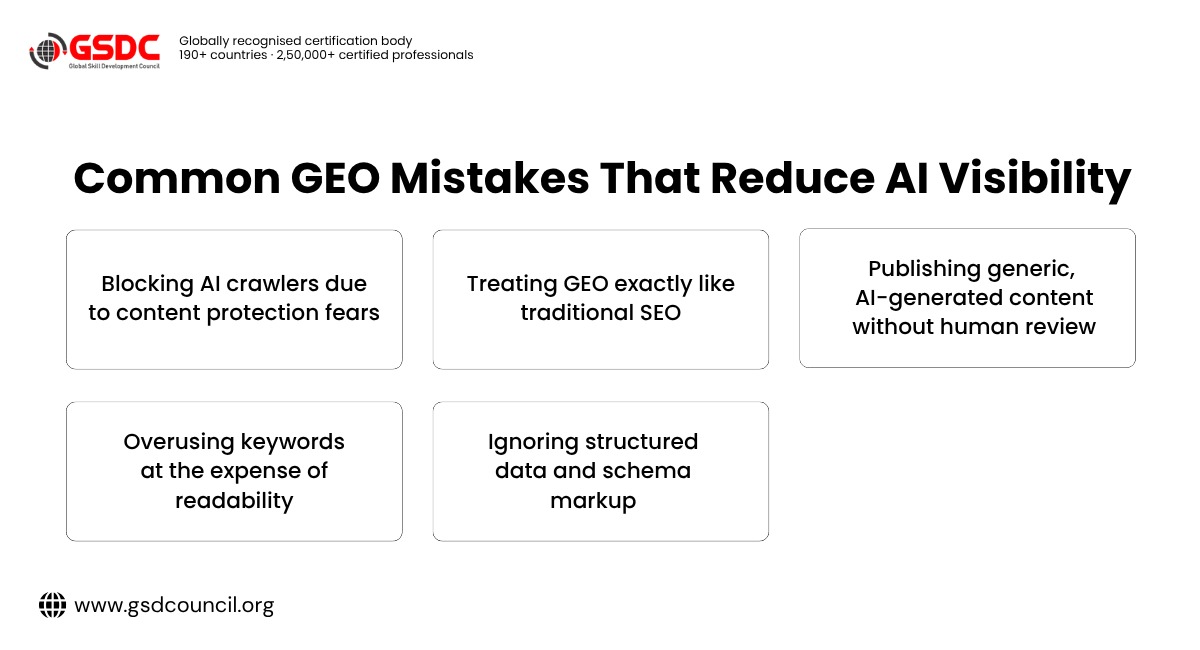
- Ensure AI crawlers are not blocked
- Test visibility by asking AI platforms relevant questions
Tracking citations over time helps refine strategy and measure progress.
Build Your AI Search Skills with GSDC’s GEO Certification
As AI-powered platforms change how people discover information, understanding Generative Engine Optimization (GEO) is becoming increasingly valuable for digital marketing and content professionals.
GSDC’s GEO Certification can help professionals develop their understanding of AI search optimization, content visibility, and the evolving relationship between GEO and traditional SEO. It can support learning about how AI search engines select and cite content, why structured information matters, and how to improve brand visibility in AI-generated answers.

For professionals looking to strengthen their digital marketing knowledge, GEO Certification can complement existing SEO skills and help them prepare for emerging opportunities in AI-driven search.
Conclusion
Generative Engine Optimization represents the next evolution of digital visibility. As AI-driven platforms increasingly shape how users discover information, GEO is becoming essential for brands that want to remain visible, trusted, and competitive.
However, GEO is not a replacement for SEO it is an extension of it. The organizations that succeed will be those that integrate both approaches, balancing traffic-driven optimization with citation-driven authority. By focusing on clarity, structure, trust, and real value, businesses can position themselves to win in both traditional search and AI-generated discovery.

Related Certifications
Frequently Asked Questions
The primary goal of GEO is to get content cited and recommended in AI-generated answers, not just ranked in search results.
No. GEO complements SEO. Strong SEO foundations significantly improve the chances of being cited by AI platforms.
GEO success is measured through AI citations, brand mentions, and share of voice across generative platforms rather than clicks alone.
Yes, by focusing on micro-niches, original insights, and specialized expertise rather than broad, highly competitive topics.
Content that is clear, well-structured, conversational, frequently updated, and supported by original research performs best in AI-generated results.
Stay up-to-date with the latest news, trends, and resources in GSDC
If you like this read then make sure to check out our previous blogs: Cracking Onboarding Challenges: Fresher Success Unveiled
Not sure which certification to pursue? Our advisors will help you decide!