7 Steps to Become a Forward Deployed Engineer

Written by Emily Hilton
Artificial intelligence (AI) is changing how businesses solve problems, build software, and improve their daily operations. However, implementing new technology is not always easy. Companies need professionals who can understand business challenges, work directly with customers, and develop technical solutions that deliver real results. This is where a forward deployed engineer plays an important role.
Forward deployed engineers combine software development, problem-solving, and customer collaboration. They work closely with business teams to understand their needs and build solutions that fit real-world situations. As more organizations adopt AI and advanced software systems, the demand for these professionals is growing.
If you enjoy coding, solving practical problems, and working with different teams, this career may be worth exploring. This blog explains what a forward deployed engineer does, the skills you need, and seven steps to help you start your career in this field.
What Is a Forward Deployed Engineer?
A forward deployed engineer is a technical professional who works closely with customers or business teams to develop and implement software solutions. Unlike traditional software engineers who may work mainly within a development team, these engineers spend more time understanding real business problems and adapting technology to solve them.
The forward deployed engineer meaning comes from the idea of placing technical expertise close to the people and situations where it is needed. In simple terms, forward deployed means working directly with users or customers instead of building solutions in isolation.
If you are wondering what is a forward deployed engineer, think of someone who understands a customer's problem, develops a technical solution, tests it in the real environment, and improves it based on feedback.
Similarly, what is forward deployed engineering? It is an approach to software development in which engineers collaborate directly with customers to make technology useful, practical, and effective.
What Does a Forward Deployed Engineer Do?
Understanding what does a forward deployed engineer do can help you decide whether this career matches your interests.
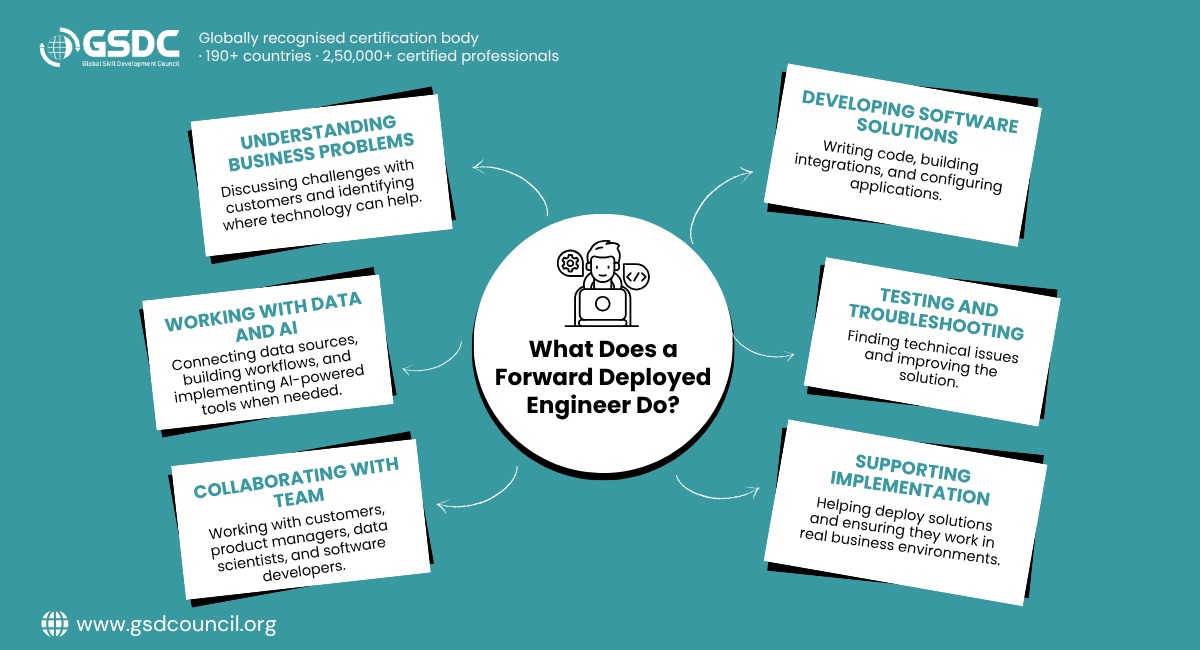
Their responsibilities often include: So, what are forward deployed engineers expected to achieve? Their main goal is to connect technology with business needs and ensure that the solutions they build deliver practical value.
7 Steps to Become a Forward Deployed Engineer
Step 1: Build a Strong Foundation in Programming
Programming is an essential starting point for this career. You need to understand how software works and how to write code that solves problems.
Start by learning one programming language. Python is a useful choice because it is widely used in automation, data processing, AI applications, and backend development. JavaScript is another option, particularly if you want to build web applications.
Focus on the following fundamentals:
- Variables, loops, functions, and data structures
- Object-oriented programming
- Error handling and debugging
- Basic algorithms and problem-solving
- Writing clean, readable code
You do not need to master every programming language at the beginning. Choose one, practise regularly, and build small applications to strengthen your understanding.
Step 2: Learn Software Development Fundamentals
A forward deployed software engineer needs more than programming knowledge. You should understand how applications are developed, connected, tested, and deployed.
Learn the basics of frontend and backend development, databases, APIs, and version control.
For example, imagine a company wants to connect its customer relationship management (CRM) system with an AI assistant. You may need to use APIs to exchange information, work with a database to retrieve customer records, and develop backend logic to process requests.
You should also become familiar with Git, GitHub, SQL, HTTP, and basic software testing.
These skills help you build solutions that can work with existing business systems rather than operating as standalone applications.
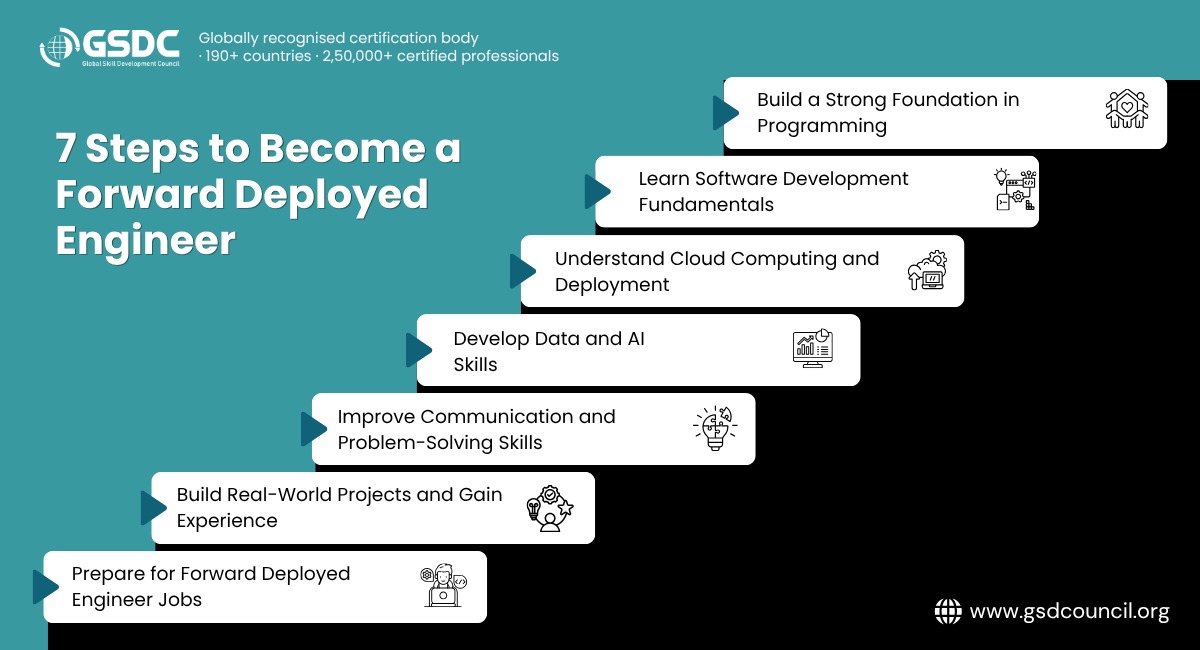
Step 3: Understand Cloud Computing and Deployment
Forward deployed engineers often work with software that must operate within a customer's existing technical environment. Understanding cloud platforms and deployment methods can help you handle these requirements.
Start with the basics of cloud computing, including virtual machines, storage, networking, permissions, and application hosting. You can explore platforms such as AWS, Microsoft Azure, or Google Cloud.
You should also learn about:
- Docker and containerisation
- Linux command-line basics
- Environment variables and configuration
- CI/CD fundamentals
- Application monitoring and troubleshooting
You do not need to become a cloud architect immediately. The goal is to understand how applications move from development to production and how to identify common deployment problems.
Step 4: Develop Data and AI Skills
Modern businesses increasingly use AI to automate tasks, analyse information, and support decision-making. As a result, AI knowledge can be valuable for professionals entering this field.
An AI forward deployed engineer may help organizations implement AI models, connect enterprise data, build retrieval-augmented generation (RAG) applications, or integrate AI agents into business workflows.
Start by learning how to work with data using Python and SQL. Then explore machine learning fundamentals, large language models (LLMs), prompt engineering, and AI APIs.
You should also understand the basics of data privacy, access controls, model limitations, and responsible AI use.
For example, a company might want an AI assistant that answers employee questions using internal documents. You could help connect the document repository, retrieve relevant information, integrate an LLM, and test whether the answers are useful and accurate.
You do not need to be an AI researcher. Practical knowledge of integrating and deploying AI solutions is a strong starting point.
Step 5: Improve Communication and Problem-Solving Skills
Technical knowledge is only one part of the job. Forward deployed engineers must understand customer requirements and explain technical decisions in simple language.
A customer may describe a business problem without knowing which technology can solve it. Your responsibility is to ask the right questions, understand the existing workflow, and identify a practical solution.
Develop these skills by practising how to:
- Ask clear questions and understand user requirements
- Explain technical concepts to non-technical people
- Break complex problems into smaller tasks
- Work with changing requirements
- Present solutions and collect feedback
- Collaborate with cross-functional teams
These abilities are particularly important because a technically impressive solution may still fail if it does not address the customer's actual needs.
Step 6: Build Real-World Projects and Gain Experience
Practical experience helps you demonstrate that you can apply your knowledge to real problems. Instead of building projects only to practise coding, choose projects that solve a specific business challenge.
Consider developing projects such as:
- An AI chatbot that answers questions from company documents
- A dashboard that combines data from multiple APIs
- An automated report-generation tool
- A customer support workflow using AI and business data
- An application that connects two business systems
For each project, explain the problem, your technical approach, the tools you used, the challenges you faced, and the results.
Share your code through GitHub and document your projects clearly. You can also contribute to open-source projects, participate in internships, or take on freelance assignments to gain practical experience.
A strong portfolio demonstrates how you think, solve problems, and turn technical ideas into usable solutions.
Step 7: Prepare for Forward Deployed Engineer Jobs
Once you have developed your technical skills and completed practical projects, start preparing for forward deployed engineer jobs.
Review job descriptions to understand the skills employers expect. Some positions focus on AI implementation, while others require backend development, cloud infrastructure, data engineering, or enterprise software integration.
Prepare for interviews by practising coding problems, API integration, system design fundamentals, and real-world troubleshooting scenarios. Be ready to explain how you would approach an unclear customer requirement and how you would measure whether a solution was successful.
Search for related titles such as Forward Deployed Software Engineer, Solutions Engineer, AI Engineer, and Implementation Engineer. Responsibilities vary by organization, so read each job description carefully.
You should also research the forward deployed engineer salary for your location, experience level, and technical specialization. Compensation can vary significantly depending on the employer, industry, responsibilities, and whether the role involves travel or direct customer engagement.
Following these steps gives you a practical forward deployed engineer roadmap, from learning the fundamentals to preparing for interviews and applying for relevant positions.
Skills Required to Become a Forward Deployed Engineer
Before applying for roles, make sure you are building a balanced set of technical and professional skills.
Skill area | What to learn |
Programming | Python, JavaScript, or another suitable language |
Software development | APIs, databases, backend development, Git |
Cloud and deployment | Cloud platforms, Docker, CI/CD basics |
Data and AI | SQL, data processing, LLMs, AI integrations |
Problem-solving | Debugging, root-cause analysis, solution design |
Communication | Customer discussions, documentation, presentations |
Business understanding | Workflows, requirements, outcomes, and ROI |
You can develop these skills through independent projects, practical training, and a structured forward deployed engineer course. Choose learning resources that include hands-on exercises rather than focusing only on theory.
How GSDC's Forward Deployed Engineer Certification Helps You
Learning programming and software development is an important first step, but becoming job-ready also requires an understanding of how to apply these skills to business challenges. The GSDC Forward Deployed Engineer Certification can help you build a stronger foundation in this emerging career path.
The Forward Deployed Engineer Certification can support your learning by helping you understand the role of forward deployed engineering, the importance of customer collaboration, and the practical skills needed to connect technology with business requirements.

Here is how it can support your career development:
- Understand the role: Learn about the responsibilities of a forward deployed engineer and how the role connects software development with real business needs.
- Strengthen practical knowledge: Build a better understanding of the technical concepts and problem-solving approaches relevant to forward deployed engineering.
- Connect technology with business goals: Develop an understanding of how technical solutions can address customer challenges and support business outcomes.
- Support career preparation: Use the learning experience to complement your portfolio, technical skills, and interview preparation.
- Demonstrate professional development: Add a relevant credential to your professional profile to show your interest in this growing field.
If you are exploring a forward deployed engineer certification, consider how it fits into your current experience and career goals. Combine certification learning with hands-on projects, programming practice, and cloud or AI implementation experience for a more well-rounded skill set.
Conclusion
Becoming a forward deployed engineer requires a combination of technical knowledge, practical experience, communication, and problem-solving skills. You do not need to learn everything at once. Start with programming, build your software development foundation, explore cloud computing and AI, and practise solving real business problems.
As you progress, focus on projects that demonstrate your ability to understand customer needs and develop useful technical solutions. Research job requirements, prepare for interviews, and continue learning as technologies evolve.
The right combination of skills, practical experience, and structured learning can help you prepare for opportunities in this emerging field. With consistent effort, you can build a career that brings software engineering closer to real-world business challenges.

Related Certifications
Frequently Asked Questions
Not exactly. Both roles involve software development, but a forward deployed engineer typically works more closely with customers to understand their problems, implement solutions, and adapt technology to real business environments.
Python is a good starting point because it is useful for automation, backend development, data processing, and AI integrations. You can learn additional languages as your projects and job requirements demand.
Yes. Freshers can work toward this career by learning programming, software development, APIs, cloud fundamentals, and AI basics. Building practical projects, completing internships, and earning a relevant certification can help demonstrate their skills to employers.
The forward deployed engineer salary depends on location, experience, employer, and technical expertise. Roles requiring strong software development, cloud, AI, and customer-facing skills may offer different compensation packages. Check current job listings in your target market for realistic salary expectations.
A certification is not always mandatory. Employers generally assess technical ability, practical experience, and problem-solving skills. However, a relevant certification can support structured learning and complement a strong project portfolio.
Stay up-to-date with the latest news, trends, and resources in GSDC
If you like this read then make sure to check out our previous blogs: Cracking Onboarding Challenges: Fresher Success Unveiled
Not sure which certification to pursue? Our advisors will help you decide!