How GE’s Adventure Series Used Design Thinking to Calm Kids in MRIs?
Written by Matthew Hale
- Setting the Scene: The Challenge
- Applying the Design Thinking Process: A Breakdown
- Mapping the Design Thinking Cycle
- The Results: Benefits of Design Thinking in Healthcare
- Why This Case Study Works as a Model of Design Thinking in Healthcare
- Insights for Practitioners: Applying the Design Thinking Process in Healthcare
- Broader Implications and Additional Examples of Design Thinking in Healthcare
- Lessons Learned & Strategic Takeaways
- Potential Limitations and Considerations
- Why This Matters?
- FAQs:
Have you ever thought about what it feels like for a child to lie inside a massive MRI machine, cold, loud, and unfamiliar for what feels like an eternity?
Thoughtful innovation is not merely improving technology in healthcare, but it is probably the rehousing of experiences to benefit people.
Of particular interest is the experience of the Adventure Series of GE Healthcare, a reinvention of the experience of a child in the pediatric MRI, which made the clinical and intimidating realm of imaging a fantastic user-centered adventure through the eyes of a child.
The case study provides a definite example of what design thinking is in the healthcare sector, how the steps of the design thinking process were implemented, and what the positive effects of design thinking can be when implemented effectively.
We will go through the design thinking approach, trace the design thinking process, and derive a lesson for healthcare leaders, innovation teams, or anyone studying instances of design thinking in healthcare.
Setting the Scene: The Challenge
In diagnostic imaging specifically for children, there was a clear problem: procedures like MRI scans are scary. Large machines. Strange noises. A requirement to stay perfectly still. Many pediatric patients needed sedation just to endure the process. According to one account, up to 80% of kids undergoing MRI scans required sedation because of anxiety and movement.
GE Healthcare’s engineers and designers observed something disturbing: a little girl crying as she approached a scanner, her parents powerless, the machine appearing like a “brick with a hole in it” in the eyes of a scared child.
The technical sophistication of the machine did not mitigate the emotional trauma for that child or for many like her.
The challenge: How do you redesign a clinical imaging experience so that pediatric patients feel comfortable rather than frightened, tolerant of the procedure rather than resentful, and in doing so, deliver better outcomes (fewer repeat scans, less sedation, better image quality)?
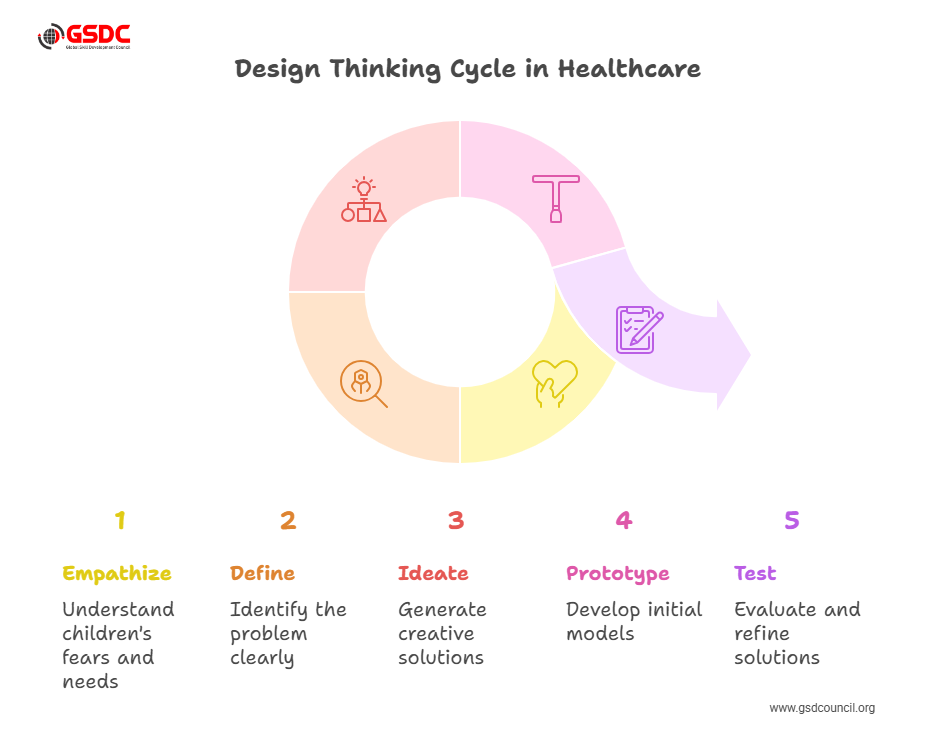
This is where the concept of design thinking in healthcare enters. The team decided to apply the design thinking process: empathize, define, ideate, prototype, and test to radically transform the experience. Let’s examine how.
Applying the Design Thinking Process: A Breakdown
The “Adventure Series” is a textbook case of the design thinking methodology in action. Here’s how GE Healthcare moved through the design thinking process steps:
Empathize
In the first phase, the team immersed itself in the world of pediatric patients. They visited daycare centers, observed children’s behavior, participated in sessions at a children’s museum, and interviewed child-life specialists, parents, and clinicians.
They asked: How does a 5-year-old interpret an MRI suite? What are the fears, the triggers?
One report noted: “The room itself is kind of dark and has those flickering fluorescent lights … that machine … looked like a brick with a hole in it.”
This empathy work is a core pillar of what design thinking is in healthcare, recognizing that in healthcare, human emotions, perceptions, and experiences matter just as much as technology.
Define (in design thinking)
Based on the empathise findings, the team crafted a clear problem statement:
“Children experience MRI scans as frightening, unfamiliar, sensory, and emotionally stressful settings; the experience is blocking each child’s ability to stay still, often requiring sedation.”
This “define” or problem framing is a key step in the design thinking cycle, setting a human-centered definition of the issue rather than a purely technical one.
Ideate
With that defined challenge, the team brainstormed creative & child-friendly solutions. They imagined themed rooms: a pirate ship, a coral under-sea journey, a “camp under the stars,” a submarine voyage.
These were not trivial decorations; they were stories that repositioned the MRI process into an adventure for the child.
The design thinking process emphasizes divergent thinking at this stage, generating many ideas without constraint.
Prototype
They built prototypes: murals on the walls, floors painted as pirate ship planks, lights designed to look like underwater bubbles, soundscapes of ceaseless waves, and stories in which the child becomes the hero of the journey inside the machine.
At one hospital, the “Jungle Adventure” room featured a canoe-shaped scanner bed in a koi-pond scene.
This stage of prototyping is central to design thinking in healthcare, demonstrating that you can test physical, sensory changes, not only software, to improve outcomes.
Test
In pilot hospitals, the team tested the themed rooms. Feedback was immediate: children shifted attitude from fear to curiosity; scanning throughput increased; sedation requirements fell; satisfaction scores soared.
One report shows an over 90% increase in satisfaction.
Testing and iteration are critical aspects of the design thinking methodology.
Mapping the Design Thinking Cycle
To make the case concrete, here’s how the design thinking cycle is mapped in this project:
|
Phase |
Activities |
Insights / Outputs |
|
Empathize |
Observations in daycare & hospitals; child interviews; staff interviews |
Realized the emotional burden, environmental fear, and sedation statistics |
|
Define |
Framed a clear problem: “MRI experience = trauma for children” |
The problem statement focused on the child's fear rather than the equipment specs |
|
Ideate |
Brainstormed themed rooms, story-driven experience ideas |
Generated concepts like Pirate Adventure, Under-Sea, and Camp theme |
|
Prototype |
Built physical themed settings, sound/lighting changes, and story scripts |
Created pixel-trial rooms, tested pilot installations |
|
Test |
Measured sedation rates, throughput, and satisfaction scores |
Found major gains: fewer sedations, higher throughput, happier families |
By following this design thinking process, the GE Healthcare team moved from insights to meaningful impact, not merely incremental improvement but a reframing of the user experience.
The Results: Benefits of Design Thinking in Healthcare
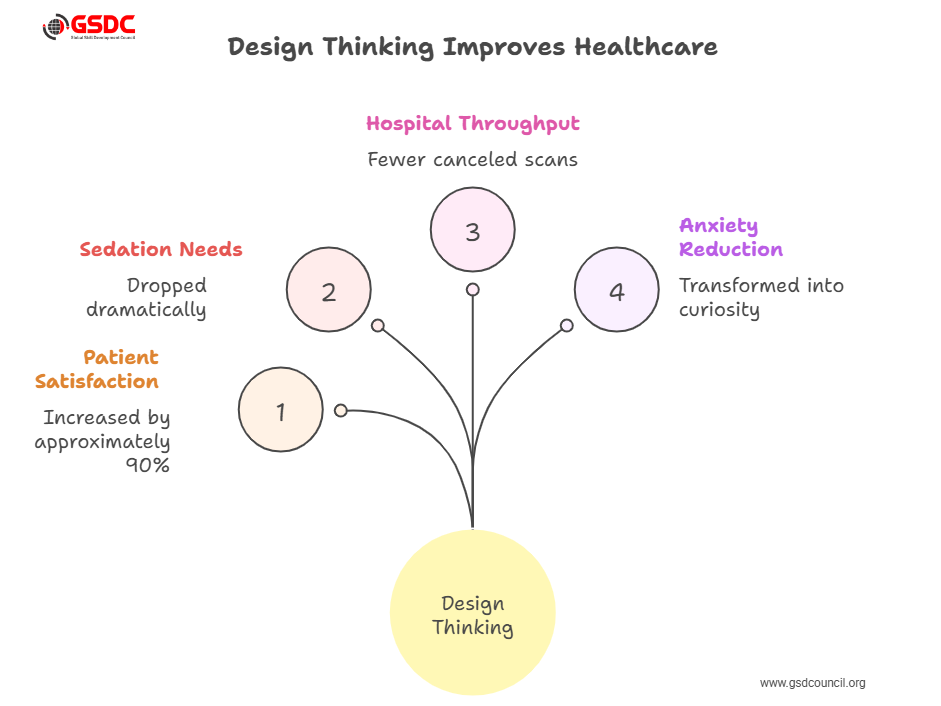
What happened when you applied design thinking in healthcare with fidelity? The Adventure Series delivered measurable benefits:
- Patient satisfaction increased by approximately 90%.
- Sedation requirements dropped dramatically (in one site, fewer than 27% of children required sedation, where previously almost every child did).
- Hospitals increased throughput: fewer canceled or postponed scans, less rescheduling.
- For parents and children, the anxiety of MRI scanning was transformed into curiosity and even eagerness: “Mommy, can we come back tomorrow?” said one child.
These are clear illustrations of the benefits of design thinking: not just aesthetic improvement, but operational efficiency, patient experience improvements, cost savings, and emotional well-being.
In other words, the design thinking methodology helped translate human empathy into business and clinical value.
Why This Case Study Works as a Model of Design Thinking in Healthcare
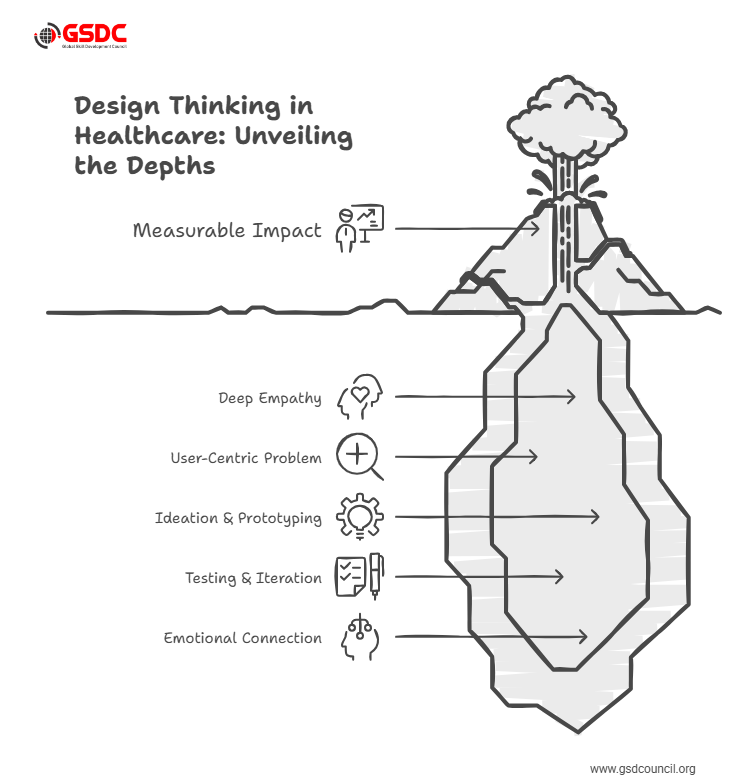
This case qualifies as a strong design thinking case study in healthcare for several reasons:
- It begins with deep empathy and user research, not assumptions.
- It defines a user-centric problem rather than simply upgrading technology.
- It ideates and prototypes beyond the existing constraints of imaging equipment.
- It tests, iterates, and scales real-world clinical settings, with measurable outcomes.
- It connects emotional/psychological outcomes (child calmness) with operational ones (less sedation, more throughput) and business results (higher satisfaction, potentially lower cost).
These are all hallmarks of what design thinking in healthcare is, done well: human-centered design that delivers measurable impact.
Insights for Practitioners: Applying the Design Thinking Process in Healthcare
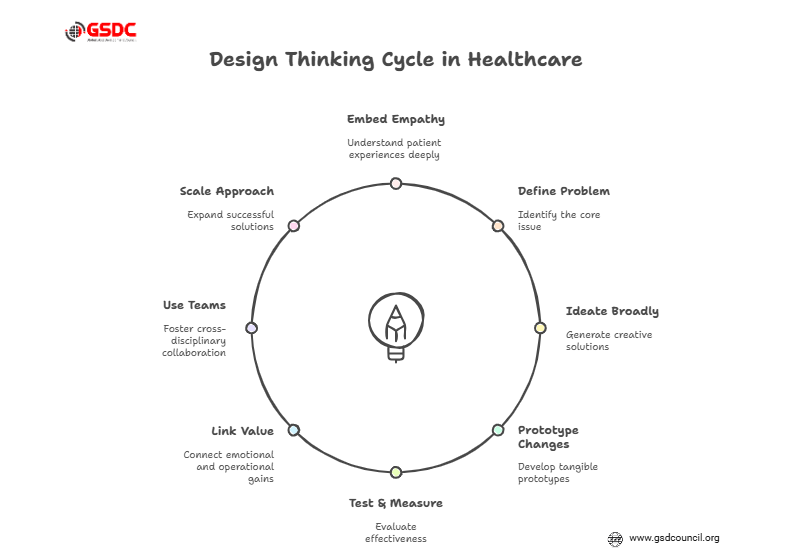
If your organization is considering adopting design thinking, or you’re pursuing a design thinking certification and want practical healthcare-oriented insights, here are takeaways based on this case:
Embed Empathy Early and Deeply
Don’t stop at asking clinicians what they think; go to patients. Observe feelings, interruptions, and anxieties. The GE team visited the daycare, the children’s museum, and observed children undergoing scans. Use that insight to fuel your design thinking in healthcare efforts.
Define the Right Problem
The problem wasn’t “Our machine is outdated.” It was “Children are terrified of the scanning environment, and sedation is high.” A precisely defined phase ensures your solutions are human-centered and strategic.
Ideate Broadly
When you ask “how might we…”, you allow imagination. For example: “How might we let the MRI become a submarine journey for a child?” Dare to dream beyond incremental improvement. That’s core to the design thinking methodology.
Prototype Sensory & Experience Changes
Healthcare often focuses on hardware/software. But the Adventure Series changed floors, walls, sounds, narratives. Prototype physical/logistical changes. The design thinking process steps allow you to experiment.
Test & Measure
What you test informs what you improve. GE measured sedation rates, throughput, and satisfaction scores. If you are practicing design thinking in healthcare, don’t forget measurement. Also, plan for scaling.
Link Emotional and Operational Value
Improving children's emotions is meaningful. But linking it to operational gains makes a business case. That’s one of the key benefits of design thinking: delivering value across dimensions.
Use Cross-Disciplinary Teams
Design thinking works best when you bring together engineers, designers, clinicians, child life specialists, and even children. The GE team brought in a children’s museum to help ideate. This cross-disciplinary collaboration is vital in healthcare innovation.
Scale the Approach
This was not a one-off. GE rolled out the Adventure Series to multiple hospitals and modalities (MRI, CT, PET). Recognize that the design thinking cycle must include scaling and iteration beyond the first site.
Broader Implications and Additional Examples of Design Thinking in Healthcare
While the GE Healthcare case is marquee, there are many examples of design thinking in healthcare worth knowing.
The usefulness of the design thinking process expands beyond pediatric scans.
For instance: redesigning telehealth workflows, improving chronic-disease self-management tools, and rethinking hospital way-finding for elderly patients. These all follow the same core design thinking methodology: empathize, define, ideate, prototype, test.
For those seeking design thinking certification, many outstanding programs exist (e.g., IDEO U, Interaction Design Foundation), and these often highlight similar healthcare cases.
Understanding the benefits of design thinking, improved experience, lower cost, and faster throughput helps you advocate for design thinking in your organization.
Lessons Learned & Strategic Takeaways
From the GE Adventure Series case, here are some distilled lessons:
- User emotion is a legitimate design frontier: In healthcare, the emotional experience is as important as technical performance. This case shows that design thinking in healthcare drives meaningful change.
- Small changes can unlock major gains: The themed room may seem like a modest idea, but the impact was huge. Don’t underestimate the power of experience redesign.
- Don’t treat the problem as purely technical: The “define” phase reframed the issue from “MRI machine design” to “children’s fear and motion during scan.” That reframing enabled innovation.
- Link the human story to operational metrics: Improved child calmness led to fewer sedations, higher throughput, and cost savings. This is what makes the benefits of design thinking clear.
- Prototype early, iterate often: The team didn’t build a full roll-out first; they piloted themed rooms, adjusted, then scaled. This is central to the design thinking cycle.
- Embed across the organization: GE’s design thinking approach didn’t stay in one product team; it influenced imaging modalities, hospital processes, and design culture. This suggests that a design thinking certification is less important than embedding the mindset.
Potential Limitations and Considerations
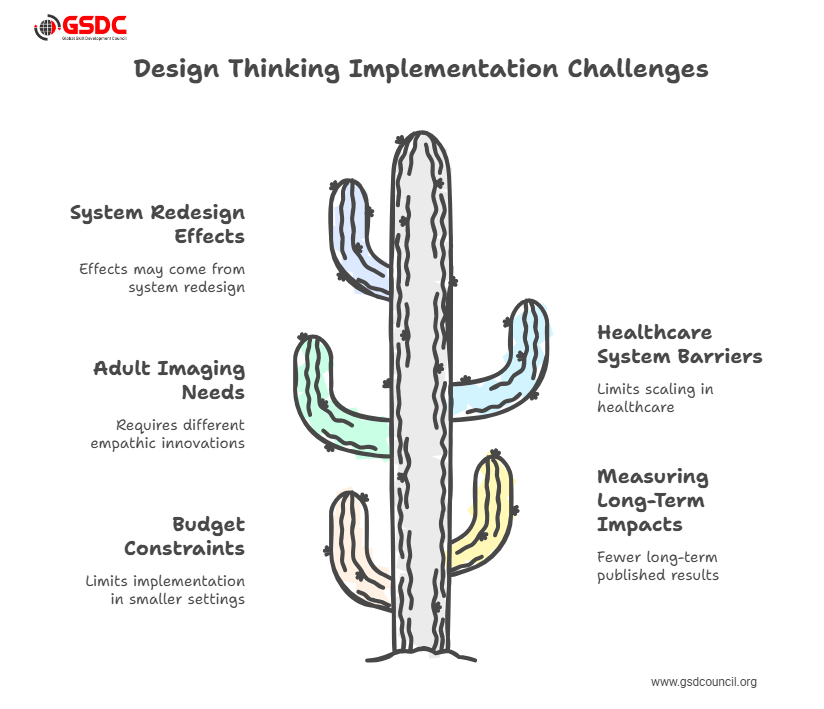
While the case is strong, it is helpful to acknowledge caveats:
- The GE Adventure Series required investment (themed rooms, décor, staff training). Budget constraints may limit implementation in smaller settings.
- Measuring longer-term impacts (beyond the initial pilot) can be complex; the case reports satisfaction improvements, but fewer long-term published results.
- While the themed-room model is brilliant for pediatric settings, adult imaging may require different empathic innovations; the design thinking methodology must adapt to the user context.
- Cultural, regulatory, or organizational barriers in healthcare systems can limit scaling. The design thinking process steps and modeler must account for existing systems.
- Because the case also drew on systems thinking (mapping workflows, hospital systems) some of the effects may come from system redesign rather than design thinking alone.
That said, the case remains a clear example of design thinking in healthcare. Think you can design and implement solutions like that?
Then let your credentials speak for you, enroll in our GSDC Certified Design Thinking, and get a global validation for your skills that can cut through the noise and make you stand out.

Why This Matters?
Due to the transition toward healthcare as something that is not just about clinical outcomes, but rather about the holistic patient experience, the importance of design thinking in healthcare increases as well.
The collateral makes the case to hard-bodied operation directors about the fact that the improved throughput, reduced sedations, and happier families. It is not only about what design thinking is in healthcare, but also how we can use the design thinking process in our organization to bring about actual impact.
The GE Adventure Series shows how the design thinking process, when used with the understanding and attention to operation, will not only change a machine or a room but also a whole experience and a result.
Any person thinking about certification in design thinking should not simply study the steps that they have to undertake to carry the mindset: empathize, define, ideate, prototype, test, measure, and scale.
It is in that place that the advantages of design thinking actually become apparent.
FAQs:
1. What inspired GE Healthcare to apply design thinking to MRI machines?
The initiative began when GE designer Doug Dietz observed a young child crying before an MRI scan. That emotional moment made him realize the problem wasn’t technical; it was experiential. This realization inspired the team to use design thinking in healthcare to reimagine the MRI experience from a child’s perspective.
2. How does the Adventure Series reflect the complete design thinking cycle?
The project followed all the design thinking process steps: empathize, define, ideate, prototype, and test. It started with observing users (children and parents), defining the real problem (fear, not machinery), ideating creative room themes, prototyping immersive environments, and testing to measure reduced anxiety and sedation rates.
3. Can the same design thinking methodology be applied to adult healthcare experiences?
Yes. While this case focused on children, the design thinking methodology can enhance any patient experience, like reducing anxiety in chemotherapy, improving waiting-room design, or simplifying pre-surgery instructions. The process is adaptable to all healthcare touchpoints.
4. What were the operational or business outcomes of the Adventure Series?
Beyond patient satisfaction, hospitals saw measurable efficiency gains, fewer sedation cases, faster scan times, and better throughput. These outcomes highlight the benefits of design thinking in improving both patient well-being and hospital performance.
5. How can professionals learn to apply similar principles in their own healthcare settings?
Practitioners can explore design thinking certification programs or internal innovation labs. The key is fostering empathy-driven collaboration among clinicians, designers, and patients to co-create human-centered solutions tailored to real healthcare challenges.

Related Certifications
Stay up-to-date with the latest news, trends, and resources in GSDC
If you like this read then make sure to check out our previous blogs: Cracking Onboarding Challenges: Fresher Success Unveiled
Not sure which certification to pursue? Our advisors will help you decide!