Software Development Life Cycle: Best Practices and Responsibilities
Written by Emily Hilton
- What is the Software Development Life Cycle today?
- SDLC Models: Agile, Iterative, and Hybrid Approaches
- Responsibilities mapped to SDLC phases
- Best practices that materially improve outcomes
- Measuring success: metrics that matter
- Professionalising skills: SDLC certifications and career paths
- GSDC’s Certified Software Development Life Cycle Professional
- Practical checklist for teams (quick)
- Common pitfalls and how to avoid them
- Moving Forward
The software development life cycle remains the fundamental process in the development of reliable and high-quality software, and its significance grows more and more.
It doesn't matter if your team is working in agile sprints or using the waterfall method; having a clear SDLC process with well-defined roles can significantly lower the risks and speed up the delivery.
In this article, you will get a clear view of the contemporary SDLC, learn the best practices for each phase, understand team responsibilities, and discover how agile and iterative approaches can improve delivery speed, quality, and long-term maintainability.
What is the Software Development Life Cycle today?
At its core, the software development life cycle is a structured set of stages for taking an idea to production and through the maintenance phase. Typical SDLC phases include planning, requirements gathering, system design, development (coding), testing and software validation, software deployment, and maintenance. Each phase requires distinct ownership and governance. Modern teams treat the SDLC as iterative: design, build, validate, deploy, then iterate again.
SDLC Models: Agile, Iterative, and Hybrid Approaches
The agile mindset has changed the SDLC approach from inflexible transitions to short and frequent cycles. The iterative method divides major projects into minor increments, making it possible to get fast feedback, sooner software verification, and safer software release.
Teams usually mix agile practices with DevOps (CI/CD, trunk-based development) so that releases are automated, repeatable, and frequent, instead of being large and risky.
Consider the SDLC as a collection of feedback loops where requirements change, system design gets better, and functionality increases over each iteration.
Responsibilities mapped to SDLC phases
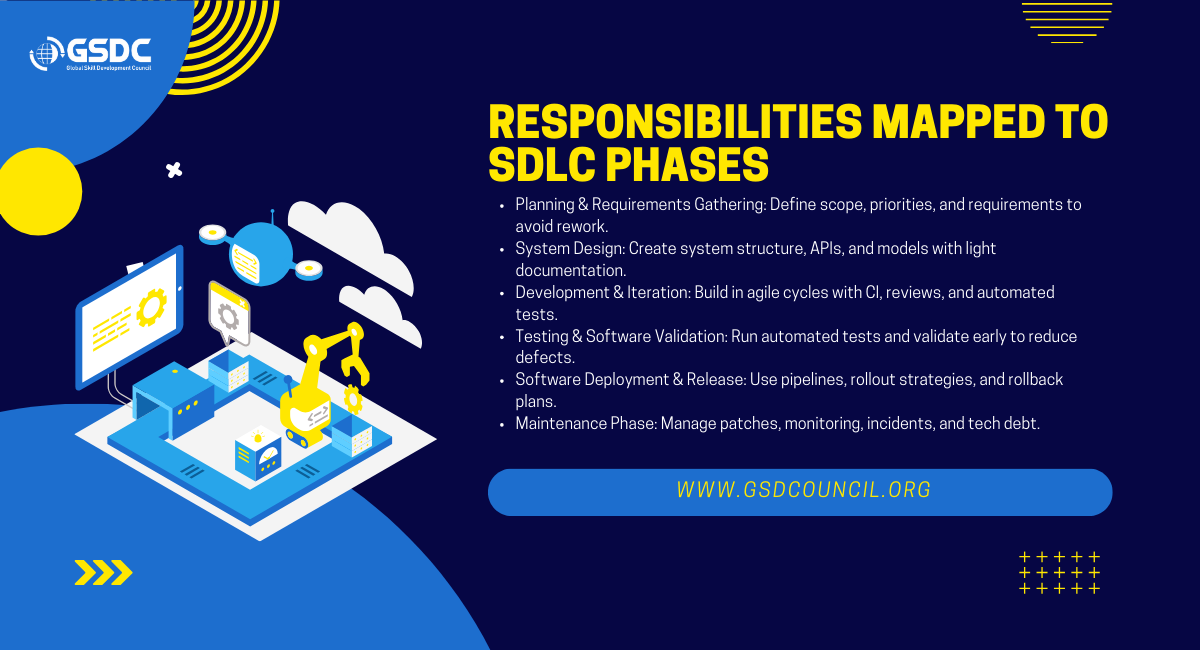
Clear role definitions keep the SDLC moving. Below is a concise responsibility map across core SDLC phases:
- Planning & Requirements Gathering: Product owners, business analysts, and stakeholders own the scope, acceptance criteria, and prioritisation. Solid requirements gathering reduces rework in later phases.
- System Design: Architects and senior engineers create the system design, APIs, data models, and non-functional requirements (scalability, security, compliance). Design decisions should be lightweight but documented.
- Development & Iteration: Developers implement features in short cycles; teams follow an agile cadence with continuous integration. Code review, automated unit tests, and feature toggles are mandatory.
- Testing & Software Validation: QA engineers and SREs manage automated tests (unit, integration, contract, and end-to-end) and validate acceptance criteria. Shift-left testing reduces cost and time to fix defects.
- Software Deployment & Release: DevOps owns automation pipelines, rollout strategies (canary, blue-green), and rollback plans to make software deployment predictable.
Best practices that materially improve outcomes
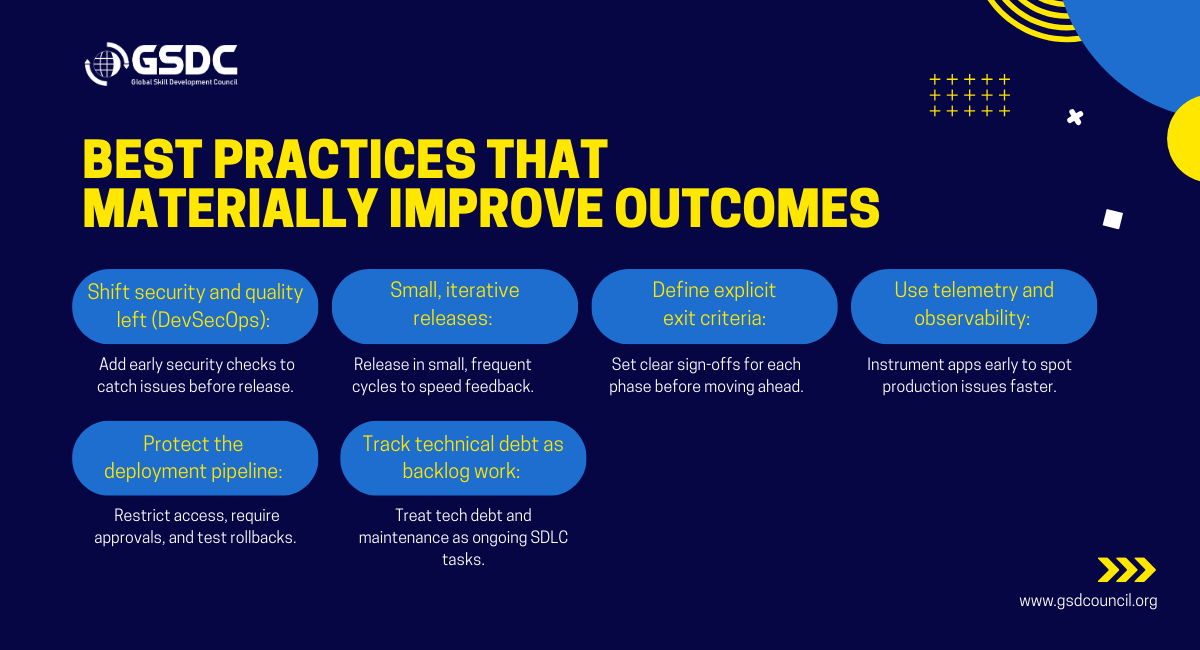
Below are practical, high-impact best practices to bake into your SDLC process:
- Automate builds, tests, and deployments (CI/CD): Automation makes the SDLC process repeatable and reduces human error during software deployment.
- Shift security and quality left (DevSecOps): Integrate static analysis, dependency checks, and threat modelling into early system design and coding stages so vulnerabilities are caught before release.
- Small, iterative releases: Prefer frequent, smaller releases over large monolithic launches. This aligns with agile and iterative principles and shortens the feedback loop.
- Define explicit exit criteria for each phase: For example, require signed-off acceptance tests after requirements gathering and documented architecture decisions after system design.
- Use telemetry and observability: Instrument apps in the development phase so production issues surface quickly during the maintenance phase.
- Protect the deployment pipeline: Limit direct production access, require approvals for releases that change critical flows, and test rollbacks in staging.
- Track technical debt as backlog work: Treat maintenance and debt reduction as part of the SDLC process, not an afterthought.
These practices are repeatedly shown to improve reliability, lower mean-time-to-repair, and increase deployment frequency.
Measuring success: metrics that matter
To judge SDLC effectiveness, track both flow and quality metrics:
- Flow: lead time for changes, deployment frequency, change failure rate, and mean time to restore (MTTR).
- Quality: escaped defects in production, automated test coverage, and results of software validation suites.
- Business: cycle time from requirements gathering to usable feature and customer satisfaction.
Focusing on these metrics makes it clear whether your SDLC process is improving outcomes or simply adding ceremony.
Professionalising skills: SDLC certifications and career paths
For individuals and organisations wanting formal recognition, several software development life cycle certification options exist. Security-focused credentials like GSDC’s certifications cover secure practices through the entire lifecycle and are respected for teams integrating security into the SDLC.
There are also vendor and independent SDLC certification programs and training courses that prepare practitioners for roles in architecture, quality engineering, and DevOps. If you’re exploring a formal pathway, look for programs titled Certified Software Development Life Cycle Professional or Certified SDLC Professional.
These aim to validate practical knowledge across sdlc phases, from requirements gathering to the maintenance phase. Always confirm prerequisites and alignment with your organisation’s tooling and methodologies.
Download our Practical SDLC Team Checklist now.
Turn best practices into action and boost delivery confidence!
GSDC’s Certified Software Development Life Cycle Professional
GSDC's Certified Software Development Life Cycle Professional is an international credential that is acknowledged for professionals who want to control all stages of SDLC. The certification gives the students the knowledge that they can practically apply in planning, requirements gathering, system design, development, testing, deployment, and maintenance.
It gives strong emphasis on agile and iterative methodologies, quality assurance practices, and real-world implementation techniques. Completing this certification, therefore, empowers the participants with the skills necessary to optimize processes, cut down on project risks, and deliver software that is easier and more consistent to predict.
It is suitable for developers, project managers, QA engineers, analysts, and anyone involved in end-to-end software development.
Benefits:
- Validity of SDLC expertise over all phases.
- Quality upgrading and delivery consistency are increasing.
- Capability in agile and iterative methodologies improvement.
- Cross-functional collaboration strengthening.
- Career prospects are boosted with a recognized credential.
- Development risks and rework help to reduce.
- Managing real-world SDLC challenges involves confidence-building.

Practical checklist for teams (quick)
- Create a cross-functional team that includes members from product, design, development, QA, and SRE departments.
- Acceptance criteria should be documented during the requirements gathering process and should be maintained throughout the project.
- Before deploying any software, ensure that automated test coverage and pipeline gates are in place.
- System design reviews and architecture decision records should be part of each major change.
- Take into account the maintenance phase: monitoring, incident runbooks, and scheduled security updates.
- Career paths should be linked to recognized SDLC certificates or software development life cycle certification tracks for skill development.
Common pitfalls and how to avoid them
- Over-documenting early: keep system design lightweight and revisited iteratively.
- Treating deployment as someone else’s problem: ensure DevOps and developers co-own release automation.
- Ignoring maintenance: the maintenance phase must be resourced and accounted for in budgets.
- Skipping validation: adequate software validation prevents customer-facing regressions.
Moving Forward
The modern software development life cycle blends disciplined engineering with agile and iterative delivery. By mapping responsibilities to each SDLC phase, automating CI/CD, shifting security left, and investing in observability, teams make software deployment predictable and reduce long-term costs in the maintenance phase. For individuals, pursuing software development life cycle certification or a certified SDLC professional program validates mastery and helps organisations hire for consistent skill sets. Treat the SDLC as a living process: iterate, measure, and improve.

Related Certifications
Stay up-to-date with the latest news, trends, and resources in GSDC
If you like this read then make sure to check out our previous blogs: Cracking Onboarding Challenges: Fresher Success Unveiled
Not sure which certification to pursue? Our advisors will help you decide!