Generative Adversarial Networks (GANs): How Generative AI Tools Learn to Create AI Images
Written by Matthew Hale
- What Are GANs?
- How GANs Work - The Two-Network Framework
- How GANs Learn: A Step-by-Step Process
- How Does AI Generate Images?
- Types of GANs in Modern Systems
- Generative AI Use Cases Powered by GANs
- Generative AI in Cybersecurity
- Challenges of Using GANs
- Why GANs Matter in the Age of Generative AI
- From Understanding GANs to Applying Them: Build Real-World Skills with GSDC
- Conclusion
Have you ever wondered, “How does AI produce images, or how do the new AI image generation tools produce real images in seconds?”
This is achieved through the use of generative AI, a rapidly growing machine learning technique, which empowers computers to identify patterns within massive data pools, creating something entirely new. At the center of this new concept are the solutions offered through GANs, or Generative Adversarial Networks, which are models that explain how artificial intelligence learns from data, behind many of the most successful AI-powered image generators on the market today.
Starting from digital design through new generative applications of AI, such as generative cybersecurity AI, GANs enable companies to transition not only from automation to creation but also demonstrate why generative AI is important.
What Are GANs?
To understand what is generative adversarial networks, think of GANs as systems that teach computers how to create.
Generative Adversarial Networks (GANs) are a deep learning model that uses real data to learn and then reproduces new information,n such as text, audio, or realistic-looking AI images. Rather than making predictions, GANs concentrate on creating something new.
This is the fundamental concept of what is generative AI and how it works: the model trains itself on pattern knowledge and then applies that knowledge to generate new content.
How GANs Work - The Two-Network Framework
The power of GANs lies in a competitive learning structure where two neural networks are trained together.
- The Generator: The generator creates data from random noise through training, generating increasingly realistic outputs.
- The Discriminator: The discriminator evaluates if the data is real or generated.
This is an explicitly adversarial process, providing a clear view of how AI learns and offering a real-world explanation of how generative AI operates in practical systems.
How GANs Learn: A Step-by-Step Process
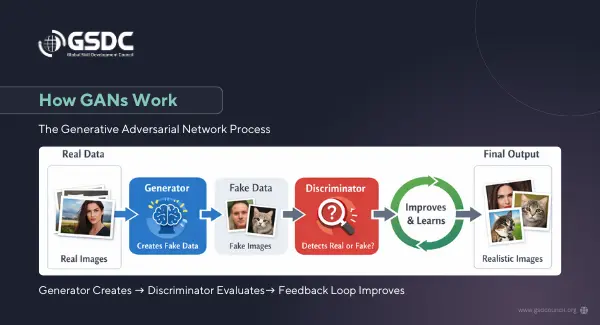
GANs are trained in a self-cycling competition and feedback. This is similar to pitting two teams against each other, wherein the other team is trying to cheat while the other is trying to catch.
1. Start with Real Data
The model is trained on real examples, such as lots of pictures, to show the model what real patterns look like.
2. Generator Generates Fake Data
The generator accepts the random noise and starts generating the fake sample. At the beginning, the generated data will normally not be of good quality.
3. Discriminator Evaluates Samples
The discriminator looks at both real and generated data and decides:
“Is this real or fake?”
4. Feedback Loop Begins
The generator aims to deceive the discriminator, and the discriminator aims to properly discern the fake examples.
5. Generator Gets Better
Every time the discriminator detects fraud, feedback is provided to the generator to improve its performance.
6. Discriminator Gets Sharper
On the other hand, the better the discriminator, the more subtle distinctions it can make between real and fake data.
7. Final Output: Realistic Data
As a result of many rounds of training, the generator becomes so good that its outputs of AI images or any other type of generated information become practically indistinguishable from real information.
This learning cycle is one of the key concepts that are being imparted under industry-aligned programs by the Global Skill Development Council (GSDC) to make professionals aware of how generative models of AI function.
How Does AI Generate Images?
A common question across industries is how does AI generate images so realistically.
GAN-based AI image generating platforms analyze millions of images to learn patterns such as shapes, colors, and lighting. Based on this information, the platforms can generate images that look real, making the image generating AI platforms that exist today produce high-quality images.
Key points:
- Recognizes visual patterns in large data sets
- Generating real-life images with GANs
- Provides business-class visual content
Types of GANs in Modern Systems
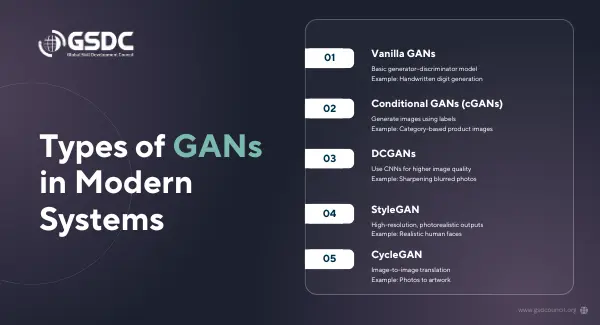
Various GANs – Generative Adversarial Networks are developed for particular generative AI tasks, ranging from simple exploration to sophisticated AI pictures.
-
Vanilla GANs
Vanilla GANs are the simplest type of GANs based on the generative adversarial network design. They introduce the simplest version of the generator/discriminator. However, they are often unstable to train.
For Example: Generating basic handwritten digits from simple datasets.
-
Conditional GANs (cGANs)
In Conditional GANs, control is exerted over the kind of images generated based on the labels or classes associated with the images. They are helpful for targeted AI image generator applications.
For Example: Creating product images based on categories such as shoes or watches.
-
Deep Convolutional GANs (DCGANs)
DCGANs incorporate convolutional neural networks to enhance the quality and form in generated results. It is most often used in contemporary image generator AI solutions.
For Example: Improving blurred product photographs for sharper marketing images.
-
StyleGAN
StyleGAN is designed for generating high-resolution, photo-realistic images with a high level of control over details.
For Example: Creating natural faces for people who are not real individuals.
-
CycleGAN
CycleGANs are known for their expertise in image-to-image translation. They are able to translate visual elements from one style
For Example: Turning real photographs into painting-style artwork.
These models and architectures provide the foundation on which professionals seek answers when searching what is the best AI image generator that meets their needs.
Such GAN models constitute the backbone of platforms that professionals use when looking for the best AI image generation tool. In order to utilize this knowledge towards effective execution within real-world security applications, the GSDC Certification In Generative AI In Cybersecurity training program is available.
✨ Download a practical toolkit to see how GANs power generative AI tools and AI image generators.📘 From What Are GANs to Real AI Image Generators – A Step-by-Step Learning Path
🚀 Start building real-world generative AI skills today!
Generative AI Use Cases Powered by GANs
GANs - Generative Adversarial Networks are now embedded across multiple enterprise domains, enabling a wide range of practical generative AI use cases that drive innovation and efficiency.
- Creative Design:
GANs can automate the creation of artwork, marketing visuals, and branding assets without human effort by generating unique designs.
- Healthcare:
In medical imaging, GANs generate synthetic datasets for medical imaging while preserving patient privacy. This would achieve the twin purpose of overcoming data scarcity and improving diagnostics.
- Media & Entertainment:
GANs drive AI-based character and virtual world generation, as well as stylized graphics that enhance storytelling and gaming experiences.
- Image Enhancement:
The GAN applications are responsible for improving the resolution of the image along with tasks involving restoring the image, which include actions such as removing noise, image upscaling, and reconstructing the image details
These examples show how GANs make many such real-world generative AI use cases possible across industries, showing that they are indeed foundational elements of the modern generative AI tools and platforms emerging today.
Generative AI in Cybersecurity
One of the applications experiencing the greatest growth rate in generative AI is the use of generative AI in cybersecurity.
Through the use of GANs, organizations are able to mimic realistic attack scenarios to prepare defenses accordingly.This enables a team to:
- Test and improve AI cybersecurity tools
- Enforce better AI risk and compliance frameworks
- Assess the effect of AI on cyber operations
These factors are responsible for the rising interest in companies and professionals who comprehend how AI can be applied to cybersecurity.
Challenges of Using GANs
While GANs are powerful, they are also among the most difficult generative AI models to train and manage in real environments.
- Unstable training:
This is where the generator or discriminator is training too rapidly, causing the training process not to converge.
- Mode Collapse:
The model tends to generate the same output again and again rather than learning all the types of data patterns, hence restricting its usability and creativity.
- High infrastructural cost:
The training of GAN requires a huge amount of data, GPUs, and time.
Because of these constraints, it has become evident why organizations are interested in structured learning patterns and formal generative AI certification offerings for the development of dependable, enterprise-class solutions.
Why GANs Matter in the Age of Generative AI
When leaders ask why is generative AI important, GANs - Generative Adversarial Networks provide the clearest answer: they allow AI systems to move beyond automation into true creation.
From AI image generation to adversarial threat modeling in generative AI in cybersecurity, GANs form the foundation of next-generation intelligent platforms that drive innovation across industries.
From Understanding GANs to Applying Them: Build Real-World Skills with GSDC
As the nature of Generative AI and its powers in molding the creation processes in organizations continues to evolve, the requirement for professionals to adopt structured learning routes becomes imperative. It is in these efforts that the Global Skill Development Council (GSDC) addresses the challenge with its Certification in Generative AI in Cybersecurity program.
This credentialing process is connected to key concepts such as the function of generative AI and AI data learning to actual enterprise-level security challenges. The participants will be able to gain meaningful insight into the function of GANs for threat simulation, awareness of AI risk and compliance, and current AI security tools. This can help the students to attain various uses of advanced AI security as well as the AI innovation ecosystem.

Conclusion
Generative Adversarial Networks have completely remade how machines learn, imagine, and innovate. Serving as the backbone for state-of-the-art generative AI systems, GANs are now being utilized for a new breed of digital creativity and intelligent automation tools.
From high-quality AI image creation to state-of-the-art threat simulation in generative AI for cybersecurity, GANs power some of the most influential generative AI use cases in modern enterprises. Their inner mechanics are no longer solely a topic of concern for data science teams but also a subject of critical knowledge for a wide range of professionals across technology, security, and digital innovation functions who shape the future of intelligent systems.

Related Certifications
Stay up-to-date with the latest news, trends, and resources in GSDC
If you like this read then make sure to check out our previous blogs: Cracking Onboarding Challenges: Fresher Success Unveiled
Not sure which certification to pursue? Our advisors will help you decide!