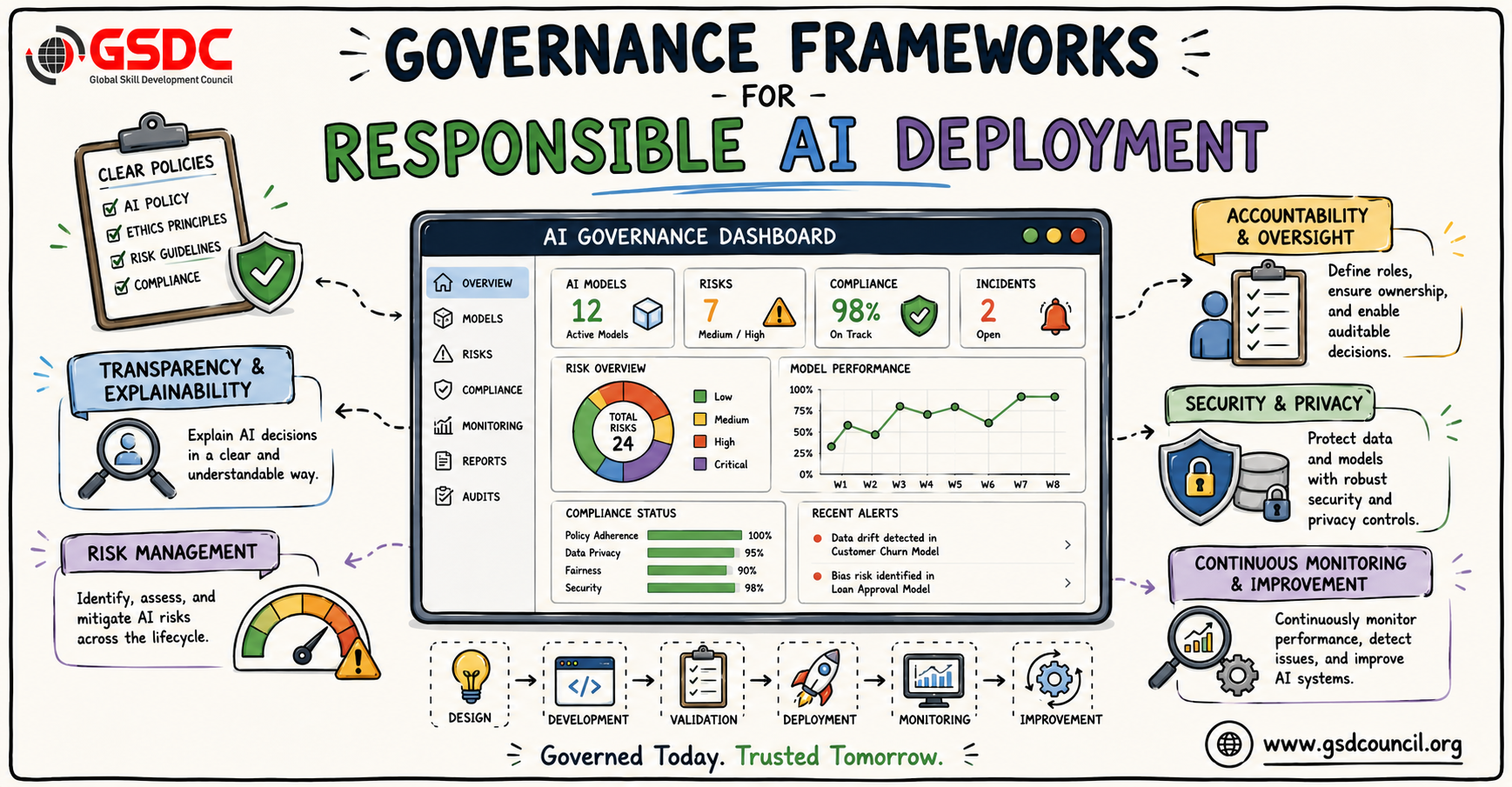
Governance Frameworks for Responsible AI Deployment
Written by Luv Johar
- What Is AI Governance?
- Why AI Governance Is Important
- The AI System Lifecycle: The Foundation of AI Governance
- Responsible AI Deployment: Moving AI Into Production Safely
- AI Model Deployment Challenges in Production
- The 7 Pillars of Responsible AI (and the Webinar's 8 Principles)
- Explainable AI: From Black Box to Trustworthy AI
- AI Ethics Board vs. AI Governance Committee
- The Three Lines of Defense for AI Governance
- ISO/IEC 42001: The Global Standard for AI Governance
- NIST AI RMF and Global Governance Initiatives
- The EU AI Act and Risk-Based Regulation
- Building a Career in AI Governance
- Conclusion
Artificial intelligence is moving from experimentation to large-scale enterprise adoption. Organizations are deploying AI in customer service, banking, healthcare, cybersecurity, HR, and operational decision-making. However, the speed of adoption has created a critical challenge: many companies are implementing AI faster than they are building governance around it.
This is exactly why AI governance frameworks have become a strategic priority. A powerful AI model alone is not enough. Organizations must ensure that AI systems are fair, transparent, secure, compliant, and continuously monitored throughout their lifecycle.
The webinar Governance Frameworks for Responsible AI Deployment explored how organizations can establish a responsible AI governance framework that supports innovation while reducing operational, legal, ethical, and reputational risks. It also explained why AI governance is important, how governance applies to every stage of the AI lifecycle, and how frameworks such as ISO/IEC 42001 and NIST AI RMF help organizations implement Responsible AI Deployment at scale.
What Is AI Governance?
AI governance is the set of roles, responsibilities, policies, procedures, controls, and oversight mechanisms that ensure AI systems are developed and used responsibly.
A governance program is not limited to compliance documentation. It is a practical operating model that helps organizations answer questions such as:
- Why is this AI system being built?
- What risks does it create?
- Is the data trustworthy?
- Can the model's decisions be explained?
- Who is accountable if something goes wrong?
- How will the model be monitored after AI deployment?
A mature, responsible AI governance framework ensures that governance is embedded into every stage of the AI lifecycle rather than being treated as a final approval activity.
Why AI Governance Is Important
One of the central themes of the webinar was why AI governance is important for modern enterprises.
AI systems make decisions that can affect loans, hiring, healthcare treatment, insurance eligibility, and many other high-impact outcomes. If governance is absent, organizations may face biased outputs, privacy violations, regulatory penalties, customer distrust, and financial losses.
The webinar emphasized why governance is a crucial component of a responsible AI framework. Governance creates accountability, establishes decision rights, defines acceptable use, and ensures that AI systems remain aligned with business objectives and societal expectations.
Without governance, organizations often encounter:
- Data quality problems
- Model bias
- Lack of explainability
- Privacy and consent violations
- Uncontrolled production changes
- Absence of monitoring after deployment
These issues are not theoretical. Many real-world AI failures have occurred because organizations focused on building the model but neglected governance controls.
The AI System Lifecycle: The Foundation of AI Governance
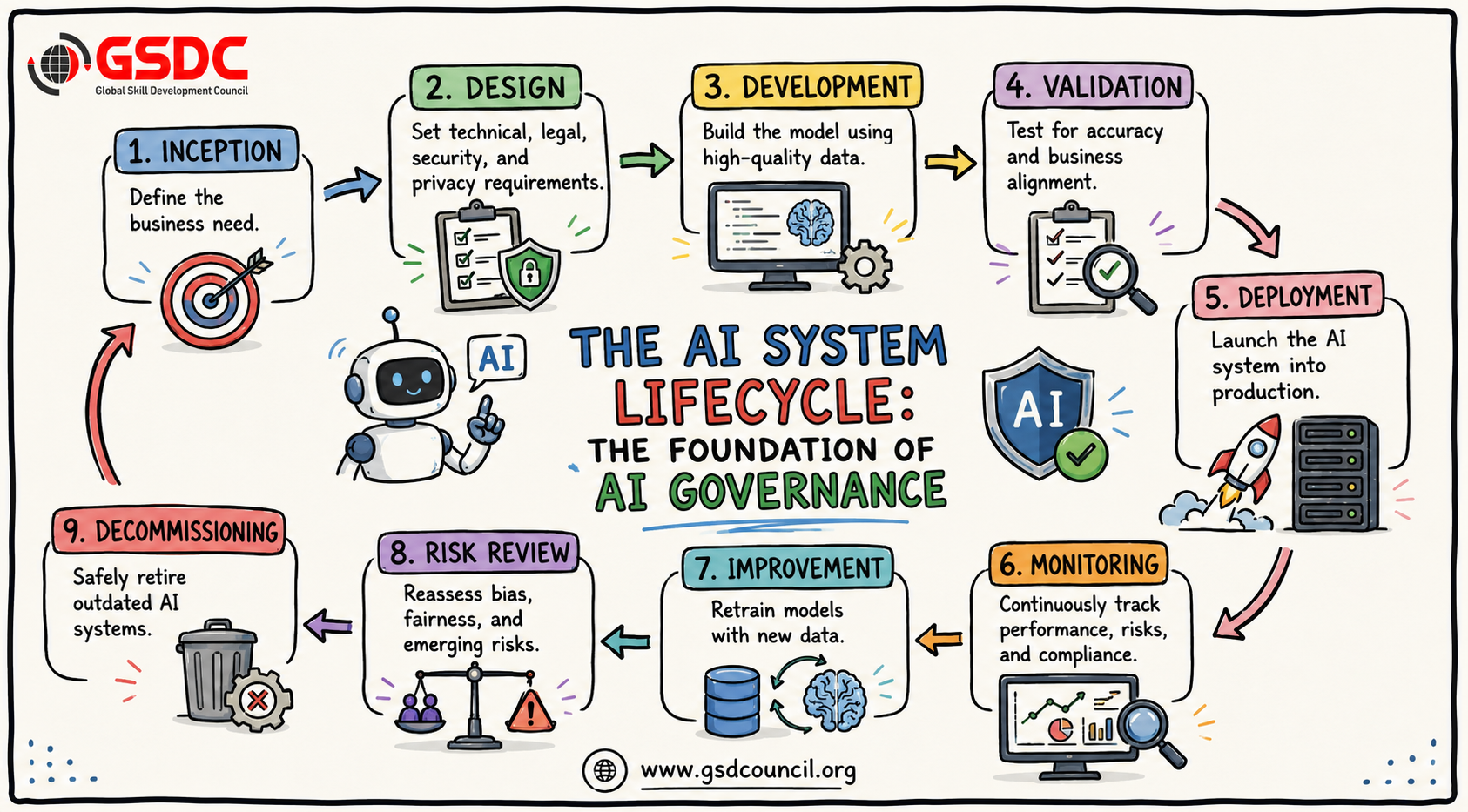
The webinar repeatedly highlighted that understanding the AI lifecycle is the foundation of all AI governance frameworks.
1. Inception
The organization defines the business objective and justifies why the AI system should exist.
2. Requirements and Design
Technical, business, legal, and operational requirements are gathered. This includes people, process, technology, security, and privacy considerations.
3. Development and Data Preparation
This is often the most critical stage because AI systems depend heavily on data quality. Poorly labeled, incomplete, biased, or corrupted training data can lead to unfair outcomes.
4. Verification and Validation
The model is tested to confirm that it solves the intended business problem and meets performance expectations.
5. Deployment
The model is released into production through a controlled change management process.
6. Operation and Monitoring
The webinar identified this as the most important stage from a governance perspective. AI systems continue to evolve because data, human behavior, and environmental conditions change over time.
7. Continuous Validation and Improvement
Models are retrained with fresh data to prevent obsolescence.
8. Re-evaluation and Risk Reassessment
Organizations reassess fairness, bias, business alignment, and emerging risks.
9. Decommissioning
When the AI system is no longer suitable, it is safely retired, and associated data is archived or deleted according to governance requirements.
This lifecycle-driven approach is what enables effective AI governance frameworks enterprise deployment.
Responsible AI Deployment: Moving AI Into Production Safely
A dedicated discussion in the webinar focused on Responsible AI Deployment.
Many organizations treat deployment as the finish line. In reality, deployment is the point at which governance becomes even more important.
Proper AI deployment requires:
- Formal change management
- Security reviews
- Privacy validation
- Approval workflows
- Rollback procedures
- Monitoring readiness
- Human oversight mechanisms
The webinar warned against releasing models directly into production without governance controls. A production deployment platform should support auditability, access control, version management, logging, and incident response.
Responsible AI Deployment is not simply about launching a model; it is about ensuring that the model can be trusted, monitored, and governed throughout its operational life.
AI Model Deployment Challenges in Production
AI deployment doesn't end when a model goes live in many cases, that's when the real challenges begin. One of the biggest reasons enterprise AI initiatives fail is that organizations focus heavily on model development but overlook what happens in production. As business environments, user behavior, and data continuously evolve, AI systems can quickly lose accuracy if they are not actively monitored and maintained. This is why understanding AI model deployment challenges in production is just as important as building the model itself.
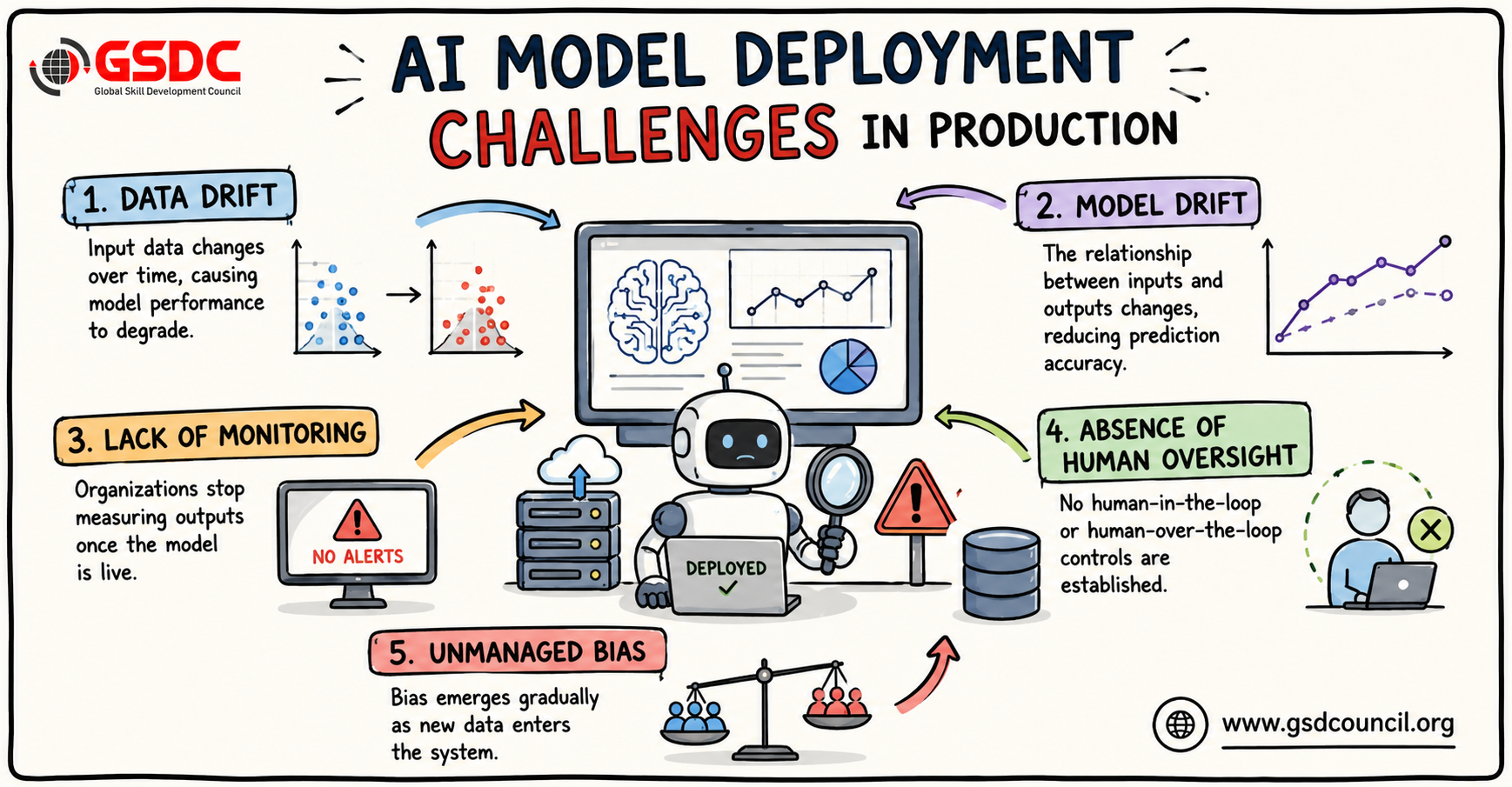
The webinar emphasized that successful Responsible AI Deployment requires continuous governance after launch. Organizations must monitor model performance, identify emerging risks, and implement human oversight to ensure AI continues making fair, reliable, and transparent decisions. Addressing common production issues through a robust, responsible AI governance framework helps organizations overcome deployment risks, maintain compliance, and ensure their AI solutions continue delivering business value long after deployment.
The 7 Pillars of Responsible AI (and the Webinar's 8 Principles)
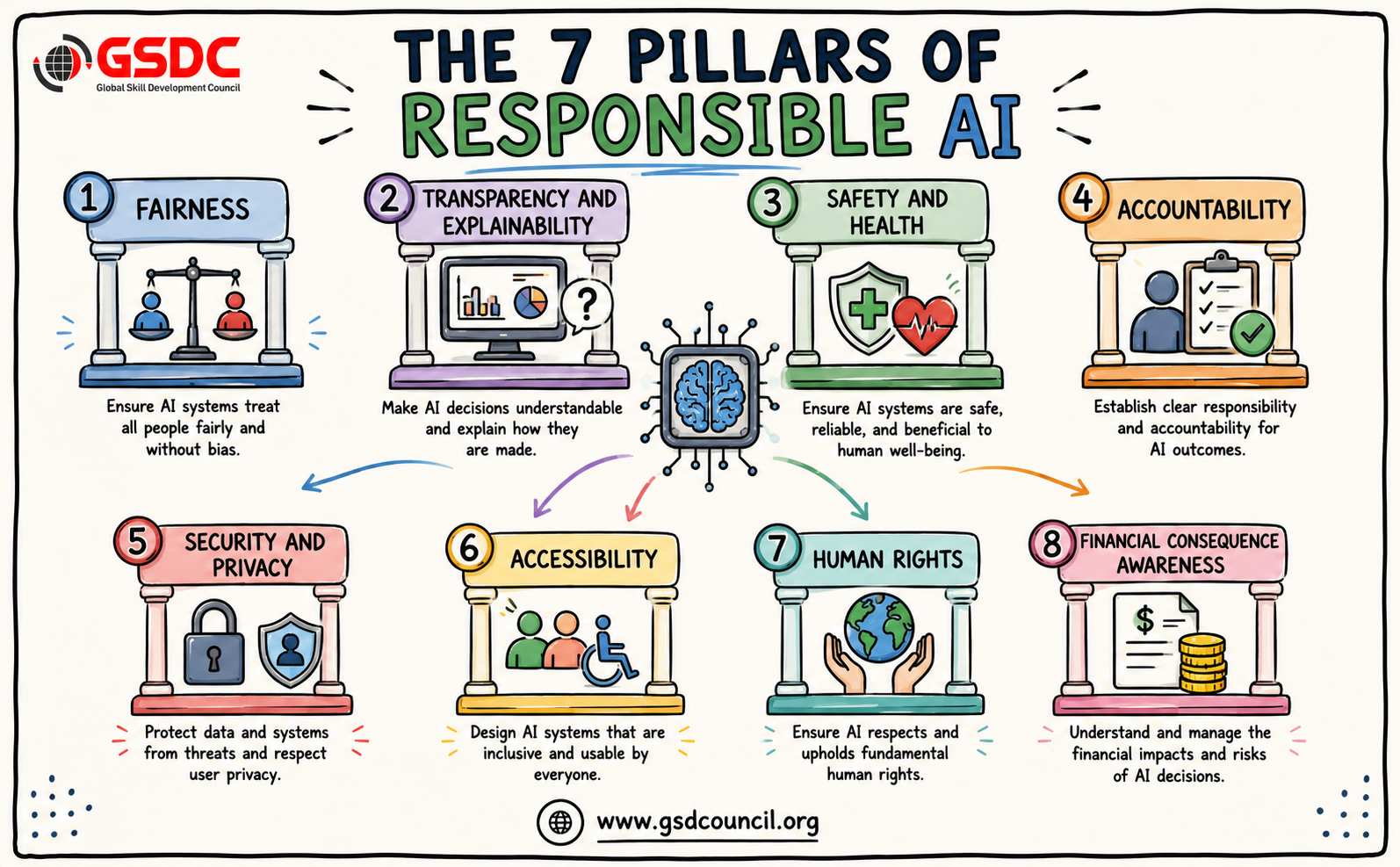
Many organizations search for the 7 pillars of responsible AI. The webinar presented a closely related framework consisting of eight responsible AI principles.
Different organizations define either seven or eight pillars, but the underlying goal is the same: AI systems must be trustworthy and human-centered.
Fairness
AI should not discriminate against individuals or groups.
Transparency and Explainability
Decisions must be understandable and justifiable.
Safety and Health
High-impact AI systems, especially in healthcare, require rigorous safety validation.
Accountability
Clear ownership must exist for AI-related decisions and outcomes.
Security and Privacy
Personal data must be protected through appropriate technical and organizational controls.
Accessibility
AI systems should be usable by diverse populations.
Human Rights
AI must respect equality, dignity, and non-discrimination principles.
Financial Consequences
Organizations should evaluate whether AI decisions could cause unjust financial harm.
These principles form the practical backbone of a responsible AI governance framework.
Explainable AI: From Black Box to Trustworthy AI
The webinar used a banking example in which a loan application was rejected, but the organization could not explain why.
This illustrates the black-box problem. If an organization cannot explain how a decision was made, it becomes difficult to establish trust with customers, regulators, and auditors.
Explainable AI requires:
- Transparent decision logic
- Documented algorithms
- Audit trails
- Logging mechanisms
- Understandable explanations for end users
Explainability is directly connected to fairness and transparency. Without explainability, organizations struggle to demonstrate that their AI systems are making decisions appropriately.
AI Ethics Board vs. AI Governance Committee
A particularly valuable section clarified the difference between an AI Governance Committee and an AI Ethics Board.
AI Governance Committee
Focuses on pre-deployment activities such as risk assessment, control validation, compliance checks, and approval for production release.
AI Ethics Board
Provides ongoing oversight after deployment. It evaluates fairness, societal impact, human rights considerations, and the long-term ethical implications of AI outputs.
The webinar emphasized that AI governance is not a one-person responsibility. Effective governance requires participation from legal, compliance, cybersecurity, data science, risk management, HR, and business leadership.
The Three Lines of Defense for AI Governance
The webinar adapted the traditional GRC model to AI governance.
First Line: Builders and Users
Data scientists, product teams, and business units own day-to-day AI risks.
Second Line: Risk and Compliance
AI risk teams, compliance professionals, and data protection officers provide oversight.
Third Line: Internal Audit
Independent auditors verify whether governance controls are properly designed and operating effectively.
This structure is especially relevant for professionals pursuing a GRC professional certification because it aligns AI governance with established enterprise risk management practices.
ISO/IEC 42001: The Global Standard for AI Governance
ISO/IEC 42001 was presented as the gold standard for AI governance.
The standard provides a structured AI Management System (AIMS) based on the Plan-Do-Check-Act methodology. It includes governance requirements, lifecycle controls, data controls, impact assessments, third-party controls, monitoring activities, and audit requirements.
The webinar noted that ISO/IEC 42001 contains 38 governance controls that organizations can use to operationalize Responsible AI Deployment.
For professionals looking to build expertise in governance, auditing, and compliance, ISO/IEC 42001 is increasingly becoming a valuable GRC certification pathway.
NIST AI RMF and Global Governance Initiatives
The webinar also discussed the NIST AI Risk Management Framework (NIST AI RMF).
NIST focuses primarily on identifying, assessing, measuring, and managing AI-related risks such as bias, reliability, security, privacy, and explainability.
In addition to NIST, organizations should be aware of broader global governance initiatives, including WHO AI governance guidance and emerging policy efforts such as A Framework for US AI Governance: Creating a Safe and Thriving AI Sector. These initiatives demonstrate that AI governance is becoming a global priority rather than a regional compliance exercise.
The EU AI Act and Risk-Based Regulation
The webinar briefly covered the EU AI Act, which categorizes AI systems into:
- Unacceptable Risk
- High Risk
- Limited Risk
- Minimal Risk
Different compliance obligations apply to each category. This risk-based approach is influencing how organizations design AI governance frameworks enterprise deployment strategies, especially for systems used in regulated industries.
Building a Career in AI Governance
As organizations accelerate their adoption of AI, the demand for professionals with expertise in AI governance, risk, and compliance continues to grow. For those looking to validate their skills, the GSDC’s Certified AI GRC Professional Certification provides a comprehensive learning path covering AI governance frameworks, risk management, regulatory compliance, and responsible AI implementation.
The Certified AI GRC Professional Certification includes hands-on training in AI lifecycle governance, AI risk assessment, global frameworks such as ISO/IEC 42001 and NIST AI RMF, governance policies, and practical AI GRC artifacts.
It is designed to help professionals build the knowledge required to establish trustworthy, secure, and compliant AI systems while preparing for roles in AI governance, risk, audit, and compliance across industries.
Conclusion
AI is no longer an experimental technology. It is becoming a core business capability, and with that capability comes responsibility.
The webinar demonstrated that successful AI adoption depends not only on model performance but also on governance. Understanding the AI lifecycle, implementing a responsible AI governance framework, establishing clear accountability, ensuring explainability, and continuously monitoring deployed models are all essential components of trustworthy AI.
Organizations that invest in strong AI governance frameworks will be better positioned to achieve secure, compliant, and scalable AI deployment. As global regulations continue to evolve, governance will become a competitive advantage rather than merely a compliance requirement

Related Certifications
Frequently Asked Questions
AI governance frameworks are structured sets of policies, controls, roles, and procedures that help organizations develop, deploy, monitor, and retire AI systems responsibly.
AI governance is important because AI systems can affect financial, healthcare, employment, and other high-impact decisions. Governance helps reduce bias, protect privacy, ensure compliance, and establish accountability.
A responsible AI governance framework integrates fairness, transparency, security, accountability, privacy, human rights, and continuous monitoring into every stage of the AI lifecycle.
The biggest challenges include data drift, model drift, lack of monitoring, unmanaged bias, security risks, and the absence of human oversight after deployment.
ISO/IEC 42001 Lead Implementer and Lead Auditor certifications are valuable starting points for professionals interested in AI governance, auditing, risk management, and broader GRC certification pathways.
Stay up-to-date with the latest news, trends, and resources in GSDC
If you like this read then make sure to check out our previous blogs: Cracking Onboarding Challenges: Fresher Success Unveiled
Not sure which certification to pursue? Our advisors will help you decide!