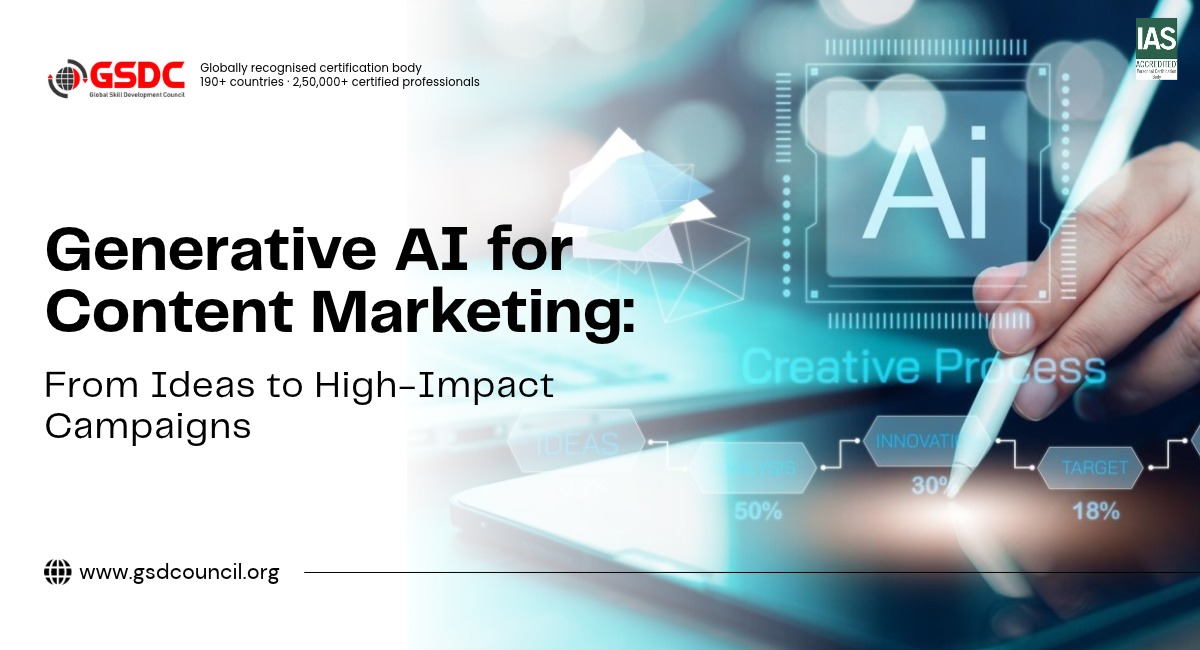
Generative AI for Content Marketing: From Ideas to High-Impact Campaigns
Written by Emily Hilton
- 1. Understanding the Role of Generative AI in Content Marketing
- 2. AI-Powered Content Ideation: Finding Better Content Ideas
- 3. Creating Effective Content Briefs and Outlines with AI
- 4. Using AI for Content Drafting and Repurposing
- 5. Maintaining Brand Voice and Content Quality
- 6. Building a Repeatable AI-Enabled Content Workflow
- How GSDC's FDE Certification Helps Professionals Prepare for AI Engineering Roles
- Conclusion
Generative AI is changing how businesses plan, create, and distribute marketing content. From brainstorming fresh ideas to writing social media posts and repurposing blogs, AI tools are helping content marketers complete tasks faster and manage multiple campaigns efficiently. However, producing content quickly does not necessarily mean producing content that connects with an audience.
As more businesses and creators use tools such as ChatGPT, Claude, Gemini, and Jasper, the amount of AI-generated content available online continues to grow. This makes originality, brand identity, and audience understanding more important than ever.
The webinar "Generative AI for Content Marketing: From Ideas to High-Impact Campaigns" explained how marketers can use generative AI throughout the content marketing process while maintaining human creativity and authenticity.
The session covered AI-powered content ideation, content briefs, drafting, content repurposing, brand voice, quality control, and building a repeatable AI-enabled workflow.
1. Understanding the Role of Generative AI in Content Marketing
Generative AI refers to artificial intelligence that can create new content, including text, images, summaries, and other forms of digital material. In content marketing, it can support brainstorming, research, content development, editing, and distribution.
However, easy content production is no longer a competitive advantage on its own. When everyone has access to similar AI tools, audiences start looking for something beyond well-written content.
- Ideas and angles: Having a fresh perspective and addressing topics that genuinely matter to the target audience.
- Brand identity: Creating content that reflects the company's personality, values, and point of view.
- Human judgment: Knowing what is accurate, relevant, original, and appropriate to publish.
AI can support the content creation process, but marketers must guide it with their knowledge, experience, and understanding of their audience. The goal should not be to let AI replace creativity but to use it to turn ideas into valuable content more efficiently.
2. AI-Powered Content Ideation: Finding Better Content Ideas
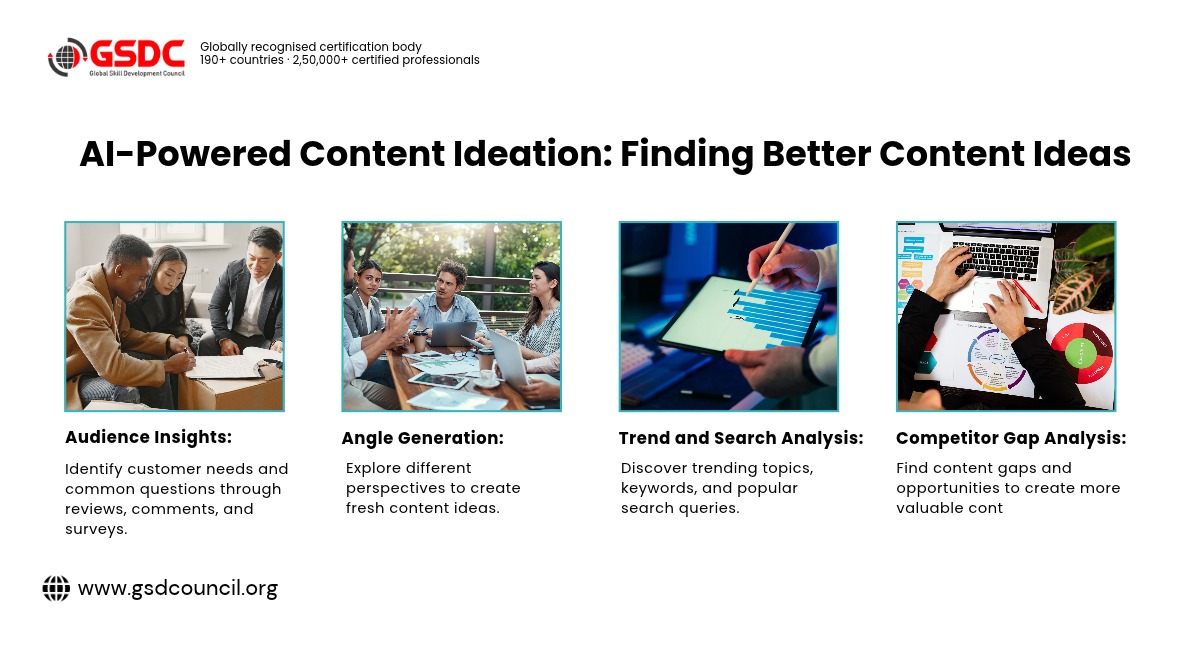
Content ideation is one of the most useful applications of generative AI. Instead of spending hours brainstorming topics, marketers can use AI to explore different perspectives and identify opportunities.
- Audience insights: AI can analyze customer reviews, support tickets, social media comments, and survey responses to identify common questions and recurring problems. For example, if customers repeatedly ask how an AI product works, marketers can turn those questions into educational videos, blogs, or social media posts.
- Angle generation: A single topic can be explored through multiple perspectives. For instance, a blog about AI in education could become content around common misconceptions, practical applications, student experiences, or future career opportunities.
- Trend and search analysis: AI can help marketers explore trending topics, search queries, keywords, and gaps in existing content. This makes it easier to identify subjects that audiences are actively interested in.
- Competitor gap analysis: By comparing existing content with competitor content, marketers can identify missing information, unexplored topics, and opportunities to offer a more useful perspective.
3. Creating Effective Content Briefs and Outlines with AI
A strong content brief provides direction before the actual writing begins. It is a short document that explains what the content should achieve, who it is intended for, and how the message should be communicated.
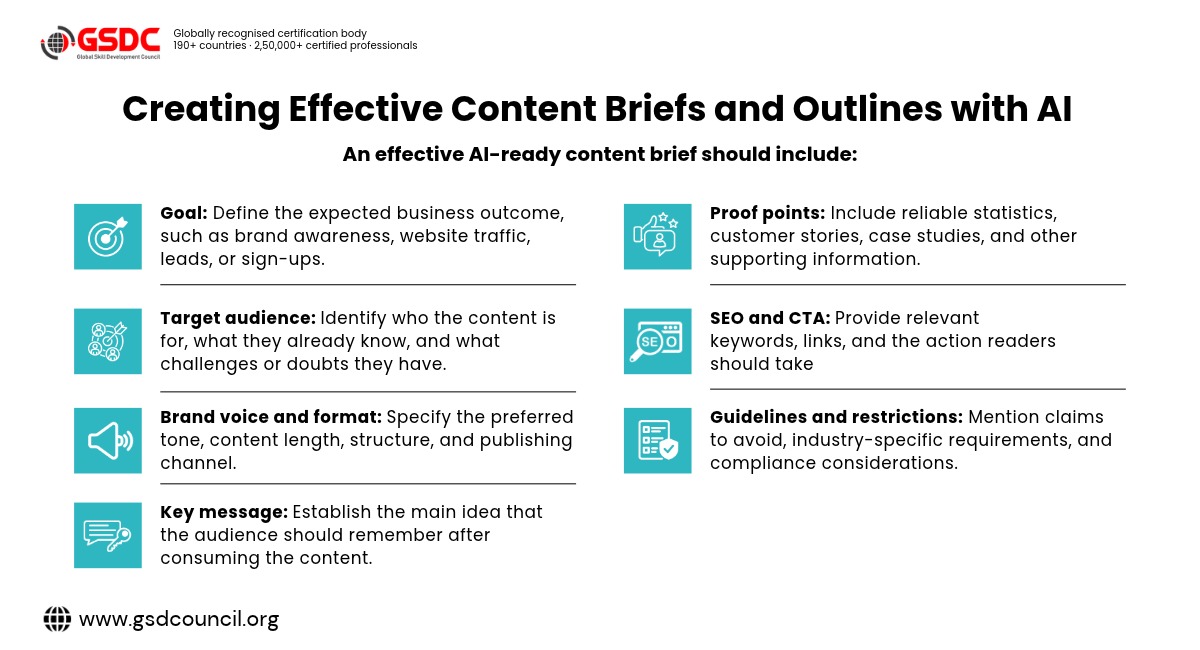
For example, a software training company targeting students interested in software engineering should tell AI about the students' career concerns, learning requirements, and interest in AI. It should also explain whether the campaign aims to generate course sign-ups or build awareness.
Once the brief is ready, marketers can ask AI to create multiple outlines with different structures. They can then select the strongest sections and combine them into a final outline.
The outline should also be reviewed critically. Marketers can ask AI to identify unclear explanations, unsupported claims, repetitive information, and missing details before moving to the drafting stage.
4. Using AI for Content Drafting and Repurposing
Once the content brief and outline are approved, AI can help create the first draft. It can also suggest headlines, opening hooks, introductions, and ways to improve the flow of existing content.
However, the first draft should not automatically become the final version.
Human involvement remains essential when adding original insights, personal experiences, opinions, examples, and industry knowledge. Marketers must also verify facts, check sources, and ensure that the final content communicates the intended message.
Another important application is content repurposing.
Instead of creating every piece of content from scratch, marketers can develop one detailed piece of content and transform it into multiple formats.
For example, a single long-form blog or industry report can be repurposed into:
- LinkedIn posts and short articles.
- Instagram carousels and social media captions.
- Short-form video scripts and hooks.
- Email newsletters and promotional messages.
- Short WhatsApp updates and broadcast messages.
Each format requires a different approach. LinkedIn content needs an engaging opening to encourage readers to continue. Short videos need attention-grabbing hooks, while emails should have focused subject lines and clear calls to action.
AI can adapt the original content for different platforms, but marketers should review each version to ensure it fits the platform's audience and communication style.
5. Maintaining Brand Voice and Content Quality
One common problem with AI-generated content is that it often sounds generic. Even when the information is correct, the writing may not reflect the company's personality.
The solution is to create a clear brand voice guide and provide it to AI.
Instead of using vague instructions such as "write in a friendly tone," marketers should give specific directions. For example, a brand may want its content to sound warm but not overly casual, knowledgeable but not academic, and confident without appearing arrogant.
A brand voice guide should also include preferred terminology, words or phrases to avoid, sentence length, spelling preferences, formatting rules, and examples of previously approved content. Before publishing AI-assisted content, marketers should evaluate it across five important areas:
- Accuracy: Are the facts, statistics, and claims correct?
- Voice: Does the content reflect the brand's personality?
- Originality: Does it offer a meaningful perspective rather than repeating common information?
- Compliance: Does it follow relevant industry and content guidelines?
- Performance: Is it likely to achieve the intended marketing objective?
This becomes particularly important in regulated industries such as healthcare and finance, where inaccurate information or unsupported claims can create serious problems.
6. Building a Repeatable AI-Enabled Content Workflow
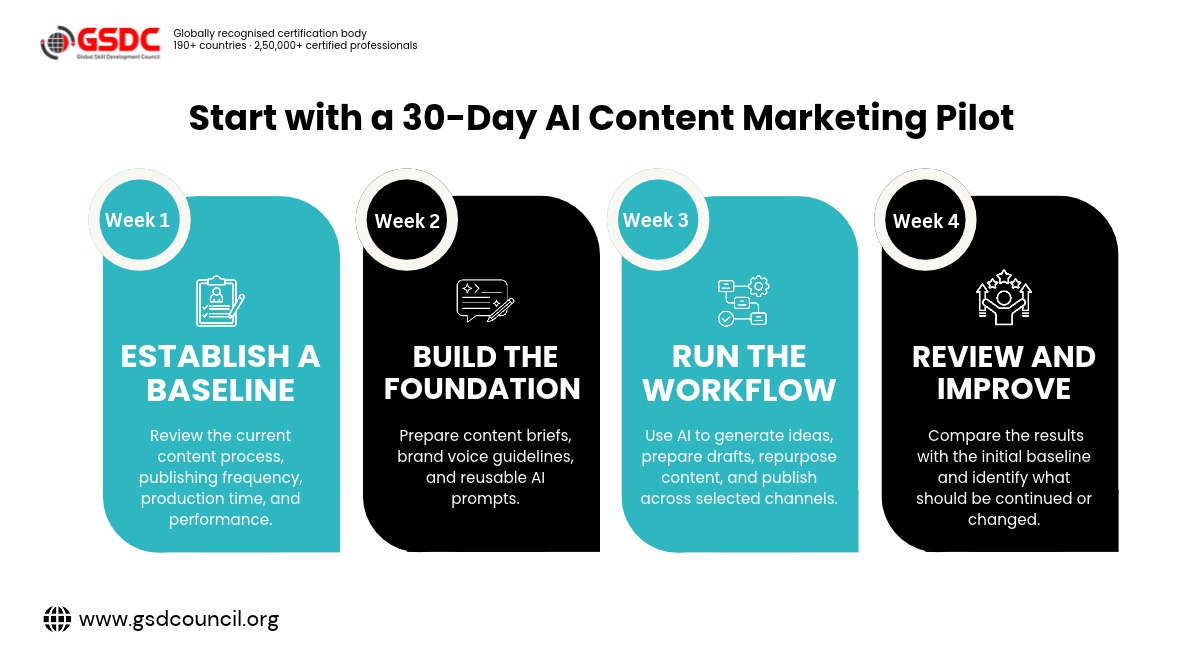
Using AI effectively requires more than knowing how to write prompts. Businesses need a structured workflow that defines how content moves from an initial idea to publication and performance analysis.
- Planning: AI helps identify trends, group related ideas, and explore content opportunities. Human marketers decide which topics deserve priority.
- Briefing: AI can help organize information and complete content brief templates, while marketers approve the direction and objectives.
- Drafting: AI prepares the initial content, while humans add original insights, examples, and relevant experiences.
- Reviewing: AI can assist with preliminary checks, but the final review and approval remain the responsibility of the content team.
- Publishing: AI helps adapt content for different platforms. Marketers manage scheduling, publishing, and engagement.
- Learning: Performance data, audience feedback, clicks, leads, and engagement help identify what is working. These insights can be used to improve future content ideas and campaigns.
To make this workflow sustainable, businesses should maintain a shared prompt library, assign clear ownership at every stage, protect confidential information, and use a focused set of tools for writing, SEO, and scheduling.
The speaker also demonstrated an internal social media management system that brings content planning, task tracking, scheduling, and social media accounts into one workflow.
How GSDC's FDE Certification Helps Professionals Prepare for AI Engineering Roles
As businesses increasingly adopt AI solutions, professionals need skills that go beyond traditional software development. GSDC's Forward Deployed Engineer (FDE) Certification helps professionals understand how to connect AI technologies with real-world business requirements.
The Forward Deployed Engineer (FDE) Certification focuses on developing knowledge of AI implementation, technical problem-solving, system integration, and customer collaboration. It helps professionals understand how to work with AI-driven solutions, address implementation challenges, and align technology with business objectives.

For professionals interested in building a career in AI engineering, solution development, or enterprise AI implementation, the certification offers an opportunity to strengthen their understanding of the FDE role and its practical applications.
Conclusion
Generative AI is making content marketing faster and more accessible, but producing more content does not automatically create better marketing results. The real advantage comes from combining AI's speed with human creativity, strategic thinking, and judgment.
The webinar highlighted an important working principle: the 10-80-10 rule. Marketers contribute the first 10% by developing the idea and defining the direction. AI handles approximately 80% of the execution, while humans take responsibility for the final 10% through reviewing, refining, and approving the output.
By developing strong content briefs, maintaining consistent brand guidelines, repurposing valuable content, and following a measurable workflow, businesses can use generative AI to create more relevant and effective campaigns.
Ultimately, AI should help marketers close the gap between having an idea and bringing it to life. The creativity, authenticity, and decisions that make content meaningful must still come from people.

Related Certifications
Frequently Asked Questions
AI helps marketers generate ideas, analyze audience feedback, write blogs, create social media content, and repurpose existing material.
Yes. Brand guidelines, tone instructions, and approved content samples help AI maintain a consistent brand voice.
Humans develop the initial idea (10%), AI handles most of the execution (80%), and humans review and refine the final output (10%).
AI can transform blogs, reports, and webinars into LinkedIn posts, email newsletters, carousels, and video scripts.
Businesses can track content production time, engagement, website traffic, organic search performance, leads, and conversions.
Stay up-to-date with the latest news, trends, and resources in GSDC
If you like this read then make sure to check out our previous blogs: Cracking Onboarding Challenges: Fresher Success Unveiled
Not sure which certification to pursue? Our advisors will help you decide!