Struggling to Implement AI in Your Organisation? 5 Ways a Forward Deployed Engineer Can Help
Written by Emily Hilton
Artificial intelligence is becoming part of business strategy across industries. Organisations are exploring AI to automate repetitive tasks, improve customer experiences, analyse data, and support faster decision-making. However, investing in AI does not automatically translate into business results.
Many companies can demonstrate what an AI tool can do, but integrating it into everyday operations is a different challenge. The AI application may not connect with existing systems, the available data may be unreliable, employees may hesitate to use it, or the solution may fail to deliver the expected results.
These are some of the most common AI adoption challenges organisations face when moving from experimentation to implementation.
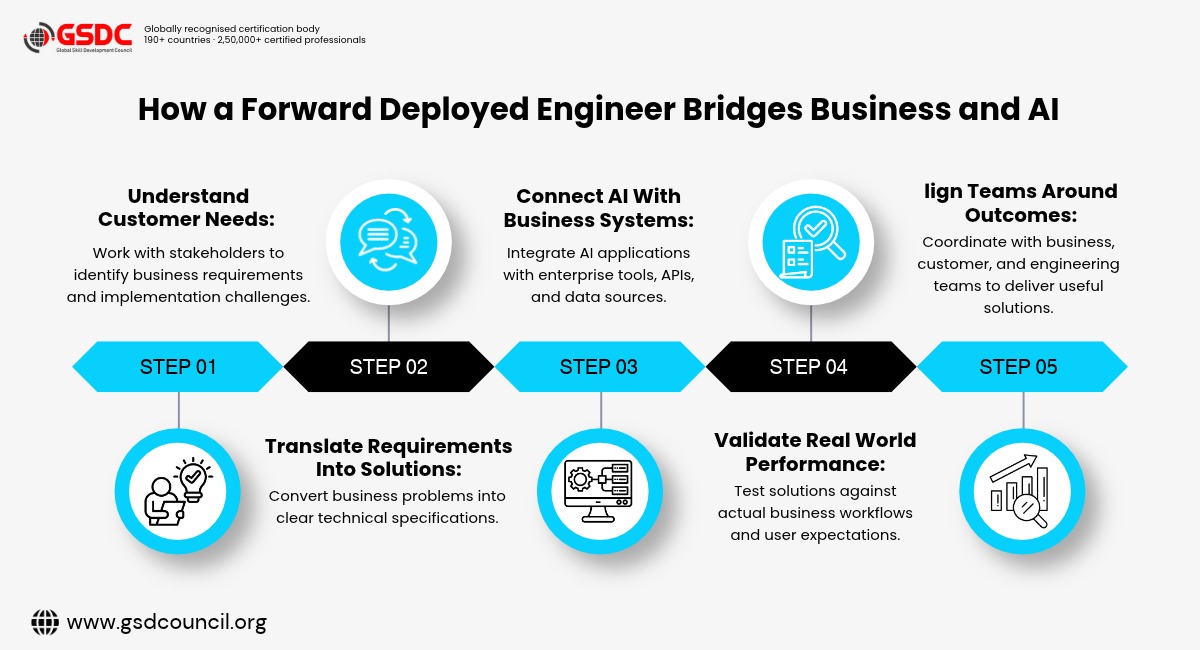
A Forward Deployed Engineer (FDE) helps bridge this gap by working with customers, business stakeholders, and engineering teams to develop and implement solutions for real-world problems.
Let's explore five ways a Forward Deployed Engineer can help your organisation overcome AI implementation challenges.
Why Do Organisations Struggle with AI Implementation?
Before exploring possible solutions, it is important to understand why AI projects face difficulties.
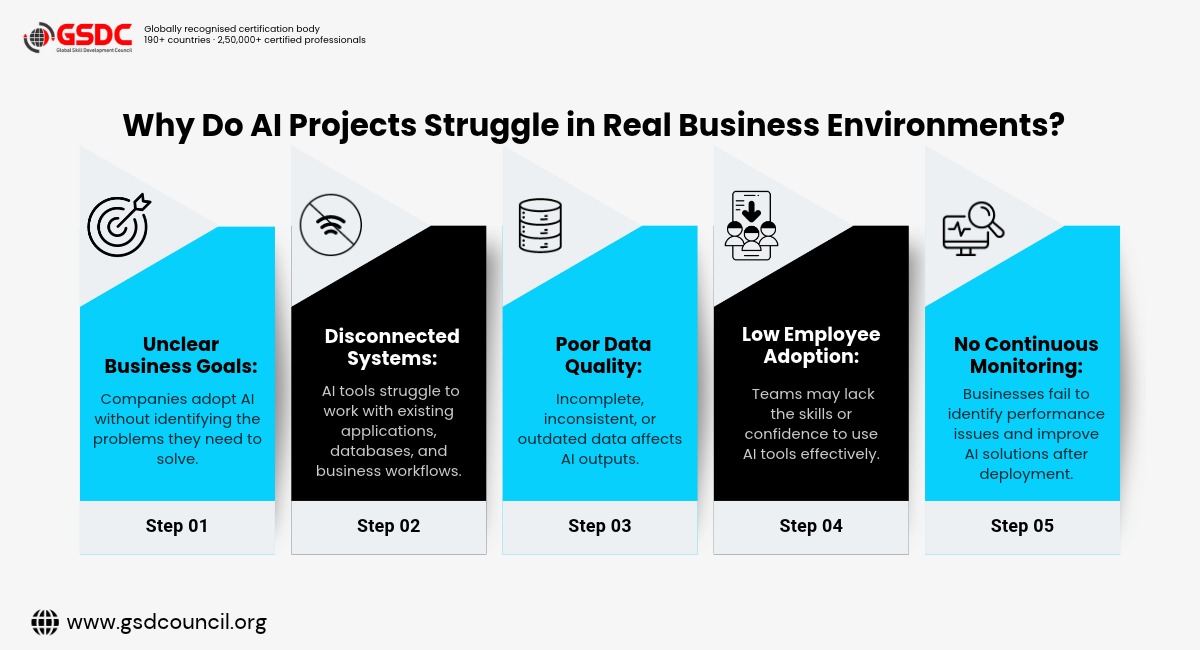
Some common challenges include:
- Unclear business objectives: Organisations adopt AI without defining the specific problem they want to solve or the outcomes they expect.
- Disconnected systems: AI applications may not integrate smoothly with existing databases, CRM platforms, enterprise software, or internal workflows.
- Poor data quality: Incomplete, outdated, inconsistent, or inaccessible data can affect the reliability of AI-generated results.
- Limited employee adoption: Employees may lack the training, confidence, or motivation to incorporate AI into their daily work.
- Insufficient testing and monitoring: A solution that performs well in a demonstration may produce inaccurate results, encounter unexpected errors, or become expensive when used at scale.
These AI implementation challenges can lead to wasted resources, delayed projects, and limited business value. In some cases, corporate AI implementation failure happens because organisations focus on the technology itself rather than the environment in which it needs to operate.
Overcoming these challenges requires a structured approach that connects business needs, technical capabilities, and employee workflows.
5 Ways a Forward Deployed Engineer Can Help With AI Implementation
1. Identify the Right Business Problem Before Choosing AI
One of the first steps in any successful AI implementation strategy is identifying a problem worth solving.
Organisations sometimes begin by selecting an AI tool and then searching for ways to use it. However, a technology-first approach can lead to solutions that look impressive but have little impact on actual business operations.
A Forward Deployed Engineer works closely with business stakeholders and customers to understand their existing processes, identify operational bottlenecks, and define the expected outcomes.
For example, a customer support team may want to introduce an AI assistant to reduce response times. Before building the solution, an FDE would examine how support requests are received, how employees access information, which questions occur most frequently, and where delays happen.
This investigation helps determine whether an AI assistant is the right solution and what it needs to accomplish.
How an FDE helps:
- Identifies specific business problems and their underlying causes.
- Translates business requirements into clear technical objectives.
- Defines measurable success criteria before development begins.
- Helps organisations prioritise AI use cases based on feasibility and business value.
By starting with the problem rather than the technology, organisations can build an AI implementation roadmap around meaningful business outcomes.
2. Connect AI Applications With Existing Business Systems
An AI application rarely operates independently in an enterprise environment. It may need information from databases, CRM platforms, document repositories, internal applications, or other business systems.
Connecting these systems can be one of the most complex parts of implementation.
For instance, an organisation might deploy an AI assistant that answers questions about customer accounts. However, if the assistant cannot securely retrieve accurate information from the company's CRM or internal database, its answers may be incomplete or outdated.
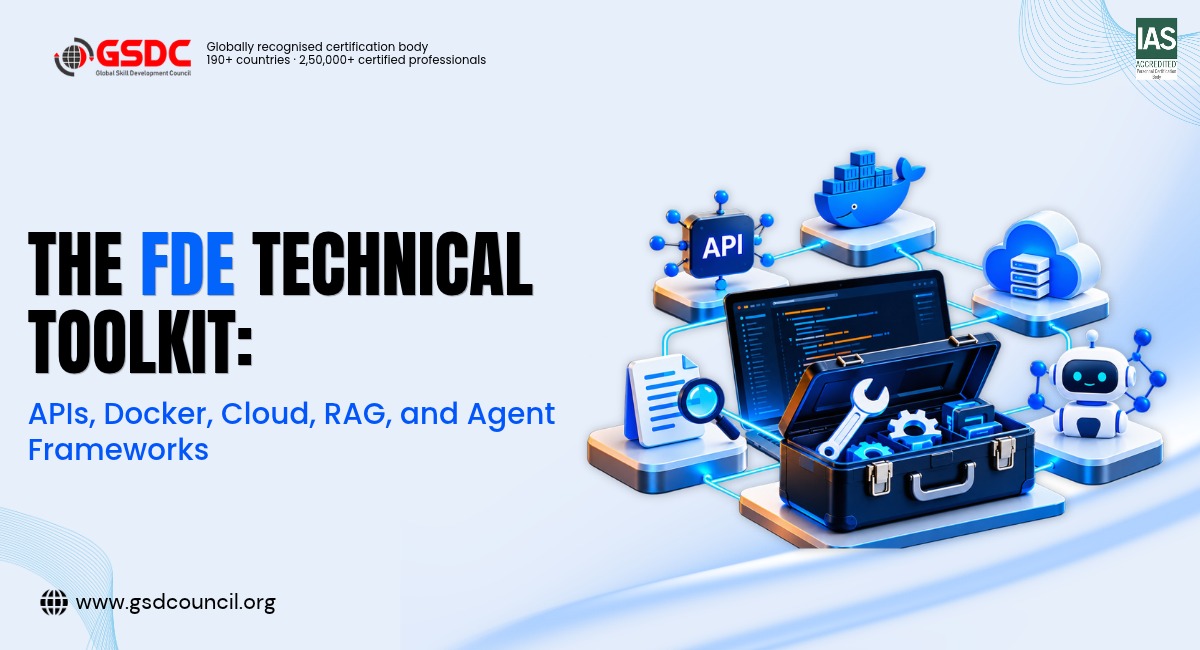
A Forward Deployed Engineer helps address these integration challenges by working with APIs, data sources, application logic, and existing infrastructure. The goal is to make the AI solution work within the organisation's actual technical environment.
Depending on the use case, this may involve connecting an AI model to an internal knowledge base, building data pipelines, integrating enterprise applications, or developing workflows that allow AI outputs to trigger specific actions.
How an FDE helps:
- Assesses existing systems and their integration requirements.
- Connects AI applications with relevant databases, APIs, and enterprise tools.
- Identifies compatibility issues and technical limitations.
- Helps ensure that data access, authentication, and permissions are handled appropriately.
This work helps organisations move beyond isolated AI experiments and introduce solutions that fit their existing business processes.
3. Improve Data Readiness and AI Reliability
AI systems depend on the quality and availability of the information they receive. Even a capable AI model can produce unreliable results when the underlying data is incomplete, inconsistent, or irrelevant.
This is particularly important when organisations use generative AI, retrieval-augmented generation (RAG), or AI agents to work with internal business information.
Consider a company that wants to use AI to answer employee questions about policies and procedures. If its documents are outdated, duplicated, or spread across disconnected systems, the AI application may retrieve the wrong information or provide an inaccurate answer.
A Forward Deployed Engineer investigates these issues and helps prepare the technical environment for reliable AI implementation. This may include reviewing data sources, improving retrieval methods, evaluating model responses, and testing how the system behaves when information is missing.
How an FDE helps:
- Assesses data quality, accessibility, and readiness for the intended use case.
- Identifies data gaps and retrieval problems that affect AI outputs.
- Tests AI responses against relevant business requirements.
- Introduces monitoring, error handling, and escalation processes for unreliable results.
An effective AI readiness framework should evaluate not only whether an organisation has access to AI tools, but also whether its data, systems, processes, and teams are prepared to use them.
4. Help Employees Adopt AI in Their Daily Workflows
Successful AI implementation depends on more than technical performance. Employees must also understand how the solution works, when to use it, and where human judgement remains necessary.
A technically sound application may see limited adoption if it introduces unnecessary steps, does not fit existing workflows, or fails to address employees' practical concerns.
For example, an organisation may introduce AI-generated reports to help its sales team. If employees must manually transfer information between multiple applications to use the tool, the new process may create more work rather than reduce it.
A Forward Deployed Engineer works with users and business stakeholders to understand these challenges. By gathering feedback and observing how people use the solution, the FDE can identify friction points and recommend improvements.
The role can also involve documenting workflows, supporting user testing, explaining technical limitations, and collaborating with internal teams responsible for training and change management.
How an FDE helps:
- Aligns AI workflows with the way employees already work.
- Collects user feedback and identifies adoption barriers.
- Improves the usability of AI applications through practical adjustments.
- Helps teams understand where AI can assist and when human review is required.
Addressing these factors can improve the business impact of AI adoption challenges by making solutions more useful, accessible, and relevant to employees.
5. Test, Deploy, and Continuously Improve AI Solutions
An AI project is not complete when a prototype works. The solution must perform reliably in real business conditions, handle unexpected situations, and deliver value after deployment.
AI applications can encounter issues that are difficult to identify during demonstrations. Responses may become inaccurate when data changes, integrations may fail, processing costs may increase, or system performance may decline as usage grows.
A Forward Deployed Engineer helps move solutions from prototype to production through testing, deployment, monitoring, and ongoing improvement.
For example, an AI-powered document processing system may perform well on a small set of sample documents but struggle with unusual formats or incomplete information. An FDE can test these scenarios, identify failure points, improve the workflow, and introduce appropriate human review mechanisms.
How an FDE helps:
- Tests solutions against realistic business scenarios and edge cases.
- Evaluates accuracy, response time, operational cost, and reliability.
- Supports deployment, troubleshooting, and integration monitoring.
- Uses performance data and user feedback to guide continuous improvement.
This approach helps organisations create an AI adoption roadmap that extends beyond initial deployment and accounts for long-term performance.
How to Implement AI in Business: A Practical Roadmap
Organisations looking for guidance on how to implement AI should follow a structured process instead of treating adoption as a one-time technology project.
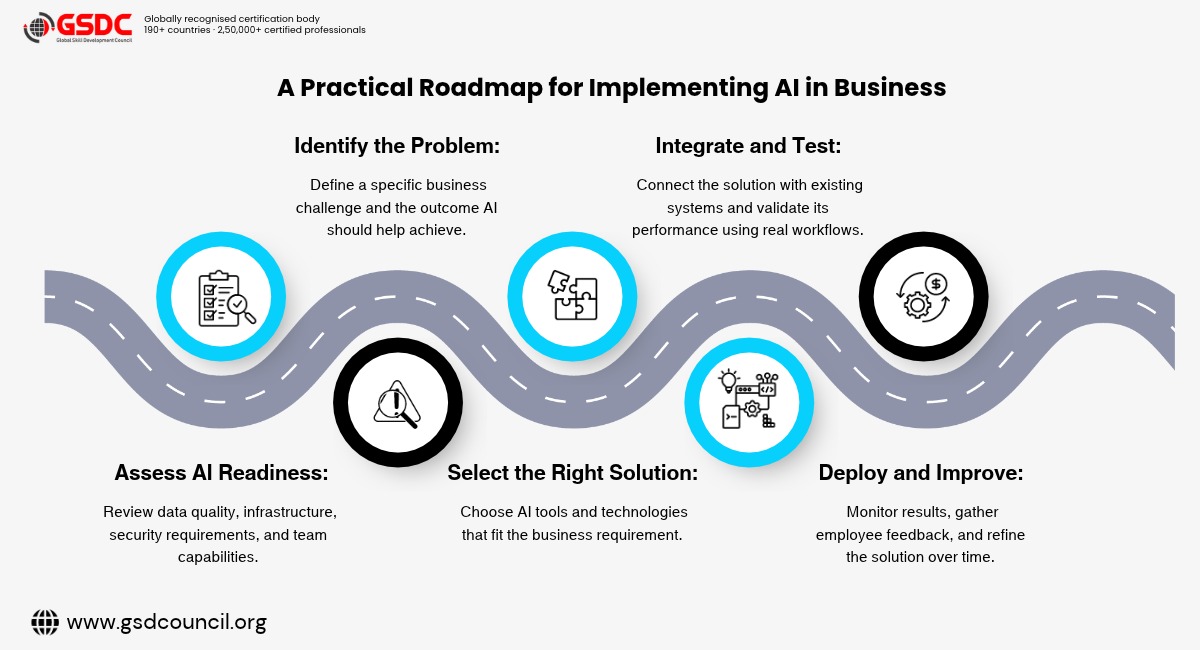
A practical AI implementation roadmap can include the following stages:
Step 1: Define the business objective. Identify the operational challenge and establish measurable outcomes.
Step 2: Assess organisational AI readiness. Review data quality, existing systems, infrastructure, employee capabilities, security requirements, and governance processes.
Step 3: Select the right AI approach. Determine whether the use case requires traditional machine learning, generative AI, RAG, AI agents, workflow automation, or a combination of technologies.
Step 4: Build a focused prototype. Develop a small solution that tests the core assumptions before committing to a larger rollout.
Step 5: Validate the solution. Evaluate its accuracy, reliability, security, cost, and usefulness against the defined requirements.
Step 6: Integrate and deploy. Connect the solution to relevant systems, establish monitoring, and prepare employees to use it.
Step 7: Measure and improve. Track business outcomes, gather feedback, and make changes as requirements and operating conditions evolve.
This process provides a foundation for an AI readiness framework that can be adapted to an organisation's size, industry, technical environment, and business priorities.
Forward Deployed Engineers can contribute across these stages by connecting business requirements with technical implementation and helping teams address problems as they emerge.
When Should a Business Consider FDE Support?
Not every AI project requires a dedicated Forward Deployed Engineer. However, the role can be particularly valuable when implementation involves complex integrations, customer-specific requirements, multiple stakeholder groups, or AI applications that must operate within existing enterprise systems.
An organisation may benefit from FDE support when:
- Its AI proof of concept works, but production deployment keeps getting delayed.
- AI applications cannot reliably access the data or systems they need.
- Different teams disagree about the problem the AI solution should address.
- Employees are not adopting the new application as expected.
- The organisation needs to test, deploy, and improve AI solutions in real business environments.
Businesses may also explore AI implementation services from specialist providers or internal engineering teams. The important consideration is whether the team has the technical expertise and business understanding needed to deliver a working solution.
An FDE can help connect these responsibilities and keep implementation focused on the problem the organisation needs to solve.
Build Your Forward Deployed Engineering Skills With GSDC
As organisations continue exploring AI, they need professionals who can connect business requirements, technical development, system integration, and real-world implementation.
Forward Deployed Engineering brings these responsibilities together. It offers a career path for professionals interested in applying technology to practical business challenges while working closely with customers and engineering teams.
The GSDC Certified Forward Deployed Engineer Certification is designed for professionals who want to understand the FDE role and develop relevant knowledge in customer-focused engineering and technical implementation.
What Can You Learn Through the GSDC FDE Certification?
- Understand the FDE Role: Learn how Forward Deployed Engineers translate business and customer requirements into technical solutions.
- Explore AI Implementation: Develop an understanding of how AI technologies can address real-world business challenges.
- Strengthen Technical Knowledge: Explore relevant engineering concepts, tools, APIs, and system integration.
- Bridge Business and Engineering: Understand how business objectives connect with technical requirements and existing systems.
- Explore the FDE Career Path: Learn about the responsibilities and skills associated with Forward Deployed Engineer opportunities.
The certification can be relevant to software developers, AI and machine learning professionals, solutions engineers, technical consultants, and other technology professionals interested in customer-focused implementation.

Final Thoughts
AI adoption challenges are rarely limited to choosing the right tool. Organisations must also understand their business problems, prepare their data, connect existing systems, support employees, and ensure that solutions perform reliably after deployment.
A Forward Deployed Engineer can help address these challenges by working across business and engineering teams, turning requirements into technical solutions, and improving those solutions through testing and real-world feedback.
For organisations planning their next AI initiative, the priority should be to define a clear objective, assess organisational readiness, and follow an implementation roadmap that measures actual business outcomes.
For professionals interested in this growing area of technology, the FDE role offers an opportunity to combine engineering knowledge, problem-solving, and customer collaboration. Building these skills can be a useful step toward exploring the Forward Deployed Engineering career path.

Related Certifications
Stay up-to-date with the latest news, trends, and resources in GSDC
If you like this read then make sure to check out our previous blogs: Cracking Onboarding Challenges: Fresher Success Unveiled
Not sure which certification to pursue? Our advisors will help you decide!