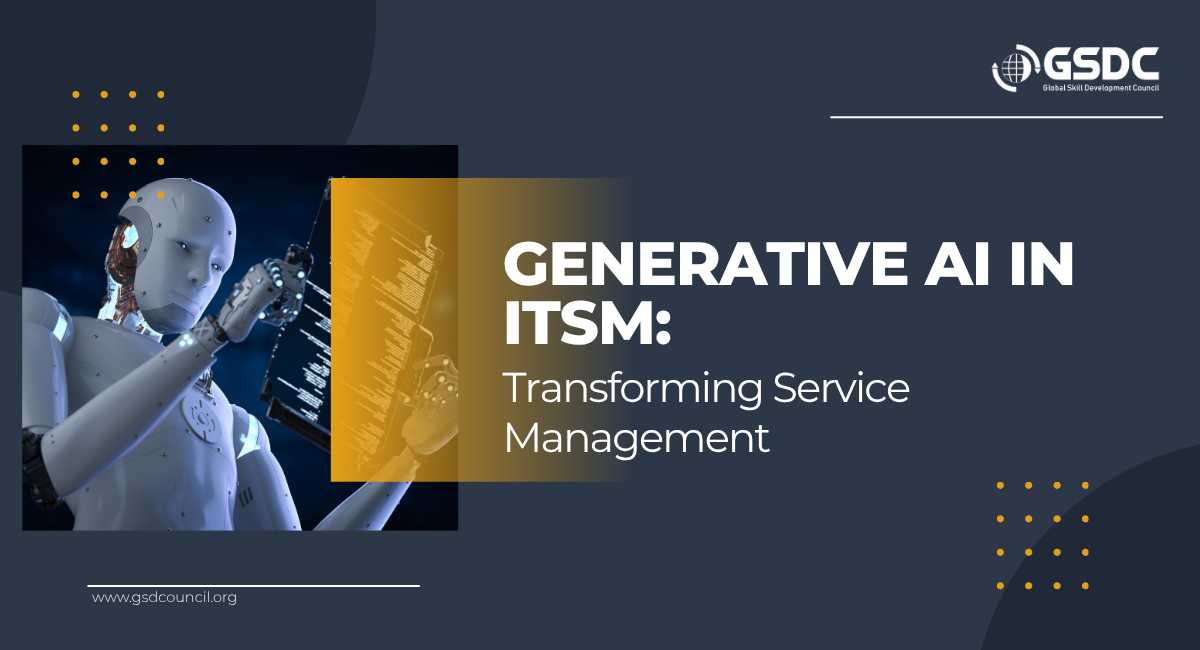
Generative AI in ITSM: Transforming Service Management for Professionals
Written by Matthew Hale
- What is Generative AI? And How its Transforming IT Service Management (ITSM)
- How Does Generative AI Work in ITSM?
- Generative AI Trends:
- Use Cases of Generative AI in ITSM
- The Role of GenAi in Modern ITSM
- Generative AI in ITSM Certification: Enhancing Professional Skills
- Challenges and Considerations
- Conclusion:
The launch of Agentforce ITSM by Salesforce highlights a growing trend: organizations are adopting AI-powered solutions to improve efficiency, reduce downtime, and enhance user experience. AI-driven ITSM is evolving from simple automation to predictive and adaptive service management, helping IT teams anticipate and resolve issues before they escalate.
Over 70% of organizations now use generative AI in at least one business function, with IT operations leading adoption. Platforms like Agentforce showcase how predictive incident management, automated ticket prioritization, and intelligent recommendations reduce downtime, improve SLA compliance, and allow IT teams to focus on higher-value strategic initiatives.
The future of generative AI in ITSM includes autonomous decision-making, proactive problem resolution, and deeper integration with enterprise workflows, enabling IT teams to work smarter, resolve incidents faster, and continuously optimize service delivery.
What is Generative AI? And How its Transforming IT Service Management (ITSM)
Generative AI is a type of artificial intelligence that creates new outputs from learned patterns in existing data. Unlike traditional AI, which analyzes, predicts, or classifies information, generative AI produces innovative solutions tailored to specific challenges.
In IT Service Management (ITSM), generative AI is valuable because it enables adaptive, real-time solutions for complex IT issues.
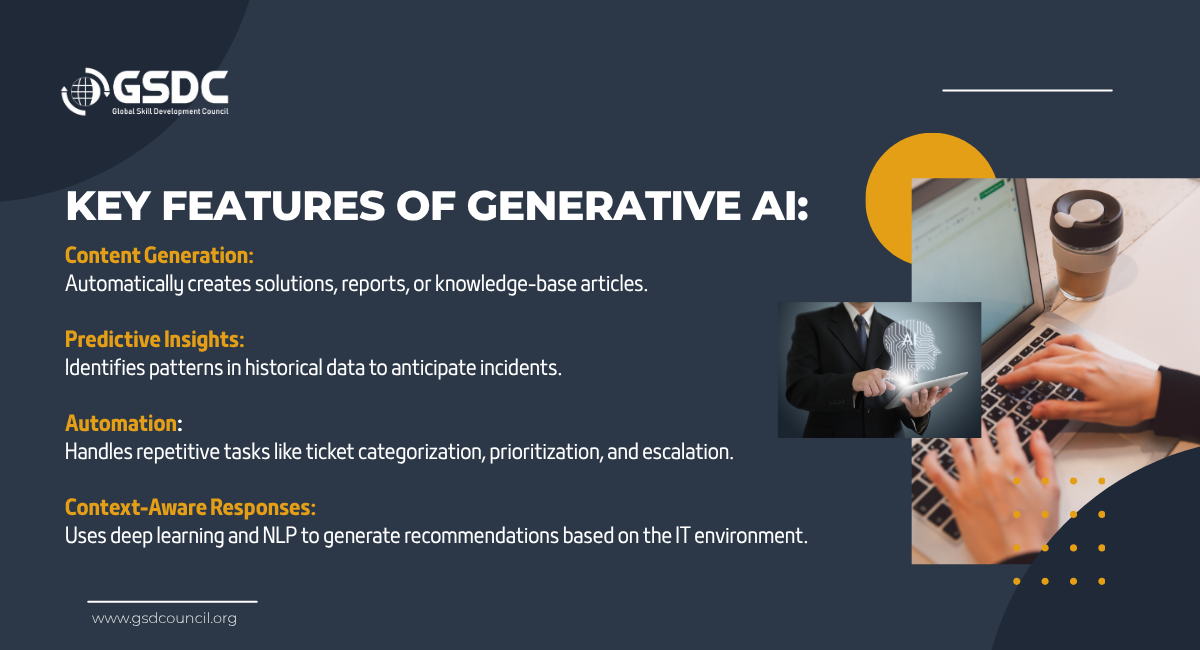
Why It Is Important in ITSM:
- Proactive Problem-Solving: Helps IT departments to change their reaction mode into a prediction one.
- Efficiency Gains: Lessens the manual work of the staff and makes them available for other more valuable tasks.
- Improved User Experience: Accelerated ticket handling and correct instructions lead to user contentment.
- Innovation: The use of such a tool allows IT staff to continuously improve their work practices.
How Does Generative AI Work in ITSM?
Understanding generative AI helps IT teams optimize workflows, leverage insights, and enable predictive, error‑free operations.
Core Mechanisms & Technology:
- Uses large language models (LLMs) and deep learning to learn patterns from incident logs, change records, and support tickets.
- Methods such as GANs (Generative Adversarial Networks) and VAEs (Variational Autoencoders) create human-like responses by approximating data distributions.
- Most of the time, it is coupled with retrieval-augmented generation (RAG) to get the most relevant context in order to produce precise answers.
Application in ITSM Workflows:
- Automated Ticket Classification & Prioritization: Examines past incidents and figures out the level of urgency so that tickets can be automatically routed.
- Predictive Incident Management: Prevents problems going beyond control; uses past data to create scenarios of potential risks.
- Knowledge-Base Generation & Recommendation: Creating or updating knowledge bases and suggesting the most relevant solutions for current tickets.
Through the comprehension of such devices, IT departments are capable of converting the customary reactive service management into adaptive, proactive, and intelligent workflows which lead to quicker resolutions, fewer manual tasks, and a more user-friendly experience.
Generative AI Trends:
Generative AI is transforming ITSM by enabling proactive operations, intelligent automation, and seamless integration, helping organizations improve decisions, service delivery, and workflow efficiency.
Key Trends:
- Integration with Legacy ITSM Platforms: AI incorporated in present tools helps to automate the process without changing the whole structure.
- AI-Driven Insights: It reflects on the past data and suggests the most suitable and fastest ways of taking decisions based on the available data.
- Enhanced End-User Experience: NLP-enabled chatbots and virtual assistants get issues fixed quicker, thereby raising user happiness and cutting down the time of manual support.
Generative AI trends show that ITSM is evolving toward proactive, intelligent automation, and integration with enterprise workflows. These advancements also demonstrate how generative AI is changing creative work by enabling IT teams to generate solutions and optimize processes with minimal manual input.
Use Cases of Generative AI in ITSM
Understanding what are the use cases of generative AI is essential for strategic implementation.
Key Applications with Real Examples:
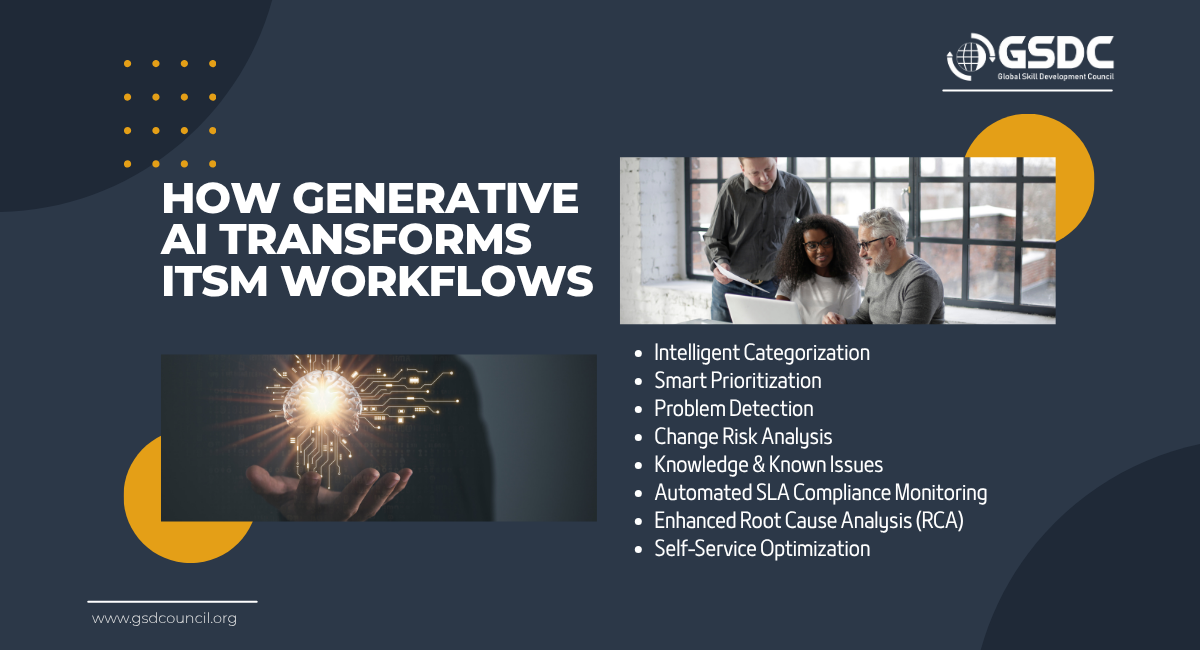
Understanding what are the use cases of generative AI is essential for IT professionals looking to implement it strategically. Generative AI is transforming IT Service Management (ITSM) by enabling intelligent, proactive, and automated operations.
- Intelligent Categorization: AI clusters incidents based on historical patterns, predicts probable root causes, and ensures precise, context-driven ticket classification.
Example: EasyVista’s EV Pulse AI automatically analyzes incident logs and suggests resolutions, reducing manual effort and speeding up ticket handling.
- Smart Prioritization: Generative AI assigns urgency to tickets using business context, SLAs, and sentiment analysis. This ensures critical issues are addressed first and resources are optimally allocated.
Example: Salesforce Agentforce ITSM reduced critical ticket resolution time by 35% by automatically prioritizing incidents based on business impact.
- Problem Detection: AI proactively identifies recurring issues before they escalate, helping organizations shift from reactive to preventive ITSM.
Example: EasyVista reports that organizations using generative AI can detect recurring patterns early, preventing system downtime and disruptions.
- Change Risk Analysis: AI assesses potential risks of proposed IT changes by analyzing historical incidents and change data. This reduces operational risk and ensures smoother deployment of updates.
Example: Large banks implement generative AI to predict software update impacts on critical services, avoiding costly downtime.
- Knowledge & Known Issues: Generative AI can recommend relevant knowledge-base articles for faster ticket resolution and auto-generate content to expand the knowledge base continuously.
Example: IT teams using AI-assisted knowledge management report faster self-service resolution, reducing dependency on human agents.
- Automated SLA Compliance Monitoring: AI can continuously monitor service level agreements (SLAs), identify potential breaches, and suggest proactive measures to ensure compliance.
- Enhanced Root Cause Analysis (RCA): Generative AI can correlate incidents across multiple systems, identify underlying issues, and suggest long-term fixes rather than temporary patches.
- Self-Service Optimization: AI-powered chatbots and virtual assistants can handle routine queries autonomously, freeing human agents for complex issues. These systems learn from ongoing interactions, improving over time.
Benefits of Implementing Generative AI in ITSM:
- Quick resolution of incidents and lower mean time to repair (MTTR)
- Optimization of operations and reduction in manual tasks
- Improved end-user engagement and delight
- Prevention of issues in advance and reduction of time offs
- Smarter decision-making through AI-driven insights
Professionals with a Certified Generative AI in ITSM credential can streamline IT workflows, boost operational efficiency, and enhance service quality. They also support IT teams in integrating AI tools with legacy systems for a smooth transition to AI-powered service management.
🚀 Download Your Generative AI in ITSM Toolkit!Download the checklist for the following benefits:
🛠️ Quick-start templates, workflow diagrams, and AI integration checklists.
📈 Boost efficiency, reduce downtime, and elevate your IT service management today!
The Role of GenAi in Modern ITSM
Generative AI shifts ITSM from reactive workflows to predictive, data-driven operations.
Key Benefits:
- Decrease Ticket Resolution Times: Using automation, tickets get categorized, prioritized, and solution suggestions are generated.
- Lower Operational Costs: The system automates the performance of the same tasks that are in the workflow and also optimizes it. More than 70% of the organizations consider that AI will be their agent in the simplification of operations.
- Make User Experiences Better: Interaction with customers through chatbots which are empowered by NLP and self-service platforms that are AI-driven result in the upholding of support which is both accurate and satisfying.
Strategic Impact:
- Anticipating solutions to problems by making use of past data.
- Matured decision-making for operations and strategy-driven initiatives.
- Innovation in IT workflows, enabling smarter process design and continuous improvement
Generative AI in ITSM Certification: Enhancing Professional Skills
Professionals seeking to validate their expertise in generative AI in ITSM can pursue the Certified Generative AI in ITSM credential offered by GSDC. The program covers AI-driven ITSM workflows, including predictive incident management, automated ticket prioritization, and knowledge-base optimization, helping IT teams implement solutions efficiently and make data-driven decisions.
Structured programs from GSDC provide practical resources, best practices, and access to a professional network. These tools help IT teams stay updated on emerging AI trends, optimize workflows, and make a strategic impact in enterprise IT operations.

Challenges and Considerations
While it offers a lot of benefits, the use of generative AI is still challenged in various aspects:
- Data Privacy & Security: The most sensitive IT and user data have to be in compliance with the regulations and protected.
- Integration with Legacy Systems: To effectively integrate older ITSM tools with AI workflows, one needs to have a detailed plan and management process for changes.
- Skill Development & Change Management: The staff needs to understand the principle of generative AI and be capable of managing AI-driven workflows.
- Investment Considerations: There are significant upfront costs, but the investment is worthwhile because of the quality of service improvements, predictive problem-solving, and fewer disturbances.
An organization that deals with these issues properly is on its way to realizing a future of proactive, efficient, and user-centric operations.
Conclusion:
Generative AI is reshaping IT Service Management, enabling IT teams to move from reactive workflows to proactive, adaptive, and predictive operations. By leveraging AI-driven insights, organizations can reduce downtime, optimize operations, and enhance end-user satisfaction. The future includes virtual support agents, predictive problem-solving, and continuous process improvement, transforming IT operations into intelligent, agile, and user-focused systems.
The future of generative AI in ITSM is set to include virtual support agents, predictive problem-solving, and continuous process improvement, transforming IT operations into more intelligent, agile, and user-focused systems. Organizations that embrace these capabilities can unlock higher operational efficiency, stronger decision-making, and a culture of innovation in IT service management.

Related Certifications
Stay up-to-date with the latest news, trends, and resources in GSDC
If you like this read then make sure to check out our previous blogs: Cracking Onboarding Challenges: Fresher Success Unveiled
Not sure which certification to pursue? Our advisors will help you decide!