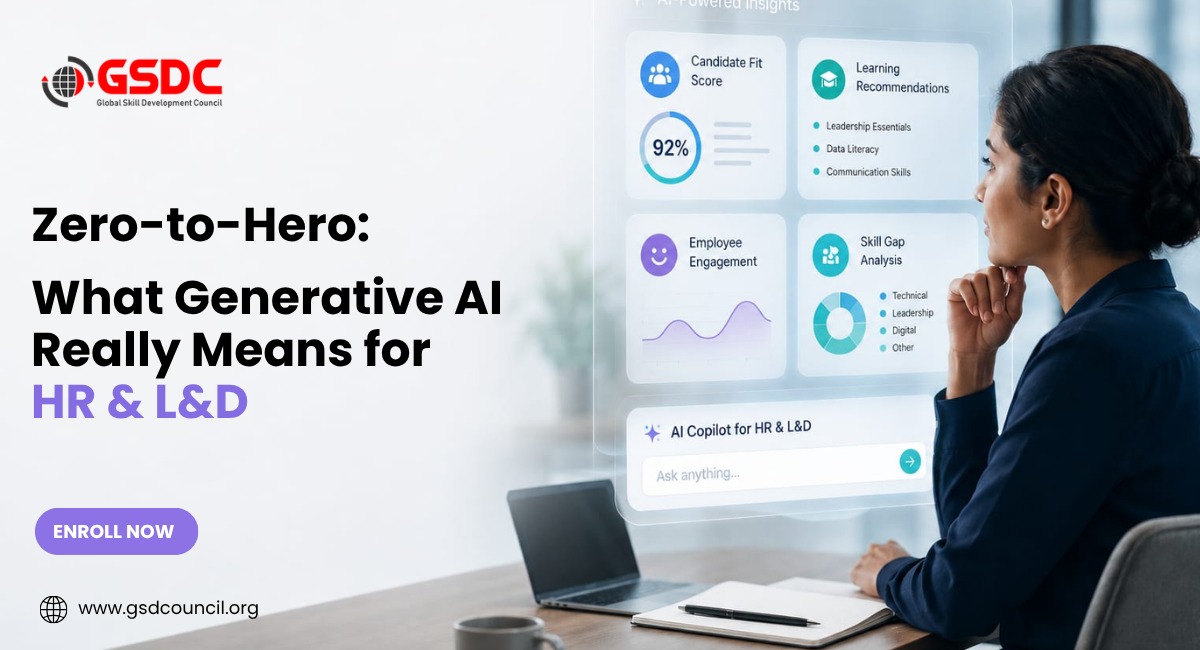
Zero-to-Hero: What Generative AI Really Means for HR & L&D
Written by Emily Hilton
- What Is Generative AI in HR?
- Traditional AI vs Generative AI vs LLMs
- Why Prompting Matters More Than the Tool
- Understanding the Prompt Framework for HR (RTCF)
- Few-Shot Prompting for HR
- Role Prompting for L&D
- Chain of Thought Prompting HR Teams Can Use
- Prompt Chaining Course Design for L&D
- RAG for L&D Content
- AI Agents for HR Onboarding
- Measuring AI ROI in L&D
- Responsible AI in HR / EU AI Act
- The Future of HR and L&D Is Human + AI
- Conclusion
If you spent six hours last week writing a job description, onboarding guide, or training announcement, another HR team may have completed the same work in under 15 minutes using Generative AI.
That does not mean AI is replacing HR professionals. It means HR and Learning & Development teams are entering a new era where repetitive work is automated, content creation becomes faster, and strategic human skills become more valuable.
In 2026, Generative AI is no longer a “future trend” for HR teams. It is becoming a baseline workplace capability. Organizations are already using AI to accelerate recruitment, personalize learning experiences, automate onboarding support, and improve internal communication. According to the reports, organizations are increasingly adopting AI across recruitment, onboarding, employee engagement, and workforce management functions.
The professionals who understand how to work with AI, not against it, will lead the next generation of HR transformation. This beginner-friendly guide explains what Generative AI actually means for HR and L&D teams, where it fits into daily workflows, how prompting works, and how organizations can use it responsibly.
What You Will Learn?
- Understand the difference between traditional AI, Generative AI, and Large Language Models (LLMs), explained in simple, HR-friendly language.
- Learn how prompting techniques like the RTCF prompt framework for HR, few-shot prompting for HR, role prompting for L&D, and chain of thought prompting HR improve AI-generated outputs.
- Discover how Generative AI is transforming recruitment, onboarding, employee learning, and training content development.
- Explore practical applications such as RAG for L&D content, AI agents for HR onboarding, and AI-assisted workplace learning experiences.
- Learn how organizations can measure the business impact and ROI of Generative AI initiatives in HR and L&D.
What Is Generative AI in HR?
The easiest way to understand generative AI in HR is this:
Traditional software follows fixed rules. Generative AI creates new content based on instructions.
For example:
- Traditional HR software can track applications.
- Generative AI can write interview questions, onboarding emails, learning summaries, or policy drafts.
This is why HR and L&D teams are rapidly adopting AI. Instead of spending hours creating repetitive content manually, professionals can focus more on strategy, employee experience, leadership development, and organizational growth.
Generative AI tools are powered by Large Language Models (LLMs). These models are trained on massive amounts of data and can understand patterns in language, context, and intent.
That means AI can:
- Draft learning content
- Summarize employee feedback
- Personalize training paths
- Generate HR communication
- Create onboarding workflows
- Assist recruiters with candidate outreach
However, AI only works well when humans provide clear instructions.
That is where prompting becomes essential.
Traditional AI vs Generative AI vs LLMs
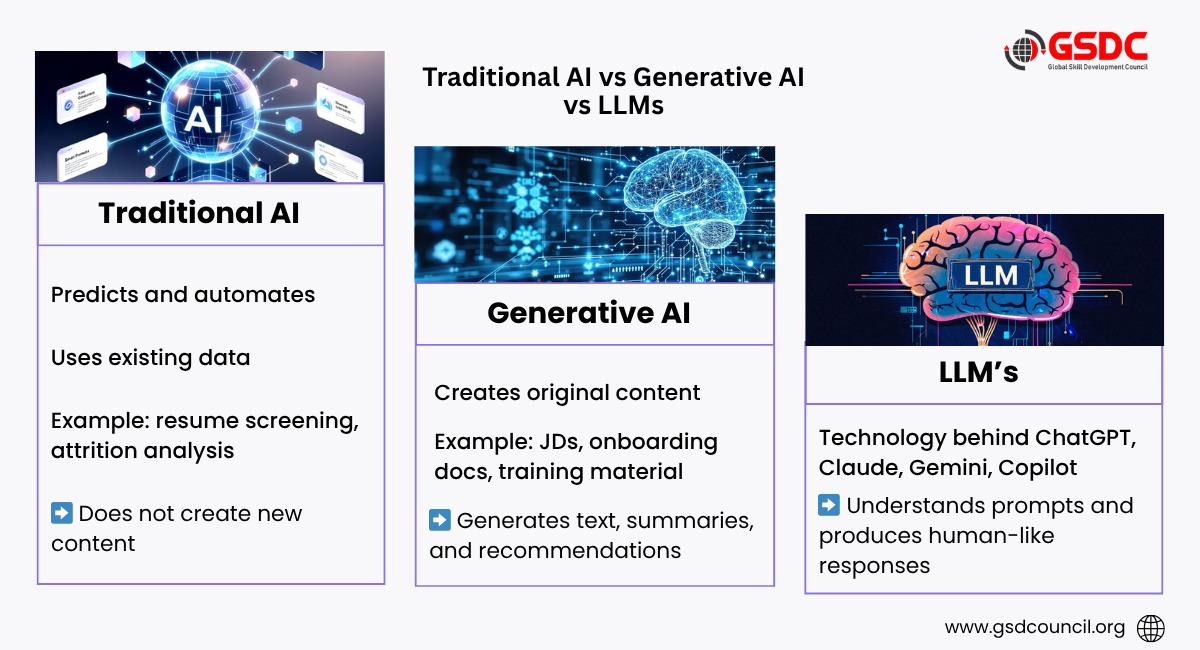
Many HR professionals hear terms like “AI,” “Generative AI,” and “LLMs” used interchangeably, but they are not the same. Understanding the difference is important because each type of AI serves a different purpose inside HR and Learning & Development workflows.
Traditional AI
Traditional AI focuses mainly on prediction, automation, and pattern recognition. These systems analyze historical data to identify trends or automate repetitive decision-making processes.
Common HR examples include:
- resume screening systems
- attendance prediction tools
- employee attrition analysis
- workforce analytics dashboards
- chatbots with fixed responses
Traditional AI does not generate original content. Instead, it classifies information, predicts outcomes, or automates predefined workflows based on existing data patterns.
Generative AI
Generative AI works differently because it creates entirely new outputs instead of only analyzing data.
Examples include:
- writing job descriptions
- creating onboarding documents
- drafting training modules
- generating interview questions
- producing internal communication
Instead of simply processing information, Generative AI can create original text, summaries, recommendations, presentations, and learning content in seconds.
Large Language Models (LLMs)
LLMs are the technology powering most Generative AI tools like ChatGPT, Claude, Gemini, and Copilot. They understand human language and respond to prompts written in natural conversation style.
For HR professionals, LLMs are especially powerful because they transform prompting into a practical workplace skill. With clear instructions, HR teams can use LLMs to accelerate recruitment, personalize learning experiences, improve onboarding, and support employee communication at scale.
Why Prompting Matters More Than the Tool
One of the biggest misconceptions about Generative AI is that simply using a powerful tool automatically guarantees high-quality results. In reality, the effectiveness of AI depends far more on the quality of the prompt than on the platform itself. Whether an HR team uses ChatGPT, Claude, Gemini, or Copilot, the output will only be as strong as the instructions provided.
A vague request like:
“Write onboarding content.”
usually produces generic and unfocused responses because the AI lacks context. It does not know the company size, industry, employee role, tone, learning objectives, or formatting expectations.
However, a detailed prompt such as:
“Create a beginner-friendly onboarding guide for remote sales employees at a SaaS company. Use a supportive tone, include company culture values, and keep it under 700 words.”
gives the AI clear direction and generates far more useful output.
This is why modern HR teams are learning structured methods like clear AI instructions HR, role prompting for L&D, few-shot prompting for HR, and chain of thought prompting HR. Strong prompting transforms AI from a generic chatbot into a strategic productivity partner.
Understanding the Prompt Framework for HR (RTCF)
One of the easiest beginner approaches is the prompt framework for HR (RTCF).
RTCF stands for:
- Role
- Task
- Context
- Format
This framework helps HR professionals create clear AI instructions that HR teams can use consistently.
Example Without RTCF
“Write a training email.”
Example Using RTCF
“Act as an HR onboarding specialist. Write a welcoming onboarding email for newly hired remote employees joining a technology company. Keep the tone professional but friendly. Format the response as a short email with bullet points.”
The second instruction provides:
- A role
- A task
- Context
- Expected format
The result becomes significantly more useful.
Organizations are now building internal HR prompt templates library systems so teams can reuse high-performing prompts instead of starting from scratch every time.
Few-Shot Prompting for HR
Another powerful technique is few-shot prompting for HR.
This means giving AI a few examples before asking it to generate new content.
For example:
- Show two examples of strong performance feedback
- Ask AI to create a third one in the same style
This helps AI understand:
- Tone
- Structure
- Communication style
- Organizational standards
HR teams use few-shot prompting for:
- Interview evaluation templates
- Employee communication
- Learning content
- Policy formatting
- Performance review language
This improves consistency across departments.
Role Prompting for L&D
Role prompting for L&D involves assigning AI a professional identity before requesting output.
Examples:
- “Act as a leadership coach.”
- “Act as a compliance training expert.”
- “Act as an instructional designer.”
This technique improves the relevance of generated content because the AI responds from a more specialized perspective.
L&D teams often use role prompting to:
- Design workshops
- Create assessments
- Build microlearning modules
- Develop coaching exercises
- Generate certification preparation material
It also helps create more learner-focused experiences.
Chain of Thought Prompting HR Teams Can Use
One challenge with AI is that simple prompts may produce shallow answers.
Chain of thought prompting HR methods encourage AI to explain reasoning step-by-step before producing final outputs.
For example:
“Analyze the onboarding process step-by-step before recommending improvements.”
This technique improves:
- Problem-solving
- Workflow analysis
- Training recommendations
- Process optimization
HR professionals use this method for:
- Policy evaluation
- Employee journey mapping
- Learning gap analysis
- Workforce planning
It often produces more thoughtful and accurate responses.
Prompt Chaining Course Design for L&D
As AI maturity grows, organizations are moving beyond single prompts into prompt chaining course design strategies.
Prompt chaining means linking multiple prompts together in sequence.
For example:
- Generate a course outline
- Expand each module
- Create quizzes
- Develop case studies
- Generate learner summaries
Instead of asking AI to create an entire course at once, the process becomes structured and modular.
This improves:
- Accuracy
- Content quality
- Learning flow
- Instructional consistency
L&D teams increasingly use prompt chaining to accelerate course development while maintaining quality standards.
RAG for L&D Content
One major concern with AI is hallucination when AI generates incorrect or fabricated information.
That is where RAG for L&D content becomes important.
RAG stands for Retrieval-Augmented Generation.
Instead of relying only on general training data, AI retrieves information from approved company documents before generating responses.
For example:
- Internal HR policies
- Compliance manuals
- Training frameworks
- Employee handbooks
- Organizational SOPs
This helps organizations:
- Improve accuracy
- Protect consistency
- Reduce misinformation
- Deliver enterprise-specific learning content
RAG systems are becoming essential for large organizations using AI in regulated environments.
AI Agents for HR Onboarding
The next evolution beyond chatbots is AI agents for HR onboarding.
Unlike basic AI assistants, AI agents can perform multi-step actions autonomously.
For example, an onboarding AI agent may:
- Send welcome emails
- Schedule orientation sessions
- Assign learning modules
- Answer employee questions
- Track completion progress
- Escalate unresolved issues
This reduces administrative burden while improving employee experience.
However, organizations still need human oversight to ensure empathy, fairness, and compliance remain central to HR processes.
AI should support HR professionals, not replace human judgment.
Measuring AI ROI in L&D
Many organizations experiment with AI but struggle to prove business value.
That is why measuring AI ROI in L&D has become increasingly important.
Companies now evaluate:
- Time saved
- Reduction in manual work
- Faster course creation
- Employee engagement improvements
- Learning completion rates
- Knowledge retention
- Recruitment efficiency
For example, if AI reduces course development time from three weeks to three days, the productivity gain becomes measurable.
ROI should not only focus on cost reduction.
It should also measure:
- Employee experience
- Learning personalization
- Faster onboarding
- Better communication
- Strategic HR impact
Successful AI adoption combines operational efficiency with human-centered outcomes.
Responsible AI in HR / EU AI Act
As AI adoption grows, organizations must also focus on responsible AI in HR / EU AI Act compliance and ethical governance.
AI systems can unintentionally introduce:
- Bias
- Privacy concerns
- Inaccurate recommendations
- Transparency issues
This is especially critical in HR because AI decisions can affect hiring, promotions, performance reviews, and employee development.
The European Union’s AI Act is pushing organizations toward stronger governance standards around:
- Transparency
- Risk management
- Human oversight
- Data protection
- Ethical AI deployment
Even organizations outside Europe are beginning to adopt similar standards.
Responsible AI practices include:
- Human review of AI outputs
- Bias monitoring
- Data security controls
- Transparent AI usage policies
- Ethical governance frameworks
The goal is not just efficient AI adoption, but trustworthy AI adoption.
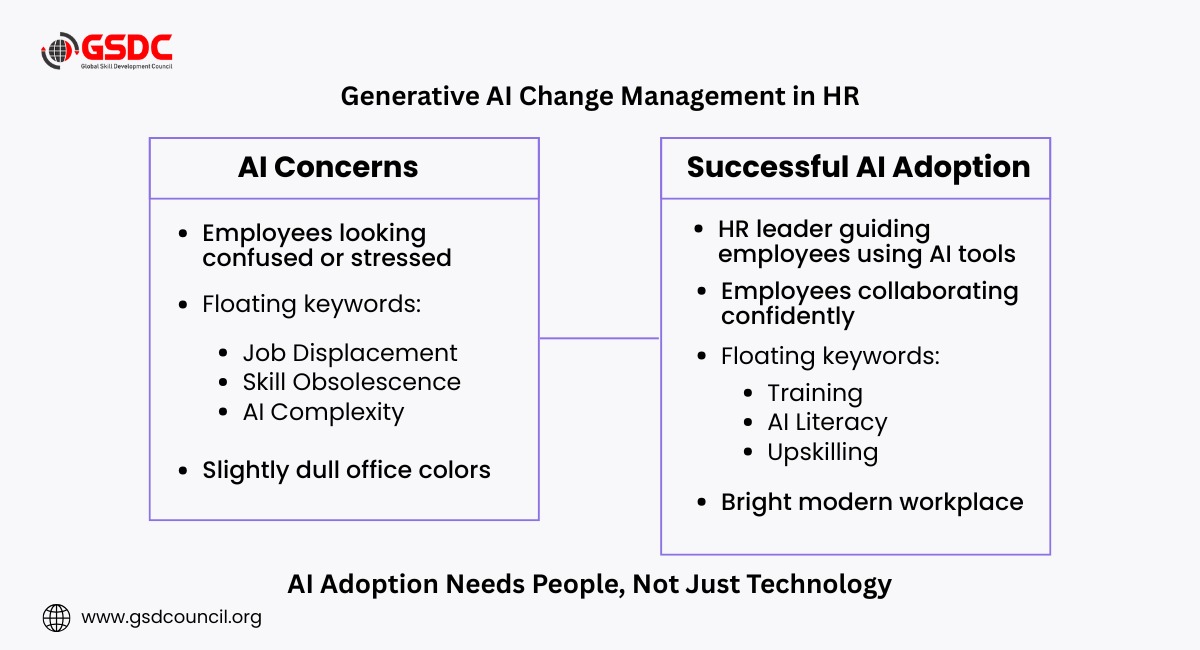
The Future of HR and L&D Is Human + AI
Generative AI is not eliminating the need for HR and L&D professionals.
Instead, it is changing the nature of their work.
Routine administrative tasks are becoming automated, while strategic responsibilities become more valuable.
The future HR professional will need:
- AI literacy
- Prompting skills
- Data interpretation abilities
- Ethical governance understanding
- Human-centered leadership
Organizations that invest in AI education today will be better positioned for the future workforce.
Building Practical GenAI Skills for HR & L&D
Many professionals are now exploring programs such as the Global Skill Development Council GSDC GenAI L&D HR certification to build practical AI capabilities for workplace transformation.
The Certification In Generative AI In HR & L&D is designed for HR professionals, L&D leaders, trainers, instructional designers, and people managers who want to understand how Generative AI can be applied in real workplace scenarios. Instead of focusing only on theory, the program helps learners explore practical areas such as prompt engineering, AI-assisted learning design, HR automation workflows, responsible AI practices, and enterprise AI adoption strategies.
The goal is not to become an AI engineer.
The goal is to become an HR or L&D professional who understands how to collaborate effectively with AI tools while maintaining empathy, ethics, creativity, and strategic thinking.
Conclusion
Generative AI is rapidly reshaping how HR and L&D teams operate. From recruitment and onboarding to learning design and employee communication, AI is helping organizations work faster, personalize experiences, and improve operational efficiency.
However, successful adoption requires more than simply using AI tools. Organizations must understand prompting methods, governance frameworks, responsible AI practices, and change management strategies.
The companies that succeed will not be the ones replacing humans with AI. They will be the ones combining human expertise with AI capabilities to create smarter, faster, and more employee-centered workplaces.
For HR and L&D professionals, this is not just a technology shift.
It is a career transformation opportunity.

Related Certifications
Frequently Asked Questions
Stay up-to-date with the latest news, trends, and resources in GSDC
If you like this read then make sure to check out our previous blogs: Cracking Onboarding Challenges: Fresher Success Unveiled
Not sure which certification to pursue? Our advisors will help you decide!