What Is Operational Efficiency? How ISO 9001 Audits Improve It
Written by Matthew Hale
- First, Let's Talk About What Operational Efficiency Actually Means
- What Is ISO 9001, and Why Does the Audit Matter?
- Understanding the ISO 9001 Audit Process
- The ISO 9001 Audit Checklist: Your Operational Roadmap
- How ISO 9001 Internal Audits Drive Operational Efficiency - With Real Data
- How to Improve Operational Efficiency Using ISO 9001 Auditing: A Practical Framework
- The Customer Satisfaction Connection
- Benefits of ISO 9001 Certification: Internal vs. External Business Impact
- A Note on Common Mistakes That Undermine Audit Value
- Getting Started: Building an Audit Program That Works
- Where Do You Go From Here?
- Final Thought
There's a question every operations manager has quietly wrestled with at some point: Why do we keep fixing the same problems?
Defective shipments. Customer complaints that loop back every quarter. Processes that work perfectly on paper but fall apart on the floor. These aren't random events. They're symptoms of a system that hasn't been properly examined.
That's where ISO 9001 auditing comes in - not as a bureaucratic checkbox, but as a structured lens through which organizations finally see what's actually happening versus what they think is happening.
This blog breaks down exactly how the ISO 9001 audit process drives real operational efficiency, what the numbers say, and how your organization can use it to stop repeating history.
First, Let's Talk About What Operational Efficiency Actually Means
Most people use the phrase "operational efficiency" the way they use "synergy" or "best practices" confidently, frequently, and without stopping to define it. So before we connect it to ISO 9001, let's actually nail down what it means.
What is operational efficiency? Simply put, it's your organization's ability to deliver what it promises: products, services, outcomes, without burning through more time, money, people, or materials than necessary. Not just once, but repeatedly. The goal isn't perfection on a good day. It's consistent across all days.
What is operational efficiency in management? Here's where it gets interesting. In a management context, efficiency isn't just about individual tasks running smoothly. It's about whether your leadership structure, your decision-making, your resource allocation, and your quality controls are all pulling in the same direction. When they are, waste shrinks. Rework drops. Value reaches the customer faster. When they aren't, even if every department thinks it's doing its job, the gaps between functions swallow time and money quietly.
The difference often shows up in examples rather than definitions. Consider these:
- A hospital cut patient discharge time from 4 hours to 90 minutes, not by hiring more staff, but by standardizing the documentation workflow that was causing the bottleneck
- A manufacturing plant reduced scrap rates by 22% after finally tracing a recurring defect back to one fixable step in the assembly line
- A logistics company lifted on-time delivery from 84% to 97% by rethinking routing protocols that an audit had flagged as inconsistent
Three different industries. Three very different problems. But in each case, the turning point was the same - someone looked at the process carefully and honestly, and saw what was actually there.
That's what ISO 9001 auditing is designed to make happen.
What Is ISO 9001, and Why Does the Audit Matter?
ISO 9001 is the world's most widely recognized quality management standard, developed by the International Organization for Standardization. The current version ISO 9001:2015 is built on seven quality management principles, including customer focus, leadership, process approach, and continual improvement.
As of 2023, over 1.1 million organizations in more than 170 countries hold ISO 9001 certification (ISO Survey, 2023). In the United States, the standard is a cornerstone across manufacturing, healthcare, defense contracting, and professional services. U.S. federal contractors frequently list it as a preferred supplier qualification, U.S. healthcare providers use it to standardize patient care processes, and American aerospace suppliers often require it of their entire vendor chain.
But certification isn't a one-time event. It requires ongoing ISO 9001 internal audits and third-party surveillance audits - led by qualified professionals, often holding credentials like the Certified ISO 9001:2015 Lead Auditor - to verify that the quality management system (QMS) remains effective and continually improves.
The audit is the engine that keeps the standard honest.
Understanding the ISO 9001 Audit Process
Most people, when they hear "audit," picture someone arriving with a clipboard, working through a checklist, and handing over a report full of problems. And while that's not entirely wrong, it misses what a well-run ISO 9001 audit process is actually trying to do.
It's not about catching people out. It's about seeing clearly - and then fixing what the view reveals.
The process runs through five stages, and each one matters:
Stage 1: Audit Planning
Before anything else, the scope gets locked down. Which processes are under review? Which clauses of ISO 9001:2015 apply? Who owns what? An ISO 9001 audit checklist gets built here - not as a formality, but as the tool that keeps the audit focused and consistent from start to finish.
Stage 2: Document Review
This happens before anyone sets foot on the floor. Auditors go through procedures, work instructions, past audit records, and performance data. By the time the on-site phase begins, a good auditor already has a working theory about where the gaps might be.
Stage 3: On-Site Audit
Opening meeting. Evidence collection. Closing meeting. Staff get interviewed. Operations get watched. What's written in the procedures gets held up against what's actually happening day to day - and the distance between those two things is often where the most important findings live. Those gaps are nonconformities, and finding them is the point.
Stage 4: Audit Report and Findings
Everything gets documented and sorted - major nonconformities, minor nonconformities, and areas that could simply be stronger. A formal report goes out. This isn't the finish line. It's the starting gun for what comes next.
Stage 5: Corrective Action and Follow-Up
Root causes get identified. Corrective actions get documented. And then - the step most organizations underinvest in - follow-up audits confirm whether the fix actually held, or whether the same issue is quietly building again underneath.
Run this properly, repeat it consistently, and the QMS stops being a shelf of documents nobody opens and starts doing what it was always meant to do. For professionals who want to be the ones running this process - not just participating in it - the Global Skill Development Council (GSDC) offers the training and certification to build that capability the right way.
Here's the rewrite with bullets kept, but humanised throughout:
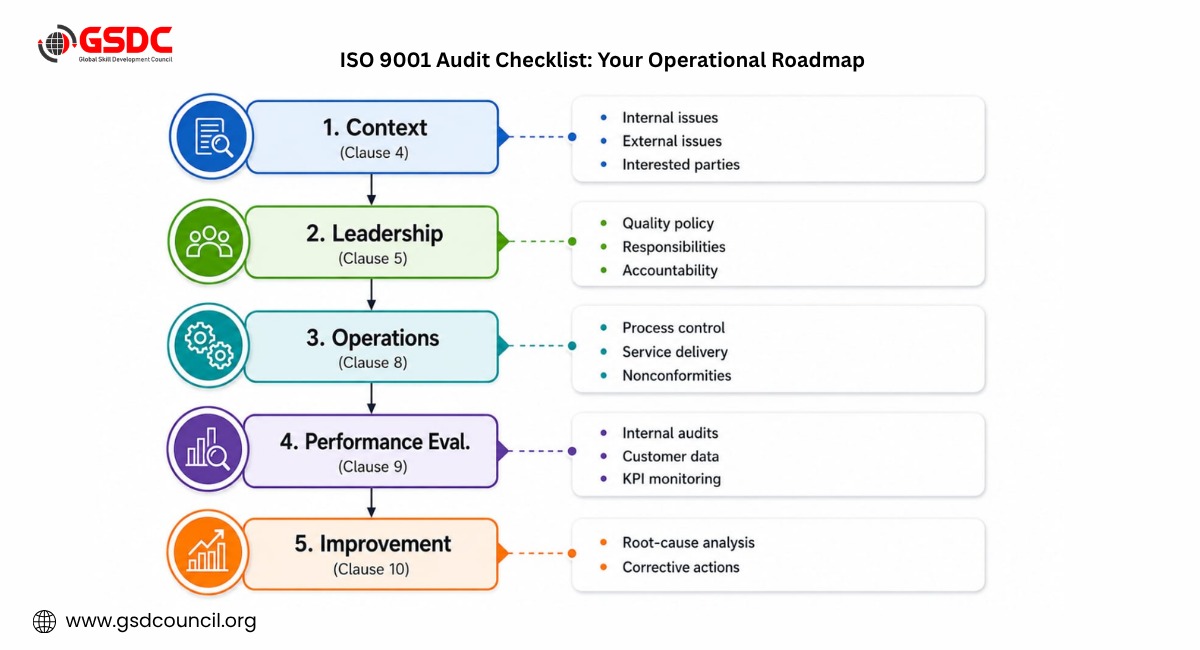
The ISO 9001 Audit Checklist: Your Operational Roadmap
Here's something worth thinking about. Two organizations, same industry, similar size. One keeps improving. The other keeps having the same conversations about the same problems, year after year. What separates them?
Usually, it's not an effort. Its structure.
An ISO 9001 audit checklist - specifically an ISO 9001:2015 audit checklist - is what gives an audit its backbone. Without one, audits become inconsistent and subjective. With one, auditors and process owners are working from the same map, asking the same questions, measuring against the same standard every single time.
Here's what that map actually covers:
Context of the Organization (Clause 4)
- Have internal and external issues been identified?
- Are the interested parties and their requirements documented?
Leadership (Clause 5)
- Is the quality policy something people actually know and follow - or just a framed document on the wall?
- Are roles, responsibilities, and authorities clearly assigned, or does accountability blur at the edges?
Operations (Clause 8)
- Are production and service processes running under proper control?
- When nonconforming output appears, is there a consistent way of handling it?
Performance Evaluation (Clause 9)
- Are internal audits happening on schedule, or getting quietly pushed back each quarter?
- Is customer satisfaction data being collected and genuinely acted on?
Improvement (Clause 10)
- Are nonconformities being traced to their actual root cause, or just patched over?
- Is there real, visible evidence that things are getting better over time?
That last section matters more than most people realise. A good checklist doesn't just keep an audit on track - it forces the questions that expose inefficiencies everyone has quietly learned to work around. The ones so embedded in daily routine that nobody registers them as problems anymore.
Until the audit does.
How ISO 9001 Internal Audits Drive Operational Efficiency - With Real Data
Numbers have a way of ending arguments that opinion can't.
A 2022 study published in the International Journal of Quality & Reliability Management tracked organizations with mature ISO 9001 internal audit programs. What they found wasn't marginal:
- 19–27% reduction in internal cost of poor quality (COPQ)
- 15–23% improvement in on-time delivery performance
- Measurable drop in customer complaint rates - within just 18 months of putting regular internal audits in place
These aren't vanity metrics. They hit the income statement directly - through fewer warranty claims, less rework, lower defect costs, and customers who actually come back.
The ROI case is just as straightforward. Research into quality management returns has consistently shown that for every $1 put into auditing and quality management processes, organizations get back $6 to $10 - through reduced rework, fewer warranty claims, and less process failure. Put that number in front of a CFO who thinks QMS investment is overhead, and the conversation changes quickly.
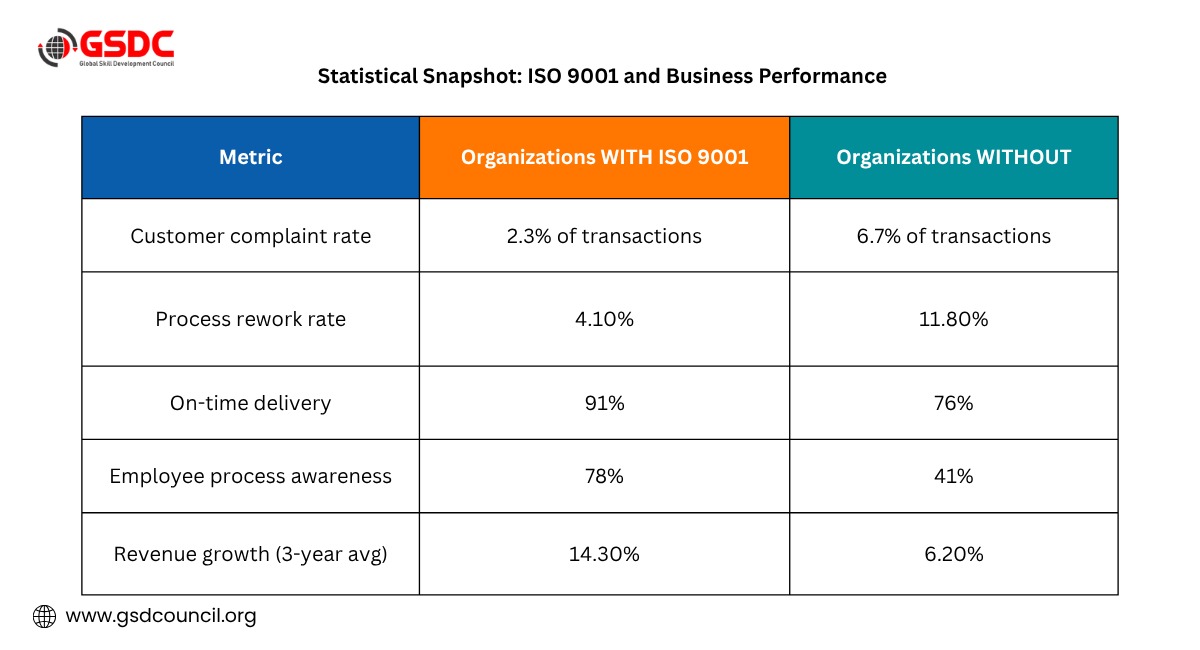
The point isn't that ISO 9001 is a magic fix. It's those organizations willing to look honestly at how their processes are running - and act on what they find - that consistently outperform those that don't. The data just confirms what the best-run operations already know.
How to Improve Operational Efficiency Using ISO 9001 Auditing: A Practical Framework
Organizations that extract the most value from ISO 9001 treat the audit not as an annual inspection, but as a continuous improvement tool. Here's a framework based on proven practice:
1. Audit More Frequently Than Required
The standard requires internal audits at "planned intervals," but many organizations reduce frequency to save time - and then wonder why problems resurface. High-performing organizations audit critical processes quarterly or even monthly.
2. Involve Process Owners, Not Just the Quality Team
When ISO 9001 internal audits are seen as a quality department exercise, findings sit in a report. When process owners lead their own audits (with training), findings become ownership, and ownership drives action.
3. Use Audit Data to Feed Operational Dashboards
Audit findings should connect directly to KPIs. If an audit reveals that 30% of customer complaints relate to a specific product line, that data point should appear on the operational dashboard alongside production metrics.
4. Apply Root-Cause Analysis Rigorously
The most common failure point in corrective action is stopping at the symptom. If a shipment error is found, the corrective action shouldn't be "remind staff to double-check." It should trace back to whether the verification procedure is unclear, whether training was inadequate, or whether workload peaks are creating shortcuts.
5. Close the Loop Visibly
When an audit drives a process improvement, communicate it. Share the before/after with the team. This builds a culture where audits are seen as improvement tools rather than fault-finding exercises.
The Customer Satisfaction Connection
Let's address the second half of this topic directly.
ISO 9001 is fundamentally a customer-focused standard. Clause 5.1.2 specifically requires top management to ensure that customer requirements are understood, communicated, and met. The audit process verifies this is happening in practice, not just in policy.
Here's how this translates to better customer outcomes:
Consistent Product and Service Quality:
Audits verify that processes deliver outputs within defined specifications. Customers receive what they were promised, every time.
Faster Complaint Resolution:
Organizations with active ISO 9001 internal audit programs typically have documented complaint-handling processes that are regularly reviewed for effectiveness. Resolution times drop. Escalations decrease.
Proactive Problem Prevention:
Rather than waiting for a customer to report a defect, internal audits identify potential failure points before they reach the customer. Prevention is always cheaper than correction.
A 2021 survey by the British Standards Institution (BSI) found that 73% of ISO 9001-certified organizations reported measurable improvement in customer satisfaction scores within two years of full QMS implementation compared to 31% of non-certified organizations over the same period.
Benefits of ISO 9001 Certification: Internal vs. External Business Impact
Internal Benefits of ISO 9001 Certification | External Benefits of ISO 9001 Certification |
Clearer process ownership and accountability | Enhanced credibility with enterprise clients and government contracts |
Reduced waste and rework | Competitive differentiation in RFP and tender processes |
Better training frameworks and onboarding consistency | Access to international markets where ISO 9001 is a supplier requirement |
Data-driven decision-making culture | Stronger supplier relationships built on shared quality expectations |
Improved employee confidence in systems and procedures | Increased customer trust through consistent quality management |
Better visibility into process performance and improvement opportunities | Stronger market positioning and business growth opportunities |
For U.S. manufacturers supplying automotive or aerospace OEMs, ISO 9001 is often non-negotiable. U.S. federal contractors increasingly find it listed as a preferred or required qualification in procurement documentation. And for U.S. healthcare providers navigating accreditation requirements, a mature QMS backed by regular audits provides a clear compliance and operational advantage.
The ISO 9001 certification benefits show up in contract wins, customer retention rates, and margin protection - not just on a certificate.
A Note on Common Mistakes That Undermine Audit Value
Even organizations that invest in ISO 9001 sometimes fail to extract the operational efficiency gains they expect. The usual culprits:
Treating audits as compliance theater.
When auditors and auditees both know what answers are expected, findings become sanitized. The system looks healthy on paper, while real problems remain invisible.
Skipping the management review.
Clause 9.3 requires top management to review QMS performance data, including audit results. When this is a rushed formality rather than a genuine strategic conversation, improvement opportunities go unaddressed.
Corrective actions without verification.
Writing a corrective action plan is not the same as solving the problem. Without follow-up audits to verify effectiveness, the same issues recur.
Siloing the QMS from operations.
When the quality management system lives in its own folder rather than being integrated into daily operations, audits produce findings that operations managers treat as someone else's problem.
Getting Started: Building an Audit Program That Works
Whether you're building from scratch or trying to get more out of a QMS that's gone a bit stale, the difference between an audit program that drives real change and one that just produces paperwork usually comes down to how it was set up.
Here's what actually works:
Map your core processes first.
You can't audit what you haven't defined. Start by identifying every process that directly touches product quality or customer experience - and be honest about what's actually happening, not just what the procedure says.
Build a risk-based audit schedule.
Not every process deserves the same attention. The ones most likely to fail, or most likely to affect customers when they do, get audited more often. Everything else gets scheduled around that.
Use a proper ISO 9001:2015 audit checklist.
Not a yes/no tick sheet - a checklist built around evidence-based questions that push auditors to look for proof, not just reassurance. The quality of the checklist determines the quality of the findings.
Train your auditors properly.
Audit technique, root-cause analysis, report writing - these are skills, not instincts. A recognized certification, like those offered by GSDC, gives auditors the credibility and practical grounding to do the job properly.
Connect findings to real improvement projects.
Every significant nonconformity should have a named owner, a corrective action, and a deadline. If a finding doesn't lead to a change, the audit was just an exercise.
Then measure whether it's working.
Track COPQ, complaint rates, on-time delivery, and audit closure rates. If the program is genuinely driving improvement, the numbers will move. If they aren't, something in the process needs a harder look.
Where Do You Go From Here?
There's a difference between understanding ISO 9001 and being the person organizations trust to run the audit process. One comes from reading. The other requires verified, demonstrated competence.
For quality professionals, compliance leads, and operations managers across the U.S., a Certified ISO 9001:2015 Lead Auditor credential is what closes that gap. It tells employers and clients you can plan, lead, and stand behind a full-scope QMS audit - not just talk about one.
The Global Skill Development Council (GSDC) offers a certification pathway built around real audit scenarios for professionals who need practical skills they can actually use.
In an environment shaped by federal procurement requirements, aerospace supply chain standards, and healthcare accreditation demands, verified credentials aren't a career bonus. They're the entry point.
Final Thought
The organizations that use ISO 9001 auditing most effectively aren't doing it to satisfy an external requirement. They're doing it because they've learned a fundamental truth: you cannot improve what you cannot see clearly.
Operational efficiency doesn't come from working harder. It comes from working with greater clarity - knowing where the breakdowns are, why they happen, and what it takes to eliminate them systematically.
ISO 9001 internal audits, run with discipline and genuine intent, provide exactly that clarity. And in today's competitive environment, clarity is a strategic advantage.

Related Certifications
Frequently Asked Questions
It's how well an organization converts its resources - people, time, money - into consistent results without unnecessary waste. In a management context, it's specifically about whether your systems, decisions, and processes are aligned to deliver value reliably, or quietly working against each other.
A five-stage cycle: planning, document review, on-site audit, findings report, and corrective action follow-up. The goal isn't the report itself - it's finding where the quality management system is working, where it isn't, and what needs to change.
It covers every key clause of the standard - organizational context, leadership, operations, performance evaluation, and improvement. Questions are evidence-based, meaning auditors aren't looking for the right answer. They're looking for proof that the right things are actually happening.
It forces clarity. Processes get standardized, accountability gets defined, and recurring problems get traced to their actual root cause rather than patched over. Less rework, fewer complaints, faster delivery - it compounds over time.
Credibility with federal contractors and enterprise clients, a genuine edge in RFP processes, access to international supply chains, and internal cost savings through reduced waste and rework. The benefits show up in contracts won and margins protected.
The standard says "planned intervals" - deliberately flexible. High-performing organizations audit critical processes quarterly or more. The frequency should match the risk. Higher stakes mean more regular scrutiny.
An internal audit is run by your own trained people - a structured self-assessment designed to catch problems early. A certification audit is conducted by an independent third party to verify your QMS genuinely meets ISO 9001:2015 requirements. One drives improvement. The other confirms it.
Map your core processes, build a risk-based audit schedule, and use a proper ISO 9001:2015 audit checklist. Train your auditors, and make sure findings connect directly to operational metrics - that's where the efficiency gains actually come from.
It keeps audits honest and consistent. Without it, two auditors covering the same ground could come back with completely different results. With it, every finding is clause-specific and grounded in evidence.
Quality managers, compliance officers, operations leads, and consultants responsible for planning or leading QMS audits. In the U.S., if you work with federal contractors, aerospace supply chains, or healthcare organizations, clients and employers increasingly expect to see it.
Stay up-to-date with the latest news, trends, and resources in GSDC
If you like this read then make sure to check out our previous blogs: Cracking Onboarding Challenges: Fresher Success Unveiled
Not sure which certification to pursue? Our advisors will help you decide!