Reprogramming the Future: The Strategic Role of AI Foundation Professionals
Written by Matthew Hale
In every boardroom today, there’s a new phrase turning heads: “AI-led growth.” Yet behind that buzz lies a deeper question: how to use AI for strategic advantage, not just tactical automation.
We’ll explore how AI foundation professionals serve as the linchpin between technology and business strategy.
We’ll cover AI strategy, frameworks for AI implementation, what strategic ways to use AI for growth, the future of AI trends, and whether artificial intelligence certification is worth pursuing.
Setting the stage: From “Can we use AI?” to “How do we use it strategically?”
The question is no longer simply which AI to use or how AI implementation works.
Organizations increasingly ask: “What is the best AI for strategic planning?” and “How can I embed AI into our long-term value-creation processes rather than one-off projects?”
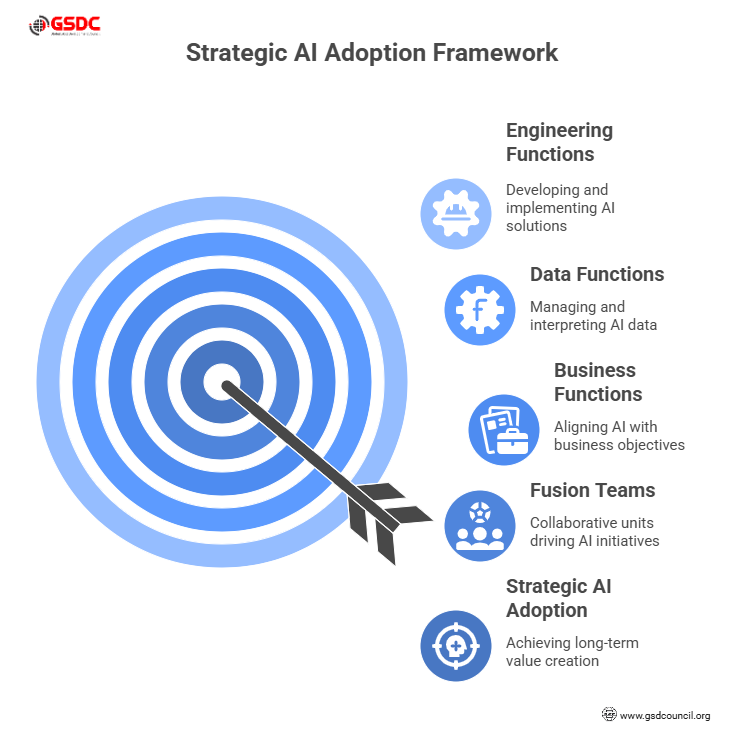
According to research by Gartner, the effective structure for AI adoption is a fusion of business, data, engineering, and strategy functions working together, or what they term “fusion teams”.
These teams form the backbone of how to use AI for strategic outcomes.
And as Harvard Business School points out: “AI won’t replace humans, but humans with AI will replace humans without AI.”
So the role of AI foundation professionals is not just to pick tools, but to architect the future workforce and processes of the enterprise.
They become the ones asking: how to implement AI in business so that it becomes a strategic asset.
The role of AI foundation professionals
What does an AI foundation professional do? In short, they translate between three worlds: business strategy, data & technology capabilities, and organizational culture.
Their core responsibilities include:
- Defining AI strategy, crafting the roadmap of how and where AI will deliver value.
- Selecting the right AI tools, deciding which AI to use, aligning with business objectives, and managing risk.
- Driving AI implementation, overseeing how AI models, data pipelines, workflow integration, and governance systems come together.
- Fostering skills, culture, and capabilities, ensuring the organization is ready to use AI responsibly and at scale.
- Measuring and iterating tracking outcomes, adjusting strategy, updating frameworks.
In their strategic role, these professionals ensure AI is not just a nice-to-have but a competitive differentiator.
Indeed, McKinsey notes that AI is “set to revolutionize strategy development” by enriching insight generation, simulation, and execution.
Why this role matters now
The urgency is real. Estimates suggest that by 2025, hundreds of millions of jobs will be impacted by AI initiatives, and organizations using AI effectively will gain a disproportionate advantage.
The size of the global AI industry is projected at hundreds of billions of dollars.
Those companies that treat AI as strategic and build a dedicated function around it are the ones best poised for growth.
Building the AI strategy framework
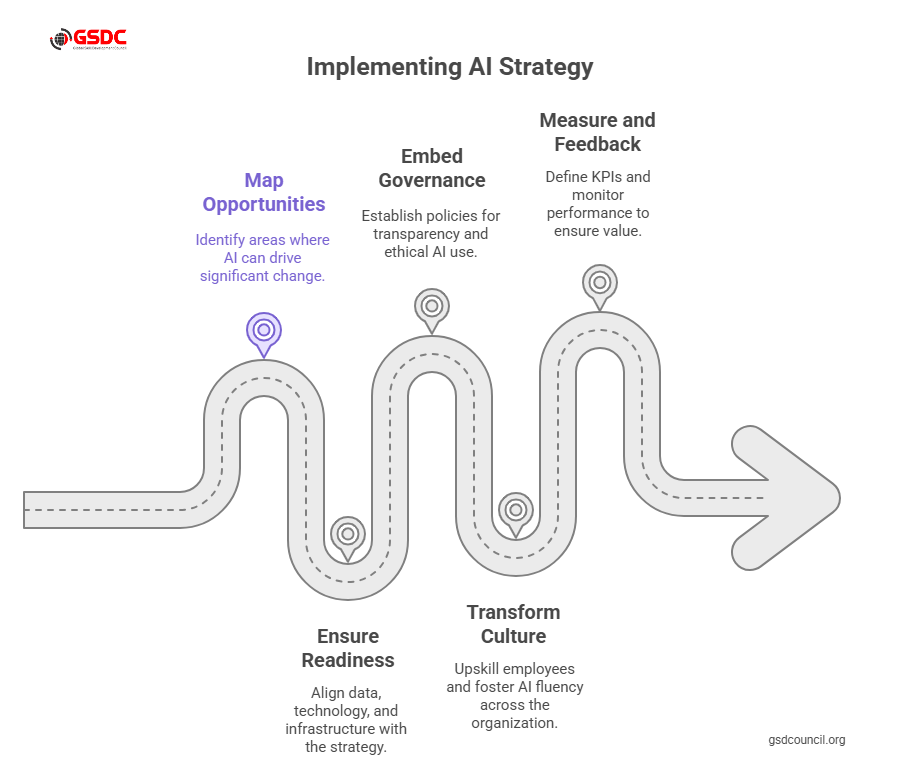
Once the “why” has been clarified, the next step is operationalizing the plan. A well-designed AI strategy framework provides structure and governance to move from vision to value.
Core components of a strategy framework
- Opportunity mapping: Identify where AI can enact real change high high-volume processes, decision-rich tasks, and strategic bottlenecks.
- Data and technology readiness: Ensure data pipelines, model infrastructure, and tool selection are aligned to strategy.
- Governance and ethics: Embed policies for transparency, bias mitigation, and human oversight.
- Talent and culture transformation: Upskill people, create AI fluency across functions.
- Measurement and feedback loops: Define KPIs tied to business value, not just technical output.
Example: How to implement AI in business
Imagine a retail enterprise wanting to optimize its supply chain and customer experience. An AI strategy might go as follows:
- Map the opportunity: high-volume returns handling, demand forecasting, personalized marketing.
- Select tools: Evaluate what AI models (ML forecasting, generative models for marketing, anomaly detection) fit best, i.e., which AI to use.
- Build infrastructure: Data ingestion, training environments, deployment pipelines.
- Pilot and scale: Start small, measure impact, then expand.
- Govern and monitor: Set metrics, monitor performance, adjust.
This process shows what are strategic ways to use AI for growth: by pairing business problems with AI capability, not just applying AI for its own sake.
Strategic ways to use AI for growth
Here are some of the most effective strategic levers for AI in organizations:
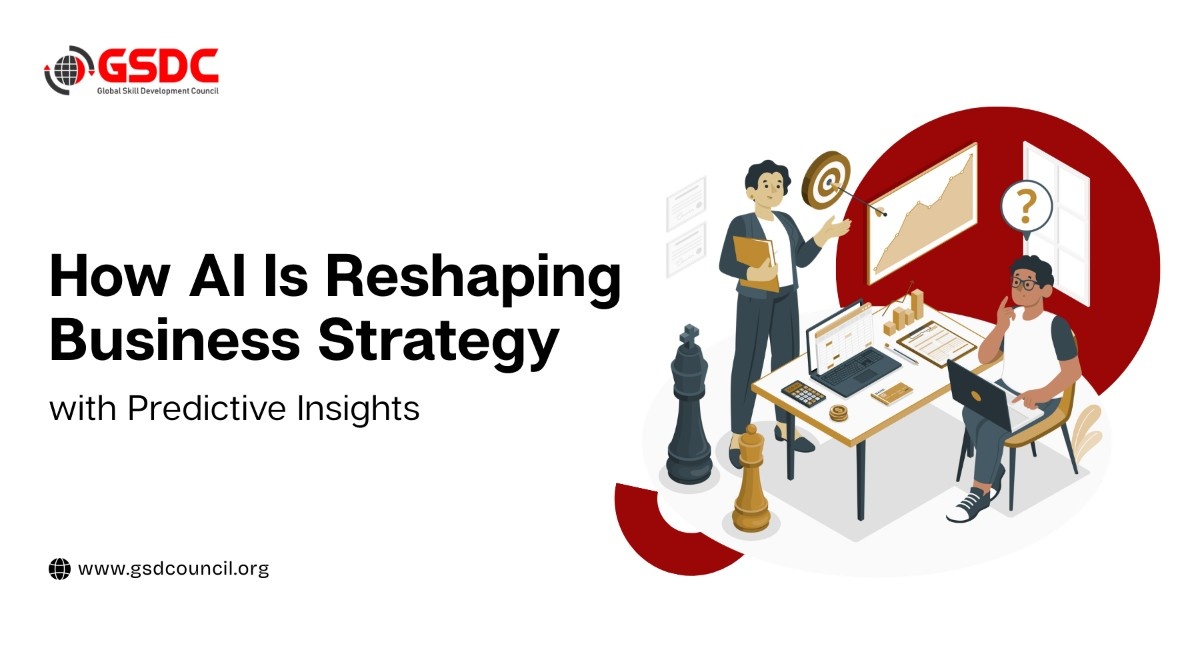
- Insight and foresight: Use AI to forecast demand, detect patterns in customer behavior, and simulate outcomes of strategic choices. This answers “what is the best AI for strategic planning?” By enabling scenario modeling and strategic foresight, AI becomes part of decision-making.
- Automation of decision-making loops: Where appropriate, embed AI in workflows to reduce latency and improve consistency, freeing human time for higher‐level tasks.
- Personalization at scale: Customer and employee experiences can be tailored using AI, driving growth and loyalty.
- Innovation acceleration: AI foundation professionals can help uncover new business models AI as a service, AI embedded in products, and lead the enterprise through transformation.
- Risk management and operational resilience: AI can help monitor system health, predict outages or business disruptions, and thus protect value.
Each of these strategic levers sits at the intersection of business ambition and technological capability and requires a deliberate framework for AI implementation to succeed.
Challenges of AI implementation
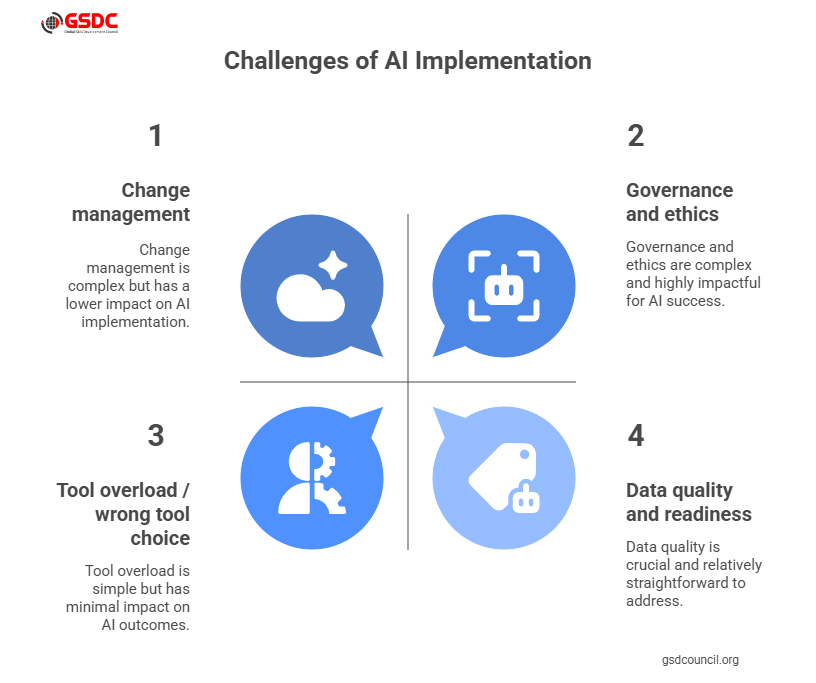
No discussion is complete without acknowledging AI implementation challenges. These often derail ambitious plans if unattended:
- Data quality and readiness: Without clean, accessible data, AI will under-deliver or produce biased outcomes.
- Talent gap: Organizations struggle to hire and retain the right mix of AI specialists and generalists.
- Governance and ethics: AI systems that lack transparency or oversight can generate trust issues or regulatory risk.
- Alignment with strategy: If the AI initiative isn’t aligned with business goals, it becomes a cost center rather than a growth enabler.
- Change management: Embedding AI changes workflows, roles, and culture without buy-in and readiness, implementation stalls.
- Tool overload / wrong tool choice: Deciding which AI to use matters; the wrong model or platform can undermine value.
An AI strategy framework that anticipates and mitigates these challenges increases the chance of success.
In fact, IMD’s research outlines “the seven foundations of successful AI implementation”: goal setting, process design, people, technology, data, leadership, and culture.
The future of AI & the evolving role
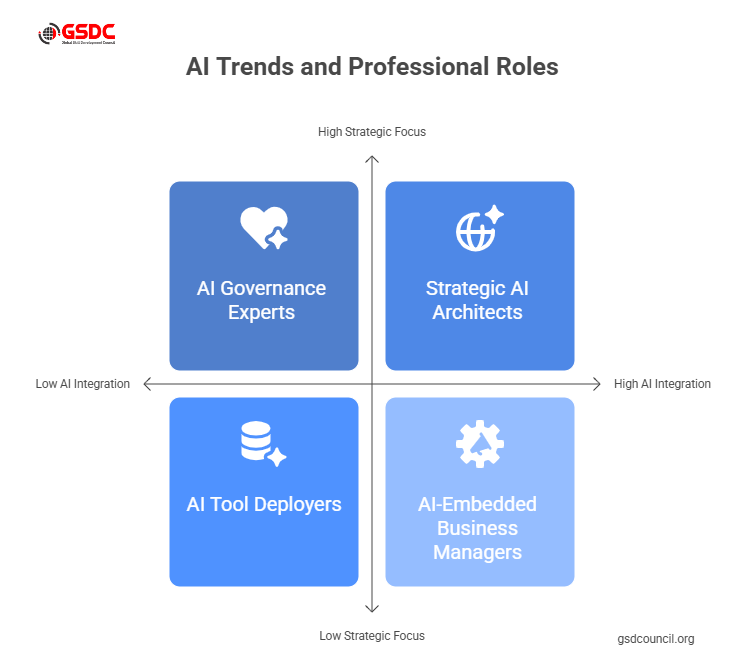
What does the future of AI look like, and how do AI foundation professionals fit into it? Several trends stand out:
AI will become embedded
Rather than stand-alone projects, AI will be deeply woven into business processes, products, and decision networks. That means the question shifts from how to implement AI in business to how to make AI the business.
Role evolution
AI foundation professionals will evolve into strategic architects of change. They’ll increasingly focus less on tool deployment and more on ecosystem design, orchestration of human-machine collaboration, governance, and value realization.
Upskilling becomes strategic
With change accelerating, organizations will invest in artificial intelligence certification for non-technical leaders and practitioners. A certification may answer: Is an AI certification worth it? If it enables professionals to speak the strategic language of AI, align initiatives to business value, and manage transformation, then yes.
New frameworks and standards
We’re seeing the emergence of frameworks for trustworthy AI, strategic AI, and scalable AI organizational models. These offer guardrails and repeatable patterns for deploying AI responsibly and effectively.
Growth in AI roles
As adoption grows, so too will the demand for AI foundation professionals, those who understand the AI strategy framework and the organizational change that comes with it. They will be crucial in driving growth, managing AI risk, and positioning companies for the future of AI trends.
Is AI certification worth it?
The notion of artificial intelligence certification has become common, but its value depends on context. Here are considerations:
- Strategic value: A certification that teaches how to align AI with business strategy (not just coding) can help bridge the gap between technology and business.
- Career path: For professionals on a site reliability engineer career path (in the SRE world) or a general digital leadership path, certification adds credibility.
- Organizational adoption: If your enterprise values AI governance, literacy, and cross-functional leadership, certification signals readiness.
- Practical relevance: Ensure the certification covers frameworks like the AI strategy framework, how to use AI for strategic goals, and AI implementation challenges, not just technical tricks.
So yes, is AI certification worth it? It can be if it equips you to lead AI strategically rather than simply operate it technically.
Putting it all together: Strategic execution roadmap
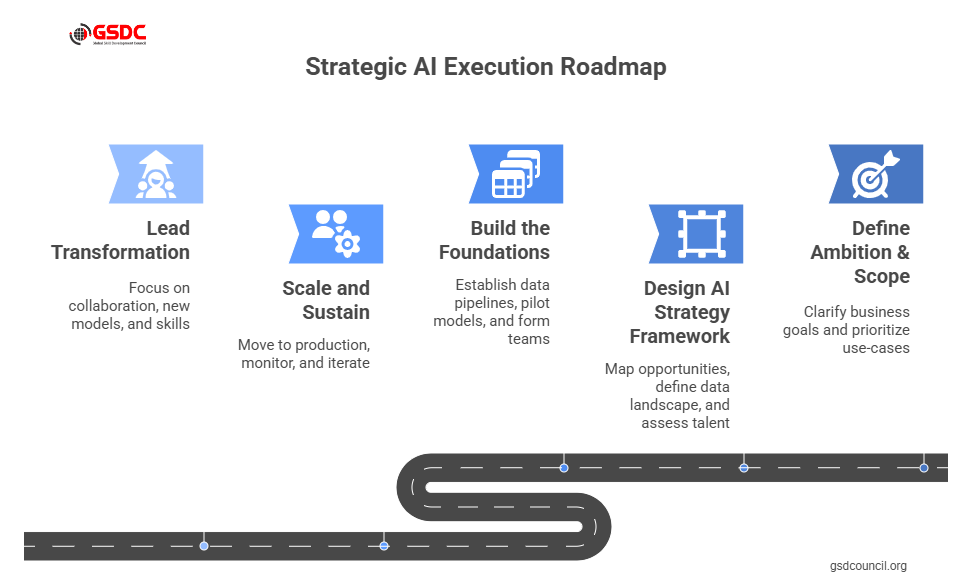
Here’s a high-level roadmap for AI foundation professionals to follow:
- Define ambition & scope
- Clarify business goals where AI could deliver strategic value.
- Prioritize use-cases based on growth, competitive advantage, or risk mitigation.
- Clarify business goals where AI could deliver strategic value.
- Design your AI strategy framework
- Map opportunities, define data and tool landscape, assess talent readiness.
- Decide which AI to use and establish governance.
- Map opportunities, define data and tool landscape, assess talent readiness.
- Build the foundations
- Establish data pipelines, pilot models, and form cross-functional teams.
- Embed the foundational governance, talent development, and culture change.
- Establish data pipelines, pilot models, and form cross-functional teams.
- Scale and sustain
- Move from pilot to production, embed continuous monitoring, iterate.
- Track strategic outcomes, not just technical metrics.
- Move from pilot to production, embed continuous monitoring, iterate.
- Lead transformation
- Focus on human-machine collaboration, new business models, and future skills.
- Maintain strategic alignment, embed AI as part of the enterprise’s DNA.
- Focus on human-machine collaboration, new business models, and future skills.
This is fundamentally how to use AI for strategic advantage, not just how to implement a tool.
Advance your career with the GSDC AI Foundation Certification gain the strategic skills to lead AI implementation and shape the future of intelligent business.

Closing thoughts
The business future is being reprogrammed. Those organizations that see AI as a strategic addition will be lagging behind those that incorporate strategic AI into their operating models.
The professionals of the AI foundation are the center of this change that determines the strategy, choice of tools, guide implementation, develop and develop talent, and influence the future of AI trends.
Put differently, they are to make AI strategy a growth driver, make sure that AI implementation is business value-driven, and make sure that the organization is prepared to undergo a new round of change.
Investing in certifications and strategic capacity and structures would be dividing if you are mapping a site reliability engineer learning journey or a wider digital leadership path.
In the era of AI, it is not about what can be automated, but how to win with AI. It is all about strategy, implementation, and people in the right positions. The professionals of the AI foundation are the ones pulling the wires, as we reprogram the future.
FAQs:
1. What is the role of AI in modern business strategy?
The role of AI is to enhance decision-making, automate complex processes, and uncover insights that drive innovation and growth. It enables companies to align technology with long-term strategic goals.
2. How do AI Foundation professionals contribute to business transformation?
AI Foundation professionals bridge the gap between technology and strategy. They design AI frameworks, oversee implementation, and ensure that AI adoption aligns with business objectives and ethics.
3. What are the key future AI trends shaping the workforce?
The future of AI trends includes generative AI integration, explainable AI for transparency, AI-driven automation, and the rise of human-AI collaboration roles across industries.
4. How can organizations build an effective AI strategy?
Building an AI strategy involves defining goals, selecting the right tools, creating governance frameworks, and developing internal skills for sustainable AI implementation.
5. What are the biggest AI implementation challenges businesses face?
Common challenges include poor data quality, lack of skilled professionals, unclear ROI, governance issues, and resistance to organizational change.
6. Is an Artificial Intelligence Certification worth it?
Yes. AI certifications validate your understanding of strategy, tools, and governance, making you more competitive in roles involving AI leadership and innovation.
7. How will the role of AI evolve in the next five years?
The role of AI will expand from task automation to strategic decision-making, shaping everything from product design to business models, powered by emerging AI foundation frameworks and trends.

Related Certifications
Stay up-to-date with the latest news, trends, and resources in GSDC
If you like this read then make sure to check out our previous blogs: Cracking Onboarding Challenges: Fresher Success Unveiled
Not sure which certification to pursue? Our advisors will help you decide!