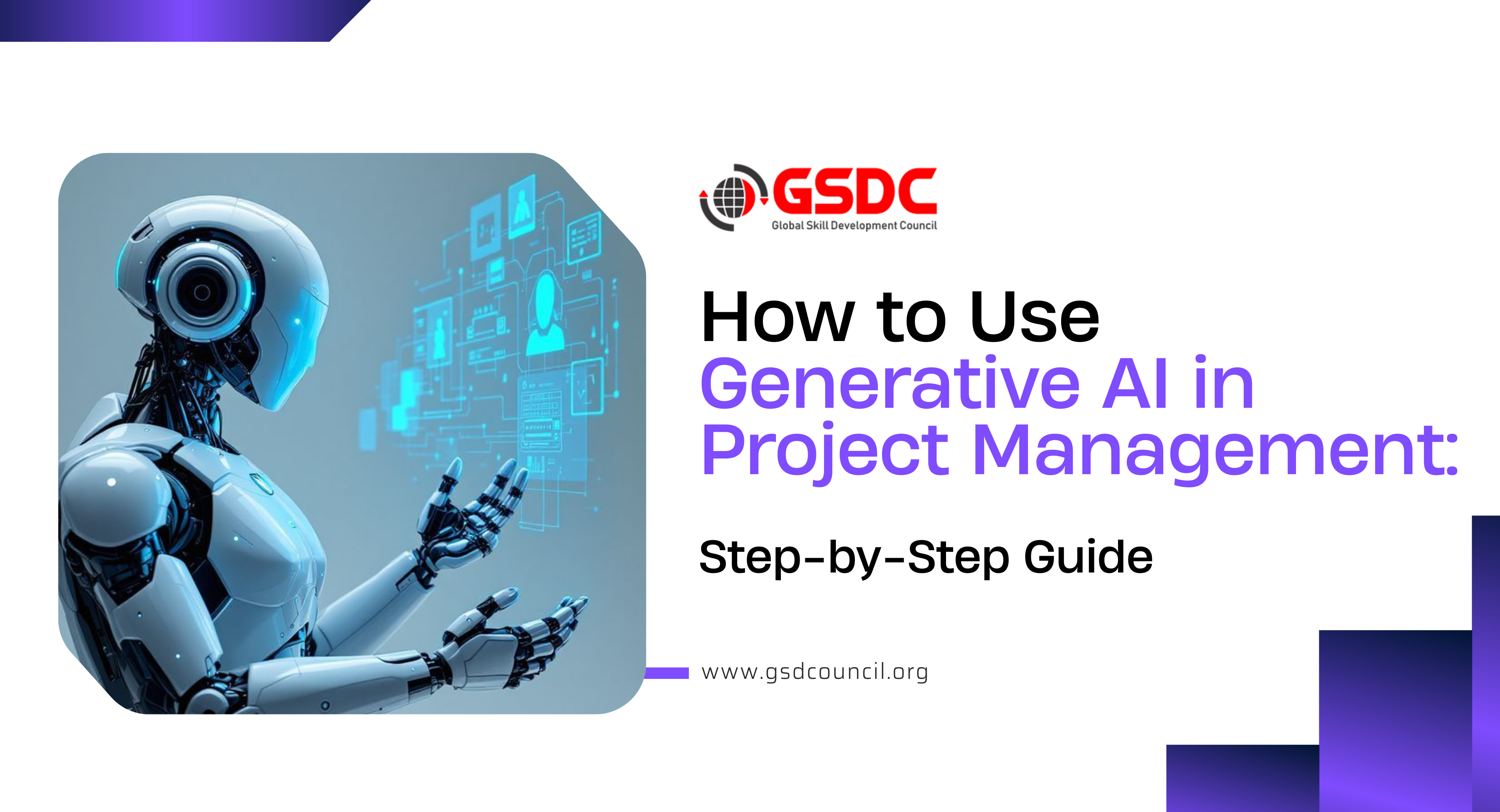
How to Use Generative AI in Project Management: Step-by-Step Guide
Written by Matthew Hale
- Generative AI Overview for Project Managers
- Why Generative AI Is Becoming Essential in Project Management
- How to Use Generative AI in Project Management: A Step-by-Step Guide
- Using Generative AI Responsibly in Project Management
- The Future of Project Management and Generative AI
- Certified Generative AI in Project Management: Building Future-Ready Skills
- Conclusion: Generative AI as a Project Manager’s Smart Assistant
A project manager’s day rarely goes as planned.
One moment you’re reviewing a timeline, the next you’re buried in emails, chats, meeting notes, and urgent updates. With information piling up, it’s clear why project management skills are important today.
This is where generative AI in project management fits in.
Rather than replacing professionals, Generative AI works as a smart assistant-helping organize work, streamline communication, track progress, and support better decisions.
This project management blog explains how to use generative AI in project management step by step, with practical, real-world examples.
Generative AI Overview for Project Managers
Before using it in real projects, project managers need a clear and practical understanding of Generative AI.
What Is Generative AI and How Does It Work?
AI models that can produce new content by identifying patterns in massive datasets, including text, schedules, summaries, reports, recommendations, and scenarios, are referred to as generative AI.
In a project management context, it works in three simple steps:
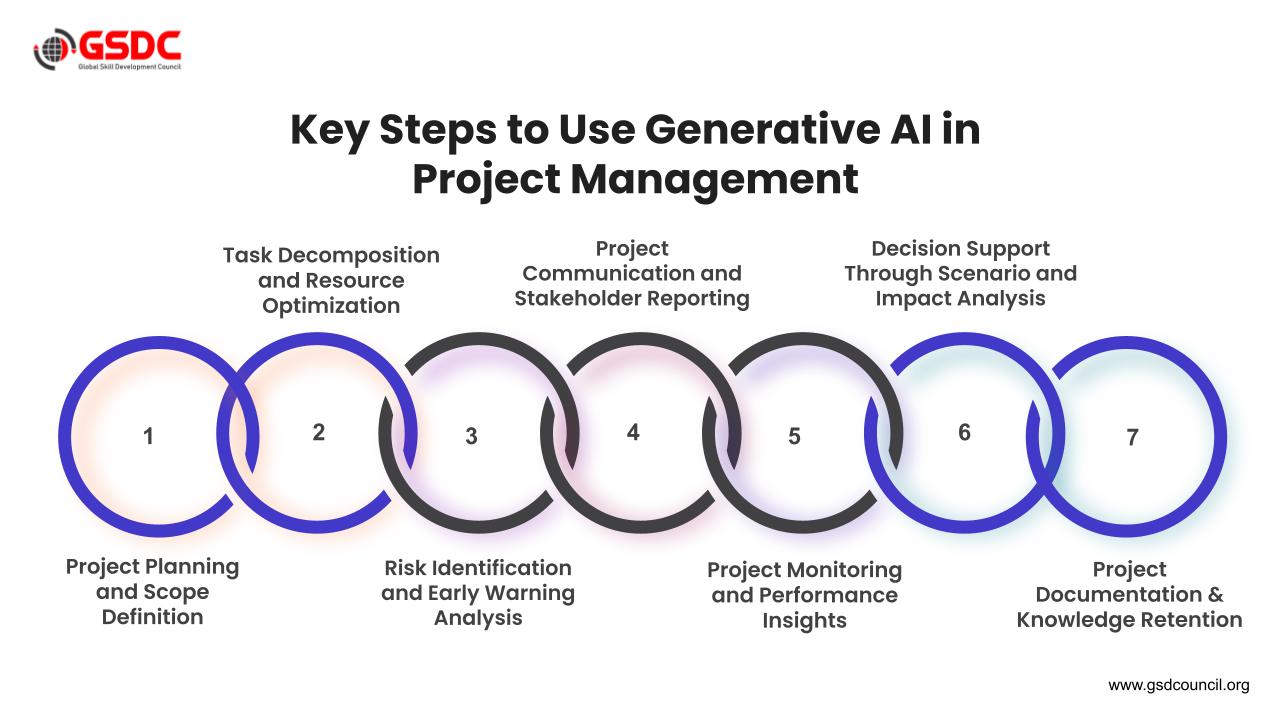
Understanding how generative AI works allows project managers to use it effectively and responsibly across planning, execution, monitoring, and decision-making-without losing control or accountability.
As organizations formalize AI skills and standards, global skill bodies such as the Global Skill Development Council (GSDC) are increasingly shaping how professionals build structured, role-relevant AI capabilities.
Why Generative AI Is Becoming Essential in Project Management
The use of generative AI in project management is changing quickly in various sectors.
Almost 70% of the project professionals already use AI in project delivery, which indicates a definite movement from trial to regular use.
- Project managers are heavily loaded with repetitive administrative tasks that take up too much of their time.
- Project data are everywhere - in emails, chats, dashboards, and documents.
- Their manual planning and reporting activities slow down execution and make it hard to see the overall picture of the work.
- In many cases, risks are only recognized after that time when delays have occurred.
- Decisions on resource allocation are made without the consideration of real-time data.
- Stakeholders require constant updates that are clear and coherent. Teams have to make quicker decisions while the project environment grows more complicated.
AI makes the project lifecycle faster, more manageable, and insightful. Generative AI is one such technology that is alleviating the burden of operational overload and enabling project leaders to concentrate on the quality of execution, alignment, and getting the most valuable results.
Download the checklist for the following benefits:
Use AI-powered templates built for real project managers 🧠
👉 Download the free Generative AI PM Toolkit 📥
How to Use Generative AI in Project Management: A Step-by-Step Guide
Step 1: AI-Assisted Project Planning and Scope Definition
Project planning often starts with high-level requirements and limited clarity.
With generative AI in project management, project managers can:
- Convert short business briefs into draft project plans
- Structure phases, milestones, and deliverables
- Suggest timelines and dependencies
- Draft project charters and scope documents
Example: In tools like Asana AI or ClickUp AI, a project manager can input a short description of a website redesign. The tool generates a phased plan covering discovery, design, development, testing, and launch. The manager then reviews assumptions and adjusts timelines.
Step 2: Structured Task Decomposition and Resource Optimization
Execution issues often arise from unclear tasks or uneven workloads.
Generative AI helps by:
- Breaking objectives into actionable tasks
- Grouping work by role or skill
- Mapping dependencies
- Flagging overloaded resources
Example: Using Monday.com or Wrike, AI workload views highlight when one team member is assigned multiple critical-path tasks across projects, allowing the manager to rebalance work before delays occur.
Step 3: Continuous Risk Identification and Early Warning Analysis
Risk management is traditionally reactive.
Generative AI improves this by:
- Suggesting risks based on similar projects
- Updating risk registers automatically
- Detecting repeated delays or scope changes
Example: In enterprise environments using Microsoft Project with Copilot, AI can detect repeated slippage in approval stages and surface early warning signals, prompting proactive intervention.
Step 4: AI-Enabled Project Communication and Stakeholder Reporting
Project communication consumes a significant portion of a manager’s time.
Generative AI supports communication by:
- Drafting status updates
- Summarizing email and chat conversations
- Converting meeting notes into action items
- Creating executive-level summaries
Example: With Microsoft Copilot in Teams, meeting discussions are summarized automatically, highlighting decisions, risks, and assigned actions-reducing manual documentation effort.
Step 5: Real-Time Project Monitoring and Performance Insights
Manual tracking often fails to reflect real-time project health.
Generative AI enables better monitoring by:
- Aggregating task updates across tools
- Highlighting delayed or blocked work
- Identifying recurring execution issues
- Generating automated progress reports
Example: In Jira with Atlassian Intelligence, AI summarizes sprint progress, flags bottlenecks, and highlights recurring issues across sprints, helping managers focus on resolution rather than reporting.
Step 6: Decision Support Through Scenario and Impact Analysis
Project managers constantly make trade-off decisions.
Generative AI supports decisions by:
- Comparing delivery scenarios
- Summarizing trade-offs and impacts
- Analyzing historical project patterns
Example: In Smartsheet AI, managers can ask how scope changes might affect deadlines or resourcing, and receive scenario-based insights to guide decision-making.
Step 7: Intelligent Project Documentation and Knowledge Retention
Project knowledge often disappears after delivery.
Generative AI helps preserve it by:
- Summarizing documents and decisions
- Creating lessons-learned reports
- Supporting faster onboarding
- Making project knowledge searchable
Example: Using Notion AI or Confluence with Atlassian Intelligence, project documentation is automatically summarized, allowing new team members to quickly understand project context and history.
Using Generative AI Responsibly in Project Management
Responsible use of generative AI in project management is essential for trust, governance, and long-term value.
- Avoid sharing confidential or sensitive project data with public AI tools.
- Review and validate all AI-generated outputs before using them.
- Be transparent with teams about how and where AI is being used.
- Apply human judgment to all decisions influenced by AI insights.
- Retain full accountability for outcomes and decisions.
Used correctly, Generative AI strengthens professional judgment-it does not replace it.
As Generative AI becomes part of everyday project work, many professionals are turning to structured programs like the Certified Generative AI in Project Management to build practical skills and apply AI responsibly.
The Future of Project Management and Generative AI
The future of generative AI is closely aligned with the future of work with generative AI, especially in project-driven organizations.
As AI becomes a core part of project delivery:
- Project managers will become outcome owners and strategic decision-makers instead of task coordinators.
- Leadership will have more time as routine planning, reporting, and tracking are increasingly automated.
- Real-time data, patterns, and predictive insights will play a bigger role in decision-making.
- Reactive firefighting will decrease as risk identification advances earlier in the project lifecycle.
- Instead of being set at the beginning of a project, resource planning will become more flexible and ongoing.
- Organizations will accelerate workforce transformation with AI, redefining roles and skill expectations.
- Human oversight, governance, and ethical AI use will become crucial project management skills.
Together, these shifts signal a move from task-heavy coordination to insight-driven, leadership-focused project management.
Certified Generative AI in Project Management: Building Future-Ready Skills
Professionals need structured learning rather than trial and error as generative AI in project management becomes more commonplace.
The Global Skill Development Council's (GSDC) Certified Generative AI in Project Management program offers a useful basis for successfully utilizing AI.
Professionals can learn how generative AI functions in project settings, apply it to planning and delivery, use AI responsibly, and develop skills related to future project leadership roles with the help of this generative AI in project management certification.
Conclusion: Generative AI as a Project Manager’s Smart Assistant
Instead of taking the place of project managers, generative AI is changing the way they organize, carry out, and oversee their work. Knowing how to apply generative AI in project management becomes a true competitive advantage when done well.
Project managers can plan more quickly and accurately, communicate more clearly, detect risks earlier, and make stronger, data-driven decisions thanks to Generative AI's reduction of repetitive administrative tasks. Professionals can now focus more on leadership and results and less on coordination, thanks to this change.
The most successful project managers will be those who use AI sensibly and carefully, not those who oppose it. Instead of taking the place of project expertise, generative AI enhances it by serving as a dependable helper that facilitates improved project delivery.

Related Certifications
Stay up-to-date with the latest news, trends, and resources in GSDC
If you like this read then make sure to check out our previous blogs: Cracking Onboarding Challenges: Fresher Success Unveiled
Not sure which certification to pursue? Our advisors will help you decide!