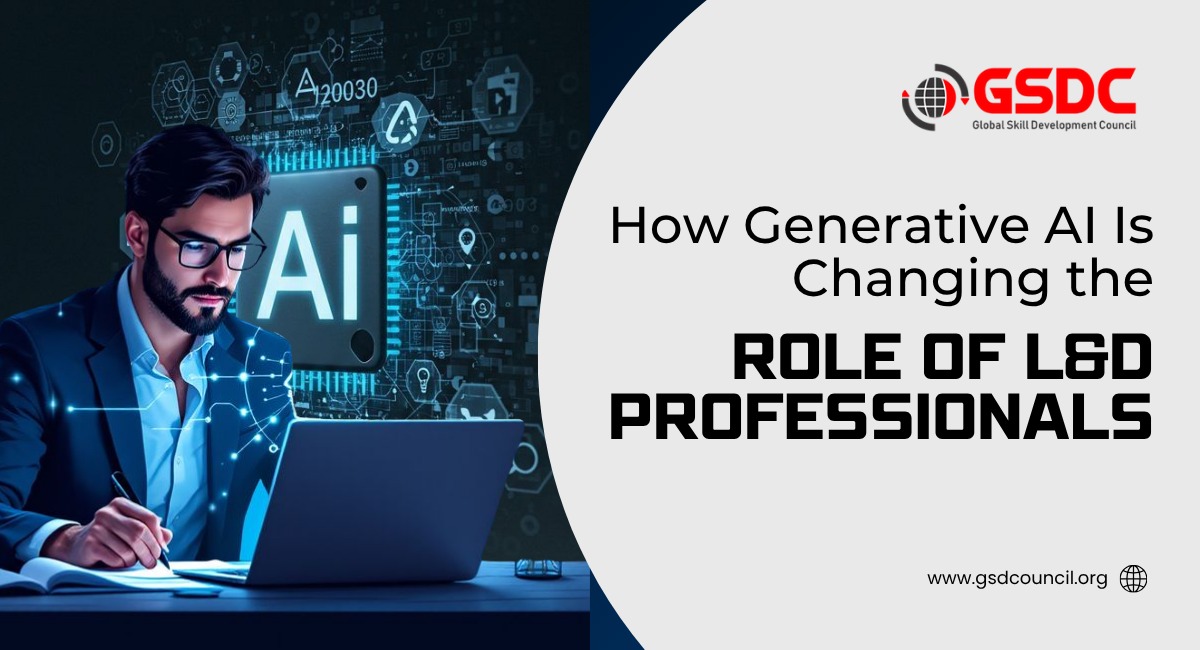
How Generative AI Is Changing the Role of L&D Professionals
Written by Matthew Hale
- Why the Old Model Can No Longer Keep Pace
- Generative AI Use Cases in Learning and Development
- How Generative AI Is Transforming L&D Roles
- The Evolving Role of L&D Professionals in the AI Era
- AI Tools for L&D Professionals: What to Look For
- Building a Robust AI in L&D Strategy
- The Future of L&D with Generative AI
- Preparing L&D for the AI-Driven Future
- Conclusion
Until recently, corporate learning used to be predictable: detect a skill gap, create a program, conduct a training session, and follow up on its completion. This routine was clear, easy to manage, and, for a long time, successful.
That rhythm is now being rewritten.
The rise of generative AI in learning and development is not just accelerating content creation, it is fundamentally redefining how learning functions operate and deliver value. More importantly, it is reshaping expectations around the role of AI in learning and development across organizations.
Key shift: Learning is moving from scheduled events to continuous, embedded capability building.
This transformation is not just technological, it is structural. As generative AI in learning and development evolves, learning is shifting from being an isolated event to becoming an integrated part of everyday work.
Why the Old Model Can No Longer Keep Pace
There is an evolution of skills needs taking place that outpaces the capabilities of the traditional cycle of learning. There is now a reduction in business cycles, which means employees must continue learning as they work, not when they are set aside from their tasks for a training session.
The impact of generative AI on L&D is accelerating this shift. More importantly, generative AI in learning and development is exposing the limits of a content-centric approach.
Instead of asking, “What training should we deliver?” L&D leaders must now ask, “What conditions support continuous capability growth?”
This is where AI transforming learning and development becomes critical, enabling a move toward adaptive, continuous learning powered by generative AI in L&D.
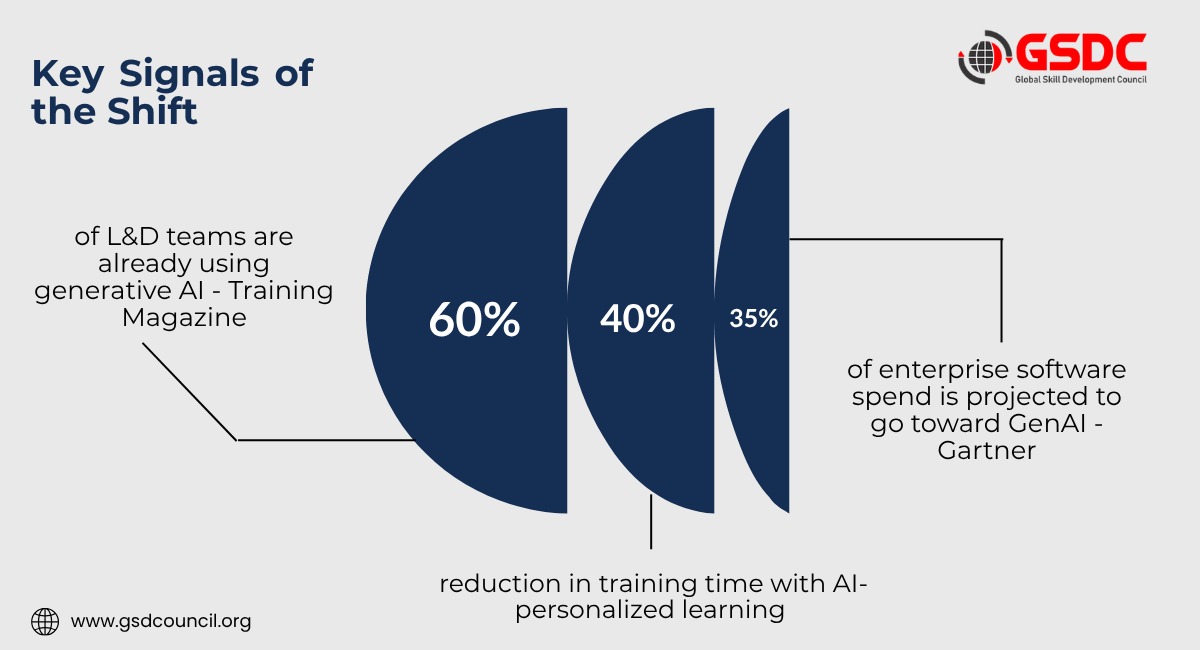
Generative AI Use Cases in Learning and Development
In addition to its importance, it is necessary to understand that the value of AI is in implementation. Today, generative AI use cases in learning and development go far beyond content generation.
Adaptive Pathways for Personalized Learning
AI analyzes performance data and creates adaptive learning journeys in real time. This highlights the growing role of AI in learning and development in personalization.
Faster Content Production
AI enables the creation of materials much faster than traditional approaches; a course takes hours rather than days or even weeks.
Real-Time AI Coaching
Employees will be able to get advice and coaching on the spot. It is here where the role of AI in L&D professionals comes into play.
Evaluation of Capabilities
AI allows shifting away from the metric of course completion towards the measurement of skills acquisition.
Instant Localizatio
Using generative AI in learning and development, businesses can scale content to different languages and regions.
Key takeaway: AI is not only generating content but changing the very process of learning at the workplace.
This is why modern organizations, such as the Global Skill Development Council (GSDC), have come to recognize those capabilities.
How Generative AI Is Transforming L&D Roles
Understanding how generative AI is transforming L&D roles is essential for modern learning teams.
Tasks that used to be performed manually, such as content production and management of learning programs, have become automated. This way, AI transforming L&D roles leads to specialists moving towards high-level activities.
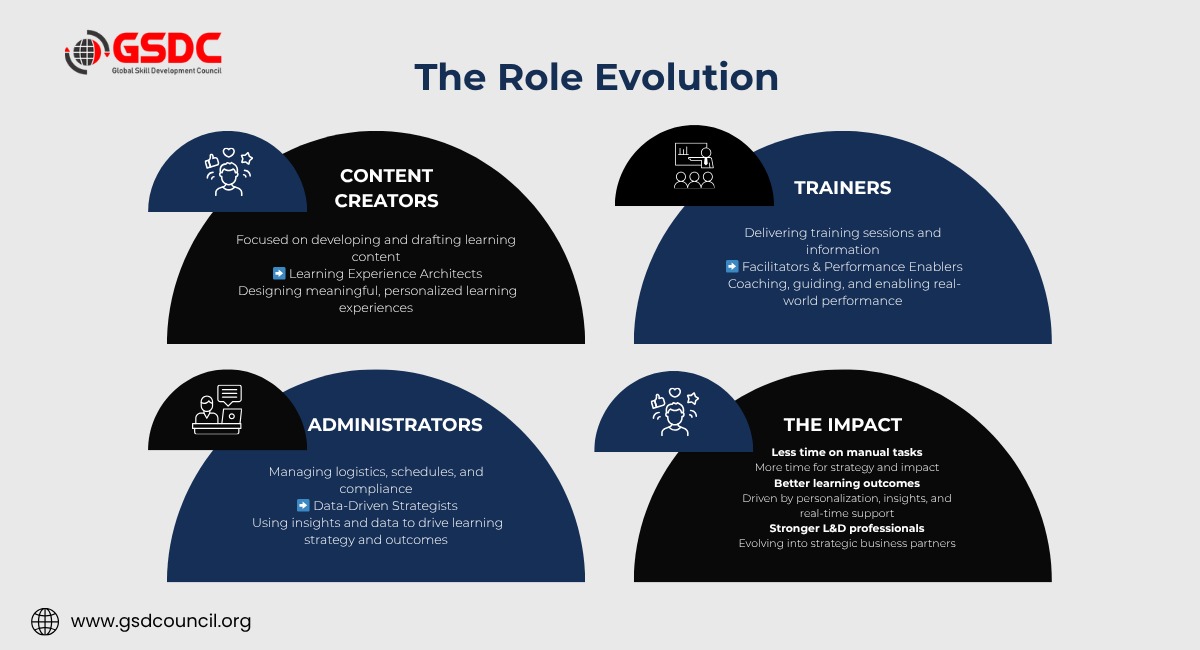
- Content producers → Experience designers in learning
- Training specialists → Learning facilitators
- L&D administrators → Strategists
This shift highlights the growing importance of the role of L&D professionals in the AI era, where human expertise focuses on strategy, design, and impact.
The Evolving Role of L&D Professionals in the AI Era
What's usually asked - "Will AI replace L&D professionals?" fails to grasp the true evolution happening. The role of L&D professionals in the AI era is not diminishing; it is becoming more crucial. As artificial intelligence changing L&D roles automates processes, human knowledge is evolving into strategy, governance, and decision-making.
L&D professionals are already well-equipped with systems thinking, information design, and quality assurance skills. The key difference is in the application of these skills in generative AI in learning and development.
Here's what is required of modern L&D professionals:
- Creating human-AI collaborations in learning ecosystems
- Controlling content generated by AI for accuracy and relevancy
- Translating insights into tangible business value and enhancing the role of AI in learning and development
- Improving AI literacy among L&D teams
- Learning redesign for effective application
- Developing a governance framework for quality assurance and compliance
Key shift: From offering training programs → towards developing capabilities.
Programs like Certification in Generative AI in HR & L&D are helping professionals build these future-ready skills.
Bottom line: L&D is evolving from education to enablement.
AI Tools for L&D Professionals: What to Look For
Choosing the appropriate AI tools for L&D professionals is much more than just a buying decision; it is a strategic process that determines how fast the organization can gain capabilities.
A few qualities of top AI tools include:
Capability | What It Enables | Watch Out For |
Adaptive content delivery | Real-time personalization based on learner performance | Over-reliance on completion data instead of capability signals |
Conversational authoring | Create course content using natural language prompts | Content drift without proper governance |
Secure AI assistants | Role-based answers using approved internal knowledge | Hallucinations from uncontrolled external sources |
Multimodal output | Generate video, audio, and interactive learning from one prompt | Inconsistent brand voice without human review |
Analytics & measurement | Link learning outcomes to business KPIs and performance | Integration challenges with existing systems |
Building a Robust AI in L&D Strategy
While enthusiasm for implementing AI tools can help kickstart L&D strategy construction, creating lasting value involves much more than just using technology.
1. Focus On Highly Impactful and Low-Risk Pilots
It begins with a pilot program, whether it's related to onboarding or compliance, with a clearly defined business objective. Specify a single metric and make measurable improvements to develop a solid case for scaling.
2. Move Away from Completion Metrics
Completion rate measures are outdated in modern times. The effective role of AI in learning and development lies in its capability of improving performance and achieving speed to competency.
3. Make Your AI a Performance Partner
AI should be integrated into employees' workflow to have any actual effect. This is how AI transforming learning and development proves itself truly valuable.
4. Promote Generative AI Literacy Among Employees
Implementing an efficient use of AI tools among the organization's staff is crucial to successfully utilizing generative AI in learning and development.
5. Define Content Governance Standards Before Scaling
Scaling AI learning programs should not result in decreased quality and accuracy of content due to inadequate control measures.
A successful AI in L&D strategy is not about faster content creation, it’s about enabling continuous capability building at scale.
The Future of L&D with Generative AI
The future of L&D with generative AI is moving away from conventional training towards capability-based, continuous learning woven into the fabric of everyday life. Conversational AI provides continuous, on-demand support, while generative AI in L&D gives teams the opportunity to generate content specific to their roles.
With AI becoming integral to workflows, human-AI collaboration becomes a key competency, emphasizing that AI transforming learning and development is changing the dynamics of learning.
Organizations embracing the change will have an edge, whereas those staying content-centric may lose out.
L&D is evolving from a training function to a capability engine embedded in everyday work.
Preparing L&D for the AI-Driven Future
With the emergence of generative AI in L&D and its transformation of the field, it is important to develop the necessary capabilities. L&D professionals need to acquire expertise in AI strategy, governance, and performance-based learning aligned with the growing significance of AI in L&D.
Organizations like Global Skill Development Council support this shift through programs such as the Certification in Generative AI in HR & L&D, helping professionals build practical, future-ready expertise.

Conclusion
It’s no longer a matter of discussion or debate; it’s time to see the impact of generative AI on L&D.
The real issue here isn’t even about adopting AI technology, but rather the effectiveness of its implementation into an AI in L&D approach. With the rapid pace at which AI will transform L&D positions, professionals need to adapt to their changing responsibilities in the age of AI.
Those who win aren’t those leveraging AI to perform tasks better or faster than before. The victors are those using it to reinvent learning - from mere training delivery to capability development.

Related Certifications
Frequently Asked Questions
Stay up-to-date with the latest news, trends, and resources in GSDC
If you like this read then make sure to check out our previous blogs: Cracking Onboarding Challenges: Fresher Success Unveiled
Not sure which certification to pursue? Our advisors will help you decide!