What Is ITSM? How Cloud Asset Management Saves Millions
Written by Matthew Hale
- What Is Cloud Asset Management?
- How CAM Supports Cloud-Based ITSM
- Why Is Asset Management Important in the Cloud?
- Examples of Real-World Cost Optimization in Cloud Services
- Common Cloud Asset Management Tools
- Key Benefits of Cloud Asset Management
- Getting Started with Cloud Asset Management
- Preparing for Modern IT Asset Management Roles
- Conclusion
In late 2025, major outages were reported at cloud service providers such as AWS and Microsoft Azure, resulting in the unavailability of customer portals for thousands of global business systems.
Such events have highlighted the stark reality that many organizations have no clear understanding of what is happening in their cloud.
This is why it has become important to understand ITSM and its application with structured cloud service management platforms. Unmanaged by proper governance, cloud resource capacity grows without being noticed, and risks, along with expenses, start multiplying uncontrollably.
This Cloud Asset Management guide explains how cloud asset management works, why is asset management important, and how it supports secure, compliant, and cost-efficient cloud operations.
What Is Cloud Asset Management?
Cloud Asset Management (CAM) is the process of discovering, monitoring, and managing cloud assets that an organization uses. The cloud assets may include virtual computing machines, storage, Software as a Service solutions, licenses, and other associated items.
To understand its real value, it is helpful to understand what is ITSM. IT Service Management focuses on delivering reliable IT services, and cloud asset management ensures every service is supported by accurate, up-to-date asset data.
This is where cloud based asset management software and modern ITSM cloud solutions become essential for visibility, governance, and control.
How CAM Supports Cloud-Based ITSM
Cloud Asset Management plays a key role in strengthening IT Service Management by connecting services with the cloud resources that support them.
- Enables service visibility: Accurate asset data ensures every service is mapped to the correct cloud resources, improving transparency across the ITSM cloud environment.
- Centralizes asset and service data: There is a central system that an organization uses for maintaining its services and assets, which makes it easy for an entity to recognize the place of infrastructure in business operations.
- Improves governance & control: Ownership policies, approval policies, & lifecycle policies reduce the risk of unseen & misconfigured cloud resources.
- Enables real-time monitoring: With automation, real-time monitoring of use, effectiveness, and compliance with various providers becomes possible.
- Ensures service quality enhancement: It helps improve service quality by enabling the efficient handling of incidents.
Why Is Asset Management Important in the Cloud?
One of the most common questions in IT operations is why is asset management important. With worldwide public cloud expenditure expected to surpass $720 billion in 2025, it has become incredibly important to effectively manage cloud resources.
Companies that don't monitor their consumption can throw away up to 32% of their cloud money on services that are non-utilized or under-utilized.
Cloud asset management helps organizations prevent:
- Budget overruns on cloud services due to forgotten and unnecessarily large resources.
- Security issues are coming from service misconfiguration and the presence of unused assets.
- License and compliance problems through the monitoring of entitlements.
- Interdepartmental communication problems by having consolidated dashboards.
- Inefficient spending by keeping consumption in line with the real business demand.
Examples of Real-World Cost Optimization in Cloud Services
Such examples have highlighted how companies from different industries have been able to avoid cloud waste through the use of cloud visibility.
- E-commerce company cuts cloud spend by 75% after discovering large volumes of idle AWS instances and oversized storage. By rightsizing workloads and removing unused resources, the company significantly reduced monthly bills while improving performance stability.
- Global technology firm saves $1.5 million annually by introducing asset tagging, ownership mapping, and governance policies, giving teams clarity on which services were driving cloud costs.
- Media company Anzu reduces AWS costs by 50% by aligning compute reservations with real usage patterns and cleaning up under-utilized services, resulting in over $1 million in annual savings.
Download the checklist for the following benefits:
Cloud getting messy? 😅 Download the ITSM & Cloud Asset Control Guide and get back in control. 📥
Common Cloud Asset Management Tools
It is typical for companies to use a combination of different tools to gain full visibility and control of their cloud environments.
- Automated discovery platforms that are always locating virtual machines, storage, and SaaS services across providers.
- License and subscription tracking systems to monitor the usage, entitlements, and renewals.
- Cost optimization dashboards that analyze the spending patterns and point out the areas of waste.
- Configuration monitoring tools are aimed at identifying misconfigurations, security vulnerabilities, and policy violations.
These top-performing tools of this kind are those interfaced with cloud service management platforms, which allow for effortless asset tracking, reporting, and governance.
Key Benefits of Cloud Asset Management
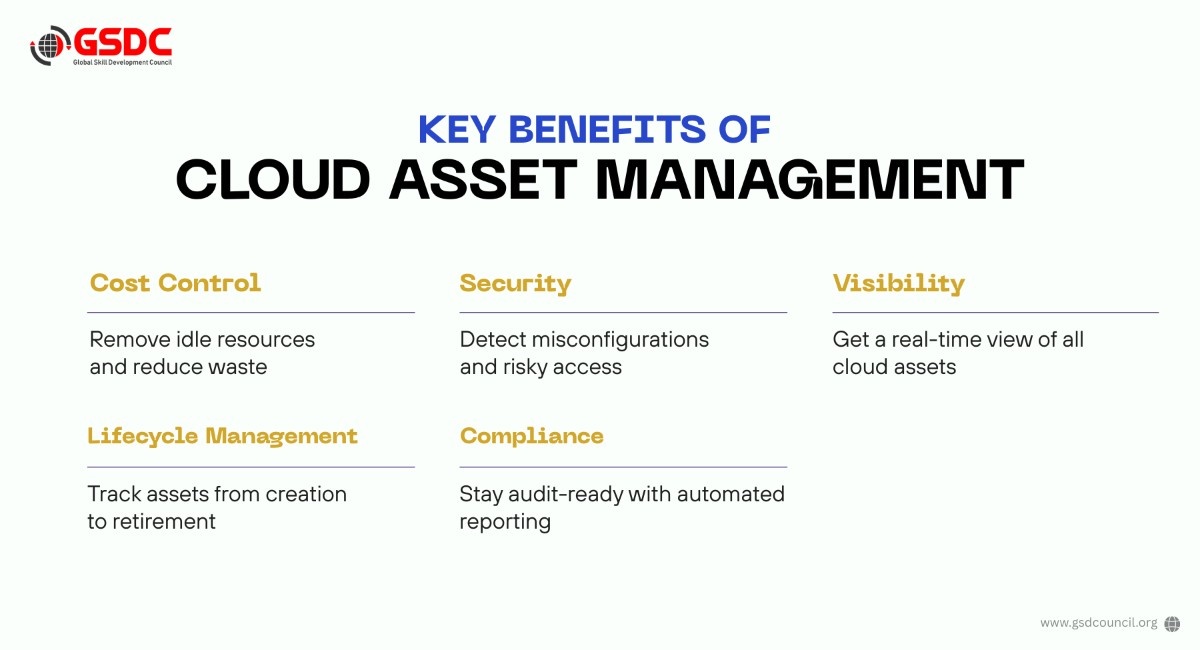
- Cost control: Cloud environments can rapidly expand, frequently without being noticeable. Through cloud based asset management software, companies can instantly identify unused virtual machines, unused subscriptions, and storage that is too large, thus being able to remove waste and regulate cloud budgets.
- Security enhancement: Today's ITSM cloud solutions regularly check cloud environments for unusual configurations of services, resources that have been left inactive, permissions set to allow everyone, and other high-risk assets that could cause data leak if exploited.
- Visibility: IT teams can get a single, live view of all cloud resources by using an advanced cloud asset management tool similar to what big corporations have. It becomes a lot easier to figure out who owns which asset and also understand how assets support business services.
- Lifecycle management: Cloud based ITSM systems that are integrated keep a record of assets starting from purchase and deployment up to optimization and retirement thus nothing is overlooked, and every asset has a defined role.
- Compliance: With continuous monitoring and automated reporting, organizations can easily be audit-ready, fulfill their regulatory obligations, and have correct license and entitlement records.
Getting Started with Cloud Asset Management
The following steps can help organizations take a systematic and hands-on approach to implementing cloud asset management.
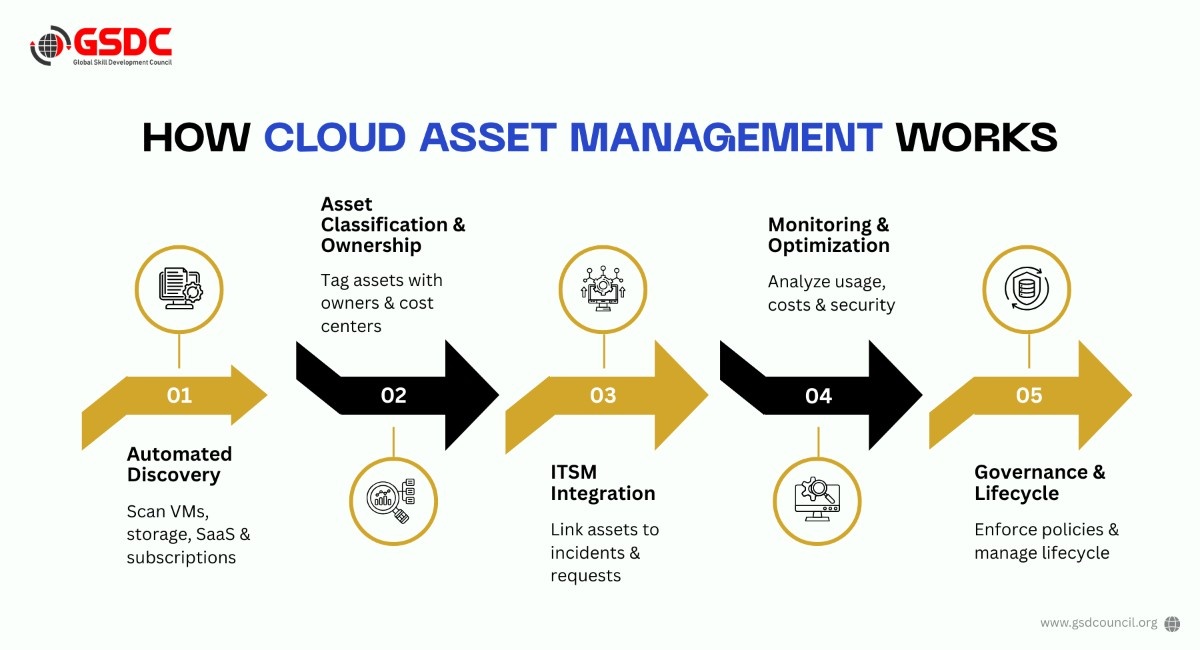
- Discover all cloud resources across providers: Leverage discovery automation in your cloud asset management software to find out all the virtual machines, storage services, and SaaS subscriptions that have been used.
- Centralize asset data: Keep all asset-related data in one place by using cloud-based asset management software that allows storing ownership, cost, and usage information accurately.
- Integrate with your ITSM cloud platform: Unify your asset repository with your existing ITSM cloud platform in such a way that the incidents, changes, and service requests are automatically connected to the correct assets.
- Monitor costs and usage regularly: Use the dashboards and reports in your cloud based ITSM environment to recognize the parts that are waste and hence reallocate the savings for the best use.
- Establish ownership and governance: Assign clear responsibility for every asset to ensure accountability, security, and compliance.
Doing these actions will help you to make Cloud Asset Management a part of your daily ITSM cloud solutions workflows.
Preparing for Modern IT Asset Management Roles
With the increase in complexities associated with cloud systems, there has been a rising demand for competent professionals who can manage digital assets along with other IT services as a whole.
This Global Skill Development Council training course provides the IT Asset Management Foundation Certificate, enhancing their ability to deal with the actual issue of asset management. This training course will benefit the students by making them aware of the role of cloud asset management within the present scenario of IT service delivery. This will prepare the students for working in the cloud-first firms.

Conclusion
Cloud Asset Management is an essential area of expertise within current IT ops. And this is because, with the expanded scale of the cloud, the need is not just for infrastructure; it is the need for visibility, accountability, and governance on each digital asset.
When asset tracking is integrated with service management, incident response time is reduced, and organizations can remain in compliance while ensuring that every cloud service is utilized for an actual business need. This ensures that with the right expertise, the cloud complexity is turned into an advantage.

Related Certifications
Stay up-to-date with the latest news, trends, and resources in GSDC
If you like this read then make sure to check out our previous blogs: Cracking Onboarding Challenges: Fresher Success Unveiled
Not sure which certification to pursue? Our advisors will help you decide!