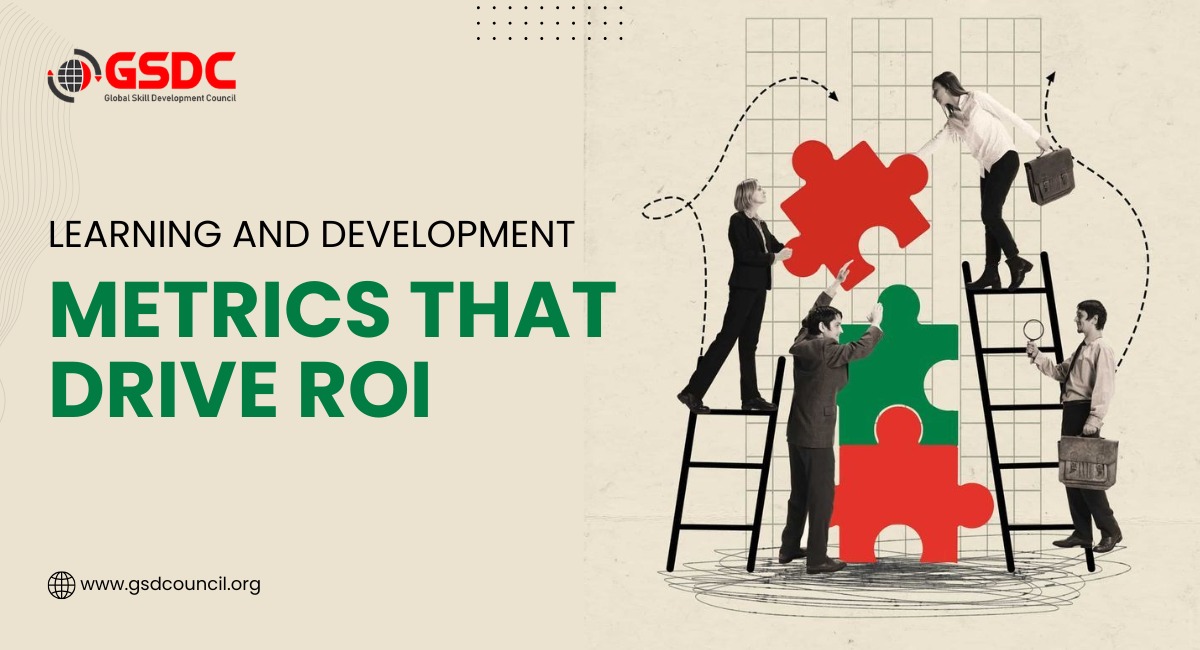
Learning and Development Metrics That Drive ROI in 2026
Written by Matthew Hale
- Why Learning and Development Metrics Matter More Than Ever
- Market Growth of Learning and Development
- What Are Learning and Development Metrics?
- Key Learning and Development KPIs to Track
- Learning in the Flow of Work Metrics
- What Is ROI in Learning and Development?
- How to Measure ROI in Learning and Development
- L&D ROI Metrics 2026: Key Trends
- L&D Strategy Example (Data-Driven Approach)
- Common Mistakes in L&D Metrics Tracking
- How Strengthening Your L&D Strategy with the Right Certification Can Help You
- Final Thoughts
Learning and development metrics are no longer just a reporting tool; they are essential for driving real business impact.
In 2026, learning and development (L&D), also known as human capital development and upskilling, focuses on improving employee skills and overall workplace performance. Unlike traditional training, L&D is continuous and closely aligned with business goals.
This shift is reflected in industry trends. C-suite leaders now see employee upskilling and reskilling as the top investment area for productivity. At the same time, the global learning and development market, valued at around USD 378 billion in 2022, continues to grow rapidly.
The way people learn is also evolving. With the rise of artificial intelligence, many Gen Z professionals already see AI as an equally effective or even better source of guidance than managers.
As a result, organizations are focusing more on learning metrics and analytics, learning and development KPIs, and learning ROI metrics to measure real outcomes.
Because today, one question matters most: How to measure ROI in learning and development and prove its value to the business?
Why Learning and Development Metrics Matter More Than Ever
Investment in learning and development activities is on the rise, but the emphasis has shifted from merely delivering learning programs to demonstrating the impact of these programs.
This has come about due to several significant changes in the current scenario:
- Skills are becoming outdated more frequently
- The pace of digital transformation is quickening
- Workforce demands are in a state of flux
This has necessitated the need for having a clear view of the impact of these programs. Thus, learning and development metrics have assumed greater importance.
The industry reflects this trend. The global L&D market is expected to grow at a steady 3% CAGR through 2030, fueled by e-learning, microlearning, and AI-powered training.
But investment alone isn’t enough.
Organizations are now focusing on learning and development KPIs, learning metrics and analytics, and a structured L&D metrics track to measure effectiveness and align learning with business goals.
Because without measurement, learning cannot prove value.
Market Growth of Learning and Development
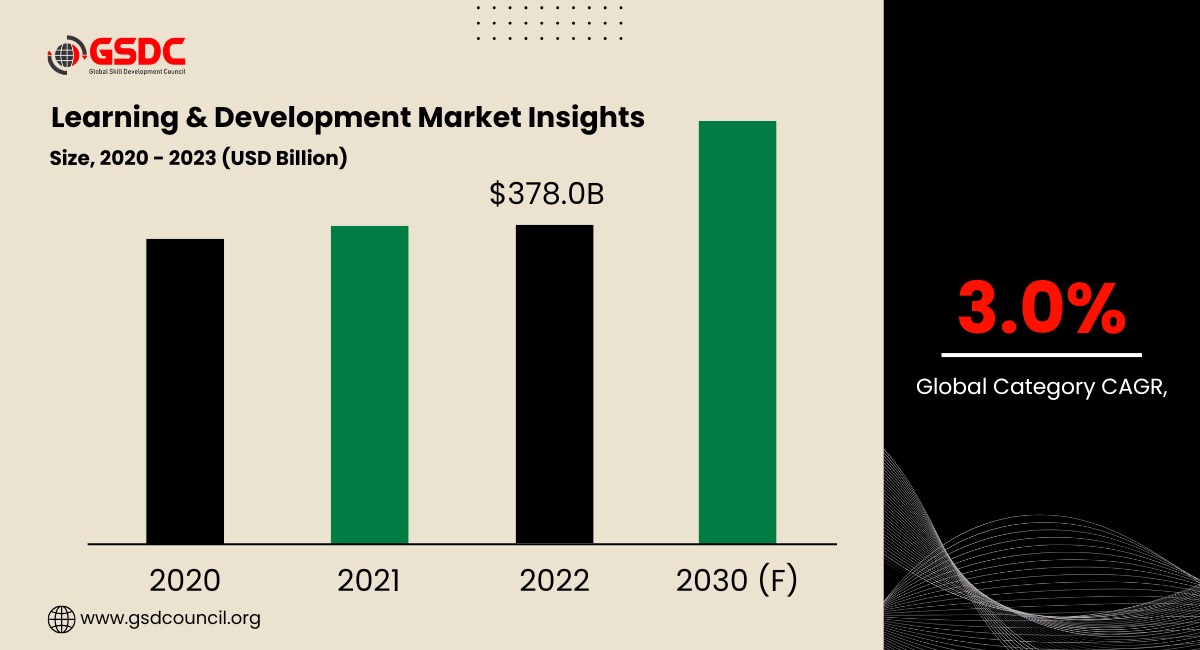
This data highlights why organizations must focus on learning ROI metrics and roi metrics for learning and development to track real business impact.
What Are Learning and Development Metrics?
Learning and development metrics are measurable indicators used to evaluate how effective training programs are.
These metrics for learning and development help organizations understand whether employees are improving their skills, if training is aligned with business goals, and whether the organization is seeing measurable results and returns.
In simple terms, they connect learning efforts directly to real business impact.
Key Learning and Development KPIs to Track
To develop an effective track for organizational L&D metrics, the focus must be on the right set of learning and development KPIs that cover the aspects of both engagement and business.
1. Completion Rate
It is an essential metric used to track the completion rates of the employees who have taken the course. This metric is used to gauge the level of engagement.
2. Skills Gap Measurement L&D
It is used to determine the gap between the existing skill set of employees and the required skill set. This is an important metric as organizations are focusing on the reskilling and upskilling of employees to remain competitive in the changing market scenario.
This is where learning metrics and analytics play an important role in identifying and closing these gaps effectively.
Learning in the Flow of Work Metrics
Current trends in L&D are focusing on a new form of ‘learning in the flow of work’ and ‘continuous’ learning.
Learning in the flow of work metrics assists in measuring the effectiveness of employee learning in the process of work.
1. On-the-Job Learning
On-the-job learning metrics measure the effectiveness of employee learning by directly applying new knowledge to work.
2. Microlearning Engagement
Microlearning engagement metrics measure the effectiveness of employee interaction with microlearning modules.
3. Performance Improvement
Performance improvement metrics measure the effectiveness of employee productivity and efficiency after training.
Microlearning is a significant current trend in training and development, which involves short training modules of less than five minutes and is helpful for employee engagement and knowledge retention.
Professionals who wish to learn and effectively utilize these metrics for better employee training and development may take advantage of the ‘Certified L&D Analytics & Metrics Professional’ course and gain practical knowledge in the field of learning metrics and analytics.
What Is ROI in Learning and Development?
ROI in learning and development refers to the value an organization gains from training compared to the cost invested. It shows whether learning initiatives are delivering measurable business results.
Today, organizations are under increasing pressure to justify L&D spending. This makes learning ROI metrics more important than ever.
How to Measure ROI in Learning and Development
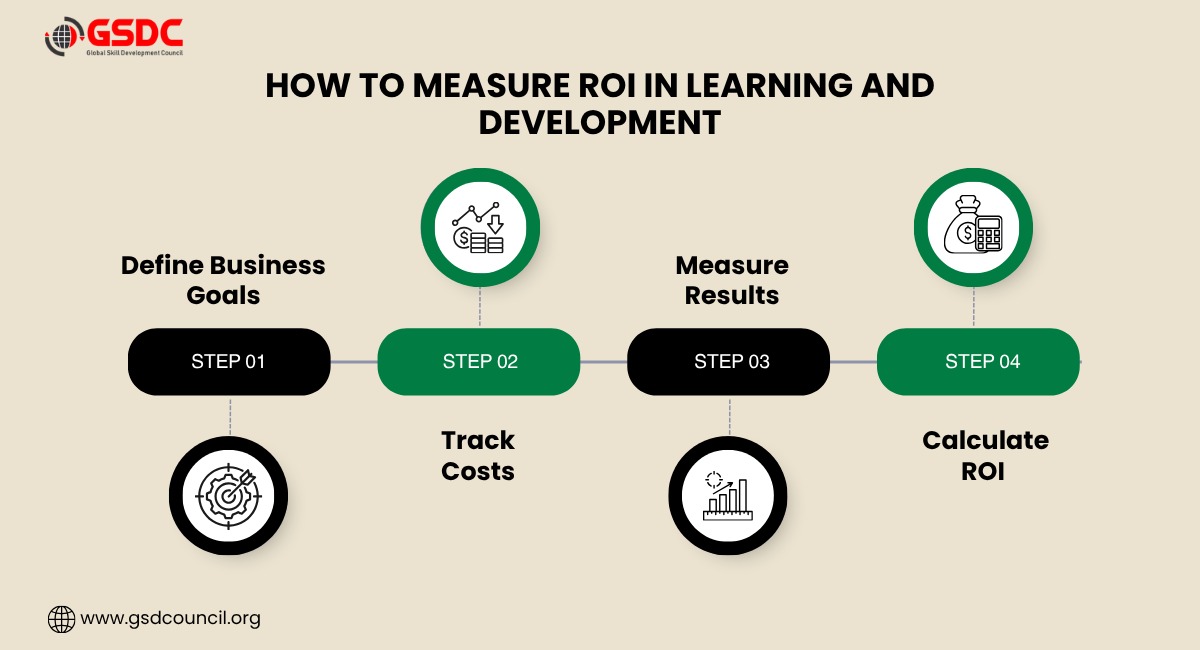
Understanding how to measure ROI in learning and development requires a structured approach that connects learning outcomes to business results.
Step 1: Define Business Goals
Start by aligning training with clear business outcomes such as improved productivity, higher revenue, or better efficiency.
Step 2: Track Costs
Include all relevant costs, such as learning tools, employee time, and training resources, to get an accurate investment value.
Step 3: Measure Results
Evaluate outcomes using learning and development KPIs like performance improvement, time saved, and error reduction. These indicators help quantify the impact of training.
Step 4: Calculate ROI
Apply a standard formula to measure returns:
L&D ROI = (Benefits – Costs) / Costs × 100
This forms the foundation of learning and development ROI and supports effective use of learning ROI metrics.
Organizations looking to build strong capabilities in this area often refer to frameworks and best practices supported by bodies like the Global Skill Development Council, which emphasize data-driven learning and measurable outcomes.
L&D ROI Metrics 2026: Key Trends
In 2026, the l&d roi metrics 2026 are also more advanced, as they are not just limited to tracking but also include decision-making.
The key trends in the l&d roi metrics 2026 are as follows:
1. AI-Driven Learning Insights
In 2026, organizations are also using AI to track the learning behavior and performance of employees in real time, which is helping them make quick decisions regarding the training.
2. Personalized Learning Paths
Using AI for personalizing the learning process is also helping organizations make the process more efficient.
3. Real-Time Analytics
Modern learning metrics and analytics focus on live performance data rather than static reports, enabling organizations to track impact continuously and adjust strategies quickly.
4. Automated Reporting
Automation is simplifying how organizations track learning and development KPIs, reducing manual effort and improving accuracy in measuring outcomes.
It is also observed that the adoption of the digital learning process is on the rise, as almost all organizations are adopting the technology-driven process with the help of automation.
This also shows the importance of the roi metrics for the learning and development process, as the process is becoming more advanced with the help of the use of technology.
L&D Strategy Example (Data-Driven Approach)
A good L&D strategy example in 2026 is one based on data and continuous measurement. Today’s organizations are shifting from simply delivering learning programs to demonstrating actual impact through learning and development metrics.
1. Align Learning with Business Goals
Training programs should be directly related to business KPIs like productivity, performance, and revenue. Today’s L&D is expected to impact business results in some way.
2. Focus on Skills Gap Measurement L&D
Measuring skills gaps in different departments of an organization is a great way to implement L&D strategies.
3. Use Learning Metrics and Analytics
Learning metrics and analytics enable organizations to measure and improve their learning programs more effectively. Without data, L&D strategies can never achieve consistent results.
4. Measure ROI Continuously
Continuously applying how to measure ROI in learning and development ensures that training programs are actually delivering results.
5. Leverage Technology
Modern L&D strategies rely on AI, analytics, and digital platforms to make smarter, faster decisions and scale learning effectively.
Common Mistakes in L&D Metrics Tracking
Even with access to data, many organizations struggle to measure the real impact of learning.
- Focusing only on completion rates, which track engagement but not actual impact
- Ignoring learning and development ROI makes it difficult to justify L&D investments
- Not using proper roi metrics for learning and development to measure business outcomes
- Failing to connect training with performance, productivity, and business goals
How Strengthening Your L&D Strategy with the Right Certification Can Help You
With more emphasis being placed on learning and development metrics, there is an increasing need for learning and development metrics professionals.
The Global Skill Development Council offers certifications like the Certified L&D Analytics and Metrics Professional, which can help professionals develop skills in learning metrics and analytics, learning and development KPIs, and learning ROI metrics.
This can help them build a stronger learning and development metrics track.

Final Thoughts
The L&D world is changing rapidly, and this can be attributed to the impact of digital transformation and the changing needs of the workforce.
Organizations can no longer afford to focus only on tracking; instead, there should be a shift towards impact and alignment.
For an organization to be successful, there should be learning and development metrics, learning ROI metrics, advanced learning metrics and analytics, and an understanding of what learning ROI means.
By focusing only on the most important L&D metrics for employee training, an organization can make learning a true driver of business success.

Related Certifications
Frequently Asked Questions
Stay up-to-date with the latest news, trends, and resources in GSDC
If you like this read then make sure to check out our previous blogs: Cracking Onboarding Challenges: Fresher Success Unveiled
Not sure which certification to pursue? Our advisors will help you decide!