Think Like a Forward Deployed Engineer to Solve AI Problems
Written by Sharan Umavassee
- Why Enterprise AI Projects Fail Despite Powerful Technology?
- The Real Product Is Adoption, Not Software
- What Makes a Forward Deployed Engineer Different?
- Thinking Like a Systems Engineer Instead of Just a Developer
- Solving the Right Problem Before Building AI
- Building Trust Through Continuous Customer Collaboration
- Designing AI Workflows That People Actually Use
- Documentation Should Drive Adoption
- Become a Certified Forward Deployed Engineer with GSDC
- Four Habits of Successful Forward Deployed Engineers
- Conclusion
Artificial Intelligence has transformed software development, enabling organizations to build AI-powered applications in days rather than months. Despite this rapid progress, many enterprise AI initiatives still struggle to deliver meaningful business outcomes. The primary challenge is often not the AI model itself but ensuring that employees adopt the solution and that it integrates effectively into existing business workflows. As organizations increasingly embrace AI in business and generative AI for business, successful implementation depends on a well-defined AI strategy.
This challenge has led to the emergence of one of the fastest-growing roles in enterprise technology: the Forward Deployed Engineer (FDE). Unlike traditional software engineers who primarily develop products or consultants who focus on strategy, Forward Deployed Engineers collaborate closely with customers to solve real-world business problems. They bridge the gap between advanced AI capabilities and AI for enterprise implementation, ensuring that enterprise generative AI solutions are not only deployed successfully but also deliver measurable business value.
This blog delves into the key insights into why enterprise AI projects often fail, what distinguishes successful AI implementations, and how Forward Deployed Engineers create lasting value by focusing on customer outcomes rather than merely delivering software. It also highlights what is a Forward Deployed Engineer and why Forward Deployed Engineering is rapidly becoming one of the most in-demand career paths in the AI industry.
Why Enterprise AI Projects Fail Despite Powerful Technology?
The common assumption is that AI projects fail because of poor models, software bugs, or insufficient computing power. However, the webinar highlights a completely different reality.
Today's AI models are becoming increasingly capable. Building applications is easier than ever, and organizations have access to advanced large language models, cloud infrastructure, and automation tools. Yet many enterprise AI projects never progress beyond the pilot stage.
The biggest reason is lack of user adoption.
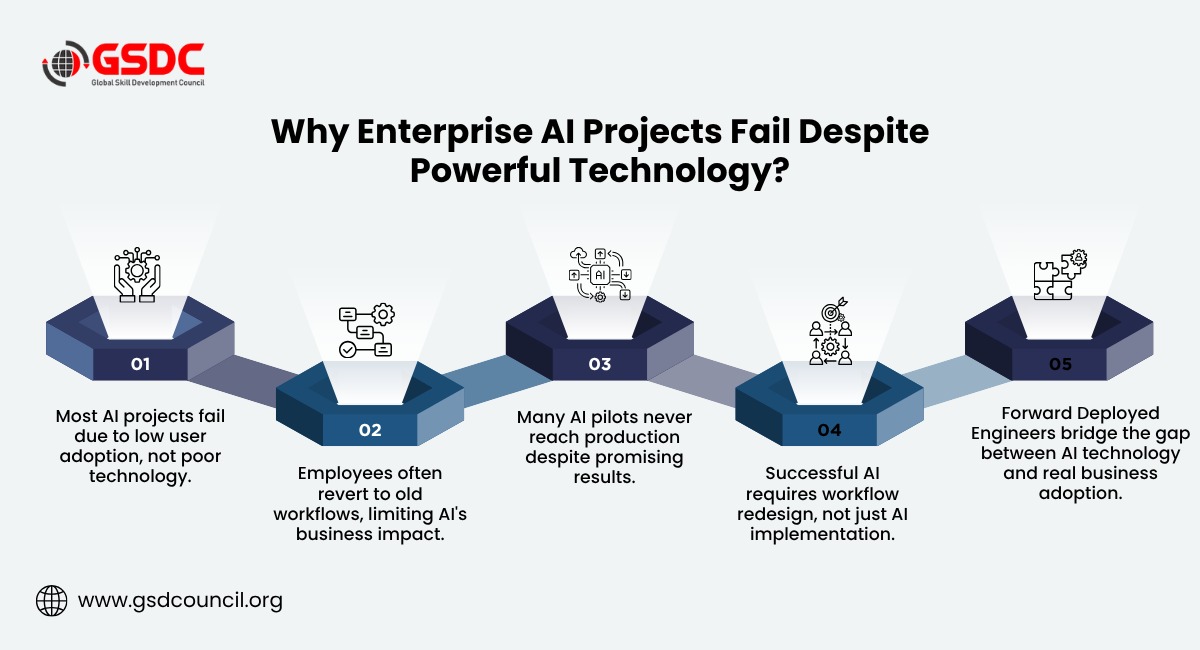
A technically excellent solution creates no business value if employees never integrate it into their daily work. Many enterprise applications quietly disappear not because they are broken, but because users simply return to their old methods.
The webinar references several industry findings that reinforce this challenge:
- Research from MIT's Initiative on the Digital Economy found that a significant majority of Generative AI pilot projects fail to produce measurable business value.
- S&P Global reported that many AI proof-of-concept projects are abandoned before reaching production.
- McKinsey found that while most organizations use AI in at least one business function, only a small percentage have redesigned workflows to fully benefit from AI.
These findings highlight an important lesson:
Enterprise AI success depends more on adoption than on technology.
Forward Deployed Engineers are hired specifically to solve this adoption problem.
The Real Product Is Adoption, Not Software
One of the strongest messages from the webinar is that enterprises should stop viewing AI models as the final product.
Instead, the real product is organizational adoption.
Organizations often make the mistake of adding AI on top of outdated processes rather than redesigning workflows around AI capabilities.
Imagine a marketing department that has followed the same content approval process for twenty years. Simply adding an AI assistant to that workflow rarely produces transformational results. Instead, the workflow itself needs to be redesigned to remove unnecessary manual steps and leverage automation effectively.
The webinar emphasizes that organizations often respond with:
"This is how we've always done it."
This mindset prevents AI from delivering its full value.
Forward Deployed Engineers challenge these assumptions by asking questions such as:
- Why does this process exist?
- Is every step still necessary?
- Which tasks should humans perform?
- Which tasks can AI automate?
- How can the workflow be redesigned rather than simply automated?
Instead of adapting AI to old processes, they redesign business processes to maximize AI's strengths.
What Makes a Forward Deployed Engineer Different?
Traditional software engineering focuses on building scalable products for thousands of customers.
Consultants analyze business challenges and typically deliver recommendations through presentations or reports.
A Forward Deployed Engineer combines both worlds—but goes much further.
Rather than simply writing code or preparing strategy documents, FDEs embed themselves within customer organizations to understand business operations firsthand.
Their responsibility extends beyond software delivery.
They own the complete outcome.
This means they:
- Understand customer workflows
- Build customized AI solutions
- Monitor how employees use them
- Improve adoption
- Gather feedback
- Convert successful customer solutions into reusable product features
The webinar describes this as creating a continuous feedback loop between customers and product teams.
Instead of merely shipping features, FDEs ensure those features solve real problems.
Their success is measured not by lines of code but by measurable customer impact.
The Real Product Is Adoption, Not Software
One of the most valuable concepts discussed during the webinar is systems thinking.
Many engineers naturally focus on writing code.
Forward Deployed Engineers first focus on understanding the complete system before writing a single line of code.
This involves mapping:
- Business workflows
- Human decision points
- Data flows
- Existing software
- Manual processes
- Organizational dependencies
The webinar points out that many critical business processes are undocumented.
Often, organizations rely on experienced employees who have accumulated years of institutional knowledge.
An FDE spends time with these stakeholders to understand why processes exist before attempting automation.
Interestingly, the webinar notes that:
The AI model is usually the easiest part of the project.
The difficult part is understanding people, workflows, communication, approvals, and organizational behavior.
This human-centered approach separates successful AI deployments from failed ones.
What Makes a Forward Deployed Engineer Different?
Traditional software engineering focuses on building scalable products for thousands of customers.
Consultants analyze business challenges and typically deliver recommendations through presentations or reports.
A Forward Deployed Engineer combines both worlds—but goes much further.
Rather than simply writing code or preparing strategy documents, FDEs embed themselves within customer organizations to understand business operations firsthand.
Their responsibility extends beyond software delivery.
They own the complete outcome.
This means they:
- Understand customer workflows
- Build customized AI solutions
- Monitor how employees use them
- Improve adoption
- Gather feedback
- Convert successful customer solutions into reusable product features
The webinar describes this as creating a continuous feedback loop between customers and product teams.
Instead of merely shipping features, FDEs ensure those features solve real problems.
Their success is measured not by lines of code but by measurable customer impact.
Thinking Like a Systems Engineer Instead of Just a Developer
One of the most valuable concepts discussed during the webinar is systems thinking.
Many engineers naturally focus on writing code.
Forward Deployed Engineers first focus on understanding the complete system before writing a single line of code.
This involves mapping:
- Business workflows
- Human decision points
- Data flows
- Existing software
- Manual processes
- Organizational dependencies
The webinar points out that many critical business processes are undocumented.
Often, organizations rely on experienced employees who have accumulated years of institutional knowledge.
An FDE spends time with these stakeholders to understand why processes exist before attempting automation.
Interestingly, the webinar notes that:
The AI model is usually the easiest part of the project.
The difficult part is understanding people, workflows, communication, approvals, and organizational behavior.
This human-centered approach separates successful AI deployments from failed ones.
Solving the Right Problem Before Building AI
Another important lesson is that customers rarely describe technical problems accurately.
Instead, they use vague statements such as:
- "The system is slow."
- "It doesn't work."
- "It's unreliable."
- "Our process is inefficient."
The Forward Deployed Engineer's role is to translate these opinions into measurable engineering objectives.
For example:
Instead of accepting "The application is slow," they investigate:
- Which process is slow?
- How often does it happen?
- Under what conditions?
- What response time should be achieved?
By converting subjective complaints into measurable metrics, FDEs define problems that engineering teams can actually solve.
The webinar even shares a striking example where a model's accuracy improved dramatically simply by renaming one response field from "Final Choice" to "Final Answer."
The AI model remained unchanged.
The prompt structure changed.
This reinforces an important engineering principle:
Small implementation details often produce massive improvements.
Building Trust Through Continuous Customer Collaboration
Unlike traditional development teams that work independently before delivering finished software, Forward Deployed Engineers collaborate with customers throughout the entire project lifecycle.
Their job is not simply to deliver code; it is to understand how the customer works, identify pain points, and ensure the solution fits naturally into existing business operations.
This requires frequent communication with different stakeholders, including business leaders, technical teams, and end users. Instead of making assumptions, FDEs validate ideas early and often, adjusting the solution based on real feedback.
The webinar emphasizes that every customer engagement should include a sponsor within the organization. This internal champion helps prioritize requirements, validates decisions, and ensures the project aligns with business objectives. By working closely with this sponsor, the FDE can make informed decisions while maintaining stakeholder confidence.
Ultimately, trust is built through collaboration, transparency, and delivering measurable improvements, not through lengthy presentations or technical jargon.
Designing AI Workflows That People Actually Use
A recurring message throughout the webinar is that artificial intelligence alone does not create business value. What matters is how AI in business fits into the broader workflow. Forward Deployed Engineers focus on integrating AI for enterprise into the tools employees already use, rather than forcing users to adopt entirely new platforms. Whether teams work in Figma, Salesforce, Adobe Experience Manager (AEM), Digital Asset Management (DAM) systems, or command-line interfaces, the goal is to meet users where they are.
Instead of asking employees to change everything about their daily routines, FDEs design lightweight integrations through APIs, plugins, scripts, webhooks, or enterprise automation pipelines. This minimizes disruption while improving efficiency across enterprise AI environments.
The webinar also highlights the importance of human-in-the-loop systems. Although artificial intelligence can automate repetitive tasks, critical decisions often require human review. By combining AI automation with human oversight, organizations improve reliability, reduce errors, and increase confidence in AI-assisted workflows.
This balanced approach encourages adoption because employees view AI as a supportive assistant rather than a replacement, enabling organizations to scale successful enterprise AI use cases and deliver long-term business value.
Documentation Should Drive Adoption
Effective documentation goes beyond recording technical details; it helps users adopt and maintain AI solutions successfully.
- Keep documentation close to the codebase for easier access and maintenance.
- Document architecture, workflows, and key decisions to simplify future development.
- Create user-friendly resources such as demos, implementation guides, and tutorials.
- Focus on long-term usability so both engineers and customers can confidently use and expand the solution.
Well-structured documentation improves onboarding, accelerates adoption, and supports the long-term success of enterprise AI projects.
Become a Certified Forward Deployed Engineer with GSDC
As the demand for AI professionals who can bridge the gap between technology and business continues to grow, earning the Certified Forward Deployed Engineer credential from GSDC professionals builds the practical skills needed for this evolving role.

The Certified Forward Deployed Engineer focuses on enterprise AI implementation, solution architecture, workflow optimization, customer-centric problem solving, AI deployment strategies, and cross-functional collaboration, the same competencies highlighted throughout this webinar.
Whether you are a software engineer, AI engineer, solutions architect, consultant, or technical product professional, the GSDC Certified Forward Deployed Engineer certification validates your ability to design, deploy, and optimize AI solutions that drive real business outcomes, making you a valuable asset in modern AI-driven enterprises.
Four Habits of Successful Forward Deployed Engineers
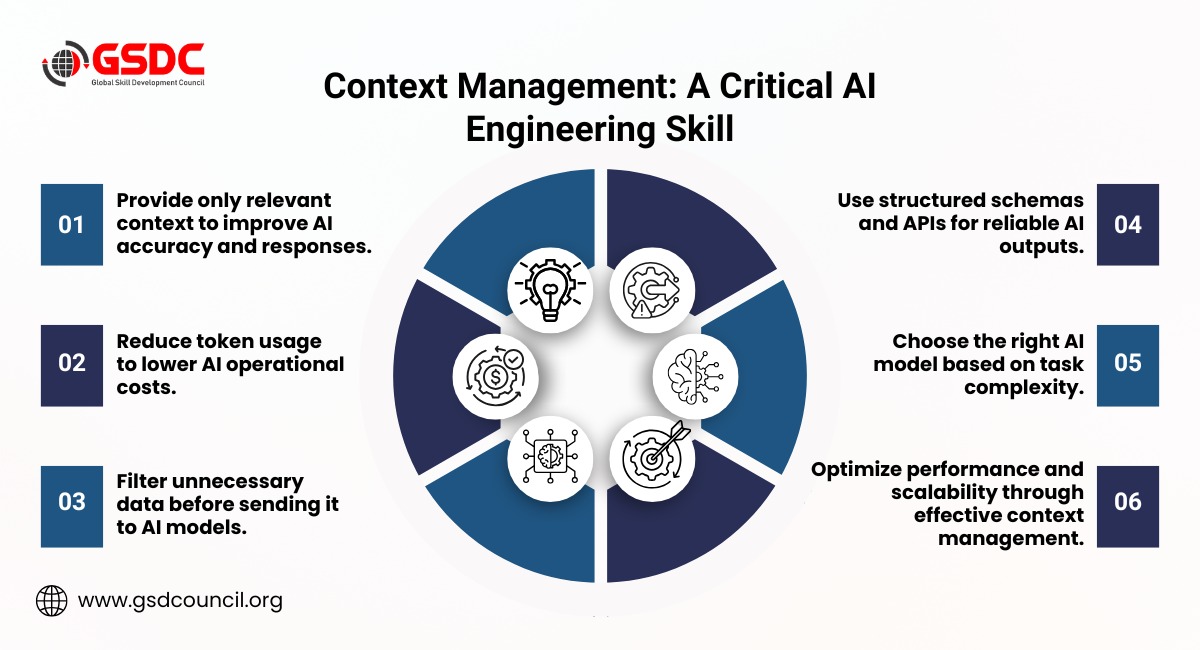
Successful Forward Deployed Engineers share four key habits that help them deliver lasting business value and drive successful enterprise AI initiatives:
- Prioritize adoption over delivery: Success is measured by whether customers continue using the solution, not just by launching it. This is essential for AI in business and long-term AI for enterprise success.
- Think in systems: They understand entire business workflows, including people, processes, and data, before building solutions, helping identify the right enterprise AI use cases.
- Validate with real data: They test ideas early using actual customer data to reduce risks and prove business value across real-world AI use cases.
- Balance AI with human judgment: While artificial intelligence speeds up development, engineers ensure every solution meets real business needs through careful oversight, especially in enterprise generative AI environments.
These habits enable Forward Deployed Engineers to create AI solutions that drive measurable business outcomes and long-term adoption.
Conclusion
The webinar makes it clear that the future of enterprise AI is not defined solely by better models or more advanced algorithms. Success depends on understanding customer problems, redesigning workflows, and ensuring that artificial intelligence is successfully adopted across the organization. As more companies embrace AI in business, the focus is shifting from simply deploying AI tools to creating measurable business outcomes through effective AI strategy and workflow transformation.
Forward Deployed Engineers represent a new generation of AI professionals who combine technical expertise with business understanding and customer collaboration. Rather than measuring success by the amount of code written, they focus on customer adoption, enterprise automation, and delivering scalable AI for enterprise solutions. Whether implementing enterprise generative AI or solving complex operational challenges, these professionals ensure that technology creates long-term business value.
As organizations continue investing in generative AI for business and expanding enterprise AI use cases, professionals who can bridge the gap between technology and business will become increasingly valuable. By thinking beyond software development and embracing customer-centric problem-solving, Forward Deployed Engineers play a critical role in helping enterprises transform artificial intelligence from an exciting experiment into a lasting competitive advantage. For professionals wondering what is a Forward Deployed Engineer and how to build a successful career in this field, developing expertise in enterprise AI implementation, customer collaboration, and AI deployment is becoming more important than ever.

Related Certifications
Frequently Asked Questions
A Forward Deployed Engineer is an AI professional who works directly with customers to solve business challenges by designing, deploying, and optimizing AI for enterprise solutions. Unlike a traditional forward deployed software engineer, an FDE focuses on customer outcomes, workflow transformation, and ensuring enterprise-wide AI adoption.
Most enterprise AI initiatives fail because of poor user adoption, weak workflow integration, and unclear business objectives—not because the underlying artificial intelligence technology is ineffective. Successful AI projects require redesigned workflows, stakeholder engagement, and a well-defined AI strategy.
Consultants primarily provide recommendations and strategic advice, while a Forward Deployed Engineer works alongside customers to build, deploy, and continuously improve AI solutions. Similar to a modern deployment engineer, they ensure solutions are adopted successfully and contribute to long-term product improvements.
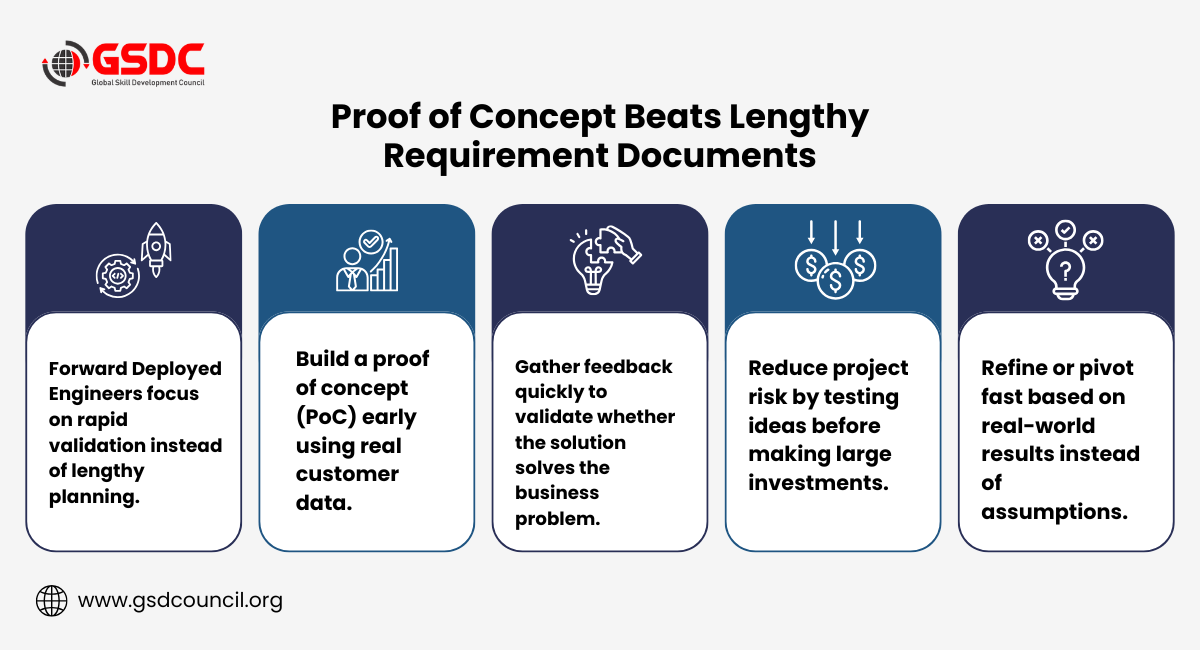
Proofs of concept validate enterprise AI use cases early by demonstrating business value before full-scale deployment. They help organizations reduce implementation risks, gain stakeholder confidence, and identify the most effective AI use cases for their business.
To become a successful Forward Deployed Engineer, professionals need expertise in AI implementation, systems thinking, enterprise automation, workflow design, rapid prototyping, customer communication, and problem-solving. As generative AI for business adoption continues to grow, these skills are becoming increasingly valuable across industries.
Stay up-to-date with the latest news, trends, and resources in GSDC
If you like this read then make sure to check out our previous blogs: Cracking Onboarding Challenges: Fresher Success Unveiled
Not sure which certification to pursue? Our advisors will help you decide!