Agentic AI Developer Certification: Curriculum, Skills & Career ROI Explained
Written by Emily Hilton
- What Is an Agentic AI Developer Certification?
- Why Agentic AI Developer Skills Matter for 2027?
- Agentic AI Developer Certification Curriculum: What Will You Learn?
- What Jobs Can an Agentic AI Developer Get?
- Agentic AI Developer Salary: What the Data Actually Shows
- What Is the Career ROI of an Agentic AI Certification?
- Agentic AI Developer Career: What Will Matter Most in 2027?
- Final Takeaway
Artificial intelligence is moving into a new phase. Instead of simply generating text, images, or code in response to prompts, AI systems are increasingly capable of planning tasks, using tools, accessing information, making decisions, and completing multi-step workflows with limited human intervention. This shift toward autonomous and semi-autonomous systems is driving growing demand for professionals who can design and deploy reliable AI agents.
This is where an agentic AI developer certification can provide a structured learning path. A well-designed certification can help developers build practical agentic AI skills, understand modern development frameworks, and demonstrate their ability to create production-oriented AI agent solutions.
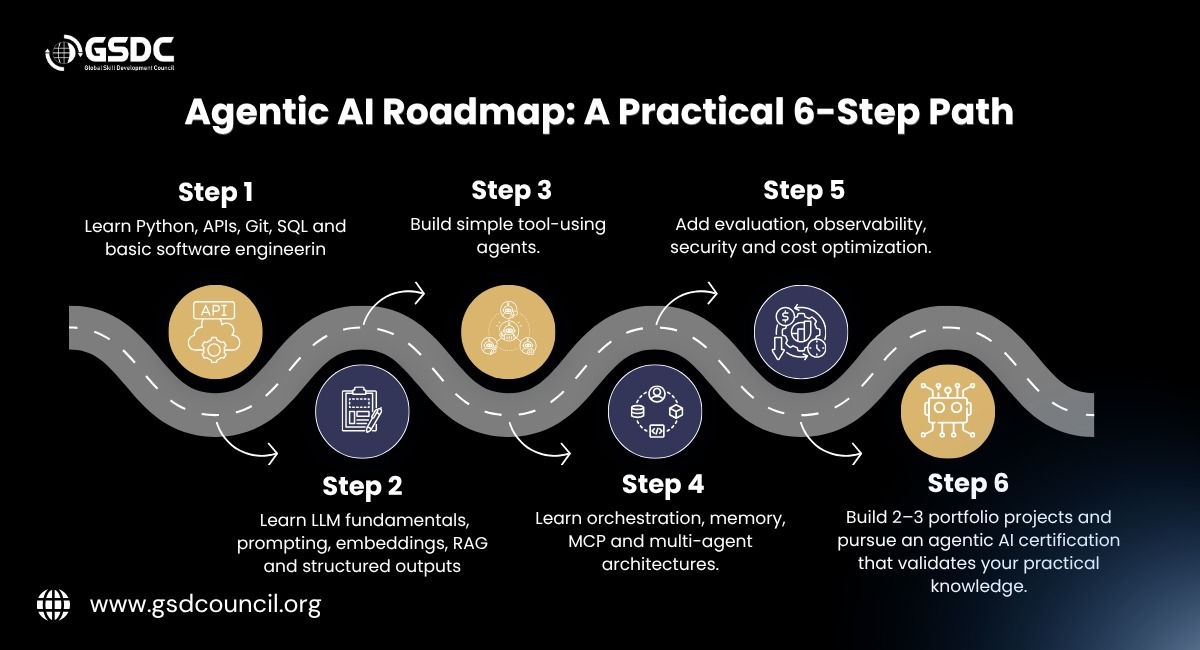
With 2027 approaching, this article explores the agentic AI roadmap, essential skills, certification curriculum, emerging agentic AI developer jobs, salary considerations, and the potential career ROI of pursuing an agentic AI certification.
For developers, the opportunity is therefore expanding beyond prompt engineering toward agent architecture, software engineering, orchestration, evaluation, security, and production deployment.
What Is an Agentic AI Developer Certification?
An agentic AI certification validates knowledge and practical capabilities related to designing, developing, deploying, evaluating, and governing AI agents.
Unlike a conventional AI course focused primarily on machine learning concepts or generative AI prompting, an agent-focused program should teach how an AI system can move through a workflow:
Understand → Plan → Select tools → Execute → Observe → Evaluate → Adapt
A strong certification should therefore combine AI fundamentals with software engineering and production practices.
Current certification frameworks illustrate this shift. The GSDC Agentic AI Developer Certification focuses on building practical, production-ready AI agents for emerging 2027 use cases. It covers agent architecture, LLMs, memory, state management, RAG, tool integration, and frameworks such as LangChain, AutoGen, CrewAI, and LangGraph.
Learners also explore multi-agent systems, orchestration, testing, debugging, observability, and deployment using modern cloud and container technologies. Security topics include guardrails, prompt-injection defense, rate limiting, retries, and human-in-the-loop controls. With hands-on capstone projects, the certification helps learners develop skills relevant to an Agentic AI Developer Career.
Why Agentic AI Developer Skills Matter for 2027?
The developer role is changing rapidly.
Microsoft reported in 2025 that more than 15 million developers were already using GitHub Copilot, while more than 230,000 organizations had used Copilot Studio to build AI agents and automations.
More recent developer research suggests that agentic development is becoming increasingly mainstream. JetBrains' 2026 Developer Ecosystem Survey, based on more than 15,000 professional developers, found that 90% of surveyed developers were using AI coding agents at work at least weekly, with 68% using them daily during the May–July 2026 period. This does not mean every developer needs to become an AI specialist. It does suggest that developers who understand how AI agents interact with software systems may be better positioned for emerging roles.
The World Economic Forum's Future of Jobs Report 2025 identifies AI and big data as the fastest-growing skill category through 2030, while AI and machine-learning specialists and software/application developers appear among the fastest-growing job roles.
Agentic AI Developer Certification Curriculum: What Will You Learn?
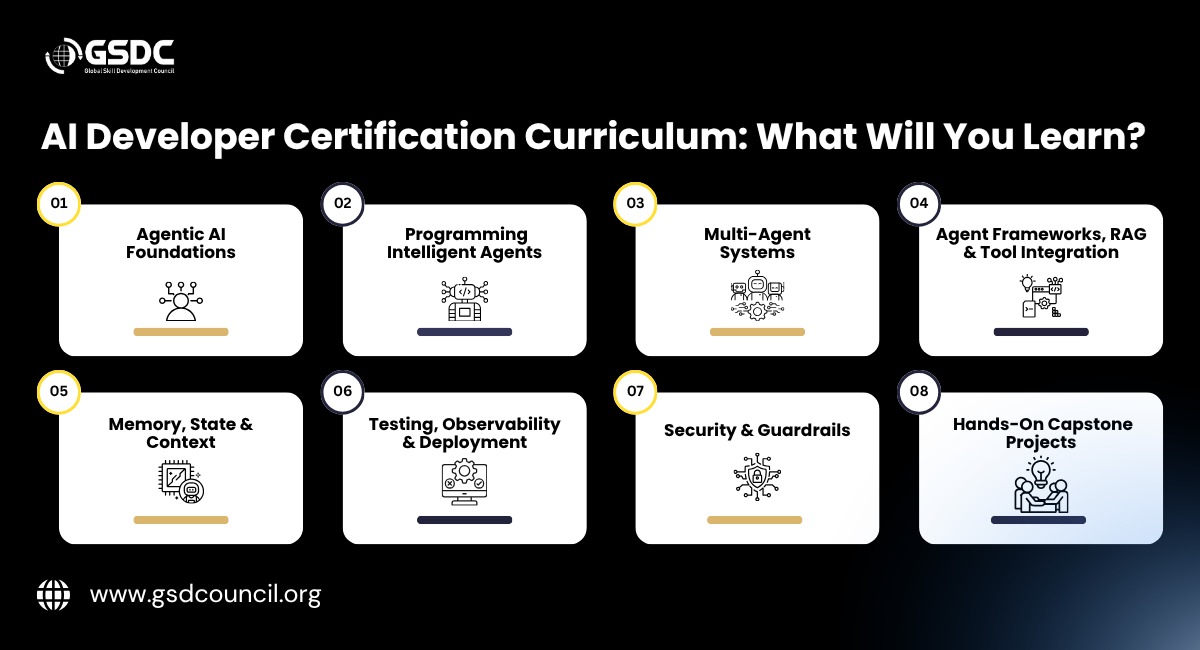
A future-focused agentic AI roadmap should take developers from AI fundamentals to building, testing, securing, and deploying autonomous AI systems. The GSDC Agentic AI Developer Certification follows this practical progression, covering the core technologies and development practices needed for modern agentic applications.
1. Agentic AI Foundations
The curriculum begins with the fundamentals of Agentic AI, including agent types, agent lifecycles, event-driven and reactive programming, state management, and memory. Learners are also introduced to popular agent development frameworks such as LangChain, AutoGen, CrewAI, and Semantic Kernel.
2. Programming Intelligent Agents
Developers learn how to build agents around goals, planning, reasoning, and actions. Key areas include function calling, tool and plugin integration, LLM-based reasoning, vector stores, state graphs, and planning approaches such as ReAct and Tree-of-Thought.
3. Multi-Agent Systems
The certification explores how multiple specialized agents can work together through agent-to-agent communication, task delegation, role assignment, synchronization, conflict resolution, and consensus mechanisms. This provides an understanding of how complex workflows can be divided and orchestrated across agents.
4. Agent Frameworks, RAG & Tool Integration
Learners gain hands-on exposure to frameworks including LangChain, LangGraph, AutoGen, and CrewAI, while exploring workflow orchestration and stateful applications. The curriculum also covers LLM integration, APIs, function calling, plugins, external tools, and Retrieval-Augmented Generation (RAG)—essential components of modern agentic applications.
5. Memory, State & Context
A major part of building effective agents is managing context. The program covers short- and long-term memory, vector databases, context-window management, summarization, checkpoints, caching, knowledge graphs, and persistent state, helping developers create agents capable of maintaining relevant information across interactions.
6. Testing, Observability & Deployment
Building an agent is only the beginning. Developers learn testing, simulation, debugging, behavioral logging, observability, and hallucination analysis before moving into production deployment. The curriculum also covers Docker, Kubernetes, cloud deployment, APIs, rate limiting, retries, and reliability mechanisms.
7. Security & Guardrails
Because agents can access tools and perform actions, security is critical. The certification addresses prompt-injection and jailbreak testing, secure tool execution, guardrails, filters, traceability, logging, fallback strategies, and human-in-the-loop controls.
8. Hands-On Capstone Projects
The program concludes with practical projects, including voice-agent development and a full-stack agentic chatbot, allowing learners to apply their knowledge to end-to-end agentic AI applications.
Overall, the curriculum progresses from Agentic AI fundamentals → Intelligent Agents → RAG & Tools → Memory → Multi-Agent Systems → Testing → Deployment → Security → Capstone Projects, helping learners develop practical agentic AI skills relevant to an evolving 2027 job market.
Explore the complete GSDC Agentic AI Developer Certification curriculum, modules, and learning outcomes.
What Jobs Can an Agentic AI Developer Get?
The emergence of agents is creating or reshaping several technical roles.
Potential agentic AI developer jobs include:
- Agentic AI Developer
- AI Engineer
- Generative AI Engineer
- AI Application Developer
- LLM Engineer
- AI Automation Engineer
- AI Solutions Engineer
- AI Platform Engineer
- AI Agent Architect
- Machine Learning Engineer
The exact job title varies considerably between employers. Some organizations may advertise an "AI Engineer" position while expecting the candidate to build agentic systems.
The broader employment outlook is also relevant. U.S. Bureau of Labor Statistics projections show software developer employment growing 15.8% from 2024 to 2034, representing approximately 267,700 additional jobs, while data scientist employment is projected to grow 33.5% over the same period.
These figures are not forecasts specifically for agentic AI developers, because that occupation is not separately classified by BLS. They provide broader context for the software and AI engineering market.
Agentic AI Developer Salary: What the Data Actually Shows
Compensation is genuinely split into two tiers, and understanding that split matters more than chasing a single average.
Broad market (US, 2026 data)
"$115,000 – $193,000 annually" range:
- ZipRecruiter data via Washington state salary page, March 2026 shows an average $115,244/year, with the 25th–75th percentile range at $95,100–$131,900
- As per Glassdoor, average $192,826/year for "Agentic AI Engineer," with a typical range of $152,427–$247,443
Top tier (frontier labs, hot AI startups):
- Total compensation: $600,000 – $1,000,000+
- A small population relative to the broader market of engineers building agentic features at enterprises and funded startups, who typically earn $150,000 – $500,000
Other key figures:
- Salary premium for agentic AI specialization over generalist software engineering: 30–50%
- Premium for senior multi-agent talent specifically: 2–3x
- India market: freshers starting around ₹8 LPA, scaling to ₹1 crore+ for experienced architects
- Other strong markets: Germany, Canada, Australia, Singapore, UAE
As per the report, 31.9% year-over-year AI spending growth is projected between 2025 and 2029, reaching $1.3 trillion by 2029 and exceeding 26% of all worldwide IT spending, driven by agentic AI-enabled applications.
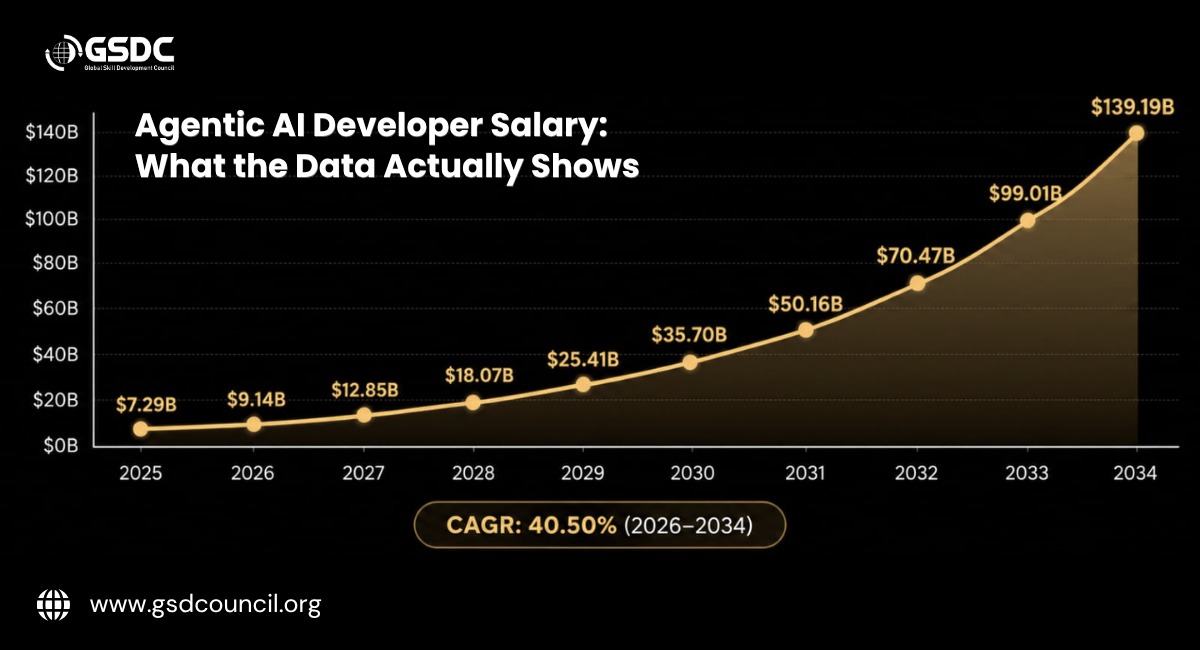
The agentic AI market is set to grow from $7.29B in 2025 to $139.19B by 2034, roughly a 19x increase in under a decade, at a compound annual growth rate of 40.50% (2026–2034). Growth is gradual through 2028 (staying under $20B), then accelerates sharply from 2029 onward, nearly doubling every two years in the back half of the decade (e.g., $50.16B in 2030 to $99.01B in 2033).
These numbers should not be treated as guaranteed agentic AI developer salary levels. They are market snapshots from salary-reporting platforms, and compensation depends on experience, location, company, technical depth, role scope, and the ability to build production systems.
For candidates, the more useful strategy is to develop skills that qualify them for higher-responsibility engineering roles rather than targeting a specific salary number.
What Is the Career ROI of an Agentic AI Certification?
The ROI of certification can be considered across four areas.
1. Skill ROI: A structured curriculum can reduce the time spent jumping between disconnected tutorials and frameworks.
2. Career ROI: A relevant credential can demonstrate focused knowledge when your previous job title does not explicitly mention AI engineering.
3. Portfolio ROI: The strongest programs include projects. A production-style agent, RAG application, multi-agent workflow, or evaluated automation can become evidence of practical ability.
4. Learning ROI: Agentic AI changes quickly. A certification can provide a structured foundation, but continuous learning remains essential.
Agentic AI Developer Career: What Will Matter Most in 2027?
The Agentic AI Developer Career is unlikely to be defined simply by knowing how to call an LLM API. GSDC’s Agentic AI Developer Certification prepares professionals to build and deploy intelligent, autonomous AI systems. The curriculum covers Generative AI and LLM foundations, agent architecture, tool use, MCP, orchestration, and production implementation. Designed for the evolving AI landscape, it helps developers develop practical skills to create reliable, scalable, and future-ready agentic AI solutions.
The valuable developer will increasingly be the person who can answer questions such as:
Can this agent complete the task reliably?
What happens when the agent makes a wrong decision?
Which tools is it allowed to access?
How do we evaluate its performance?
How much does every task cost?
Can we monitor its actions in production?
When should a human intervene?
Can the system scale securely?
That is why Agentic AI Developer Certification is the most useful way to develop agentic AI skills, combining software engineering, AI application development, systems thinking, security, evaluation, and business understanding.
Final Takeaway
By 2027, agentic AI development is likely to extend well beyond prompting and basic chatbot development. Current certification frameworks, enterprise surveys, and developer adoption data already show growing emphasis on tool use, agent orchestration, memory, evaluation, governance, security, and production deployment.
An agentic AI developer certification can be valuable when it provides a structured path from fundamentals to production-grade implementation. But the certificate itself should be viewed as one component of career development.
The strongest combination is:
Certification + Agentic AI Skills + Portfolio Projects + Production Experience + Continuous Learning
For professionals planning their agentic AI learning roadmap, 2027 is less about simply learning how to build an agent and more about learning how to build reliable, secure, observable and business-ready agentic systems.

Related Certifications
Stay up-to-date with the latest news, trends, and resources in GSDC
If you like this read then make sure to check out our previous blogs: Cracking Onboarding Challenges: Fresher Success Unveiled
Not sure which certification to pursue? Our advisors will help you decide!