How to Get Into AI With No Experience: A Complete Career Roadmap
Written by Emily Hilton
- Is AI a Good Career to Start Right Now?
- Career in Artificial Intelligence: What Roles Actually Exist
- Essential Skills for a Career in AI
- Which AI Career Path Should You Choose?
- What Should You Learn First to Get Into AI?
- How to Start a Career in Artificial Intelligence With No Experience
- AI Career Roadmap 2026: A Realistic Timeline
- How to Get a Job in AI: Practical Tips That Actually Move the Needle
- Is AI Engineering a Good Career Specifically?
- Final Thoughts
You don't need a computer science degree to build a career in AI. You need a plan, and that's what this blog gives you.
The field can look intimidating from the outside, full of jargon like neural networks, transformers, and large language models. But here's something that might surprise you: according to the World Economic Forum's Future of Jobs Report 2025, 70% of employers worldwide plan to hire people specifically for new AI-related skills over the next few years, and this demand isn't limited to candidates with computer science degrees. Companies need people who can apply AI to real problems, and many of them are building that talent from scratch.
Below is exactly how to get from zero experience to a job-ready skill set, role by role and step by step.
Is AI a Good Career to Start Right Now?
Short answer: yes, and the numbers back it up.
The World Economic Forum's own Future of Jobs Report 2025 found that AI and machine learning specialist roles are among the fastest-growing job categories in the world right now, in percentage terms. That doesn't mean every AI job is a "data scientist" or "machine learning engineer." The field is much broader than that, and a lot of the fastest growth is happening in roles that don't require a PhD or years of coding experience.
A few reasons AI stands out as a career choice today:
Demand is outpacing supply.
The same WEF report found that nearly 40% of core job skills are expected to change by 2030, and 63% of employers cite the resulting skills gap as their single biggest barrier to growth. That gap is exactly where a motivated newcomer can step in.
Entry points are widening.
Roles in AI operations, prompt engineering, AI-assisted content, quality testing, and data annotation didn't exist five years ago and now serve as legitimate stepping stones.
Salaries are climbing faster than average.
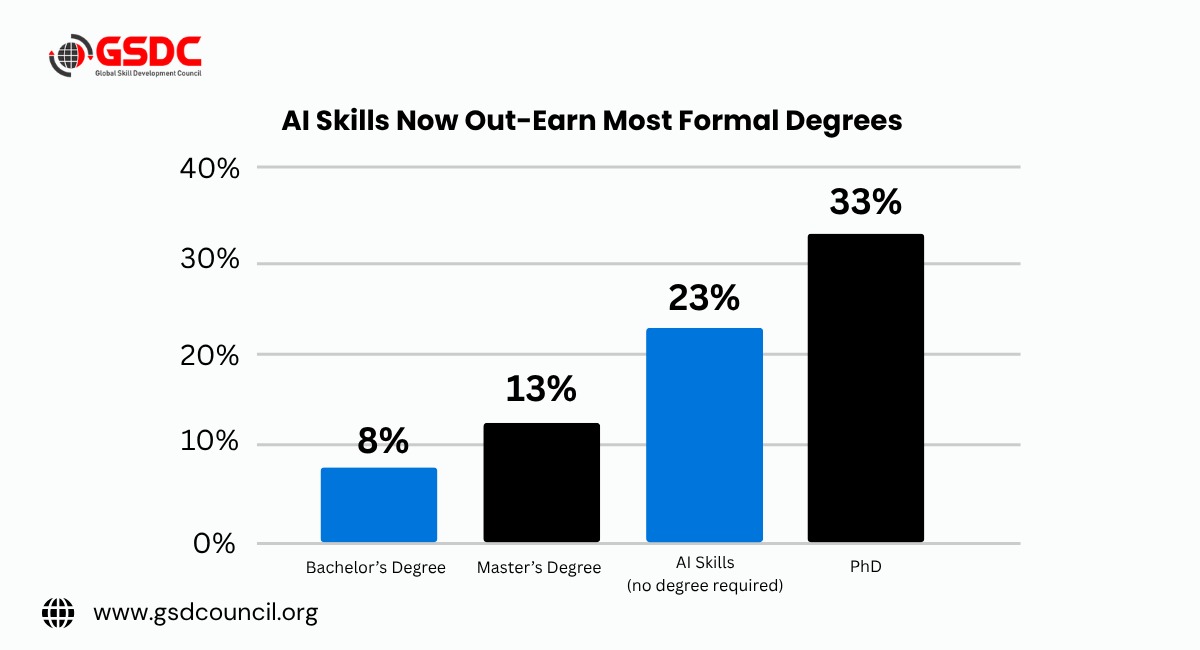
A study by the Oxford Internet Institute, University of Oxford, analyzing over 10 million UK job postings and published by the World Economic Forum in February 2026, found that candidates with AI skills commanded an advertised salary about 23% higher than comparable candidates without those skills, outpacing the roughly 13% premium tied to a master's degree.
It's not just a tech-industry trend.
Healthcare, finance, retail, manufacturing, and education are all hiring for AI-adjacent roles.
That said, "good career" doesn't mean "easy career." You'll need to build real, demonstrable skills before anyone hands you a job offer.
Career in Artificial Intelligence: What Roles Actually Exist
One reason people feel stuck before they even start is that they assume AI careers begin and end with "machine learning engineer." In reality, a career in artificial intelligence covers a wide spread of roles, each needing a different mix of skills.
Role | What They Do | Technical Skills Needed | Entry Barrier |
AI/Prompt Engineer | Designs prompts and workflows to get reliable outputs from AI models | Strong writing, basic logic, familiarity with AI tools | Low to moderate |
Data Annotator/Labeler | Prepares and tags data used to train AI models | Attention to detail, no coding required | Low |
AI Product Manager | Bridges business needs and AI capabilities for a product | Basic understanding of AI concepts, no coding required | Moderate |
Machine Learning Engineer | Builds and deploys models into production systems | Python, statistics, ML frameworks | High |
AI Ethics/Policy Analyst | Reviews AI systems for fairness, safety, and compliance | Research and analytical skills, no coding required | Moderate |
AI Business Analyst | Identifies where AI can solve operational problems | Data literacy, spreadsheets, basic SQL | Moderate |
AI Content Strategist | Uses AI tools to plan and produce content at scale | Writing, prompt design, no coding required | Low |
Data Scientist | Analyzes data and builds predictive models | Python, statistics, machine learning | High |
Notice that several of these don't require deep programming knowledge on day one. That's your opening. For most of the roles above, especially the lower-barrier ones, a credential like the Certified Artificial Intelligence Foundation certification can do a lot of the early credibility-building for you, since it signals to employers that you understand the core concepts even before you've held an AI job title.
Essential Skills for a Career in AI
Before mapping out steps, it helps to know exactly what skills employers are actually screening for. You don't need all of these to start, but the more boxes you tick, the faster you'll move.
Technical skills:
- Basic Python (this is the most requested language in AI job postings by a wide margin)
- Understanding of how machine learning models work, even at a conceptual level
- Comfort with data: cleaning, organizing, and interpreting it
- Familiarity with AI tools like ChatGPT, Claude, or similar platforms for practical use cases
- SQL basics, since most AI work involves querying data somewhere along the line
Non-technical skills:
- Problem framing, meaning the ability to spot where AI can realistically help
- Clear communication, since you'll often need to explain AI outputs to non-technical teams
- Critical thinking, so you can catch when a model's output is wrong or biased
- Adaptability, because tools and best practices in this field change every few months
A useful way to think about it: technical skills get you noticed, but the non-technical ones often decide who actually gets hired and promoted. If you're not sure how strong your current skill set already is, organizations like the Global Skill Development Council (GSDC) offer structured assessments and courses that map directly to skills like these, so you can see where the real gaps are instead of guessing.
Which AI Career Path Should You Choose?
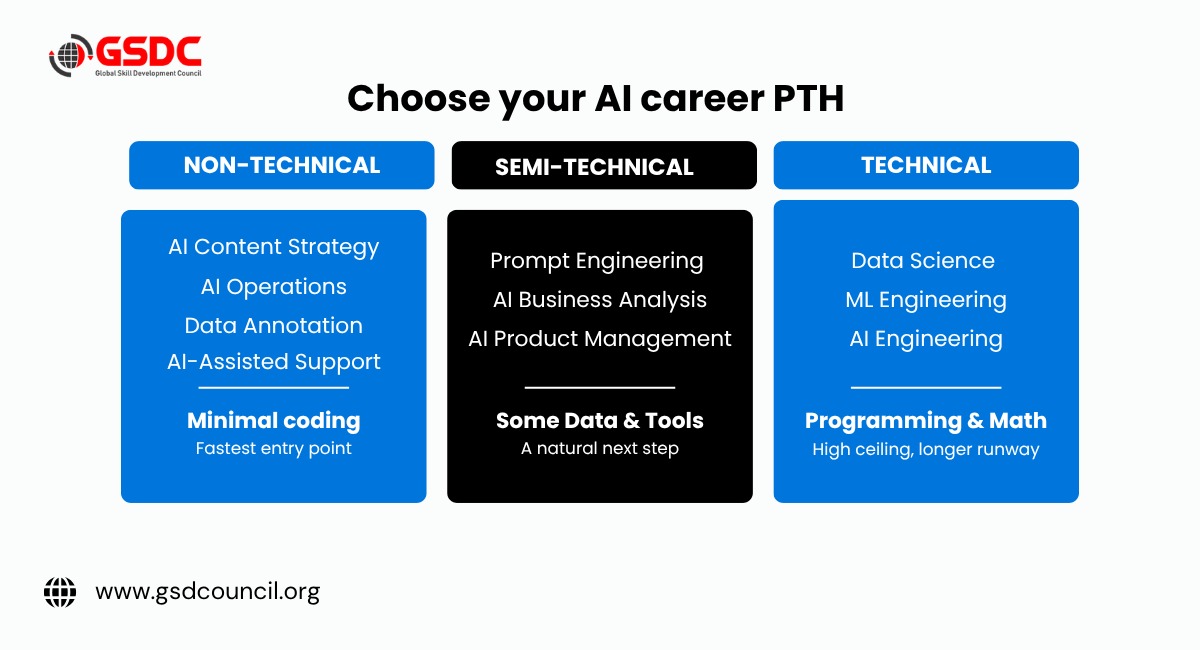
Before you pick a starting point, it helps to know that AI careers roughly split into three tiers of technical depth. You don't have to commit to one forever, but choosing a starting tier will make your first few months far more focused.
- Non-technical: AI content strategy, AI operations, data annotation, AI-assisted customer support. Minimal coding, fastest to break into, a solid first step if you're switching careers.
- Semi-technical: Prompt engineering, AI business analysis, AI product roles. Some comfort with data and tools helps, but deep coding isn't mandatory.
- Technical: Data science, machine learning engineering, AI engineering. Requires programming, statistics, and often a longer runway to become job-ready.
If you're still unsure, a simple rule of thumb: start non-technical or semi-technical to get your foot in the door and build real workplace experience with AI tools, then move technical later if that's where your interest and aptitude point you. Plenty of people build long, successful careers without ever needing to become deeply technical.
What Should You Learn First to Get Into AI?
This is probably the single most common question beginners ask, and the honest answer depends on which of the three tiers above you're aiming for. Here's a simple learning order for each path:
Whichever path you're on, notice that "AI fundamentals" comes first in all three. Understanding how models actually work, even at a basic level, makes every skill you learn afterward click into place faster.
How to Start a Career in Artificial Intelligence With No Experience
Here's the step-by-step path that works for most beginners, regardless of their starting point.
Step 1: Pick a Lane, Not the Whole Highway
Trying to learn "all of AI" at once is the fastest way to quit. Instead, choose one entry point based on your current strengths.
- Strong with words? Look at AI content, prompt engineering, or AI-assisted writing roles.
- Comfortable with numbers or spreadsheets? Data analysis or data annotation is a natural fit.
- Good at explaining things simply? AI product or business analyst roles will suit you.
- Enjoy logic and puzzles? Start learning Python and head toward machine learning.
Step 2: Learn the Fundamentals Through Structured Courses
Free tutorials and YouTube videos are genuinely useful for exploration, and plenty of people learn real skills that way. But structured courses can be especially helpful when you're starting from zero, because they give you a clear learning path, sequence skills in the right order, and often end with a credential you can point to on a resume. Look for courses covering:
- Python for data and AI
- Introduction to machine learning concepts
- Practical use of generative AI tools
- Data literacy and basic statistics
This is also where a program like the ones offered by the Global Skill Development Council can help, since structured, industry-recognized certifications give beginners a guided curriculum instead of piecing one together from scattered resources.
Step 3: Build Projects, Not Just Certificates
Certificates show your commitment to learning, while projects show how well you can apply those skills. The strongest beginner portfolio usually includes both. Even small projects count:
- Build a chatbot using a free API
- Clean and analyze a public dataset and write up your findings
- Automate a repetitive task at your current job using an AI tool
- Create a portfolio piece showing before-and-after results of an AI-assisted workflow
Put these on GitHub, a personal website, or even a simple LinkedIn post. As a general rule, hiring managers respond better to evidence they can see than to claims on a resume.
Step 4: Get Comfortable With the Tools Employers Actually Use
It's not enough to know AI exists. You need hands-on time with the tools companies are actually integrating into their workflows, and which ones matter most depends on your chosen path:
- Generative AI tools for prompting and content workflows, useful across all three tiers
- Automation platforms for building AI-powered processes without heavy coding
- Python notebooks for technical learners working with data and models directly
- Data visualization and analytics tools for turning raw data into insights
- APIs and AI development platforms for connecting AI models into real products
You don't need to master all five. Pick the two or three that match your target role and go deep instead of wide.
Step 5: Network Inside the Field, Not Just Outside It
In our experience, a meaningful share of AI roles get filled through referrals and warm introductions before they're ever publicly posted, especially at smaller companies and startups still figuring out their AI hiring. Join AI-focused communities, attend webinars, comment thoughtfully on industry discussions, and reach out to people already working in the roles you want. A short, genuine message asking about their day-to-day work often gets a better response than a cold job application.
Step 6: Apply for Bridge Roles, Not Just Dream Roles
Your first AI-related job probably won't be your dream job, and that's fine. Bridge roles like data annotation, AI quality assurance, or junior AI support positions build real experience and internal references that make your next move much easier.
AI Career Roadmap 2026: A Realistic Timeline
People often want to know how long this actually takes. Here's a general roadmap, adjustable based on how many hours a week you can commit.
Phase | Timeframe | Focus |
Foundation | Month 1-2 | Learn AI fundamentals, choose your career tier (non-technical, semi-technical, or technical), and begin relevant tool-based or technical skills |
Skill Building | Month 3-5 | Complete structured courses, start small projects |
Portfolio | Month 6-7 | Build 2-3 solid projects, create an online presence |
Networking | Month 6-8 | Join communities, connect with professionals, attend events |
Job Search | Month 8-10 | Apply to bridge roles and target roles, tailor each application |
Growth | Month 10+ | Upskill on the job, specialize, and move toward senior roles |
This isn't a rigid rulebook. Some people move faster if they study full-time, and others take longer while working a full-time job alongside it. What matters is consistent progress, not speed.
How to Get a Job in AI: Practical Tips That Actually Move the Needle
Once you've built some skills and a small portfolio, here's how to convert that into an actual job offer.
Tailor your resume to the specific AI skill, not the word "AI."
Recruiters skim for specifics like "built a data pipeline" or "automated reporting with an AI tool," not vague buzzwords.
Lead with outcomes in interviews.
Instead of saying "I learned machine learning," say "I built a model that predicted X with Y accuracy."
Apply to AI-adjacent roles inside industries you already understand.
If you've worked in retail, healthcare, or finance, that domain knowledge combined with basic AI skills is often more valuable than AI skills alone.
Ask for informational interviews.
A 15-minute conversation with someone in an AI role can teach you more about what hiring managers want than ten job descriptions.
Don't wait for the "perfect" qualification.
Most people working in AI today didn't start with an AI degree. They started with curiosity and built from there.
Is AI Engineering a Good Career Specifically?
If your goal is AI engineering rather than a broader AI career, know that it's one of the more technical and higher-paying paths, but also one of the slower ones to break into without a technical background. It typically demands strong programming skills, an understanding of machine learning architecture, and often some math background in statistics and linear algebra. It's a strong long-term goal, but most beginners are better off treating it as a destination they grow into after a year or two of building foundational skills, rather than a starting point.
That's exactly why so many beginners start with a broader foundation before narrowing into engineering-heavy roles. A credential like the Certified Artificial Intelligence Foundation certification from the Global Skill Development Council (GSDC) is built for this stage: it covers the core AI concepts, terminology, and applications that every path, technical or not, eventually needs, without assuming you already know how to code. Think of it as the on-ramp that makes a later move into AI engineering far less daunting, because you're not learning the fundamentals and the advanced material at the same time.
Final Thoughts
Breaking into AI without experience isn't about knowing everything before you start. It's about picking one entry point, building real skills through structured learning, proving those skills with small projects, and putting yourself in front of the right people.
You don't have to become a machine learning engineer on day one, or ever, if that's not the path that fits you. Start non-technical, semi-technical, or technical, whichever matches where you are now, and build from there. The demand is there. The roadmap is clear. What's left is consistent effort.

Related Certifications
Frequently Asked Questions
No. Many AI roles, especially in content, operations, product, and analysis, value demonstrated skills and project work over formal degrees.
There's no fixed timeline, but as a general guideline, people who commit consistent, focused effort often start seeing real traction within 8 to 12 months. Your actual pace will depend on your starting point, how many hours a week you can put in, and the role you're targeting.
Data annotation, AI quality testing, and AI-assisted content roles are generally the most accessible entry points.
No. The field is still expanding rapidly, and demand for skilled people continues to outpace supply across most regions and industries.
Stay up-to-date with the latest news, trends, and resources in GSDC
If you like this read then make sure to check out our previous blogs: Cracking Onboarding Challenges: Fresher Success Unveiled
Not sure which certification to pursue? Our advisors will help you decide!