Logistics & Supply Chain: Security & AI Controls with ISO 42001
Written by Luv Johar
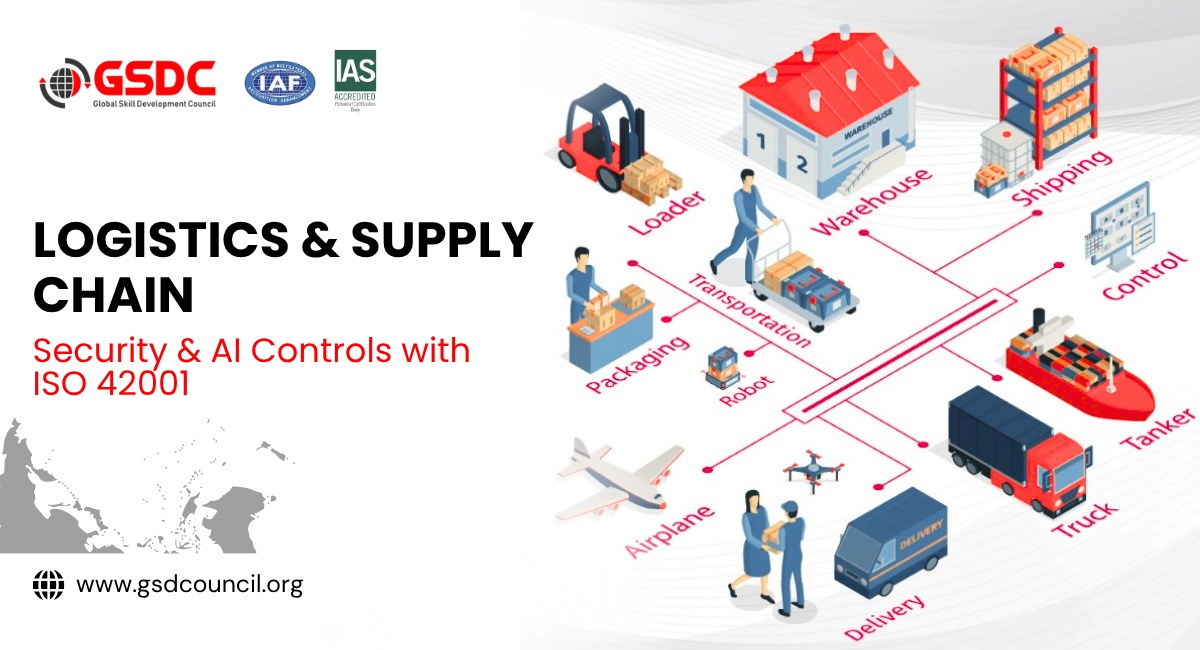
As logistics and supply chain operations increasingly rely on artificial intelligence for route planning, warehouse automation, and demand forecasting, organizations face a pressing question: how do you capture the benefits of AI in supply chain without inheriting its security, privacy, and governance risks? This makes supply chain security increasingly important as organizations adopt AI in logistics and supply chain operations.
This was the focus of a recent webinar led by Lov Johar, a certified ISO lead implementer and founder of Cyber GRC, who walked participants through how ISO 42001 (AI management) and ISO 27001 (information security management) can be integrated to strengthen resilience across supply chain operations. ISO 42001 provides an AI governance framework that can support AI security controls alongside broader compliance strategies.
Distinguishing Supply Chain from Logistics
Before diving into governance frameworks, the session clarified a distinction that's often blurred: supply chain and logistics are not the same thing. Supply chain is the complete cycle a product moves through from raw material, to supplier, to manufacturer, to distributor, to retailer, and finally to the end customer, including any returns that happen afterward.
Logistics, by contrast, is a narrower piece of that puzzle: it covers the actual movement, storage, and transportation of goods throughout that cycle. In short, supply chain is the larger umbrella, and logistics is one critical component within it. Understanding this distinction matters because AI is now being layered onto both, and each carries its own risk profile across AI in supply chain, AI in logistics, and AI in supply chain and logistics.
The Promise and the Problem of AI-Driven Logistics
AI-driven logistics offers clear benefits: greater efficiency, more accurate demand forecasting, cost reduction, and automation of repetitive tasks. These are among the key benefits of AI in supply chain, particularly when organizations use predictive analytics and supply chain optimization to improve operational decision-making. Yet despite these advantages, adoption remains limited the webinar noted that companies like Amazon are among the few operating at scale with AI-driven logistics, while most organizations have not gotten there yet.
The reasons for this hesitancy were laid out clearly. Logistics and supply chain operations depend on sensitive personal data; customer names, phone numbers, addresses, and locations are all required simply to deliver a package. Without strong privacy controls around this data, organizations face real risk. Beyond privacy, there are concerns about ethical bias in automated decision-making, the danger of relying on a single AI model with no human oversight (creating a single point of failure), and security vulnerabilities such as data poisoning and model tampering. These risks don't mean AI should be avoided but they do mean it can't be deployed carelessly, particularly as AI regulations and governance expectations continue to evolve.
Real-World AI Applications and Their Risk Counterparts
The webinar walked through several concrete AI use cases in logistics, pairing each with its associated risk. Predictive demand forecasting helps companies anticipate order volumes based on historical patterns, but it is only as reliable as the underlying data quality, provenance, and lineage. This highlights the importance of predictive analytics when applying AI in supply chain.
Route optimization automatically calculates the fastest or most efficient path for deliveries, but is vulnerable to model drift a phenomenon where an AI system that performs well today gradually produces less accurate results as road networks and conditions change over time. This drift is described as inevitable and unsolvable in any permanent sense; the only real countermeasure is continuous monitoring paired with human oversight.
Warehouse automation, where AI-powered robots handle picking, packaging, and storage, introduces safety concerns due to the absence of human intervention verifying that tasks are performed correctly. Fraud detection systems flag false claims or theft but can generate false positives that erode trust if relied upon blindly. Supplier evaluation tools assess vendor reliability using third-party risk data, but their outputs are only as sound as the fairness and transparency of the data feeding them. Across every use case, the pattern is consistent: AI brings real advantages, but each advantage comes bundled with a corresponding risk that must be actively managed through effective logistics governance, AI security controls, and appropriate compliance strategies.
The AI Lifecycle in a Supply Chain Context
The webinar detailed how ISO 42001 governance maps onto each stage of the AI lifecycle within logistics. It begins with inception, where the business goal, such as improving demand prediction, is clearly defined before any development starts. This is followed by data preparation, described as the single most consequential stage, since an AI model's entire output depends on the quality, source, and hygiene of the data it's trained on.
Development follows, where explainability and full documentation become essential so that AI decisions remain auditable. Validation checks whether the model's output actually matches the intended business objective, followed by deployment, where access control and change management take center stage. Once live, the model enters operation and continuous validation, requiring ongoing human oversight to catch drift before it compounds.
Finally, decommissioning retires outdated models, a process the webinar compared to phasing out old iPhone models, and requires careful, complete disposal of the training and output data associated with that model, given the scale of personal data logistics systems typically handle.
Conducting the AI Impact Assessment
A recurring theme throughout the session was that AI impact assessment must precede risk assessment, not the other way around. The impact assessment evaluates a model across nine dimensions: fairness, transparency, safety and health, human rights, financial and economic impact, societal and environmental impact, inclusivity and accessibility, security and privacy, and accountability. Any negative findings from this assessment feed directly into the organization's risk register, where they're tracked and remediated.
Performing the assessment itself follows a defined sequence: define the scope, identify data dependencies and map data flows (typically through a data flow diagram), identify impacts against the nine dimensions, assess the resulting risks, review compliance gaps, implement controls, and document findings a cycle that repeats continuously rather than running once.
Strengthen Your AI Audit & Governance Expertise
GSDC’s Certified ISO 42001:2023 Lead Auditor certification equips professionals with practical knowledge to assess, audit, and evaluate AI Management Systems against ISO 42001 requirements. The certification covers audit planning and execution, risk-based assessment, evidence collection, reporting, and continual improvement.
Ideal for professionals working in AI governance, compliance, risk management, and auditing, this certification helps build the expertise needed to evaluate AI management practices, identify gaps, and support organizations in maintaining effective and responsible AI governance.
Conclusion
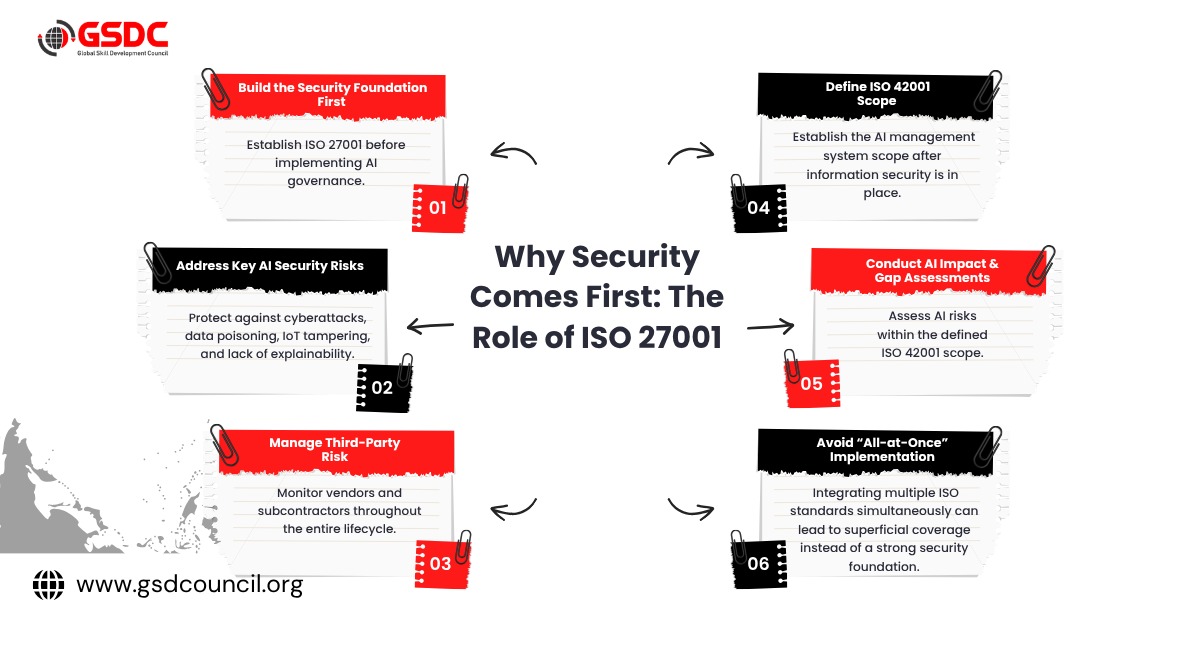
Integrating AI into logistics and supply chain operations offers genuine efficiency and cost advantages, but the webinar was clear that these gains cannot be pursued in isolation from security and governance. ISO 27001 must be firmly established before ISO 42001 is layered on top, and any organization handling customer data should add ISO 27701 for privacy as well. With clear KPIs, ongoing impact assessments, robust data provenance, and human oversight built into every stage of the AI lifecycle, organizations can responsibly capture the benefits of AI-driven logistics without exposing themselves to the security, bias, and compliance risks that come from moving too fast.

Related Certifications
Frequently Asked Questions
Supply chain is the entire end-to-end process, from raw materials through manufacturing, distribution, retail, delivery to the customer, and returns. Logistics is the subset of that process focused specifically on movement, storage, and transportation of goods along the way. This distinction is important when implementing AI in supply chain and logistics.
Model drift happens because the real-world conditions an AI model was trained on such as road networks or demand patterns change over time, causing the model's outputs to gradually become less accurate. There's no permanent fix; the recommended approach is continuous monitoring combined with regular human oversight to catch and correct drift as it occurs. This is particularly relevant when using predictive analytics for supply chain optimization.
The recommended approach is sequential, not simultaneous. Organizations should fully implement ISO 27001 first to establish information security, and only then define the scope and begin implementation of ISO 42001, since AI governance depends on having a secure data foundation already in place. This creates a stronger foundation for AI security controls and AI governance frameworks.
A data flow diagram maps where data originates, how it moves through an organization's systems, and who has access to it at each stage. It's a prerequisite for both AI impact assessment and privacy compliance, since without understanding how data flows, it's not possible to accurately assess the impact or risk of an AI system. This is especially important for AI in supply chain and AI in logistics.
The nine dimensions are fairness, transparency, safety and health, human rights, financial and economic impact, societal and environmental impact, inclusivity and accessibility, security and privacy, and accountability. Together, they determine whether an AI system can be considered responsible and trustworthy before any risk assessment begins. These dimensions support effective logistics governance and compliance strategies when deploying AI in supply chain.
Stay up-to-date with the latest news, trends, and resources in GSDC
If you like this read then make sure to check out our previous blogs: Cracking Onboarding Challenges: Fresher Success Unveiled
Not sure which certification to pursue? Our advisors will help you decide!