AI Consultant Career Guide: From Skills to Professional Success
Written by Emily Hilton
- What Does an AI Consultant Do?
- Why Choose an AI Consultant Career?
- How to Become an AI Consultant?
- Essential Skills for a Career in AI Consulting
- AI Consultant Career Path
- AI Consultant Jobs: Where Can You Work?
- AI Consultant Salary: What Can You Expect?
- How to Start an AI Consulting Business
- Certified AI Consultant: Build the Skills to Lead AI Transformation
- Conclusion
Artificial intelligence has moved beyond experimentation. Organizations are now looking for practical ways to integrate AI into products, operations, customer experiences, decision-making, and business strategy. This shift has created growing demand for professionals who can connect AI capabilities with real business problems.
That is where an AI consultant comes in.
An AI consultant helps organizations identify valuable AI opportunities, evaluate technologies, develop implementation strategies, manage risks, and turn AI investments into measurable business outcomes. As enterprises move from AI pilots toward scaled adoption, the role is becoming increasingly strategic and multidisciplinary.
This AI Consultant Career Guide explains what the role involves, the skills you need, how to become an AI consultant, potential career paths, certification options, salary considerations, and how experienced professionals can eventually build their own AI consulting business.
What Does an AI Consultant Do?
So, what does an AI consultant do?
An AI consultant acts as a bridge between business requirements and artificial intelligence technologies. Unlike a purely technical AI engineer, a consultant does not necessarily spend all their time developing models. Instead, they focus on determining where AI can create value and how an organization can implement it effectively.
Typical responsibilities include:
- Identifying business processes suitable for AI
- Assessing organizational AI readiness
- Developing AI strategies and roadmaps
- Identifying and prioritizing AI use cases
- Evaluating AI tools, platforms, and vendors
- Assessing data readiness and quality
- Estimating costs, ROI, and business value
- Designing AI implementation plans
- Supporting generative AI and AI-agent adoption
- Advising on AI governance, security, privacy, and compliance
- Managing stakeholder expectations and organizational change
- Measuring AI adoption and business outcomes
The role is becoming broader as enterprises move toward AI-enabled workflows and autonomous or semi-autonomous AI systems. Current industry trends indicate that consulting is increasingly combining traditional strategy with technology implementation and AI-enabled services.
Why Choose an AI Consultant Career?
If you are asking, is AI a good career, the current market provides strong reasons to consider it.
AI and big data are among the fastest-growing skill areas expected by employers, while analytical thinking, creative thinking, resilience, leadership, and technological literacy are also becoming increasingly important.
The opportunity is not limited to technology companies. AI consultants can work across:
- Banking and financial services
- Healthcare
- Manufacturing
- Retail and e-commerce
- Telecommunications
- Professional services
- Insurance
- Automotive
- Education
- Government
- Technology and SaaS
The demand is also shifting from simply knowing AI tools to demonstrating measurable business impact. PwC's 2026 AI Jobs Barometer reports that AI-exposed organizations are seeing stronger productivity growth and that skills in AI-exposed jobs are changing more than twice as fast as those in less-exposed roles.
This makes AI consulting particularly attractive for professionals who enjoy combining technology, business strategy, problem-solving, and client interaction.
How to Become an AI Consultant?
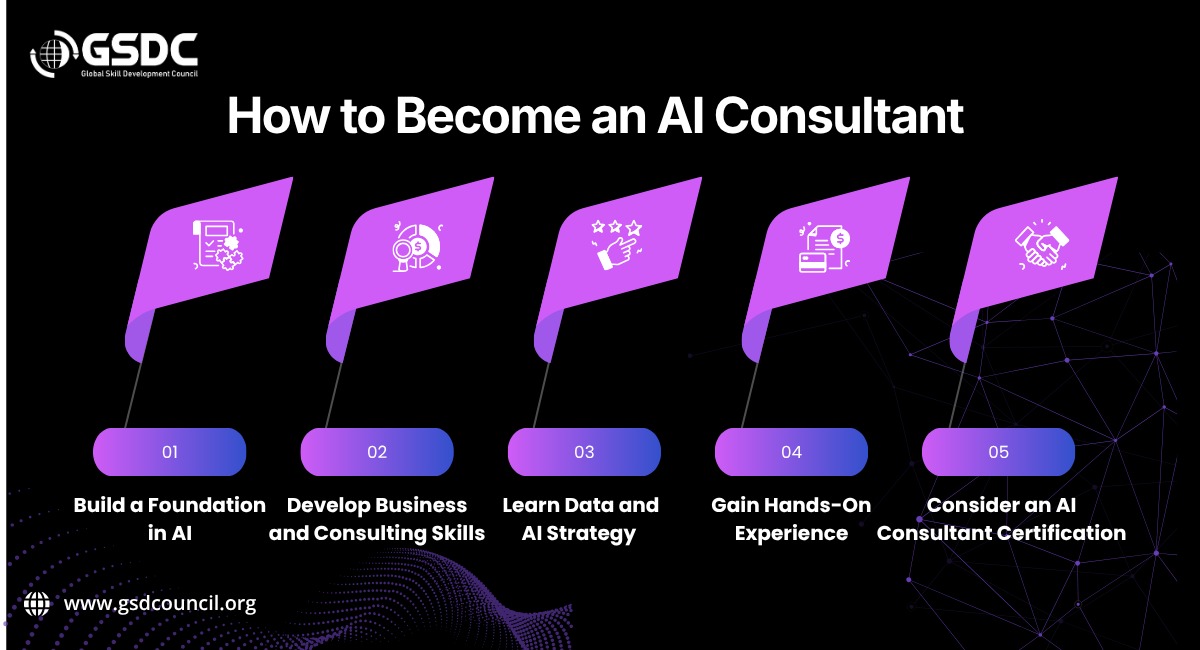
If you are wondering how to become an AI consultant, there is no single mandatory degree or career path. People enter the profession from technology, consulting, analytics, business, project management, finance, marketing, operations, and other disciplines.
A practical pathway includes the following steps.
1. Build a Foundation in AI
Start by understanding the fundamentals of:
- Machine learning
- Generative AI
- Large language models
- Natural language processing
- Computer vision
- AI agents and automation
- Retrieval-Augmented Generation (RAG)
- AI evaluation
- Data analytics
- Cloud AI platforms
You do not necessarily need to become an advanced machine-learning engineer. However, you should understand how AI systems work, what they can and cannot do, and what is required to deploy them responsibly.
2. Develop Business and Consulting Skills
Technology knowledge alone does not make someone an effective consultant.
You need to learn how to:
- Define business problems
- Conduct stakeholder interviews
- Analyze processes
- Identify pain points
- Build business cases
- Estimate ROI
- Present recommendations
- Manage client expectations
- Develop implementation roadmaps
- Communicate complex concepts simply
This combination of AI knowledge and business thinking is one of the most important aspects of an AI career roadmap.
3. Learn Data and AI Strategy
An AI consultant should be able to assess whether a company is actually ready for an AI initiative.
That means understanding data quality, infrastructure, security, integration requirements, governance, workforce readiness, and organizational processes.
A technically impressive AI solution can still fail if the organization lacks reliable data, appropriate infrastructure, user adoption, or clear ownership.
4. Gain Hands-On Experience
Theory is not enough.
Build practical projects such as:
- An AI customer-support assistant
- A RAG-based knowledge system
- An AI-powered document analysis workflow
- An AI use-case prioritization framework
- An AI ROI assessment
- An AI governance assessment
- An AI automation prototype
Your portfolio should demonstrate not just what AI technology you used, but why you used it and what business problem it solved.
5. Consider an AI Consultant Certification
An AI consultant certification can help professionals structure their knowledge and demonstrate commitment to the field.
When selecting a certification, look beyond the certificate itself. A strong program should cover AI strategy, use-case identification, process analysis, data readiness, solution design, ROI, implementation, governance, risk, and responsible AI.
Hands-on projects and real-world case studies can be particularly valuable because employers increasingly want professionals who can apply AI rather than simply describe it.
Essential Skills for a Career in AI Consulting
AI Consultant Career Path
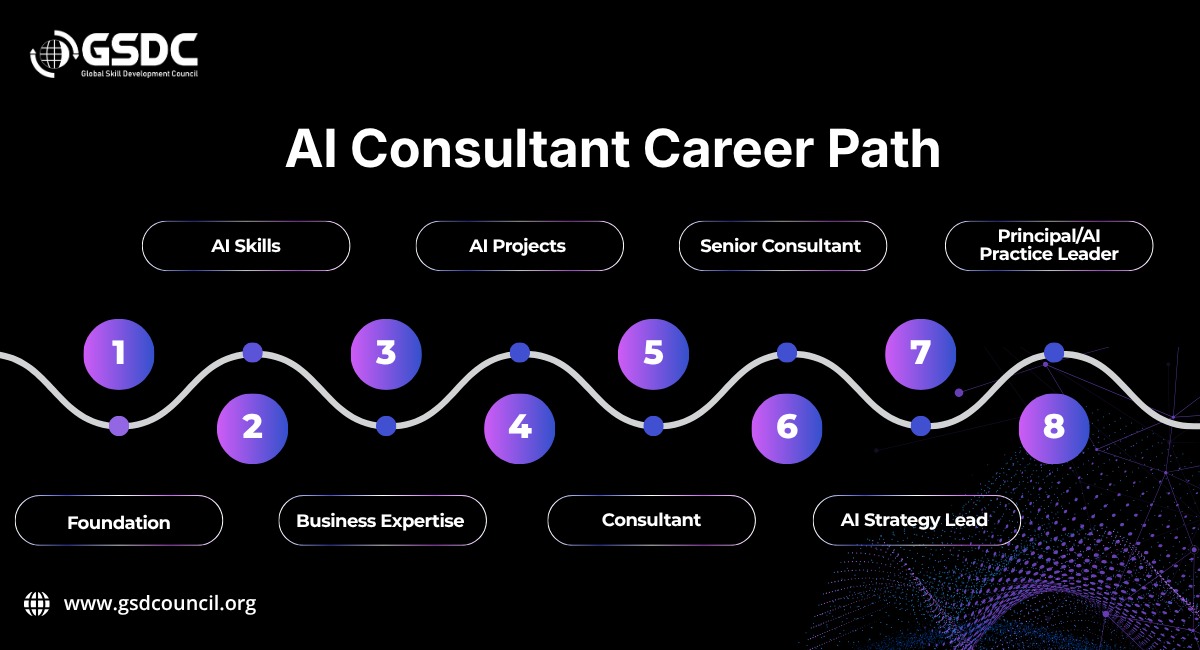
The AI career path can develop in several directions depending on your background.
A technology professional might progress from AI analyst or AI engineer into AI consultant and eventually become an AI strategy lead, principal consultant, or AI practice leader.
A business professional could move from business analyst or management consultant into AI transformation consulting and eventually specialize in AI strategy or enterprise transformation.
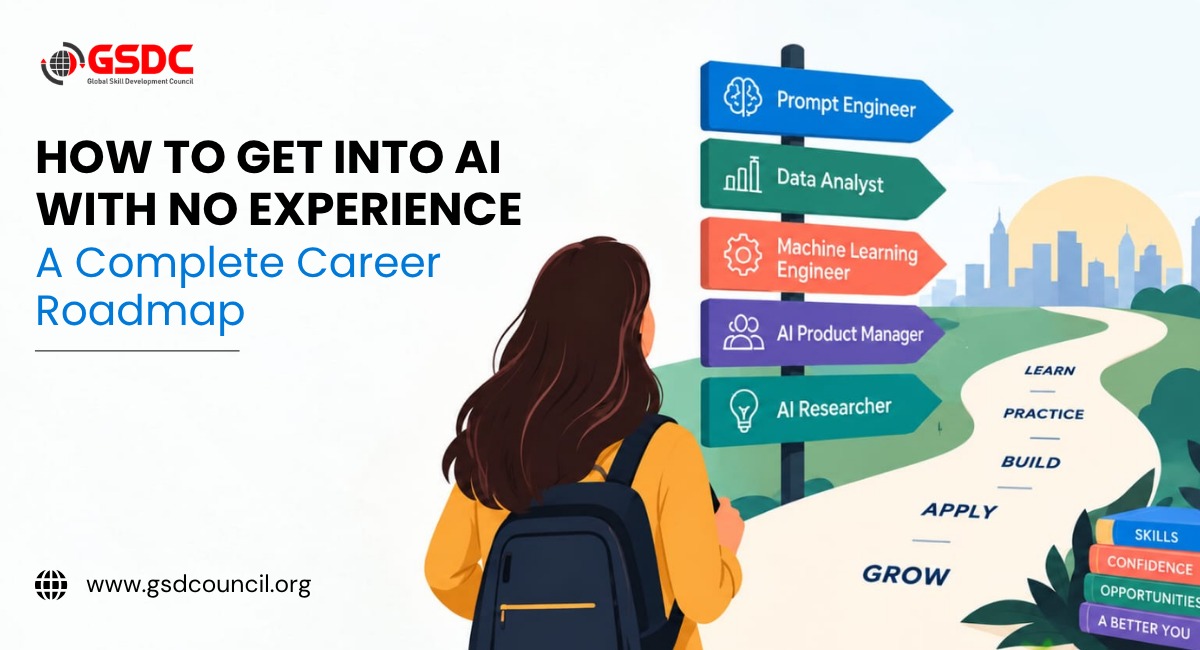
A possible AI career roadmap could look like:
Foundation → AI Skills → Business Expertise → AI Projects → Consultant → Senior Consultant → AI Strategy Lead → Principal/AI Practice Leader
Professionals can also specialize in areas such as:
- Generative AI consulting
- AI transformation
- AI governance
- AI risk management
- AI product strategy
- AI adoption
- AI automation
- Industry-specific AI consulting
This specialization can help professionals build deeper expertise and differentiate themselves in a competitive market.
AI Consultant Jobs: Where Can You Work?
The market for AI consultant jobs includes both traditional consulting firms and organizations building internal AI transformation teams.
Potential employers include:
- Management consulting firms
- Technology consulting companies
- AI-focused startups
- Cloud providers
- Software companies
- Banks and financial institutions
- Healthcare organizations
- Manufacturing companies
- Retail enterprises
- Large multinational corporations
Job titles may vary considerably. Search for roles such as:
- AI Consultant
- AI Strategy Consultant
- AI Transformation Consultant
- Generative AI Consultant
- AI Business Consultant
- AI Solutions Consultant
- AI Advisory Consultant
- AI Strategy Manager
- AI Transformation Manager
- AI Product Consultant
Because AI consulting is multidisciplinary, professionals should search beyond the exact title "AI Consultant."
AI Consultant Salary: What Can You Expect?
The AI consultant salary varies significantly according to geography, experience, industry, technical expertise, consulting firm, and specialization.
Professionals with a combination of AI expertise and business or domain knowledge can command stronger compensation than those who only possess basic AI-tool familiarity.
Current research supports the broader salary opportunity around AI skills. PwC's 2025 Global AI Jobs Barometer found that workers with AI skills received an average 56% wage premium in its analysis, while its 2026 research continues to show stronger wage growth in AI-exposed professional roles.
For candidates evaluating compensation, it is therefore better to consider skills and demonstrated business impact rather than relying on a single industry-wide salary figure.
Your earning potential can increase as you develop:
- Specialized AI expertise
- Industry knowledge
- Consulting experience
- Client-management capabilities
- Leadership experience
- A strong portfolio of successful AI projects
How to Start an AI Consulting Business
After gaining sufficient experience, some professionals may ask how to start an AI consulting business.
Start by choosing a specific market or problem rather than positioning yourself as someone who does "everything in AI."
For example, you could specialize in:
- AI strategy for SMEs
- Generative AI implementation
- AI automation for customer service
- AI readiness assessments
- AI governance
- AI adoption and workforce transformation
- AI use-case discovery
Next, develop a clear consulting offer. This could include an AI readiness assessment, AI strategy workshop, use-case prioritization, implementation roadmap, or AI governance assessment.
Build credibility through case studies, demonstrations, thought leadership, partnerships, and relevant certifications.
Most importantly, sell outcomes rather than technology. Clients are generally more interested in reducing costs, improving productivity, increasing revenue, improving customer experience, or reducing risk than simply acquiring another AI tool.
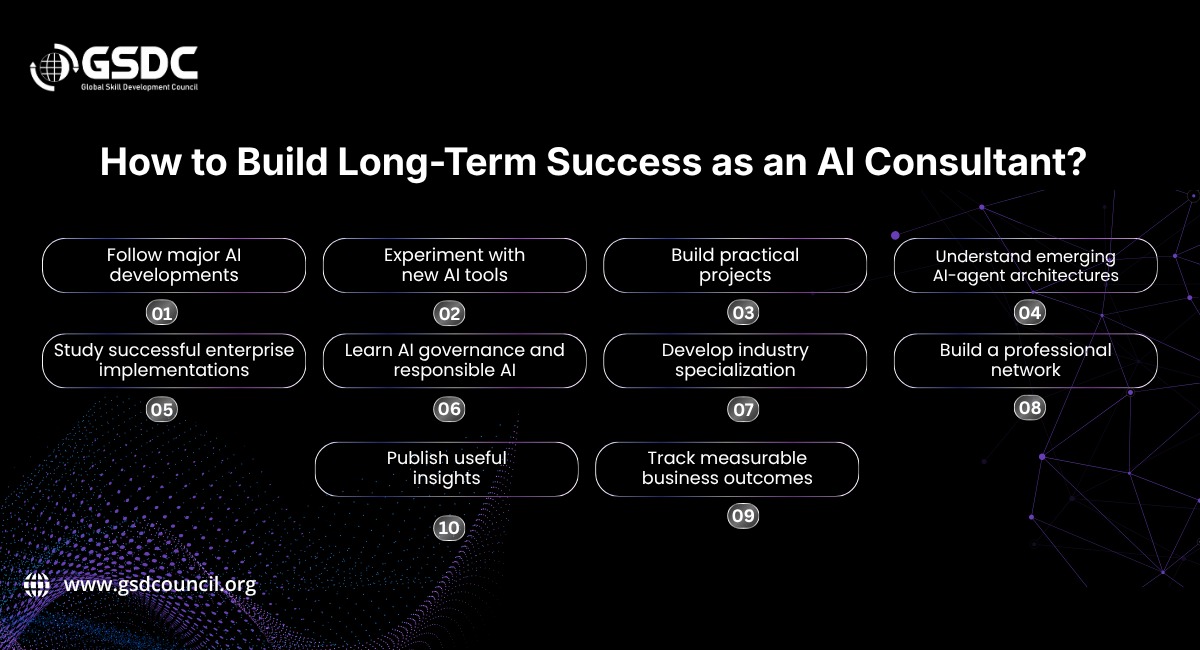
Certified AI Consultant: Build the Skills to Lead AI Transformation
GSDC’s Certified AI Consultant certification can help professionals strengthen the combination of AI, business, and consulting skills needed to support successful AI adoption. It focuses on developing the ability to identify AI opportunities, assess business and organizational readiness, evaluate use cases, and translate AI capabilities into practical business strategies.
The Certified AI Consultant certification can also help learners build knowledge of AI implementation, governance, risk, and responsible AI practices. For professionals looking to transition into AI consulting or strengthen their existing consulting expertise, this certification provides a structured way to build relevant knowledge while complementing hands-on projects and real-world experience.
Conclusion
The path to becoming an AI consultant is no longer limited to advanced programmers or machine-learning specialists. Modern AI consulting sits at the intersection of technology, business strategy, data, implementation, governance, and human decision-making.
If you are considering how to become AI consultant, focus on building a combination of AI knowledge, business understanding, consulting capability, and practical experience. An AI consultant certification can complement this journey, but real-world projects and demonstrated outcomes are equally important.
The future of AI consulting will increasingly belong to professionals who can move organizations from AI experimentation to responsible, scalable implementation. As enterprises continue integrating AI into core workflows, the opportunity for professionals who can translate AI capabilities into business value is likely to remain strong.

Related Certifications
Frequently Asked Questions
An AI consultant helps organizations identify AI opportunities, evaluate technologies, develop AI strategies, assess ROI, plan implementations, and address risks such as security, privacy, governance, and responsible AI.
You can enter AI consulting from business, analytics, finance, operations, project management, or consulting backgrounds. Build foundational AI knowledge, learn business-focused AI applications, complete practical projects, develop consulting skills, and consider an AI consultant certification.
Yes. AI and big data remain among the fastest-growing skill areas, while demand is expanding for professionals who can combine AI expertise with strategic thinking, leadership, and business skills.
Important skills include AI and generative AI fundamentals, data literacy, business analysis, AI strategy, ROI modelling, communication, critical thinking, stakeholder management, project management, and responsible AI.
Yes. Experienced consultants can build specialized AI consulting businesses around areas such as AI strategy, automation, generative AI implementation, AI governance, AI readiness, or industry-specific AI transformation.
Stay up-to-date with the latest news, trends, and resources in GSDC
If you like this read then make sure to check out our previous blogs: Cracking Onboarding Challenges: Fresher Success Unveiled
Not sure which certification to pursue? Our advisors will help you decide!