Building an AI Ready Workforce
Written by Ankit Choudhary
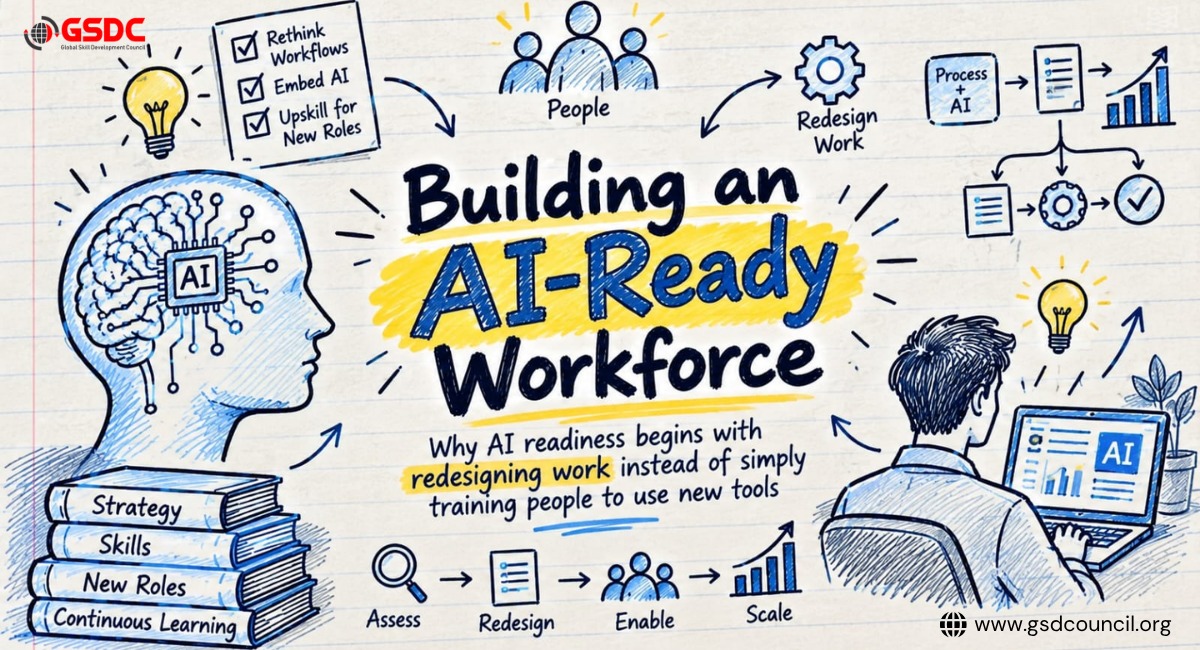
- AI readiness is not merely a training problem
- The economics of cognition are changing
- Jobs are containers; workflows are the real unit of change
- Building Agentic AI Skills for an AI-Ready Workforce
- When generation becomes abundant, judgment becomes scarce
- The apprenticeship problem
- Capability, not familiarity
- An organisation that can redesign itself
- Conclusion
AI readiness is not merely a training problem
Most IT services companies built their commercial model largely around man-hours: more work required more people, and more people working for longer produced more revenue. AI changes that relationship. Some of these companies are now reporting close to twice the delivery speed at roughly half the cost, not because one tool performs one task unusually well, but because AI changes the economics of several connected activities across the delivery lifecycle.
Once the same outcome requires materially fewer human hours, workforce transformation stops being an HR problem. It becomes a business-model problem with consequences for HR. Yet many organisations begin with tools, training, and adoption metrics. What changes is access to technology, not necessarily how the organisation produces value. AI readiness begins when the unit of work itself is reconsidered.
The economics of cognition are changing
Computers reduced the cost of calculation, the internet reduced the cost of distributing information, and the cloud reduced the cost of computing infrastructure. AI is beginning to reduce the cost of certain kinds of cognition: writing, analysis, coding, synthesis, and increasingly, multi-step execution. This does not make expertise free. It changes where human effort remains economically valuable.
Traditional software generally separated deciding from executing. A person understood the situation, translated it into rules, and the machine executed those rules. AI weakens that boundary. A person can now describe an outcome and its constraints while a system interprets the request, constructs a path, uses tools, observes what happened, and adjusts its next action. The important shift is not that software has become conversational. It is that software has started participating in decisions that often had to be made before execution could begin.
That is why comparing AI with another productivity tool understates the change. A cognitive system can alter how an activity is decomposed, who performs each part, and whether the original workflow needs to exist in the same form. The first-order effect is efficiency; the more interesting effect is organisational redesign. This shift is central to AI workforce transformation, as organisations rethink AI in the workplace, build AI skills, and develop workforce AI readiness for an increasingly AI-driven future.
Jobs are containers; workflows are the real unit of change
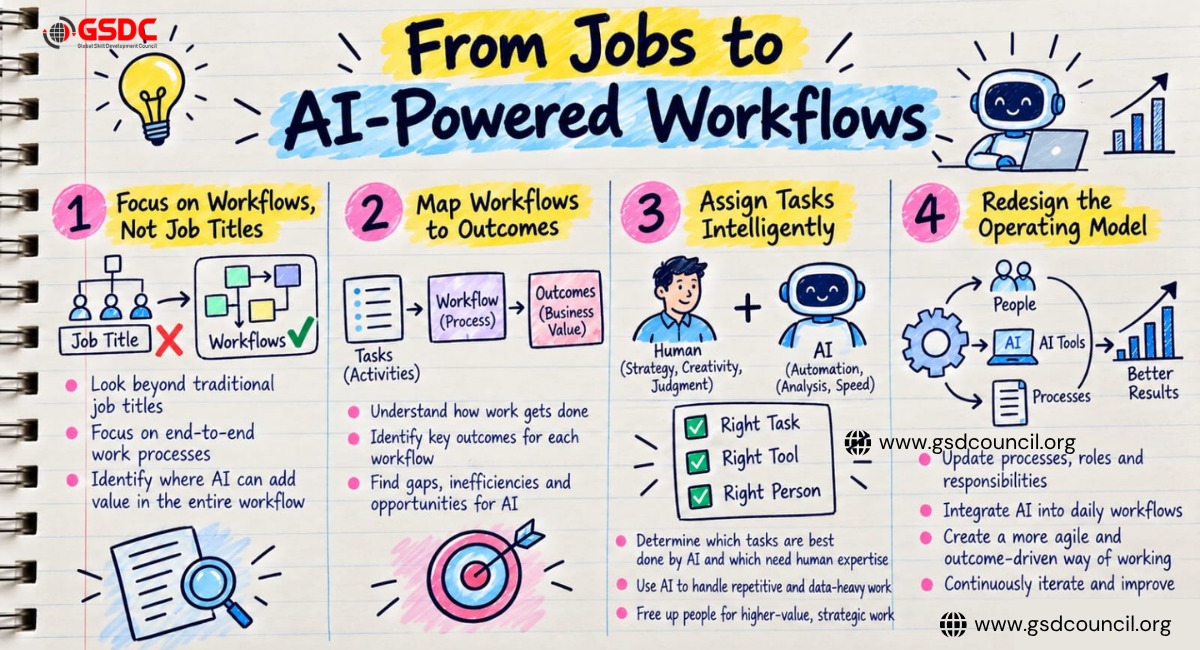
The public debate is still organised around jobs: which jobs will disappear, which will survive, and which new ones will be created. But a job is a historically convenient bundle of tasks, while AI is usually applied to a document to analyse, a decision to prepare, a test to generate, an exception to classify, or a sequence of actions to coordinate. Some of those tasks can be automated, some become easier, and others become more important because the surrounding work has become cheap.
The Anthropic Economic Index found exactly this unevenness: AI use appeared across parts of many occupations, but across most tasks in very few. Roles rarely disappear as indivisible units. Their internal composition changes until the old title describes work that no longer exists in the same form.
Organisations were traditionally designed from the outside in: organisation, department, role, responsibility, task. AI-native work benefits from reversing that lens. Begin with the outcome, map the workflow that produces it, separate it into tasks, and decide which parts belong to a person, a person working with AI, or an agent operating within an approval boundary. Only then ask what human capability and roles the new system requires.
This reversal separates adoption from transformation. Adding AI to an existing role assumes the role is correct and the technology should fit inside it. Redesigning the workflow allows the role itself to become an output of the analysis. If approvals, team boundaries, hand-offs, and measures of performance remain unchanged, the organisation has probably digitised the old operating model rather than created a new one.
Building Agentic AI Skills for an AI-Ready Workforce
As AI moves from content generation toward systems that can reason, use tools, and execute multi-step tasks, organizations need professionals who understand how these systems are designed and governed.
GSDC’s Agentic AI Professional Certification helps professionals build structured knowledge of agentic AI, including AI agents, agent architecture, tool use, and practical applications. It can complement broader workforce initiatives focused on developing durable AI capabilities.
Agentic AI Professional Certification brings following benefits:
- Build AI Knowledge – Understand AI agents and their architecture.
- Gain Practical Skills – Learn agent tools, APIs, and workflows.
- Support AI Readiness – Develop skills for AI-driven workplaces.
- Boost Career Growth – Strengthen your professional AI profile.
- Prepare for Future Roles – Build skills for emerging AI careers.
When generation becomes abundant, judgment becomes scarce
Software engineering makes this shift easy to see. An agent can now explore a repository, change several files, write tests, fix failures, and prepare a pull request. Producing code becomes cheaper, but the difficult parts do not disappear. Someone still has to understand the problem, define constraints, recognise poor abstractions, anticipate consequences, and decide whether the result belongs in the system.
The engineer's value does not simply move from coding to prompting. It moves toward specification, architecture, evaluation, trade-offs, and accountability. This is why productivity claims need care. In a 2025 randomised study, METR found that experienced open-source developers working in repositories they knew well were slower with the AI tools tested, even though they expected to be faster. The result does not show that AI coding is ineffective. It shows that capability does not become productivity merely because it is available; the tool, task, context, workflow, and cost of verification have to align.
The same movement appears in management. Managers increasingly allocate work among people, models, agents, and deterministic software. The problem expands from who should do the work to what kind of system should do it, where autonomy should stop, and who remains accountable when it fails.
This points to a broader inversion. As answers become cheap, framing the right question becomes more valuable. As content becomes abundant, discrimination becomes more valuable. As implementation accelerates, architecture becomes more valuable. As AI acquires the ability to act, supervision and governance become more valuable. AI concentrates value in the parts of expertise that remain hardest to generate: context, judgment, and responsibility.
The apprenticeship problem
There is a less comfortable consequence. The tasks easiest to give AI are often those through which junior employees learned: the first implementation, initial research, data cleaning, or a draft. They were also the environment in which people encountered edge cases, made recoverable mistakes, received feedback, and slowly built judgment.
If AI performs the beginner work, the immediate output may improve while the long-term capability of the workforce weakens. A junior can submit work of a higher apparent standard without developing the mental models required to recognise when that work is wrong. The organisation sees productivity in the present; the missing expertise becomes visible only years later.
The economic incentive compounds the problem. Organisations hired inexperienced people partly because their work was useful while they learned. If AI absorbs much of that beginner work, firms may hire fewer juniors at precisely the moment when juniors have fewer opportunities to develop. Everyone may want experienced, AI-native professionals while weakening the system that creates them.
I do not think we have a clean answer to this yet. Preventing juniors from using AI would preserve effort, not necessarily learning; allowing AI to complete everything would preserve output, not capability. A more useful direction is to treat AI differently inside a learning system: sometimes it should answer, but sometimes it should question, challenge, simulate, review, or withhold help. Productive friction that often emerged naturally from doing the work may now need to be designed deliberately.
Capability, not familiarity
Most AI training measures knowledge: whether someone understands the terminology, risks, or operation of a tool. More mature programmes measure skill: whether someone can use AI for a defined activity. Neither is the same as capability. Knowing what RAG is demonstrates knowledge; building a basic pipeline demonstrates skill; deciding whether RAG is appropriate, designing it within real constraints, and operating it reliably demonstrates capability.
The distinction matters because AI makes borrowed capability unusually easy to mistake for owned capability. A person can produce a strong analysis, working application, or polished strategy without being able to explain the assumptions underneath it or recover when the system fails. The output looks capable even when the person remains dependent on the system that generated it.
An AI-ready workforce therefore needs more than fluency with a model. They need enough domain understanding to frame the problem, AI literacy to understand the system's limits, systems thinking to anticipate second-order effects, and judgment to evaluate uncertain output. Above all, they need to remain accountable for the outcome. The tools will change repeatedly; these underlying demands are likely to be more durable.
This changes the purpose of learning. When access to information was scarcer, education was organised largely around transferring it. The internet made information abundant, but synthesis and application still required substantial effort. Generative AI now makes information interactive: it can explain, reformulate, personalise, and apply knowledge on demand. A learning system optimised mainly for content delivery, completion, recall, and certification is solving an increasingly incomplete problem. Learning will need to care less about recall alone and more about what a person can independently do, especially when the model is unavailable, uncertain, or wrong.
Building AI skills and AI literacy is therefore central to workforce AI readiness. An effective AI literacy framework should help employees move from basic knowledge to practical capability, supporting AI workforce transformation and preparing a future ready workforce for responsible AI in the workplace.
An organisation that can redesign itself
AI transformation cannot belong to one function because the work crosses functions. Leadership has to decide where AI changes strategic advantage. Business teams have to expose how outcomes are produced. Technology has to create the architecture, security, and execution boundaries. HR has to reconsider roles and talent pipelines. Learning teams have to build capability inside real work, while managers and employees redesign daily execution without transferring accountability to AI.
A practical operating model follows the same logic: begin with an outcome, map its workflow, decompose the work into tasks, allocate each task between humans and systems, identify and build the human capabilities the new allocation requires, and measure whether the outcome improved. Then repeat the process as AI capabilities change. The loop cannot be treated as closed; an AI workforce becomes better at running it.
For a long time, organisations asked how AI could help people perform their existing jobs more efficiently. That was the natural first question, but it preserves the organisation while changing only the tool. The deeper question is what happens when the work no longer needs to be organised into the same jobs, workflows, and boundaries in the first place. An AI ready workforce is not one in which everyone knows how to use AI. It is one embedded in an organisation that knows how to keep changing the way work gets done because AI exists.
Conclusion
AI readiness is not about simply training people to use AI. It requires AI workforce transformation, stronger AI skills, practical AI literacy, and a clear AI literacy framework. Building workforce AI readiness means creating a future ready workforce prepared to use AI in the workplace, while developing the capabilities needed for an autonomous AI workforce.

Related Certifications
Stay up-to-date with the latest news, trends, and resources in GSDC
If you like this read then make sure to check out our previous blogs: Cracking Onboarding Challenges: Fresher Success Unveiled
Not sure which certification to pursue? Our advisors will help you decide!