Why Does Your Business Need an ISO 9001 Lead Auditor?
Written by Matthew Hale
- The scale of ISO 9001 compliance - by the numbers
- What does ISO 9001 compliance actually mean?
- Who is an ISO 9001 lead auditor?
- What an ISO 9001 audit actually looks like
- The ISO 9001 audit checklist: a map, not a formality
- How ISO 9001 lead auditors help businesses improve
- Why ISO 9001 lead auditor certification is worth it
- Internal vs. external ISO 9001 lead auditors - both have a role
- The professionals behind the process
- The bottom line
There's a moment every quality manager dreads - the auditor walks in, clipboard in hand, and the entire team suddenly forgets where half the documentation lives.
Sound familiar?
It happens more than companies like to admit. Not because anything is being done wrong - but because nobody has taken a clear, structured look at how quality processes actually run on the ground, versus how they're supposed to run on paper.
That's exactly where an ISO 9001 lead auditor steps in. Not as a threat, but as one of the most practical problem-solvers a quality-driven organization can have.
The scale of ISO 9001 compliance - by the numbers
Before we get into how lead auditors work, it helps to understand just how significant this standard has become globally - and in the U.S. specifically.

What does ISO 9001 compliance actually mean?
ISO 9001 is the international standard for Quality Management Systems (QMS). It gives businesses a framework for consistently delivering products and services that meet customer and regulatory requirements - and signals to the world: we have documented, repeatable processes, and we actually follow them.
But ISO 9001 compliance isn't a one-time checkbox. It requires ongoing monitoring, internal reviews, and periodic external audits. Gaps appear quietly - a process updated informally here, a training record that slips there. Over time, small gaps become real risks. That's where lead auditors become indispensable.
Who is an ISO 9001 lead auditor?
An ISO 9001 lead auditor is a trained professional certified to plan, conduct, report, and follow up on audits against the ISO 9001 standard. Unlike internal auditors who review specific departments, lead auditors manage the entire ISO 9001 audit process end to end - from scope-setting to final report sign-off.
An ISO 9001 lead auditor certification typically involves a five-day intensive program, a practical examination, and demonstrated auditing experience.
Industry groups have reported growing shortages of qualified audit professionals in the U.S. and European markets, and demand shows no sign of slowing. Organizations across manufacturing, healthcare, logistics, software, and professional services all rely on certified ISO 9001 lead auditors - on staff or as consultants - to keep their QMS honest.
What an ISO 9001 audit actually looks like
An ISO 9001 audit is a structured, evidence-based review. The auditor isn't there to catch people making mistakes - they're verifying that processes align with the standard and with the organization's own documented procedures. The five-stage process below reflects the methodology taught and assessed in globally recognized programs like the GSDC Certified ISO 9001:2015 Lead Auditor certification, where mastering each stage is what separates a competent auditor from a truly effective one.
Stage | Audit Phase | What Happens |
Stage 1 | Planning | Define scope, review prior results, and assess quality manuals |
Stage 2 | Opening meeting | Brief stakeholders on audit scope, objectives, and process |
Stage 3 | On-site review | Observe processes, interview staff, and examine records |
Stage 4 | Analysis & reporting | Document findings and categorize nonconformances |
Stage 5 | Follow-up | Agree on corrective actions, set timelines, and verify closure |
The ISO 9001 audit checklist: a map, not a formality
The ISO 9001 audit checklist walks auditors and organizations through every clause of the standard - asking at each step: do you have evidence that this requirement is being met? A well-designed ISO 9001 compliance checklist covers six core areas - and working through each one systematically is a defining skill of a Certified ISO 9001:2015 Lead Auditor:
- Context of the organization - internal and external factors affecting the QMS
- Leadership commitment - visible management involvement in quality objectives
- Risk-based thinking - documented, active risk identification processes
- Operational controls - monitored production and service delivery
- Performance evaluation - customer satisfaction, audits, and management reviews
- Continual improvement - acting on what audits and data actually reveal
"Internal audits verify your QMS works as intended. They identify nonconformances before external auditors find them. Regular audits drive continual improvement by revealing opportunities to enhance processes."
- QMII (Quality Management International Inc.), ISO 9001 Internal Audit Best Practices, 2025
How ISO 9001 lead auditors help businesses improve
1. They translate the standard into your reality
ISO 9001 is written in deliberately general language - so it applies across industries. But "documented information" in a pharmaceutical company looks very different from "documented information" in a software startup. Lead auditors bridge that gap, asking not just "does this document exist?" but "does this system actually help you deliver consistent quality?"
2. They find the gaps before external auditors do
Nobody wants to discover a significant nonconformance during an ISO 9001 audit. When an ISO 9001 lead auditor conducts internal or gap audits proactively, the organization gets to find and fix problems in a low-stakes environment. Consistent internal auditing builds organizational muscle - teams get better at documenting their work and spotting deviations early.
Real-world example
A mid-sized electronics manufacturer in Ohio reduced ISO 9001 audit nonconformances by 40% within 18 months after appointing a dedicated internal ISO 9001 lead auditor. Quarterly internal audits between their annual surveillance cycles caught documentation gaps and supplier evaluation issues well before re-certification - resulting in zero major nonconformances for the first time in six years.
3. They build a real ISO 9001 compliance checklist culture
Compliance isn't just about having the right paperwork. An ISO 9001 compliance checklist becomes genuinely useful when it's tied to real operational awareness - not something pulled out only when the auditor visits. Lead auditors help teams understand why the procedures exist, which is what makes them actually follow through.
4. They strengthen how teams use ISO 9001 compliance software
More businesses today manage their QMS through ISO 9001 compliance software - document control, corrective action tracking, audit scheduling, and training records all in one place. These platforms are powerful, but only as good as the people using them.
What a lead auditor evaluates in your
ISO 9001 compliance software
- Does the system capture the specific evidence the standard requires?
- Are records being maintained correctly and consistently?
- Are internal ISO 9001 audits actually scheduled and tracked to closure?
- Does management have reliable, real-time data for review - or just a filing system?
5. They guide teams through certification and re-certification
For businesses pursuing ISO 9001 compliance for the first time, the journey can feel overwhelming - 10 clauses, dozens of sub-requirements, what feels like endless documentation. Lead auditors serve as navigators, helping teams prioritize, design audit schedules, and build the evidence trail that satisfies certification body auditors. For companies already certified, consistent internal auditing remains the most effective way to avoid major nonconformances at recertification.
Why ISO 9001 lead auditor certification is worth it
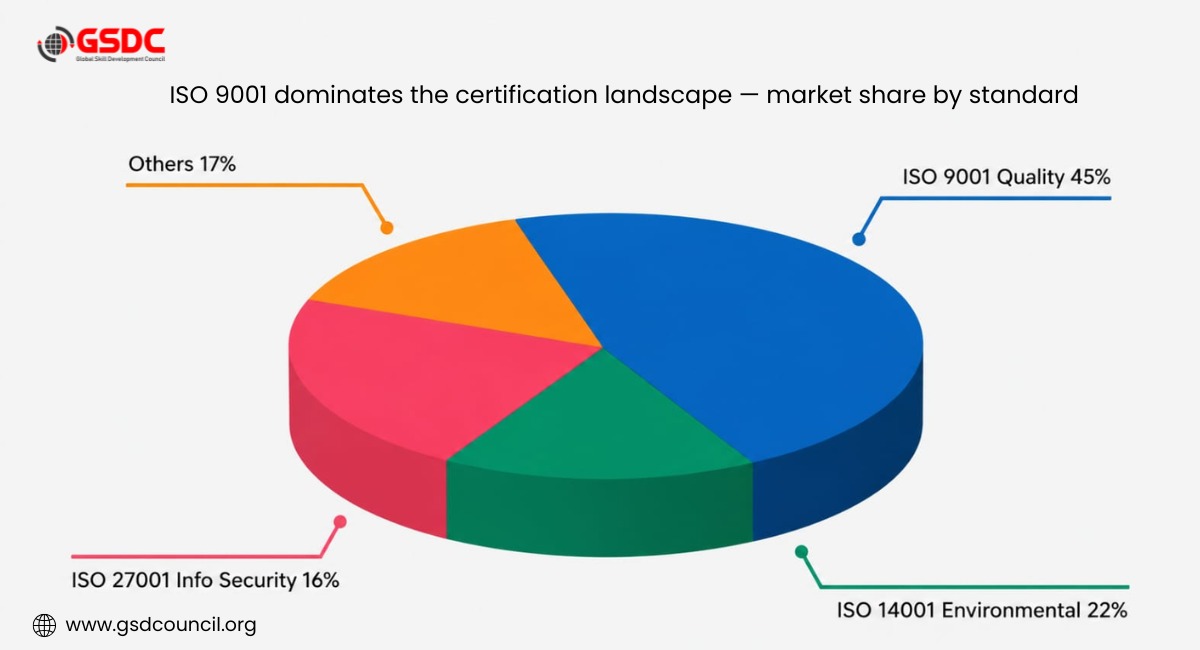
Certified ISO 9001 lead auditors are in demand across virtually every U.S. sector - aerospace, automotive, healthcare, construction, IT, and consumer goods. Per ASQ industry data, certified quality auditor professionals can expect average annual salaries of $65,000 to $95,000, depending on industry and location.
Beyond salary, an ISO 9001 lead auditor certification develops skills that travel: systems thinking, structured communication, evidence-based influence - skills that are valuable far beyond the audit room. And with the ISO certification market projected to grow from $16.1 billion in 2024 to $66.3 billion by 2034, that demand is only accelerating.
Internal vs. external ISO 9001 lead auditors - both have a role
Internal ISO 9001 lead auditors are invaluable for routine surveillance, gap analysis, and building a continuous ISO 9001 compliance culture. External auditors - particularly certification body auditors - provide the objectivity and cross-industry experience that internal teams can't replicate. The healthiest QMS programs use both.
The professionals behind the process
The kind of structured, evidence-based auditing described throughout this blog doesn't happen by accident; it's the result of rigorous training and recognized credentials.
The Global Skill Development Council (GSDC) Certified ISO 9001:2015 Lead Auditor certification prepares quality professionals to do exactly this work: planning audits, leading on-site reviews, classifying nonconformances, and driving corrective action to verified closure. For organizations wondering where to find auditors who can genuinely close the gap between how processes run on paper and how they run on the ground, and for professionals who want to be that person, this is where that capability is built.
The bottom line
ISO 9001 compliance is not about satisfying an external body once every few years. It's about building an organization that consistently delivers on its quality commitments - and keeps improving. ISO 9001 lead auditors are the professionals who make that possible: finding the gaps others miss, building ISO 9001 compliance cultures that stick, and preparing organizations to face external audits with real confidence.
The standard won't do the work for you. But the right people, with the right ISO 9001 lead auditor certification, absolutely will.

Related Certifications
Frequently Asked Questions
Think of it as a reality check. It looks at whether your business actually runs the way your quality manual says it does. Auditors aren't hunting for problems - they're checking that your processes are consistent, documented, and delivering what customers expect.
A lot more than show up with a clipboard. A lead auditor owns the entire audit - from deciding what gets reviewed and who gets interviewed, to writing the final report and making sure every nonconformance gets properly resolved.
It's the auditor's roadmap through the standard. A good lead auditor doesn't treat it as a form to fill in - they use it as a conversation starter, probing whether the processes behind each item are genuinely working or just technically present.
You'll need to complete an accredited training program, sit a practical exam, and log real auditing experience. Programs like the GSDC Certified ISO 9001:2015 Lead Auditor certification are built for working professionals, so you're not expected to put your career on hold to get there.
It means you can prove your quality isn't accidental. ISO 9001 compliance means you have the documented processes, the records, and the audit history to back your claims up - and for many procurement teams, that proof is now a baseline expectation.
A pre-audit health check. It lets you walk through your own QMS before an external auditor does - spotting where documentation is thin, where processes have drifted, and where you're genuinely strong.
The system that keeps everything in one place - documents, corrective actions, audit schedules, training records. Done well, it gives management a live picture of QMS performance. A lead auditor will quickly tell whether it's being used properly or just functioning as a very expensive filing cabinet.
Formally, most certified businesses go through an annual surveillance audit and full recertification every three years. But quarterly internal audits are a much safer rhythm - they keep the QMS honest and mean you're never scrambling to fix months of drift before an external auditor arrives.
A minor is a slip - one instance where something wasn't done as documented. A major means a requirement of the standard isn't being met at all. Left unresolved, it can put your certification at risk. Most lead auditors will tell you majors rarely appear out of nowhere - the warning signs were usually there earlier.
Rarely because they're doing bad work. More often it's the gap between how things are supposed to happen and how they actually happen day to day - processes that haven't kept up, training records nobody updated, corrective actions that got quietly forgotten. It's the kind of drift that's invisible until an auditor walks in.
Stay up-to-date with the latest news, trends, and resources in GSDC
If you like this read then make sure to check out our previous blogs: Cracking Onboarding Challenges: Fresher Success Unveiled
Not sure which certification to pursue? Our advisors will help you decide!