ISO 9001 Auditor: Roles, Responsibilities, and Key Challenges
Written by Matthew Hale
- What Is an ISO 9001 Auditor?
- Types of ISO 9001 Auditors
- ISO 9001 Roles and Responsibilities of an Auditor
- Common Challenges of ISO 9001 Auditing
- Relevance of ISO 9001 Lead Auditor Certification in Quality Auditing
- Who Should Consider ISO 9001 Lead Auditor Certification?
- Professional Development and Readiness for ISO 9001 Auditing
- Conclusion
Quality is essential for building customer trust and ensuring consistent organizational performance. As quality standards such as ISO 9001 are widely adopted across industries worldwide, trained professionals are required to assess whether Quality Management Systems (QMS) comply with ISO 9001 requirements.
This is where ISO 9001 Auditors play a crucial role. Understanding what is iso 9001 and why is it important has become essential for organizations aiming to improve operational efficiency, customer satisfaction, and regulatory compliance.
This blog explains what an ISO 9001 Auditor does, outlines ISO 9001 roles and responsibilities, explores key challenges, and highlights why ISO 9001 Lead Auditor Certification is important for long-term career growth.
What Is an ISO 9001 Auditor?
An auditor of ISO 9001 is a professional who investigates whether the QMS an organization exercises is in accordance with the ISO 9001 standard. The most common question asked by persons new to quality management is what ISO 9001 certification is and why it is so important. To put it simply, ISO 9001 certification suggests that the organization employs internationally accepted practices to enhance consistency and customer satisfaction.
The auditor is supposed to review the documented procedures and observe how processes work in real life to confirm whether those meet the ISO 9001:2015 requirements.
Typical responsibilities will include:
- Documented procedure reviews and records
- Checking whether processes are followed in practice or not
- Non-conformities and areas for improvement are identified.
- Helping to ensure alignment with ISO 9001 certification standards
This is where auditors come in. Auditors ensure that quality processes are written down and applied in daily operations.
Types of ISO 9001 Auditors
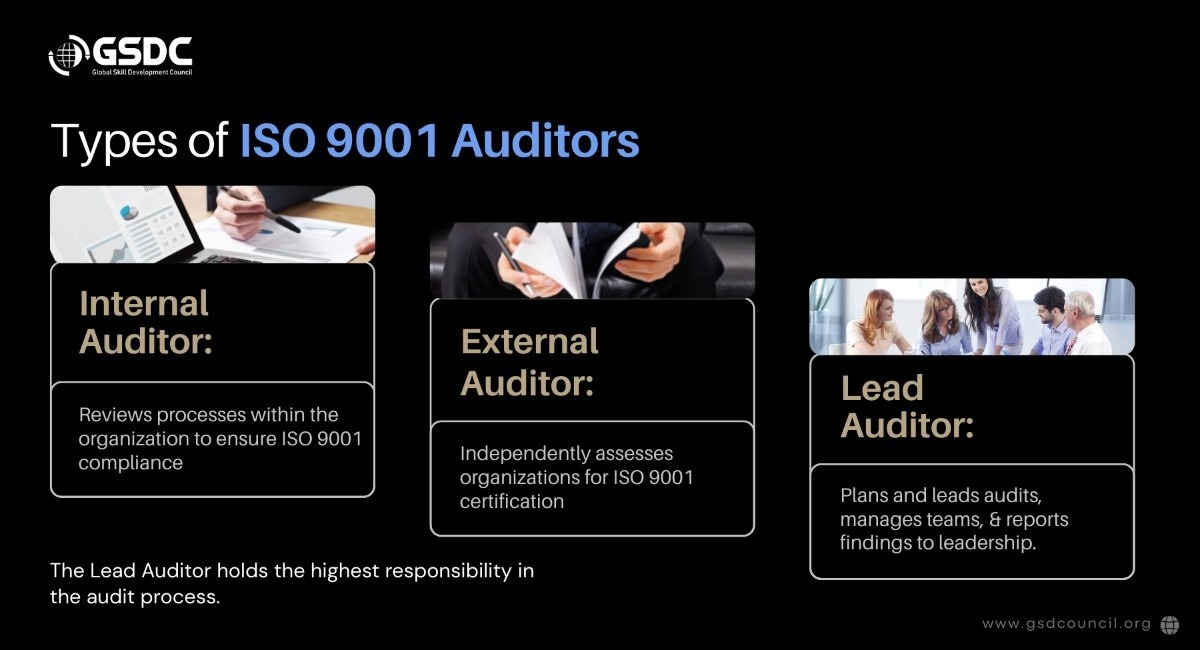
Typically, ISO 9001 auditors can be divided into three types depending on the task they perform and the degree of accountability they hold during an audit:
Internal Auditor
Internally, an auditor inspects within the boundaries of their company to ascertain if the processes are in line with ISO 9001 standards and the company's quality policies. By doing this, internal auditors are an excellent tool for early detection of gaps, aiding in the implementation of corrective actions, and paving the way for the organization to be ready when the external certification audit comes.
External Auditor
Acts as a representative of the certification bodies or audit regarding third-party organizations' audits. The purpose of their work is to provide an independent assessment of an organization's compliance with ISO 9001 certification requisites and to ascertain whether the company can be certified or re-certified to ISO 9001.
Lead Auditor
The Lead Auditor is the one who schedules the audit, leads the audit team, and delivers the audit findings to the top management level. In general, the Lead Auditor is the one to take full responsibility for the audit that is technically correct and consistent with the standards, including preparing and issuing the final report containing conclusions and recommendations.
Among these, the Lead Auditor has the highest level of responsibility, and it is usual for the Lead Auditor to be formally certified as an ISO 9001 Lead Auditor since he/she needs to have the qualities of leadership and decision-making that are essential in this role.
ISO 9001 Roles and Responsibilities of an Auditor
Both auditors and organizations should clearly understand ISO 9001 roles and responsibilities at the time of QMS implementation. The auditor under ISO 9001:2015 roles and responsibilities is the one to verify that the leadership, processes, and documentation are in accordance with the standards framework and the requirements for ISO 9001 certification.
Planning and conducting audits
Auditors scope an audit, lay out audit plans, and perform a thorough check to ensure that the requirements of the standard are met.
Reviewing operational processes and quality records
Auditors look into the documents, records, and practices to verify that the quality processes are being followed in every department.
Identifying non-conformities against ISO 9001 certification requirements
Preparing audit reports and evidence-based findings
Auditors list in an official audit report the points of interest, discrepancies, and positives that are useful for the management in making the right decision.
Recommending corrective and preventive actions
Auditors make suggestions on how the identified issues can be remedied, and quality problems recurring can be avoided.
Supporting continuous improvement initiatives
Auditors play a part in the process of continuous improvement by bringing performance, consistency, and process efficiency to attention for enhancement
These are some of how the auditors illustrate the purpose of ISO 9001 as a tool to be used for raising the level of process consistency, lowering the risk, and ultimately, increasing customer satisfaction. Many professionals build these capabilities through training and certification programs from the GSDC (Global Skill Development Council).
Common Challenges of ISO 9001 Auditing
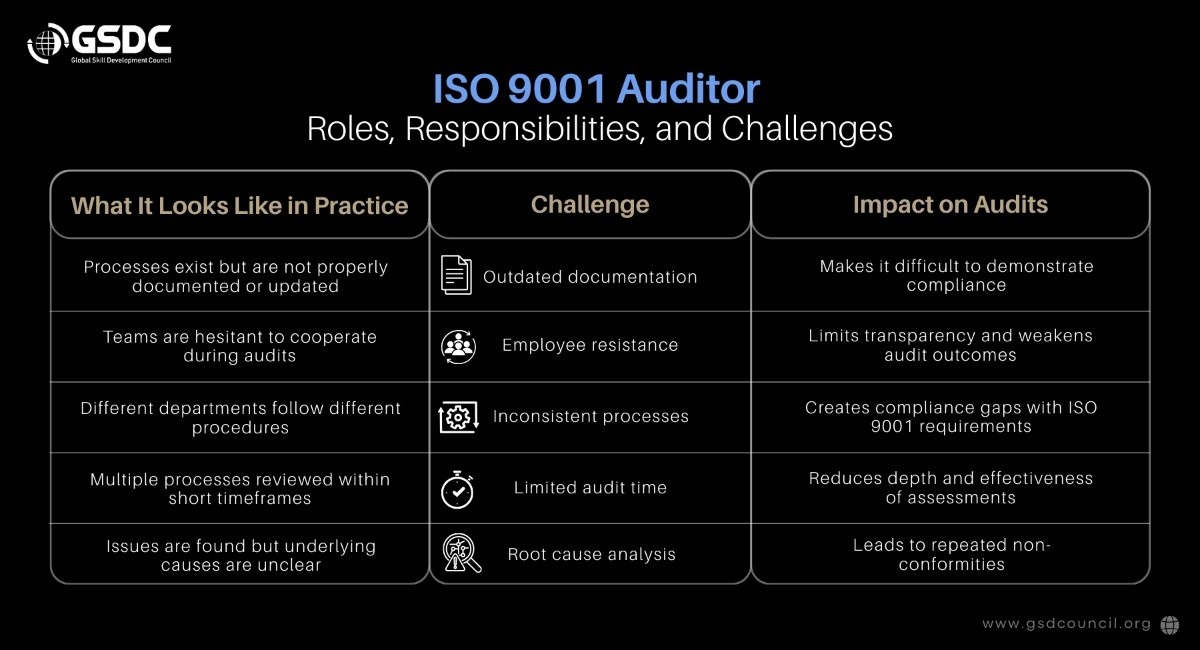
There are real challenges of ISO 9001 implementation and auditing, which even highly skilled professionals cannot avoid, despite the benefits. Below is the list of the most familiar hurdles:
Documentation that is not comprehensive or has become obsolete
The processes might be followed in reality, but they are not well documented or comply with the prevailing ISO 9001 requirements and guidelines.
Unwillingness of employees
Teams might view audits as a blame-finding exercise rather than a chance for improvement, hence they may be less open and willing to cooperate.
Non-uniform process execution
Different procedures in different departments or locations might create compliance gaps with ISO 9001 requirements.
Short time allocated for audits
However, auditors are very often advised to examine several processes within very limited time schedules. In such cases, the quality of the assessment might be compromised
Diagnosing the primary cause of a problem
Oftentimes, compliance violations are identified, but finding the primary cause and taking preventive measures is a problem.
These issues demonstrate that rigorous auditors with proper audit frameworks are needed to bring implementation of ISO 9001 to the point and to keep it at a high level. A certified ISO 9001:2015 Lead Auditor can play a very important role in the establishment of a standardized foundation of auditing knowledge and professional practice.
Relevance of ISO 9001 Lead Auditor Certification in Quality Auditing
Professional certification is definitely one of the main ways to prove that an auditor really knows, is consistent, and understands formal auditing practices, among many other things, even though learning by doing is crucial. ISO 9001 Lead Auditor Certification basically means having a thorough knowledge of auditing principles, ISO 9001 requirements, and professional auditing behavior.
Certified Lead Auditors are capable to:
- Develop and organize audits according to ISO 9001 standards
- Understand and use audit techniques in various organizational settings
- Recognize non-compliances and improvement possibilities
- Perform audits in a fair and ethical manner
It has been a frequently asked question among professionals whether ISO 9001 is beneficial or not. Actually, ISO 9001 Lead Auditor Certification is generally considered to be a stamp of quality that demonstrates one's knowledge and ability in the field of quality management and auditing, the roles in regulated and process-driven sectors.
Who Should Consider ISO 9001 Lead Auditor Certification?
This qualification is intended for anyone working in quality management, compliance or auditing roles, including:
-
Quality managers and quality professionals
You are responsible for the design, implementation, and maintenance of the Quality Management Systems (QMS) in your company.
-
Internal and external auditors
You conduct audits on an organization's compliance with ISO 9001/ ISO 14001 standards and develop action plans for improvement.
-
Consultants and compliance professionals
You assist organizations by guiding quality governance, regulatory compliance, management system rollout, etc.
-
Professionals involved in ISO 9001 implementation and maintenance
You are either initiating, verifying, or enhancing the ISO 9001 certification for your organization.
As a Lead Auditor, leading quality initiatives necessitates thorough knowledge of both ISO 9002 Standards and related Quality frameworks; an effective leader will also possess the capability to effectively lead an Audit team, assess the maturity of an Organization, and communicate Audit Findings effectively to Business Senior Management.
Professional Development and Readiness for ISO 9001 Auditing
Beyond certification, effective ISO 9001 auditing requires continuous learning and practical exposure to quality management systems. Auditors must stay current with evolving interpretations of ISO 9001:2015 requirements, industry best practices, and audit techniques.
Professional development pathways, such as structured learning programs offered by bodies like the Global Skill Development Council (GSDC), help auditors build a formal understanding of audit principles and ISO 9001 frameworks. Certifications such as the Certified ISO 9001:2015 Lead Auditor reflect a standardized approach to developing audit competence and professional readiness.
It helps one lay the very foundation of sound skills in audit planning, stakeholder engagement, and evidence evaluation, which will ensure continued effectiveness as an internal auditor, external auditor, or lead auditor.

Conclusion
ISO 9001 Auditors play a critical role in improving the way organizations handle quality, are self-governed, and strive for continuous improvement. ISO 9001 clearly explains who does what in an organization, and this helps organizations improve their compliance with the standard, reduce risks, and integrate quality into their operations.
Of course, there are challenges involved in organizations adopting ISO 9001. However, with the help of qualified auditors, these challenges can be overcome. As more industries achieve ISO 9001 certification, the role of qualified ISO 9001 Lead Auditors remains integral to ensuring quality and compliance in organizations.

Related Certifications
Stay up-to-date with the latest news, trends, and resources in GSDC
If you like this read then make sure to check out our previous blogs: Cracking Onboarding Challenges: Fresher Success Unveiled
Not sure which certification to pursue? Our advisors will help you decide!