4 Soft Skills AI Can't Replace and How to Build Them
Written by Matthew Hale
Picture two candidates applying for the same internship. One has a flawless resume: top grades, a coding certification, a polished portfolio. The other has a slightly thinner resume but handled an angry customer calmly during a part-time job and led a group project when the original plan fell apart halfway through. Most hiring managers today would pick the second candidate, and they'd have data to back that instinct.
TestGorilla's 2025 State of Skills-Based Hiring report surveyed over 2,000 employers and job seekers and found that 78% of employers have hired someone with strong technical skills who later underperformed because they were missing the soft skills or cultural fit the role actually needed. Technical ability got them through the door. It wasn't enough to keep them there.
That gap is exactly what this guide is about. If you've ever wondered what soft skills are, why employers keep bringing them up, or how to actually build them instead of just listing them on a resume, you're in the right place. Whether you're a student with a few months off, an intern in your first real job, or a professional looking to round out your strengths, this is a practical soft skills list, complete with real examples and four specific abilities worth developing this summer that no AI tool can build for you.
What Are Soft Skills?
So, what are soft skills exactly? In simple terms, soft skills are the personal habits and interpersonal abilities that shape how you work with other people and how you handle situations that don't come with a manual. Think communication, teamwork, patience, adaptability, and judgment under pressure.
They're different from hard skills, which are the technical, teachable abilities tied to a specific job, like coding in Python, reading a balance sheet, or operating a piece of machinery. Hard skills get you through the door. Soft skills decide what happens after that.
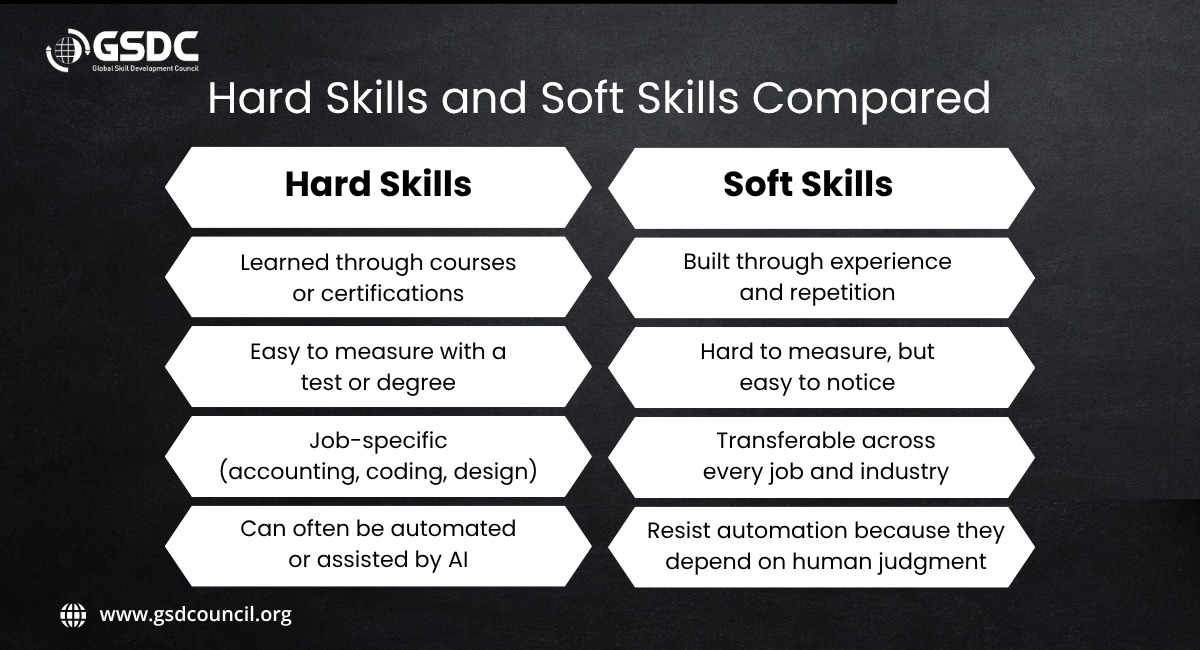
If someone asks what soft skills are in one sentence, this works well: soft skills are how you get things done through and with other people, especially when the situation is messy, emotional, or unclear.
Why Are Soft Skills Important In The Workplace?
This is where the data gets interesting. The World Economic Forum's Future of Jobs Report 2025 projects that nearly 39% of core workforce skills will change by 2030, and the abilities sitting at the top of that shift are not technical ones. They are analytical thinking, resilience, flexibility, and leadership, the very definition of soft skills.
Here's why that matters day to day in a workplace:
- Teams with strong communicators lose less time to misunderstandings and rework.
- Employees who manage stress well tend to stay longer and burn out less.
- Leaders who read a room well build trust faster than leaders who just give instructions.
- Problem-solvers who stay calm under pressure are the ones companies promote first.
AI can draft an email, summarize day-to-day work, or generate a slide deck in seconds. What it cannot do is sit across from an upset client and de-escalate the conversation, or notice that a teammate has gone quiet in meetings and check in on them. That gap is exactly why soft skills in the workplace are becoming the differentiator between an average employee and an indispensable one. It also lines up with what employers themselves report: in that same TestGorilla survey, 60% said soft skills matter more today than they did five years ago, a shift most of them tie directly to how much technical work AI now handles on its own.
Soft Skills List: Examples Of Soft Skills You Can Recognize Today
A good soft skills list usually falls into a few broad categories. Here are practical examples of soft skills, grouped so they're easier to remember:
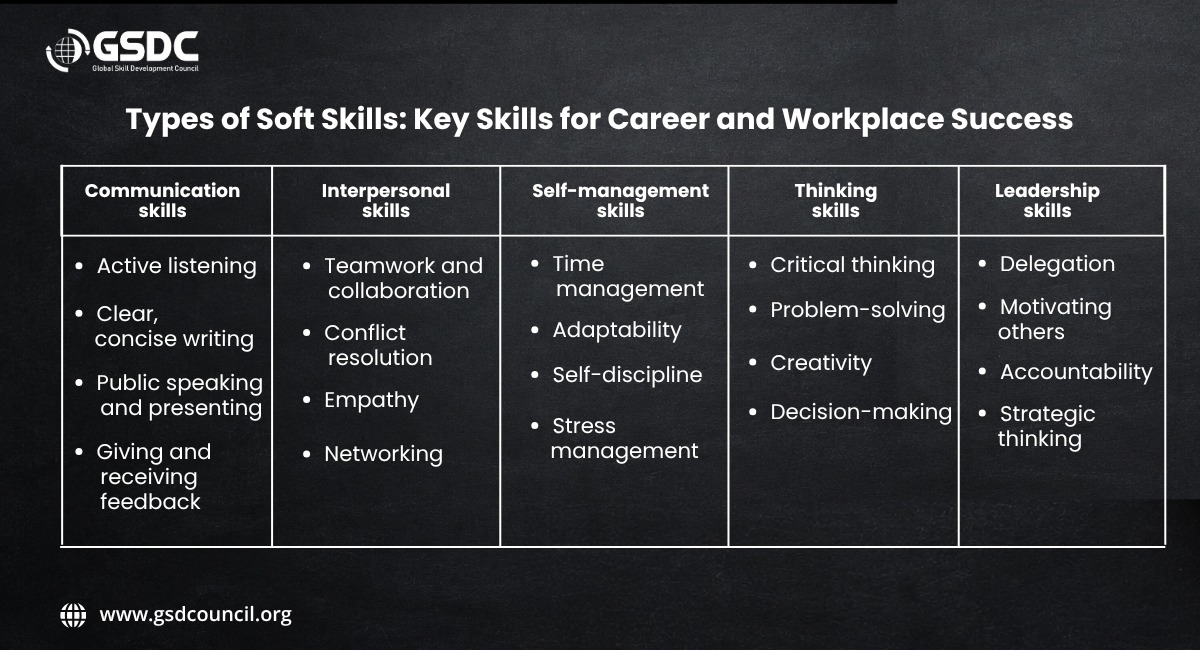
This kind of grouping isn't just a convenient way to organize a list. It's roughly how workforce development bodies like the Global Skill Development Council (GSDC) approach soft skills too, breaking them into clear categories so they're easier to teach, track, and actually improve over time instead of treating "soft skills" as one vague, unmeasurable blob.
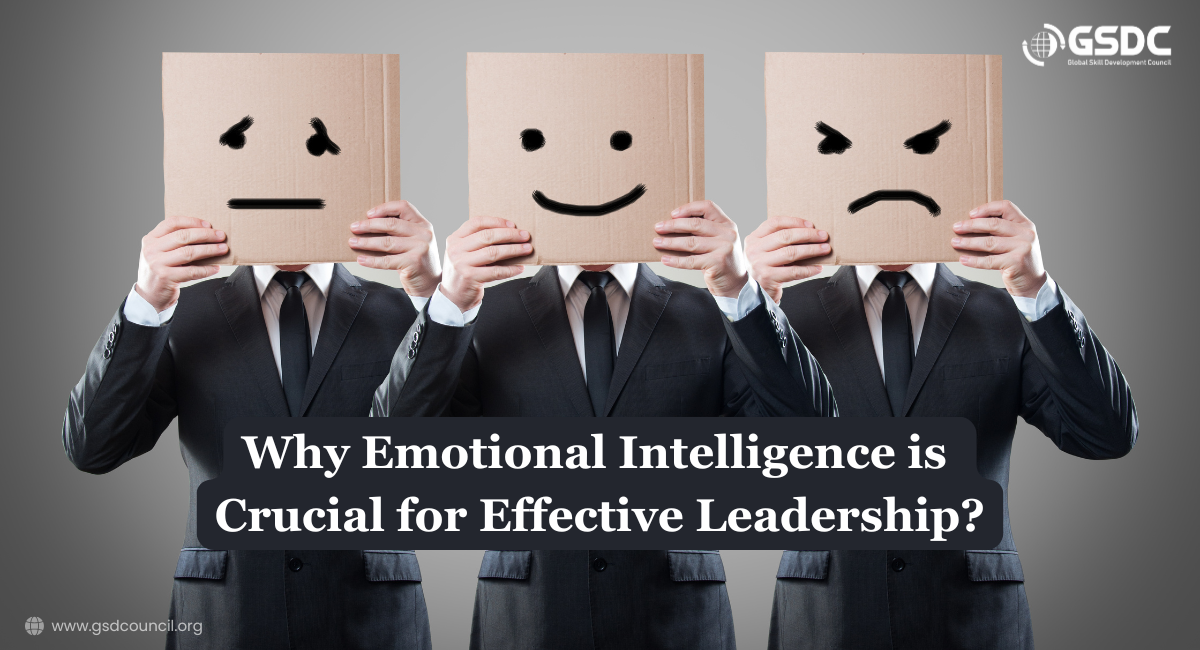
Notice that emotional intelligence skills touch almost every category on this list. That's not a coincidence. Emotional intelligence, the ability to recognize and manage your own emotions while reading other people's, is often described as the soft skill that makes all the other soft skills work.
4 Soft Skills Worth Building This Summer
Summer offers something a classroom rarely does: real stakes, real people, and real consequences for how you handle both. Here are four soft skills worth focusing on over the next few months, and what actually building them looks like in practice.
1. Emotional Intelligence
Emotional intelligence is difficult to fake in an interview or an application essay because it only shows up under real pressure. You either handled the upset customer well or you didn't. You either noticed a friend was struggling or you missed it.
This summer, look for moments where the outcome depends on reading people rather than just finishing a task. That could be:
- Supervising kids at a summer camp
- Working a customer-facing shift at a retail or hospitality job
- Mediating a disagreement within a club, team, or group project
- Sitting with a difficult conversation instead of avoiding it
The habit worth building is naming what happened afterward. What did you notice about the other person? How did you respond? What would you do differently next time? That kind of reflection is what turns an experience into an actual skill, and if you want a more structured way to build on it, a Certified Emotional Intelligence Professional program covers the exact frameworks behind reading people and managing reactions well, more on that later in this guide.
2. Persuasion And Influence
Persuasion is the ability to get someone to see things your way, or to move a group in a direction it wasn't originally heading. It depends on timing, credibility, and reading what the other person actually cares about in the moment, which is a hard thing to script or outsource, even with AI tools helping you prepare.
Ways to practice this over the summer:
- Pitch an idea to a manager or client during an internship
- Recruit volunteers for a cause or event
- Lead a small team and get buy-in on a plan
- Present a proposal and track whether it actually got approved
The key is tracking outcomes, not effort. Did your idea get adopted? Did people follow through after you asked them to? That's the proof that the skill is developing.
3. Critical Thinking
Critical thinking is what happens when the information in front of you is incomplete, contradictory, or simply doesn't have a textbook answer. It's the skill behind every good decision made under uncertainty.
You build it by putting yourself in situations where something can genuinely go wrong and you have to work out the fix yourself, such as:
- Running an independent project with no fixed roadmap
- Debating a position you don't personally hold
- Making a real call for a team or organization you're part of
- Troubleshooting a problem at work with no manager around to ask
Passive learning, sitting through lectures or watching tutorials, doesn't build this skill on its own. Active problem-solving does.
4. Relationship-Building
A supervisor or mentor who has watched you work for a few months can speak to your character and judgment in a way that no résumé line ever will. That kind of relationship takes consistency to build, and summer is long enough to start one if you're intentional about it.
Practical ways to work on this:
- Ask a professional in a field you're curious about if you can shadow them for a day
- Take a part-time role under someone worth learning from
- Volunteer somewhere often enough that people actually get to know you
- Follow up with people after you meet them instead of letting the connection fade
This isn't about collecting contacts. It's about showing up reliably enough that someone is willing to vouch for you later, which is exactly what employers and mentors look for.
How To Develop Soft Skills, Practically
Knowing the list is one thing. Actually building the skills is another. A few habits make the difference:
Put yourself in situations with real stakes.
Skills grow fastest when something is actually on the line, not in a simulated or low-pressure setting.
Ask for feedback often, not just at review time.
A quick "how did that land?" After a conversation builds self-awareness faster than waiting for an annual review.
Reflect in writing.
Keeping a short log of what worked, what didn't, and what you'd change turns random experiences into a pattern you can actually learn from.
Find one person to learn from.
Watching how someone you respect handles conflict, pressure, or a tough conversation teaches more than any course.
Practice the uncomfortable conversation instead of avoiding it.
Most soft skills, especially emotional intelligence and persuasion, only grow in moments you'd rather skip.
Turn Emotional Intelligence Into Something You Can Prove
Everything in this blog so far comes down to experience: the summer job, the hard conversation, the moment you had to read a room instead of just completing a task. That's how soft skills actually get built. But experience alone can be hard to put into words on a resume, which is where a credential can help.
The Global Skill Development Council (GSDC) offers a Certified Emotional Intelligence Professional program built for exactly this gap. It takes the instincts most people develop informally, reading emotional cues, managing conflict, staying composed under pressure, and turns them into a structured framework you can actually apply and demonstrate. The certification doesn't replace the real-world practice this blog talks about. It gives you language and proof for it, so when you tell an employer you handled a tough situation well this summer, you also have a credential backing up how and why it worked.
If the emotional intelligence section above felt like the skill you most want to strengthen, this is a practical next step worth exploring.
The Bottom Line
Soft skills aren't a backup plan for people who lack technical ability. They are the proof layer that makes everything else on a résumé or application believable. Anyone can list "team player" or "strong communicator" on a profile. Far fewer people can point to a specific summer, a specific project, or a specific hard conversation where they actually proved it.
As AI keeps taking over more of the technical and repetitive work, the abilities that stay stubbornly human, reading people, building trust, thinking through uncertainty, and influencing outcomes, are only going to matter more. AI can support this kind of work, drafting talking points, summarizing a conversation, prepping you for a hard meeting, but it can't sit in the room and do the reading, deciding, and relating for you. Building that capacity now, while the stakes are still manageable, is one of the smartest investments you can make in your own career.

Related Certifications
Frequently Asked Questions
Soft skills are the personal and interpersonal abilities that shape how you communicate, collaborate, and handle pressure at work. Unlike technical know-how, they aren't tied to one job or industry, which is why the same soft skills list, things like communication, adaptability, and problem-solving, shows up as valuable across almost every career path.
Common examples of soft skills include active listening, time management, conflict resolution, adaptability, critical thinking, and teamwork. Leadership abilities like delegation and giving feedback also count, along with emotional intelligence, which many hiring managers now treat as one of the most important soft skills of all.
Soft skills in the workplace directly affect how well teams function day to day, fewer miscommunications, faster conflict resolution, and stronger trust between colleagues. Research also backs this up: TestGorilla's 2025 hiring survey found that 78% of employers have hired someone technically strong who later underperformed simply because they lacked the right soft skills.
The fastest way to develop soft skills is through real situations with actual stakes, not classroom theory. Put yourself in scenarios that require you to lead, negotiate, or resolve conflict, then reflect afterward on what worked and what you'd do differently. Asking for regular feedback and observing someone you admire handle pressure well also speeds up the process considerably
Emotional intelligence skills are the abilities that let you recognize, understand, and manage emotions, both your own and other people's. This includes self-awareness, empathy, staying composed under stress, and knowing how to respond rather than react in a tense conversation. Of all the soft skills employers look for, emotional intelligence is often described as the one that makes the rest of them work.
Stay up-to-date with the latest news, trends, and resources in GSDC
If you like this read then make sure to check out our previous blogs: Cracking Onboarding Challenges: Fresher Success Unveiled
Not sure which certification to pursue? Our advisors will help you decide!