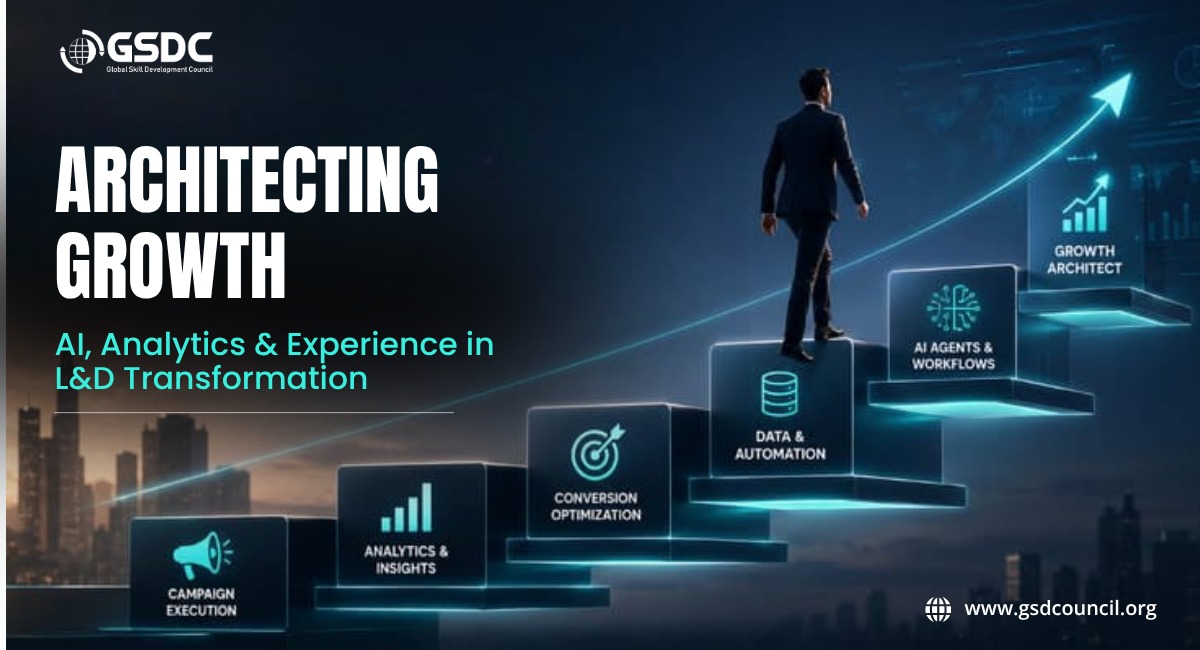
Architecting Growth: AI, Analytics & Experience in L&D Transformation
Written by Pratik Sheth
- The Shift from Systems of Record to Systems of Intelligence
- The Convergence of AI, Analytics, and Experience
- Why Data Is the Foundation of AI-Driven Learning
- From Personalized Learning to Intelligent Learning Experiences
- Measuring What Really Matters
- Building Trust Through Responsible AI
- A Real-World Example: Netflix's Personalization Engine
- Preparing L&D Teams for the AI Era
- Best Practices for Driving AI-Powered Digital Transformation
- GSDC Certified Learning & Development Professional: Building AI-Ready L&D Capabilities
- Conclusion
Organizations have invested heavily in digital transformation, adopting cloud platforms, advanced analytics, and artificial intelligence to improve efficiency and business outcomes. Yet many initiatives still struggle to deliver meaningful value. The challenge is not simply technology, but the ability to connect data, intelligence, and user experience into a cohesive system.
For learning and development, this convergence creates a significant opportunity. Modern L&D functions must go beyond delivering training to building workforce capabilities, personalizing learning experiences, supporting an effective learning and development strategy, and demonstrating measurable business impact. For every learning and development manager and learning and development specialist, this means rethinking how learning is designed, delivered, and measured.
Analytics plays an increasingly important role in this transformation. Understanding what is learning analytics and how it can connect learner behavior with organizational outcomes helps L&D teams make more informed decisions. Learning analytics tools, platforms, and dashboards can provide insights into engagement, skills, performance, and training effectiveness.
At the same time, AI can personalize learning, automate administrative tasks, and generate actionable insights. Knowing how to use AI in learning and development can help organizations create smarter, more adaptive learning ecosystems while strengthening training ROI and aligning learning initiatives with business priorities.
This blog explores how AI, analytics, and user experience are reshaping the future of L&D.
The Shift from Systems of Record to Systems of Intelligence
Digital transformation has evolved from simply digitizing processes to building systems that can learn, adapt, and support better decisions. This evolution has taken place in three stages.
Stage 1: Descriptive Analytics
Organizations used reports, dashboards, and learning analytics dashboards to understand what happened by analyzing historical data. These capabilities helped L&D teams track participation, completion rates, engagement, and other learning metrics.
Stage 2: Predictive Analytics
Machine learning enabled organizations to forecast outcomes, identify trends, and anticipate what was likely to happen next. In learning and development, predictive analytics can help identify potential skill gaps and understand where targeted learning interventions may be needed.
Stage 3: Generative AI
Today, generative AI goes a step further by helping organizations determine what to do next. Large language models and AI agents can generate insights, recommend actions, automate workflows, and support decision-making in real time. Understanding how to use AI in learning and development can help organizations apply these capabilities to personalized learning, content creation, and employee support.
For Learning and Development, this shift transforms learning platforms from systems that track activity into intelligent ecosystems that identify skill gaps, personalize learning, and deliver support when employees need it most. Learning analytics tools and a modern learning analytics platform can bring these capabilities together, helping organizations move from simply measuring learning activity to generating actionable insights.
The Convergence of AI, Analytics, and Experience
Digital transformation isn't driven by a single technology. It succeeds when analytics, AI, and user experience work together to create intelligent systems that continuously learn, adapt, and improve.
Analytics: Turning Data into Insight
Analytics provides the foundation for every AI initiative. It transforms raw data into actionable insights, helping organizations understand performance, identify trends, and measure business outcomes.
For L&D teams, analytics answers critical questions: Which skills are in demand? Where are learners struggling? Which programs deliver the greatest impact? Without these insights, AI lacks the context needed to make meaningful recommendations.
AI: Turning Insight into Action
While analytics explains what's happening, AI determines what should happen next. It can identify skill gaps, recommend personalized learning paths, generate content, automate routine tasks, and provide real-time support through intelligent assistants.
As AI continues to evolve, organizations are moving beyond standalone assistants toward AI agents capable of coordinating tasks and supporting increasingly complex workflows.
Experience: Turning Technology into Value
Even the most advanced AI creates little impact if employees struggle to use it. User experience is what transforms intelligent technology into everyday value.
For L&D, this means delivering personalized, intuitive learning experiences that fit naturally into employees' workflows. Instead of searching through multiple platforms, learners receive the right knowledge, at the right time, in the right context.
When analytics, AI, and user experience work together, organizations create learning ecosystems that continuously improve, adapt to changing business needs, and deliver measurable outcomes. This convergence is what turns digital transformation into sustainable growth.
Why Data Is the Foundation of AI-Driven Learning
AI is only as effective as the data behind it. While organizations often focus on deploying AI tools, reliable, well-governed data is what enables those tools to deliver meaningful insights and recommendations.
In L&D, data comes from multiple sources, including learning platforms, HR systems, skills assessments, performance reviews, and employee feedback. When this information is fragmented across systems, AI struggles to build an accurate picture of workforce capabilities.
By treating data as a strategic asset and improving its quality, accessibility, and ownership, organizations create a stronger foundation for AI-driven learning. This enables L&D teams to identify skill gaps, personalize learning journeys, connect learning outcomes with business performance, and support workforce planning with greater confidence.
Ultimately, better data leads to better AI and better learning experiences.
From Personalized Learning to Intelligent Learning Experiences
Personalization has always been an important goal for L&D. AI, however, is transforming it from a predefined learning path into an intelligent experience that adapts to each learner in real time.
Traditional Personalized Learning | AI-Powered Intelligent Learning |
Recommends predefined courses | Continuously adapts learning paths |
Uses historical learner data | Responds to real-time behavior and context |
Delivers the same journey to similar learners | Tailors learning to each individual's needs |
Supports scheduled learning | Delivers learning in the flow of work |
This shift enables AI to identify skill gaps, recommend relevant content, generate learning resources, and provide contextual support exactly when employees need it. As learners interact with the system, their experiences become more relevant, engaging, and aligned with business goals.
Beyond personalization, conversational assistants, intelligent search, and multimodal interfaces are making knowledge easier to access. Instead of navigating multiple platforms, employees can find answers naturally within their everyday workflows, making learning a continuous part of how work gets done.
Measuring What Really Matters
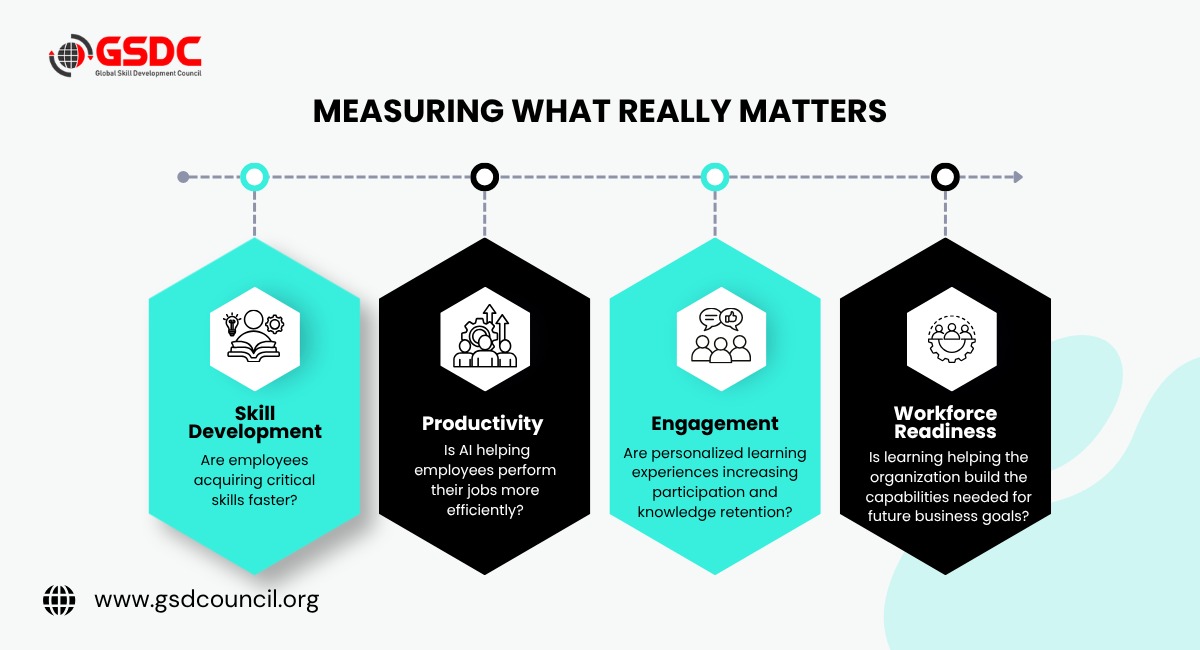
As AI becomes embedded in Learning and Development, organizations need to rethink how they measure success. Traditional metrics such as course completions, attendance rates, and platform usage provide useful operational insights, but they reveal little about the real business impact of learning.
Instead, L&D teams should focus on outcomes that demonstrate value across the organization.
It's equally important to measure the effectiveness of AI itself. Organizations should evaluate the accuracy of AI recommendations, employee trust and adoption, and whether AI is reducing administrative effort while improving learner outcomes.
By focusing on business outcomes rather than learning activity alone, L&D can demonstrate its strategic value and play a more influential role in digital transformation.
Building Trust Through Responsible AI
The success of AI-powered learning depends not only on innovation but also on trust. Employees are far more likely to embrace AI when they understand how it works, how their data is used, and how AI supports decision-making.
Building that trust starts with responsible AI governance. Organizations need clear policies for privacy, security, transparency, and accountability, supported by ongoing monitoring to identify bias, ensure fairness, and maintain the reliability of AI systems. For learning and development, responsible AI also means ensuring that learner data is handled appropriately and that AI-driven recommendations are transparent and explainable. Human oversight remains essential, particularly when AI influences learning opportunities, career development, or employee performance.
For L&D teams, the goal isn't to replace human expertise but to enhance it. AI should help employees discover relevant learning, access knowledge faster, and make better decisions while people remain responsible for critical judgments. This approach can strengthen the overall learning and development strategy while supporting more personalized and effective learning experiences.
As AI adoption continues to grow, organizations that build trust into their AI strategy will be better positioned to scale learning initiatives, encourage adoption, and deliver long-term business value.
A Real-World Example: Netflix's Personalization Engine
Netflix is often recognized for its recommendation engine, but its real success lies in how it combines analytics, AI, and user experience into a system that continuously learns from user behavior.
By analyzing viewing patterns, search activity, engagement, and user preferences, Netflix generates personalized recommendations that evolve with every interaction. The platform also continuously experiments with content rankings, artwork, and user interfaces to refine the viewing experience and improve engagement.
Rather than treating data, AI, and user experience as separate capabilities, Netflix brings them together in a continuous improvement cycle:
- Analytics uncovers user behavior and preferences.
- AI transforms those insights into personalized recommendations.
- Experience delivers those recommendations through an intuitive interface, generating new data that further improves the system.
The same principle applies to Learning and Development. Organizations can use workforce data to understand employee needs, apply AI to recommend relevant learning opportunities, and design intuitive experiences that make learning a seamless part of everyday work. The result is a learning ecosystem that becomes smarter and more valuable with every interaction.
Preparing L&D Teams for the AI Era
The role of Learning and Development is changing rapidly. As AI becomes part of everyday work, L&D professionals are moving beyond delivering training to shaping how organizations build future-ready capabilities.
Traditional L&D | AI-Enabled L&D |
Delivers training programs | Builds workforce capabilities |
Tracks learning activity | Measures business impact |
Creates learning content | Curates AI-assisted learning experiences |
Supports employees | Partners with HR, IT, and business leaders |
Responds to skill gaps | Anticipates future workforce needs |
This evolution requires new capabilities in AI literacy, data-driven decision-making, user experience design, experimentation, and cross-functional collaboration. More importantly, it positions L&D as a strategic function that helps employees work confidently alongside AI while ensuring learning remains aligned with business priorities.
Organizations that invest in both technology and talent won't simply adopt AI—they'll build a workforce capable of growing with it.
Best Practices for Driving AI-Powered Digital Transformation
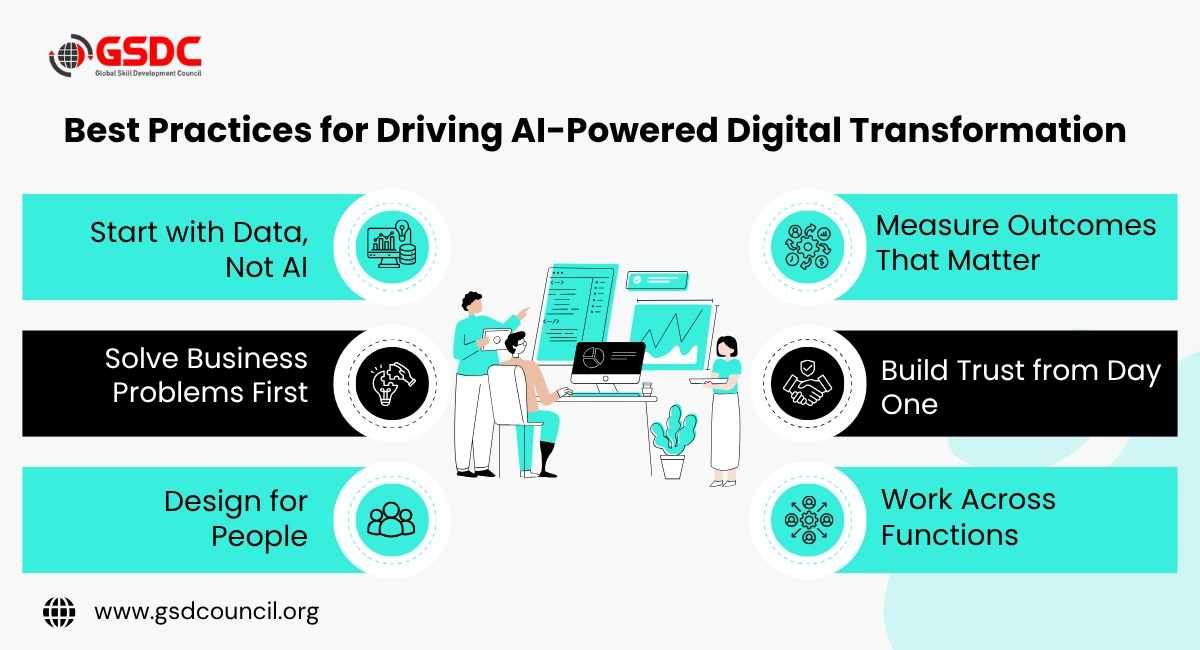
Successful organizations don't treat AI, analytics, and user experience as separate initiatives. They bring these capabilities together through a few guiding principles:
Start with Data, Not AI
AI can only generate meaningful insights when it's built on trusted, well-governed data. Investing in data quality and accessibility creates the foundation for every successful AI initiative.
Solve Business Problems First
Adopt AI with a clear purpose. Focus on initiatives that improve learning outcomes, enhance employee experiences, or address measurable business challenges rather than deploying AI for its own sake.
Design for People
The most sophisticated AI has little value if employees don't use it. Prioritize intuitive, personalized experiences that integrate learning naturally into everyday work.
Measure Outcomes That Matter
Move beyond activity metrics and evaluate how AI contributes to workforce capability, employee productivity, engagement, and overall business performance.
Build Trust from Day One
Responsible AI should be embedded into every initiative through strong governance, transparency, privacy, fairness, and appropriate human oversight.
Work Across Functions
Digital transformation isn't owned by a single team. The strongest results come when L&D, HR, IT, data teams, and business leaders collaborate to create integrated solutions that support shared business objectives.
GSDC Certified Learning & Development Professional: Building AI-Ready L&D Capabilities

GSDC’s Certified Learning & Development Professional (CLDP) Certification equips L&D professionals with the knowledge and capabilities to design modern, technology-enabled learning strategies.
Aligned with the shift toward AI, analytics, and personalized learning, the Certified Learning & Development Professional (CLDP) Certification helps professionals understand how emerging technologies can strengthen workforce development, improve learning experiences, and support measurable business outcomes.
It is designed for professionals looking to build future-ready learning and development capabilities and drive meaningful transformation across organizational learning ecosystems.
Conclusion
Digital transformation is no longer about adopting the latest technology—it is about creating systems where data, AI, and human experience work together to deliver meaningful outcomes.
For learning and development, this means moving beyond delivering training to designing intelligent learning ecosystems that continuously evolve with employee needs and business priorities. Analytics provides the insights, AI transforms those insights into action, and thoughtful user experiences ensure those capabilities create real value for learners. Learning analytics platforms and dashboards can further help L&D teams understand engagement, skills development, and learning effectiveness.
Organizations that successfully integrate these capabilities will be better equipped to build future-ready workforces, accelerate innovation, and respond to change with greater agility. As AI continues to reshape the workplace, sustainable growth will not come from technology alone—it will come from thoughtfully architecting ecosystems where intelligence, data, and people continuously learn from one another.

Related Certifications
Frequently Asked Questions
It is the integration of data analytics, artificial intelligence, and user experience to create intelligent systems that continuously learn, adapt, and improve business outcomes.
It enables L&D teams to deliver personalized learning experiences, identify skill gaps, measure business impact, and support continuous workforce development through a stronger learning and development strategy.
Analytics provides the trusted data and insights that AI uses to generate recommendations, automate decisions, and personalize user experiences. Learning analytics tools can also help L&D teams turn learner data into actionable insights.
Even the most advanced AI creates little value if employees find it difficult to use. Intuitive, low-friction experiences improve adoption, engagement, and learning outcomes.
Success should be measured through business-focused outcomes such as skill development, employee productivity, learning effectiveness, engagement, and organizational performance. Organizations can also evaluate training ROI and corporate training ROI to understand the financial and business value of learning initiatives.
Responsible AI helps organizations build trust by ensuring AI systems are transparent, secure, fair, and supported by appropriate human oversight.
Start with a strong data foundation. High-quality, well-governed data enables reliable analytics, more effective AI, and personalized learning experiences that support business objectives. Understanding what is learning analytics can also help organizations establish the right measurement framework for their learning initiatives.
Stay up-to-date with the latest news, trends, and resources in GSDC
If you like this read then make sure to check out our previous blogs: Cracking Onboarding Challenges: Fresher Success Unveiled
Not sure which certification to pursue? Our advisors will help you decide!