Why Emotional Intelligence Is the Skill AI Can't Replace
Written by Emily Hilton
- What Is Emotional Intelligence?
- Why Emotional Intelligence Matters More in an AI-Driven Workplace
- What Is Emotional Intelligence in the Workplace?
- Does AI Have Emotional Intelligence?
- What Research Says About Emotional Intelligence and Career Success
- What Do You Learn in an Emotional Intelligence Certification?
- Who Should Get an Emotional Intelligence Certification?
- Is Emotional Intelligence Certification Worth It?
- How to Choose an Emotional Intelligence Certification
- How to Improve Emotional Intelligence in the Workplace
- The Bottom Line
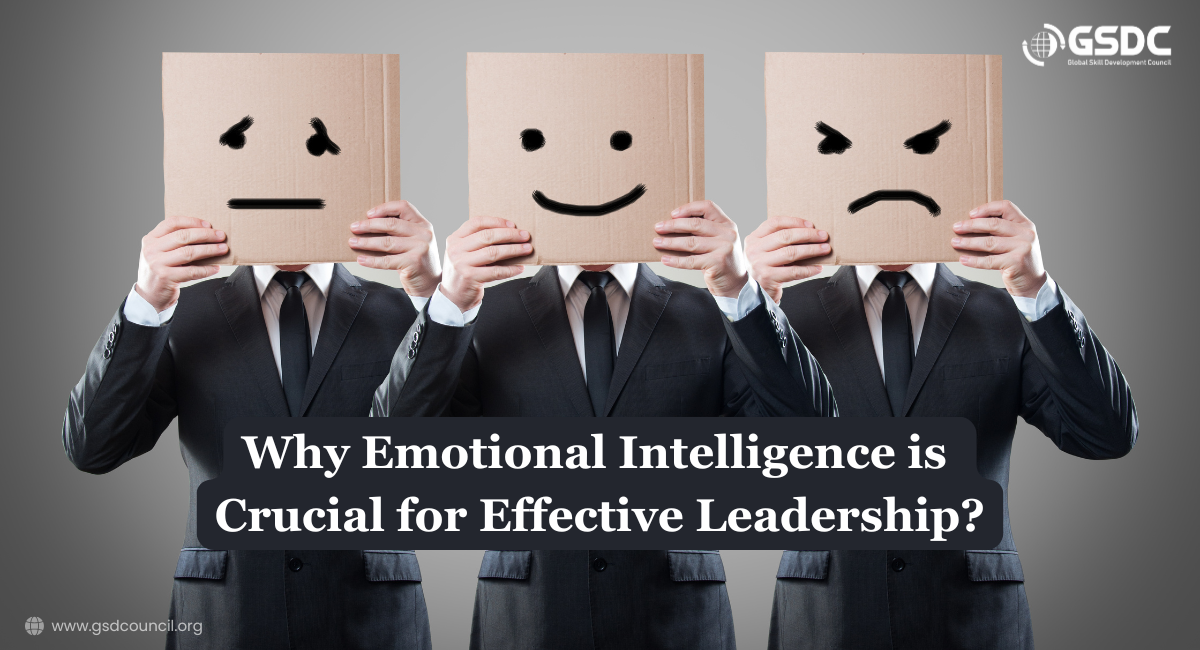
Every year, companies pour money into hiring for skills that machines are quietly catching up on: coding, data analysis, drafting reports, even basic customer support. Yet a large-scale academic meta-analysis published in the Journal of Applied Psychology found emotional intelligence to be one of the strongest known predictors of job performance, holding up even after researchers controlled for cognitive ability and personality. As AI reshapes the workplace, employers are placing more weight on human-centered skills like empathy, resilience, and self-awareness, and that shift is driving growing interest in structured emotional intelligence training and certification.
AI can write your emails, summarize your meetings, and even flag when a customer sounds upset. What it still struggles with is sitting across from a grieving colleague and knowing exactly what to say, or reading the silence in a room and deciding it's not the time to push an idea. That gap between processing emotion and actually understanding it is where emotional intelligence, and the people who are certified in it, keep proving their value.
What Is Emotional Intelligence?
Emotional intelligence (often shortened to EQ or EI) is the ability to recognize, understand, and manage your own emotions, while also being able to recognize, understand, and influence the emotions of people around you. The term was popularized by psychologist Daniel Goleman in the 1990s, building on earlier academic research, and it's now considered just as important to success as traditional IQ, if not more so.
Psychologists generally break emotional intelligence into five core components:
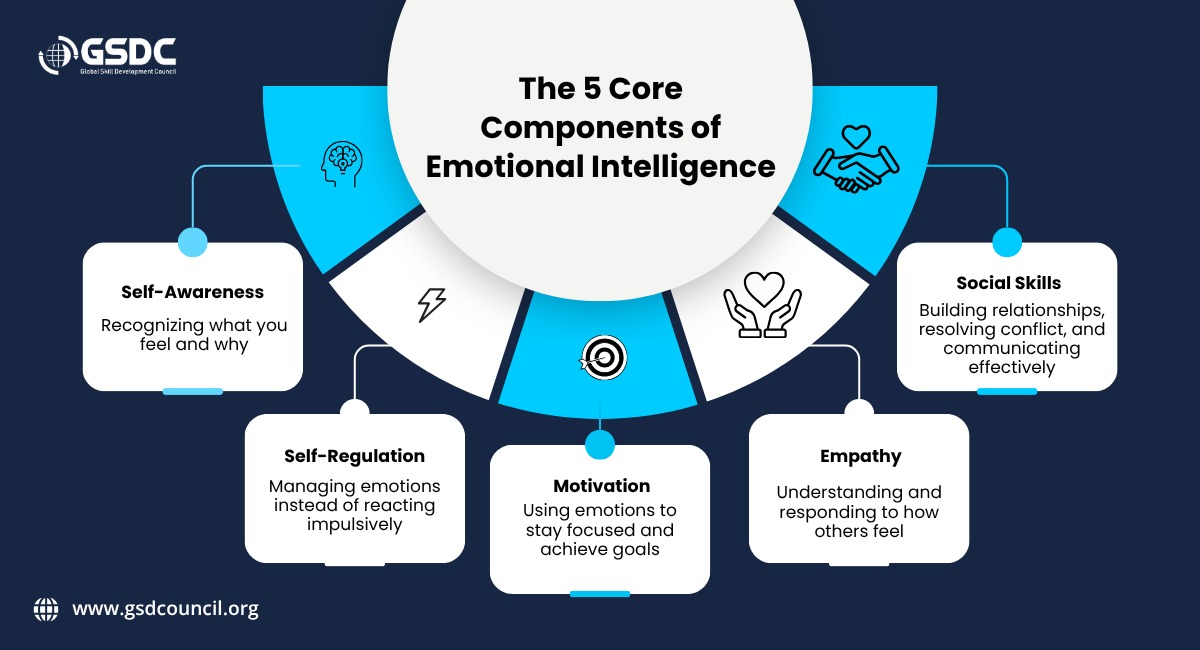
None of these are personality traits you're simply born with. They're learnable skills, which is exactly why structured training and certification programs around emotional intelligence have grown so much in demand.
Why Emotional Intelligence Matters More in an AI-Driven Workplace
AI is genuinely good at spotting patterns in emotional data: a frustrated tone in a support ticket, a disengaged phrase in a survey response. What it can't do is act on that information the way a human colleague or manager can, with judgment, context, and genuine care for the outcome.
That's the core reason emotional intelligence is climbing the list of skills employers say they need. As routine, rules-based tasks get automated, the work that's left over leans harder on the parts of a job that are relational: negotiating, leading through uncertainty, resolving conflict, motivating a team. Those are EQ tasks, not AI tasks.
What Is Emotional Intelligence in the Workplace?
Emotional intelligence in the workplace is the practical, everyday version of all of the above: how well someone handles feedback without getting defensive, how they manage a tense meeting, how they notice when a teammate is struggling before it becomes a bigger problem.
It shows up in moments like these:
Workplace Moment | Low EQ Response | High EQ Response |
Receiving critical feedback | Gets defensive, shuts down | Listens, asks clarifying questions |
A team conflict during a deadline | Avoids it or escalates it | Names the issue calmly, finds middle ground |
Leading during uncertainty | Projects false confidence or panic | Acknowledges the difficulty, stays steady |
Managing an underperforming employee | Criticizes the person | Addresses the behavior, keeps the relationship intact |
Organizations have noticed the pattern. The World Economic Forum's Future of Jobs Report 2025 lists resilience, leadership and social influence, empathy and active listening, and motivation and self-awareness among the core skills employers say will matter most in the coming years, alongside analytical thinking and technological literacy. It's part of why organizations like the Global Skill Development Council (GSDC) have built dedicated emotional intelligence certification tracks, treating this as a skill worth formally training rather than assuming people will just pick it up on the job.
Does AI Have Emotional Intelligence?
This is one of the most searched questions on the topic right now, and the honest answer is: not in the way humans do.
There's a growing field called "emotional intelligence AI" or affective computing, where algorithms are trained to detect emotional cues from tone of voice, facial expressions, or word choice. Some customer service tools use this to flag when a caller sounds frustrated. It's genuinely useful, but it's pattern recognition, not understanding.
Here's the difference:
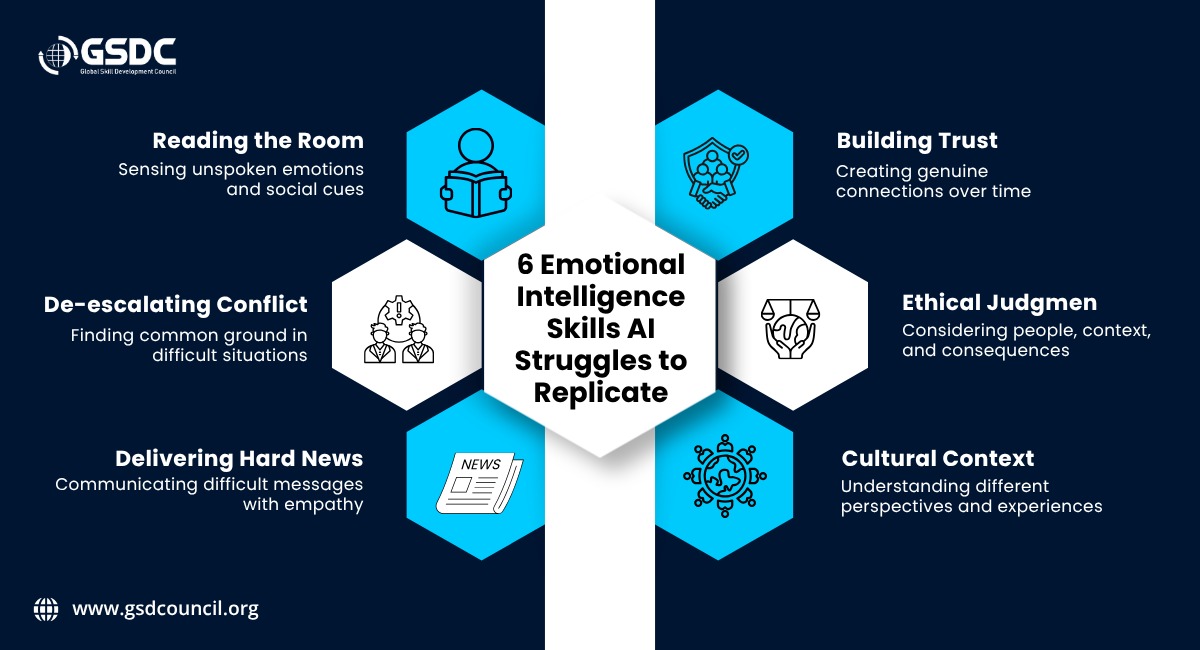
Capability | Can AI Do This? | Can Humans Do This? |
Detect tone of voice or word choice signaling anger | Yes | Yes |
Predict likely emotional reaction based on data | Yes, reasonably well | Yes |
Feel empathy from lived experience | No | Yes |
Adjust behavior based on unspoken social context | Very limited | Yes |
Build trust through vulnerability | No | Yes |
Make an ethical judgment call in an emotionally charged situation | No | Yes |
AI can simulate the outputs of emotional intelligence, a sympathetic-sounding reply, a flagged "angry customer" alert, but it has no lived experience, relationship history, or personal stake in the outcome. It's closer to mimicry than intelligence.
What Research Says About Emotional Intelligence and Career Success
Research Area | What It Shows |
Job performance | Peer-reviewed meta-analyses rank EQ among the strongest known predictors of job performance |
Leadership | Leaders with higher EQ tend to create healthier, more positive team climates |
Salary and career growth | Long-term studies link higher EQ, measured early in a career, to higher salary years later |
Future workforce | Employer surveys show human-centered skills rising in importance as AI adoption grows |
Two peer-reviewed meta-analyses, one in the Journal of Applied Psychology (Joseph & Newman, 2010) and one in the Journal of Organizational Behavior (O'Boyle et al., 2011), both rank EQ among the strongest known predictors of job performance.
On pay, a 2017 Journal of Vocational Behavior study tracked 561 U.S. business students for 10 to 12 years and found higher EI predicted higher salary later, even after controlling for cognitive ability, GPA, personality, and gender. At senior executive level, high-EI individuals earned roughly $30,000 to $40,000 more per year than their lower-EI peers.
The Yale Center for Emotional Intelligence has similarly found that emotionally intelligent leaders create more positive work climates, with lower employee burnout. TalentSmart's industry research points the same direction, though it isn't peer-reviewed.
What Do You Learn in an Emotional Intelligence Certification?
A good certification doesn't just define emotional intelligence, it trains you to apply it under real pressure. Most reputable programs cover:
- Self-awareness frameworks: Structured ways to identify your emotional patterns and triggers, often through validated self-assessments.
- Emotional regulation: Techniques for staying composed and clear-headed in high-stress moments.
- Empathy and perspective-taking: Practicing how to accurately read what someone else is experiencing, not just guess at it.
- Conflict management: Scripts and frameworks for de-escalating disagreements without avoiding them.
- Active listening: Moving beyond "waiting to talk" to genuinely absorbing what's being said.
- Workplace communication: Adjusting tone and delivery for feedback, difficult conversations, and cross-team collaboration.
- Leadership under pressure: Leading a team through uncertainty without transferring your own stress onto them.
- Relationship management: Building trust and influence over time, not just in a single interaction.
The difference between this and simply reading about EQ is practice and feedback. Certification programs typically include assessments, scenario-based exercises, and structured feedback, the same way a language course does more for fluency than a vocabulary list ever could. A well-built Certified Emotional Intelligence program is built around this exact combination: self-assessment, applied practice, and expert-reviewed feedback, rather than a definitions-only approach.
Who Should Get an Emotional Intelligence Certification?
An emotional intelligence certification isn't just a resume line. It's structured proof that you can consistently apply EQ skills in real situations, not just describe them in an interview.
It's especially valuable if you're in:
- Leadership and management, where your emotional steadiness sets the tone for an entire team.
- HR and people operations, where conflict resolution and empathy are part of the daily job description.
- Sales and client-facing roles, where reading a customer's real hesitation often matters more than the pitch itself.
- Healthcare and education, where emotional labor is constant and burnout risk is high.
- Coaching and consulting, where your ability to build trust quickly is the entire product.
A certification gives you a shared vocabulary, practical frameworks, and often a self-assessment that shows exactly where your strengths and blind spots lie, something most people never get honest feedback on otherwise.
Is Emotional Intelligence Certification Worth It?
For most people in people-facing or leadership roles, yes, with a few caveats worth knowing upfront.
The case for it:
- Research consistently links higher EQ to stronger job performance, leadership effectiveness, and long-term salary growth.
- It gives you structured practice and feedback, not just theory, which is where most self-taught EQ efforts plateau.
- It signals to employers that your interpersonal skills are trained and assessed, not just self-reported.
The caveats:
- Not all certifications are equal. Look for programs with validated assessments, practical scenario work, and instructors with real organizational psychology or leadership backgrounds, rather than a short quiz and a certificate.
- Certification is a tool, not a shortcut. It works best paired with real practice at work, feedback from colleagues, and honest self-reflection over time.
- It's most valuable in roles with heavy people-management, client-facing, or leadership responsibility. If your role is highly technical with minimal interpersonal demands, the return will be smaller, though rarely zero.
How to Choose an Emotional Intelligence Certification
Not all certifications deliver the same value. A few things worth checking before you commit time or money to one:
- Practical learning, not just theory. Does the program include scenarios, role-play, or applied exercises, or is it mostly slides and reading?
- A real assessment method. Are you evaluated through structured feedback and applied tasks, or just a multiple-choice quiz at the end?
- A complete curriculum. Look for coverage of self-awareness, empathy, communication, conflict management, and leadership, not just one or two of these.
- Workplace relevance. Does the training connect directly to situations you'll actually face at work, rather than staying abstract?
- A credible provider. Is the certification backed by an organization with a track record in professional skills training, with instructors who have real organizational or leadership experience?
If a program checks these boxes, it's likely to build skills you can actually use, not just a credential you can list.
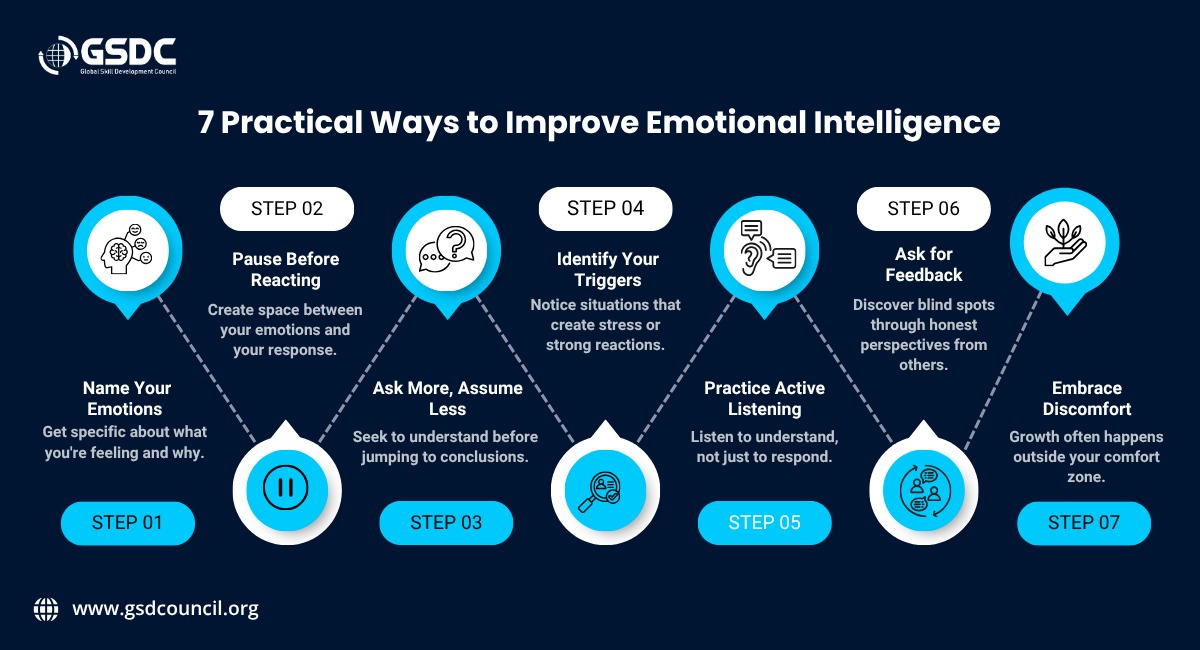
How to Improve Emotional Intelligence in the Workplace
Workplace EQ needs a slightly different approach, since it plays out in front of colleagues, managers, and clients rather than in private.
- Before a difficult meeting, name the outcome you actually want. Walking in reactive rather than intentional is where most workplace conflict starts.
- Separate the person from the problem in feedback conversations. Critique the work, not the character.
- Check in on your team beyond status updates. A simple "how are you managing the workload" surfaces issues before they become resignations.
- Model calm during pressure. Teams take their emotional cues directly from whoever is leading the room.
- Debrief after conflict, not just projects. What triggered it, and what would help next time.
Invest in structured training. Self-taught EQ has a ceiling. Certified frameworks, practice scenarios, and expert feedback take it further, faster. Programs like the Global Skill Development Council's Certified Emotional Intelligence course build exactly this kind of structured practice into the learning, rather than leaving it to trial and error on the job.
The Bottom Line
AI is only going to get better at recognizing emotion from the outside. It's a much longer way from actually carrying the weight of a hard conversation, holding the history of a relationship, or making the kind of judgment call that requires genuinely caring about the outcome. That's the gap certified emotional intelligence skills are built to fill, and it's a gap that keeps widening as automation spreads into more of the workplace.
If your career, your team, or your organization is going to stay valuable in an AI-driven workplace, emotional intelligence isn't the soft skill to deprioritize. It's the one worth formalizing.

Related Certifications
Frequently Asked Questions
It's generally understood as a set of skills and abilities that can be developed over time, though researchers measure it a few different ways: some treat parts of it as trainable abilities, others as traits or competencies. Either way, the research consensus is that EQ can be meaningfully improved through training and practice, unlike a fixed personality trait.
Yes. Structured approaches, self-awareness exercises, and certification programs all show measurable improvement over time, especially when paired with real-world practice and feedback.
Nearly all of them to some degree, but it's especially critical in leadership and management, healthcare, education, HR, sales, customer service, and coaching or consulting, any role where outcomes depend on relationships and trust.
AI can get better at detecting emotional signals from text, voice, or expressions. It cannot develop genuine emotional intelligence in the human sense, since that requires lived experience, consciousness, and a personal stake in relationships that current AI systems don't have.
For people-facing and leadership roles, the research strongly supports it. Look for programs with validated assessments and practical, scenario-based training rather than a short quiz and a certificate.
Stay up-to-date with the latest news, trends, and resources in GSDC
If you like this read then make sure to check out our previous blogs: Cracking Onboarding Challenges: Fresher Success Unveiled
Not sure which certification to pursue? Our advisors will help you decide!