The L&D Playbook for AI-First Enterprises: Skills & Strategy
Written by Niyati K Prajapati
- Why Learning & Development Is the Foundation of AI-First Enterprises?
- Understanding the Workforce Shift in the AI Era
- Building AI-Ready Employees Through the Three-Layer Competency Model
- Diagnosing AI Skill Gaps Before Launching AI Training
- The Five-Layer L&D Architecture for AI-First Enterprises
- Why Skill-Based Organizations Will Replace Job-Based Models
- How Agentic AI Is Transforming Corporate Learning
- Building Trust Through AI Governance and Change Management
- GSDC Certified Learning and Development Certification
- Conclusion
Artificial Intelligence is transforming the way organizations work, but becoming an AI-first enterprise requires more than adopting advanced technologies. The real transformation begins with people. Organizations must equip their workforce with the right skills, foster a culture of continuous learning, and prepare employees to work confidently alongside AI. As automation and generative AI reshape business operations, Learning and Development (L&D) has become a key driver of workforce readiness and AI workforce transformation.
The webinar, The L&D Playbook for AI-First Enterprises: Skills, Strategy, and Workforce Transformation, explored how businesses can build an AI-ready workforce through practical learning and development strategy.
It highlighted ways to identify skill gaps, develop future-ready capabilities, leverage Agentic AI for personalized learning, and create a culture of continuous upskilling. The session emphasized that organizations become truly AI-first enterprise by investing in their people, combining structured learning, responsible AI practices, and measurable AI workforce development to stay competitive in an evolving digital economy.
Why Learning & Development Is the Foundation of AI-First Enterprises?
Every major technological shift changes the way people work, but AI is transforming work faster than any previous innovation. Organizations are redesigning workflows, introducing intelligent automation, and integrating AI into nearly every business function. While technology is advancing rapidly, workforce capabilities often struggle to keep pace.
This is where Learning and Development becomes indispensable.
Traditional corporate training models built around annual workshops and static learning modules are no longer sufficient for today's fast-changing environment. AI technologies evolve continuously, requiring employees to learn, unlearn, and relearn throughout their careers. AI in learning and development is helping organizations create more adaptive and personalized approaches to employee training and development.
The webinar emphasized that L&D should no longer be viewed as a support function. Instead, it should serve as a strategic business capability that enables organizations to successfully adopt AI while preparing employees for changing roles and responsibilities through an effective AI adoption strategy.
Modern L&D initiatives must move beyond knowledge transfer. They should help employees build confidence in using AI tools, understand responsible AI practices, collaborate effectively with intelligent systems, and continuously develop new AI skills as business needs evolve. Building ai literacy is also becoming essential for employees across different functions.
Organizations that invest in continuous learning are significantly better positioned to adapt to technological disruption, retain talent, and remain competitive in an AI-driven marketplace. This makes AI learning and development a critical component of modern enterprise ai strategy.
Understanding the Workforce Shift in the AI Era
One of the key themes throughout the webinar was that AI is fundamentally changing the nature of work, not simply replacing jobs. This shift is central to the future of work AI landscape.
Many repetitive, routine, and data-intensive activities are increasingly being automated. Tasks such as manual data entry, repetitive reporting, and administrative processing can now be performed more efficiently by AI systems. Rather than eliminating employees, this transformation enables professionals to focus on responsibilities that require creativity, strategic thinking, collaboration, empathy, and complex decision-making.
However, this transition also creates new challenges for organizations.
Businesses now face growing demand for AI-skilled professionals while simultaneously needing to reskill their existing workforce. Employees must learn how to work alongside AI instead of competing with it. Organizations therefore need focused AI skills development and structured AI workforce development programs to address the growing ai skills gap.
The webinar highlighted that organizations should redesign roles by separating tasks into three categories:
Tasks best handled by AI through automation.
Tasks where humans and AI collaborate to improve efficiency and decision-making.
Tasks that remain uniquely human, such as leadership, innovation, relationship management, and ethical judgment.
This balanced approach allows organizations to maximize productivity while preserving the value of human expertise. It also supports broader artificial intelligence skills development across the workforce.
Ultimately, workforce transformation is not about reducing headcount, it is about redesigning work so that people and AI complement each other's strengths.
Building AI-Ready Employees Through the Three-Layer Competency Model
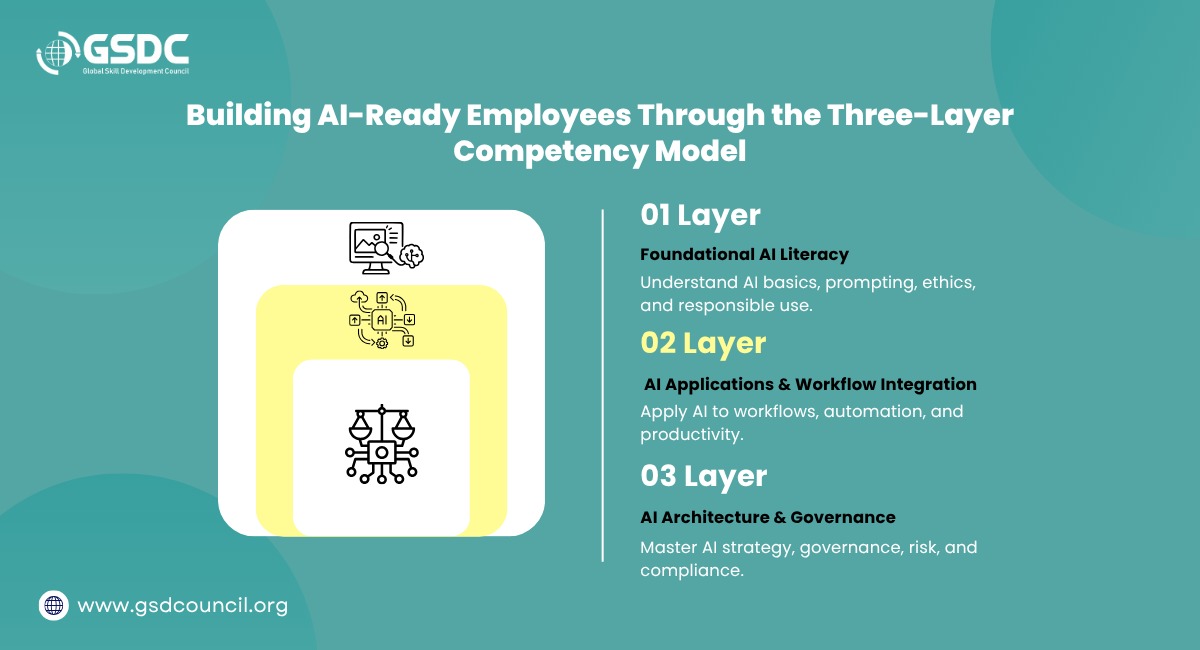
A major highlight of the webinar was the Three-Layer Competency Model, a structured framework designed to help organizations develop AI capabilities across different employee groups.
Instead of expecting every employee to become an AI engineer, the model recognizes that workforce readiness requires different levels of AI expertise depending on individual roles and responsibilities.
Layer 1: Foundational AI Literacy
The first layer focuses on establishing AI literacy across the entire workforce.
Every employee should understand the basic concepts of artificial intelligence, including how generative AI and large language models function, prompt engineering fundamentals, AI ethics, bias awareness, and responsible AI usage.
This foundational knowledge reduces uncertainty surrounding AI adoption while helping employees confidently integrate AI into their daily work. It also promotes responsible decision-making by ensuring employees understand both the opportunities and limitations of AI technologies.
Without AI literacy, organizations often experience inconsistent adoption, resistance to change, and ineffective AI implementation.
Layer 2: AI Applications and Workflow Integration
Once foundational knowledge has been established, employees need practical experience applying AI within their respective roles.
This competency level focuses on integrating AI into business workflows to improve productivity and operational efficiency.
Employees learn how to identify repetitive tasks suitable for automation, evaluate AI-generated outputs, collaborate effectively with AI assistants, and incorporate domain-specific AI tools into everyday business processes.
The webinar emphasized that AI should function as a collaborative partner rather than an independent decision-maker. Human oversight remains essential for validating outputs, ensuring quality, and making strategic decisions.
By embedding AI into everyday workflows, organizations can improve efficiency while enabling employees to concentrate on higher-value work.
Layer 3: AI Architecture and Governance
The final competency layer targets technical specialists, AI leaders, enterprise architects, and decision-makers responsible for implementing AI at scale.
These professionals require deeper expertise in enterprise AI strategy, governance frameworks, Retrieval-Augmented Generation (RAG), large language model fine-tuning, multi-agent systems, MLOps, risk management, and regulatory compliance.
The webinar emphasized that successful AI implementation depends not only on technical capabilities but also on strong governance structures that ensure transparency, accountability, privacy, and ethical AI practices.
Organizations that combine technical excellence with responsible governance create AI systems that employees, customers, and stakeholders can trust.
Diagnosing AI Skill Gaps Before Launching AI Training
The webinar emphasized that organizations should avoid rolling out generic AI training without first assessing workforce readiness. A structured AI readiness assessment helps create targeted and effective learning initiatives.
The process begins by mapping employees' current skills against future business needs to identify capability gaps. Next, organizations should analyze role vulnerability by determining which tasks can be automated and which require new AI-related competencies, enabling role redesign rather than replacement.
Equally important is evaluating the organization's learning culture. Employees should feel encouraged to experiment with AI, learn continuously, and adapt without fear of failure. Finally, businesses must assess governance readiness by reviewing AI policies, ethical guidelines, privacy requirements, and security measures before enterprise-wide AI adoption.
By focusing on skills, roles, culture, and governance, organizations can build customized AI learning strategies that prepare employees for transformation while ensuring responsible and effective AI implementation.
The Five-Layer L&D Architecture for AI-First Enterprises
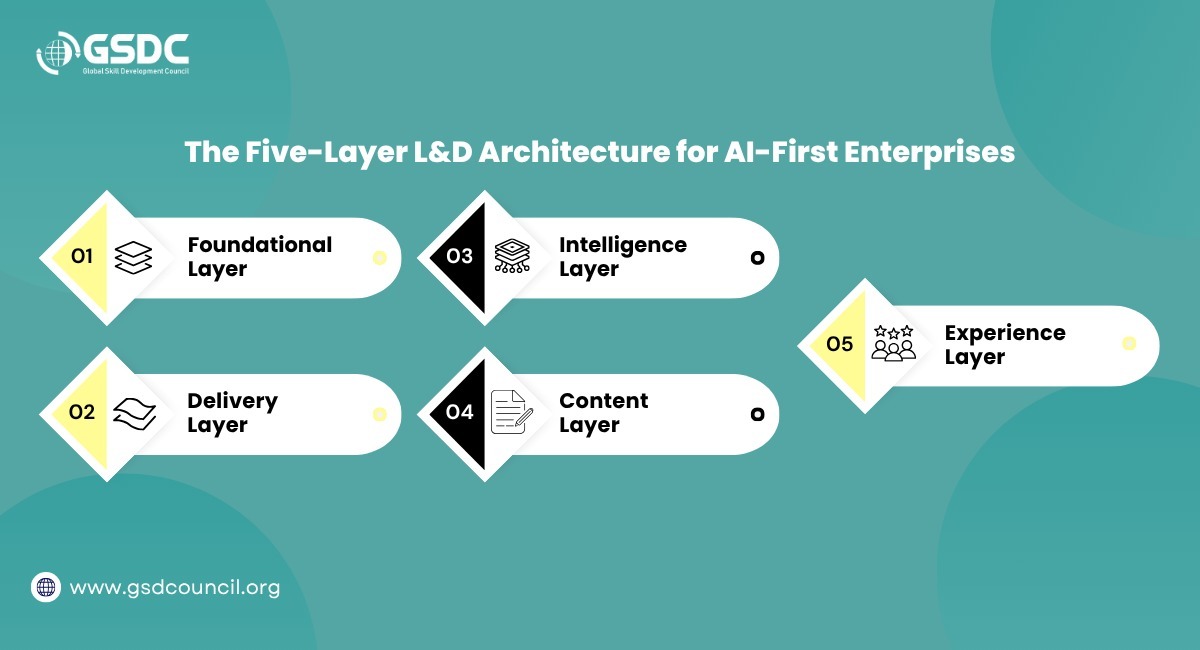
The webinar introduced a Five-Layer Learning & Development Architecture that helps organizations build an AI-ready workforce through a structured, scalable learning ecosystem.
- Foundational Layer
- Establishes AI governance and learning strategy
- Identifies skill gaps and role requirements
- Aligns learning goals with business objectives
- Delivery Layer
- Provides learning through videos, digital platforms, live sessions, and interactive experiences
- Supports flexible, accessible learning for diverse employee needs
- Content Layer
- Delivers AI-powered microlearning and modular courses
- Continuously updates content to match evolving technologies
- Personalizes learning resources
- Experience Layer
- Uses AI tutors, simulations, peer learning, coaching, and hands-on projects
- Focuses on practical, real-world skill development
- Intelligence Layer
- Tracks learning progress and identifies skill gaps
- Recommends personalized learning paths
- Predicts future workforce needs with AI-driven analytics
Together, these five layers create a continuous learning ecosystem that enables organizations to support long-term AI transformation and workforce readiness.
Why Skill-Based Organizations Will Replace Job-Based Models
The webinar highlighted a major shift from traditional job-based structures to skill-based organizations. As AI automates tasks and reshapes work, relying solely on job titles, qualifications, and years of experience is becoming less effective.
Instead, organizations are beginning to focus on employees' verified skills and capabilities. Rather than asking what role someone holds, businesses are asking what skills they possess and how those skills can create value. This approach improves workforce agility, enables faster talent deployment, and helps organizations adapt to changing business needs.
AI plays a key role by analyzing employee capabilities, identifying skill gaps, recommending personalized learning paths, and matching talent to the right opportunities. The webinar highlighted four defining characteristics of skill-based enterprises:
- Dynamic Skill Portfolios: Continuously updated records of verified employee competencies.
- Verified Micro-Credentials: Certifications that validate practical, job-ready skills.
- AI-Powered Skill Inference: AI identifies adjacent skills and recommends career growth opportunities.
- Talent Marketplaces: AI matches employees to projects based on skills rather than job titles.
This approach creates a more agile workforce while supporting continuous learning and career development.
How Agentic AI Is Transforming Corporate Learning
The webinar explored how Agentic AI is transforming Learning and Development by going beyond prompt-based assistance. Instead of simply responding to requests, Agentic AI proactively identifies learning needs, personalizes development, and guides employees throughout their learning journey, making AI in learning and development more adaptive and effective.
The evolution of AI-powered learning and development includes:
AI-Assisted Learning: Recommends relevant courses, articles, and learning resources based on employee roles and interests, supporting AI learning and development.
Personalized Learning: Tracks learner progress, adapts learning paths, and suggests content aligned with individual strengths and career goals, strengthening AI skills development.
Proactive Agentic Learning: Detects skill gaps early and recommends certifications, coaching, and hands-on learning opportunities before they affect business performance, helping address the AI skills gap and strengthen AI workforce development.
Autonomous Learning Orchestration: AI agents collaborate to assess workforce capabilities, assign personalized learning journeys, monitor progress, and recommend career pathways, supporting broader AI workforce transformation and artificial intelligence skills development.
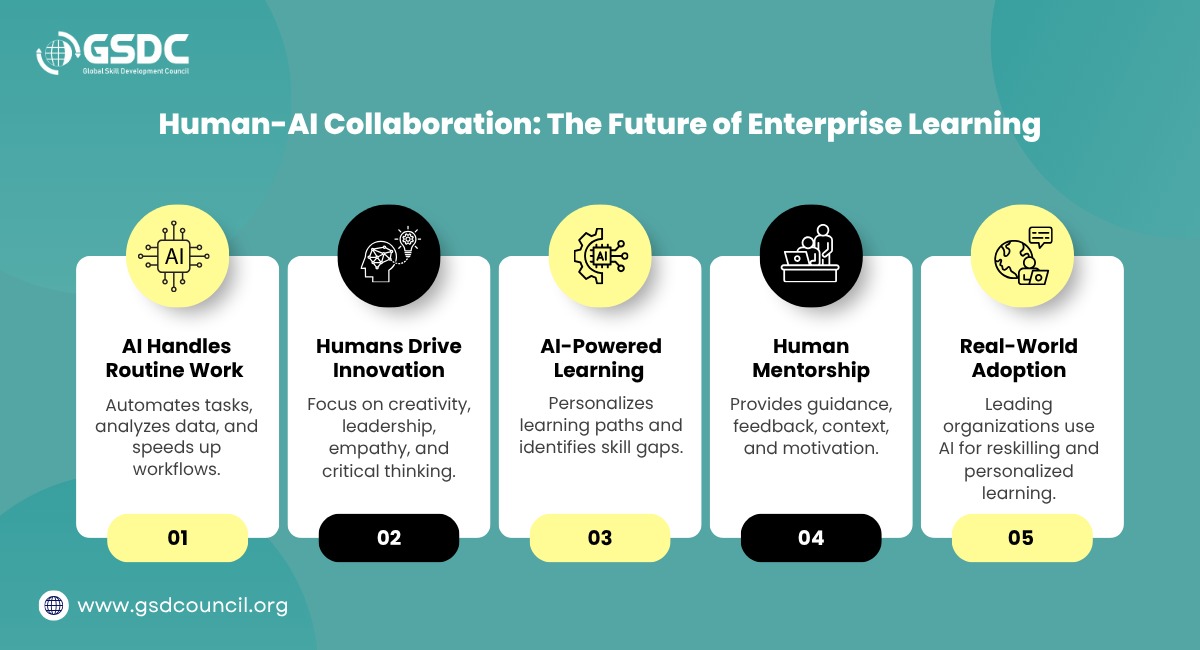
The webinar also emphasized that AI should enhance, not replace, human expertise. Managers, mentors, and L&D leaders remain essential for providing strategic guidance, ethical judgment, and the human support that AI cannot replicate. Combining AI-driven personalization with human mentorship creates more engaging, effective, and future-ready learning experiences while supporting an effective learning and development strategy.
Building Trust Through AI Governance and Change Management
Technology adoption succeeds only when people trust the process behind it.
Throughout the webinar, responsible AI governance was presented as a critical pillar of workforce transformation. Organizations that deploy AI without clear governance frameworks risk creating uncertainty, bias, privacy concerns, and resistance among employees.
Building trust begins with transparent leadership. Executives should clearly communicate why AI is being adopted, how it aligns with business objectives, and how employees will benefit from the transformation.
Managers also play an essential role in enabling successful adoption. By developing AI coaching capabilities, they can guide teams through change, answer concerns, and encourage employees to experiment confidently with new technologies.
The webinar highlighted several governance principles that every AI-first enterprise should prioritize:
- Transparency in AI implementation and decision-making.
- Strong data privacy and consent practices.
- Ethical AI policies and governance frameworks.
- Human oversight for critical AI decisions.
- Bias detection and fairness in AI systems.
Clear communication throughout the transformation journey.
GSDC Certified Learning and Development Certification
The GSDC Certified Learning and Development Certification helps L&D professionals build the skills needed to lead workforce transformation in AI-first enterprises. Aligned with the blog’s focus on AI literacy, skill-gap identification, personalized learning, continuous upskilling, and human-AI collaboration, the certification equips professionals to design future-ready learning strategies that support evolving business needs. It also emphasizes practical approaches to building AI-ready talent, strengthening learning ecosystems, and enabling organizations to adapt confidently to an AI-driven workplace.
Conclusion
Building an AI-first enterprise is about more than adopting new technology it requires developing people. The webinar highlighted how Learning and Development can drive AI workforce transformation through skill-based learning, Agentic AI, responsible governance, and continuous upskilling. Organizations that invest in AI workforce development, AI skills development, and foster human-AI collaboration will be better positioned to innovate, adapt, and thrive in an AI-driven future.

Related Certifications
Frequently Asked Questions
L&D builds AI literacy, develops future-ready AI skills, and prepares employees to work confidently with AI, ensuring successful workforce transformation.
It is a framework that develops AI capabilities through three stages: AI literacy, practical AI application, and advanced AI architecture and governance, supporting effective AI workforce development.
Agentic AI identifies skill gaps, personalizes learning paths, recommends training, and provides continuous coaching to support employee training and development and AI skills development.
Success can be measured through learner engagement, skill development, productivity, business outcomes, innovation, and employee retention as part of an effective learning and development strategy.
The biggest challenge is preparing people for change through continuous learning, responsible AI adoption, and a culture that embraces innovation as part of a successful AI adoption strategy and broader enterprise AI strategy.
Stay up-to-date with the latest news, trends, and resources in GSDC
If you like this read then make sure to check out our previous blogs: Cracking Onboarding Challenges: Fresher Success Unveiled
Not sure which certification to pursue? Our advisors will help you decide!