How to Prepare to Transition from HR Generalist to HRBP
Written by Matthew Hale
- What Does HRBP Stand For?
- What Does an HR Business Partner Do?
- HR Business Partner vs HR Generalist: What's the Real Difference?
- Is the HR Generalist Role Actually Shrinking?
- The HR Business Partner Model, Explained
- HR Business Partner Salary: What the Data Actually Shows
- How to Become an HR Business Partner: A Practical Roadmap
- HR Business Partner Job Description and Core Responsibilities
- Building Your HR Business Partner Resume
- Common HR Business Partner Interview Questions
- HRBP Certification: Is It Worth Pursuing?
- Making the Move
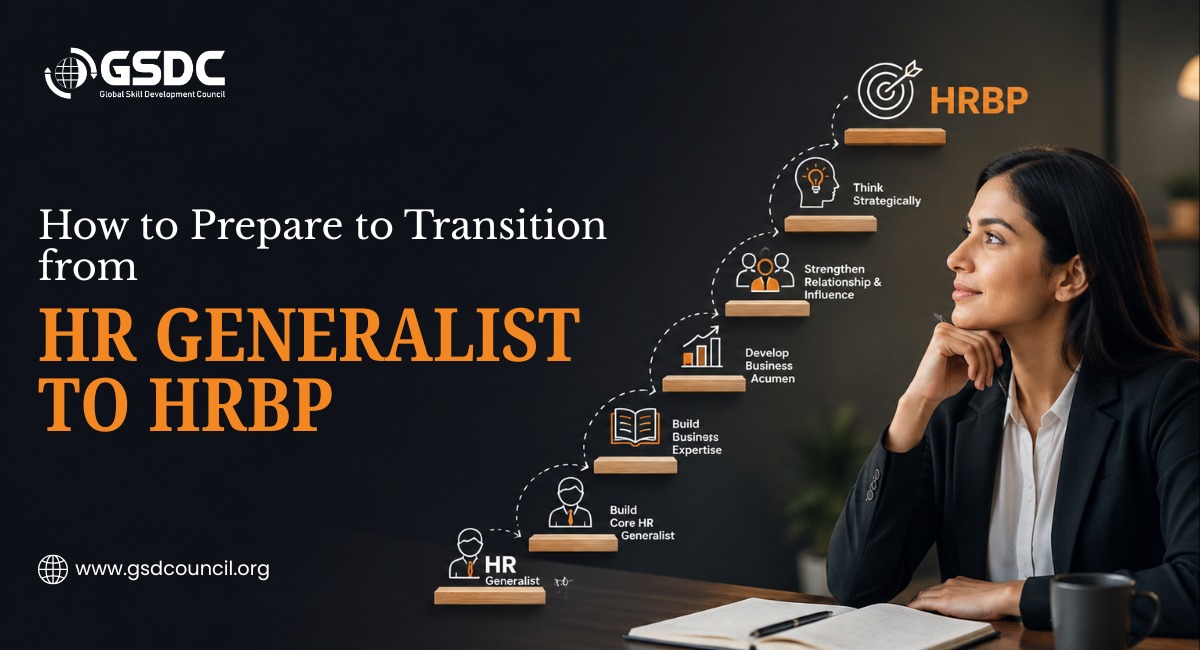
If you've spent a few years handling payroll queries, onboarding paperwork, and policy questions as an HR Generalist, you've probably felt it: a pull toward bigger, messier, more strategic problems. You want a seat at the table where business decisions get made - not just the room where they get implemented. That pull has a name. It's the move from HR Generalist to HR Business Partner (HRBP), and it's one of the most sought-after career jumps in the HR profession today.
This blog walks you through exactly what the HRBP role involves, how it's different from the generalist job you know well, what it pays, and - most importantly - the concrete steps you can start taking this quarter to get there.
What Does HRBP Stand For?
HRBP stands for HR Business Partner, but the abbreviation is the easy part. The misconception worth clearing up is this: an HRBP is not simply a senior HR Generalist with a fancier title.
The difference isn't seniority; it's the job itself. A generalist is measured by how well HR processes run. An HRBP is measured by whether the business made better decisions because HR was in the room. That's a different mandate, a different scorecard, and, as you'll see below, a different day-to-day.
What Does an HR Business Partner Do?
So what does an HR business partner actually do day to day? In practice, an HRBP:
- Sits in on leadership and planning meetings for a specific business unit or function
- Translates business goals (growth targets, restructuring, new market entry) into people plans
- Advises managers on workforce planning, org design, and performance issues
- Uses data - attrition, engagement scores, headcount cost - to build a business case for HR investments
- Leads or supports change management during reorganizations, mergers, or culture shifts
- Coaches leaders on tough calls: succession, performance management, restructuring
Where a generalist typically reacts to requests coming in, an HRBP is expected to walk into a leadership meeting with a point of view and back it with evidence.
HR Business Partner vs HR Generalist: What's the Real Difference?
This is the comparison most professionals research before committing to the transition, so it's worth being precise about it.
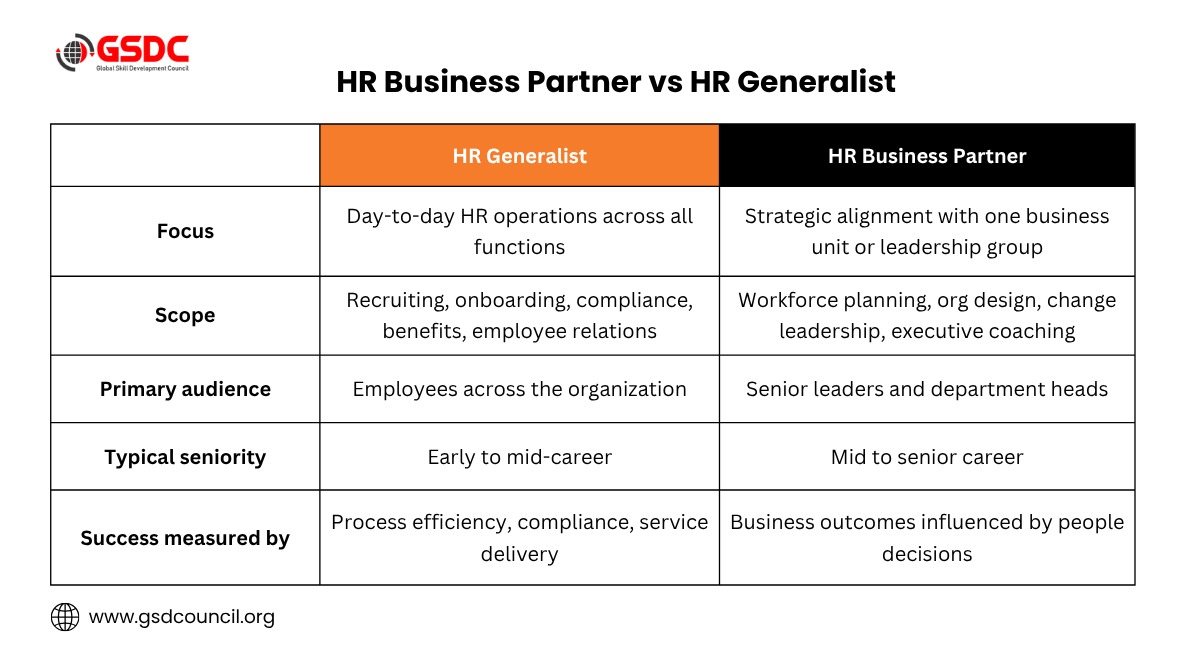
It's worth noting this isn't a strict hierarchy at every company - some organizations use "HR Generalist" and "HR Business Partner" almost interchangeably, especially in smaller firms with lean HR teams. But at mid-size and large enterprises, the distinction is usually real and it shapes how careers, pay bands, and reporting lines are structured.
A related but slightly different comparison people search for is HR generalist vs HR specialist. A specialist goes deep into one HR discipline - compensation, talent acquisition, learning and development - rather than covering the full generalist scope or a full business-partnering remit. Think of the generalist as broad-and-operational, the specialist as narrow-and-technical, and the HRBP as broad-and-strategic.
A quick example to make this concrete
Say a company plans to open operations in two new countries next year. A Generalist gets involved once the decision is made - coordinating job postings and onboarding compliance. An HRBP gets pulled in earlier, asking how many people the expansion needs, what skills are missing, what structure will let it scale, and how to retain key people once it's live.
Same expansion, two very different jobs.
The biggest difference between an HR Generalist and an HRBP isn't experience - it's the ability to influence business decisions.
Typical HR Generalist Responsibilities
Before you can bridge the gap, it helps to be honest about where you're starting from. Career-progression research from the Global Skill Development Council (GSDC) backs this up: most professionals who successfully move into HRBP roles build from a strong generalist foundation rather than skip past it, so this stage isn't wasted time, even when it doesn't always feel that way. Standard HR generalist responsibilities usually include:
- Managing recruitment and onboarding logistics
- Administering benefits, leave, and payroll coordination
- Handling employee relations issues and grievance processes
- Maintaining compliance with labor law and internal policy
- Running engagement surveys and basic reporting
- Supporting performance review cycles administratively
Recognize this list? Good - every one of these tasks is a foundation stone for HRBP work, not a dead end. The trick is learning to do them with a strategic lens rather than a purely transactional one.
Is the HR Generalist Role Actually Shrinking?
There's real market pressure behind this career move, not just ambition. During the pandemic-era shakeout, job-postings data from Glassdoor showed HR generalist openings falling by 37%, from 5,286 listings in October 2019 to 3,314 in October 2020, as companies leaned harder on automation for administrative HR tasks. Meanwhile, larger enterprises kept investing in business-partnering talent - people who could sit with leadership and connect HR decisions to commercial outcomes.
The takeaway isn't that generalist roles are disappearing. It's that the transactional slice of the job is increasingly automated, while the strategic slice - the part HRBPs own - keeps growing in demand. That's exactly why building HRBP capability early in your career is a smart hedge, not just a promotion chase.
The HR Business Partner Model, Explained
If you're preparing for an HRBP interview or just trying to understand how the function is structured, you'll run into the term HR Business Partner model repeatedly. Originally popularized by academic David Ulrich in the 1990s, the model splits the HR function into three connected pillars:
- HR Business Partners - embedded with business units, focused on strategy and leadership advisory
- Centers of Excellence (CoE) - specialists in areas like compensation, talent, or L&D who design programs
- Shared Services - centralized teams handling transactional work like payroll and employee queries
Understanding this model matters because it clarifies what a strategic HR business partner is not expected to do - namely, run the transactional machinery. Instead, the HRBP pulls in specialists from the Centers of Excellence and shared services when execution support is needed, while staying focused on advising leadership. It's also why interviewers testing for this role, or a Certified HR Business Partner credential assessing it, tend to probe how well you understand where your responsibilities end and a specialist's begin - knowing the boundaries of the model is half the job.
HR Business Partner Salary: What the Data Actually Shows
Compensation is one of the biggest draws of the HRBP track, and it's genuinely higher than generalist pay. According to Glassdoor's 2026 data, the average HR business partner salary in the US is roughly $127,500 in total pay (base typically $103,000–$160,000), compared to around $68,000 for HR Generalists - a clear reflection of the HRBP role's broader strategic scope.
You'll see different averages depending on where you look:
Source | Average Reported Pay |
Glassdoor | ~$127,500 (total pay) |
~$95,600 (base) | |
~$90,500 | |
~$75,700 (base) |
The spread comes down to three factors: seniority (a junior HRBP earns very differently than a Senior or Global HRBP advising a P&L leader), industry (finance and energy tend to pay at the top of the range), and location. Separately, the U.S. Bureau of Labor Statistics projects the broader HR management field to grow 6% between 2023 and 2033 - faster than average - with about 17,400 openings a year, a solid demand signal for anyone building toward this career.
How to Become an HR Business Partner: A Practical Roadmap
The transition tends to follow a recognizable arc - not a straight line, but a progression:
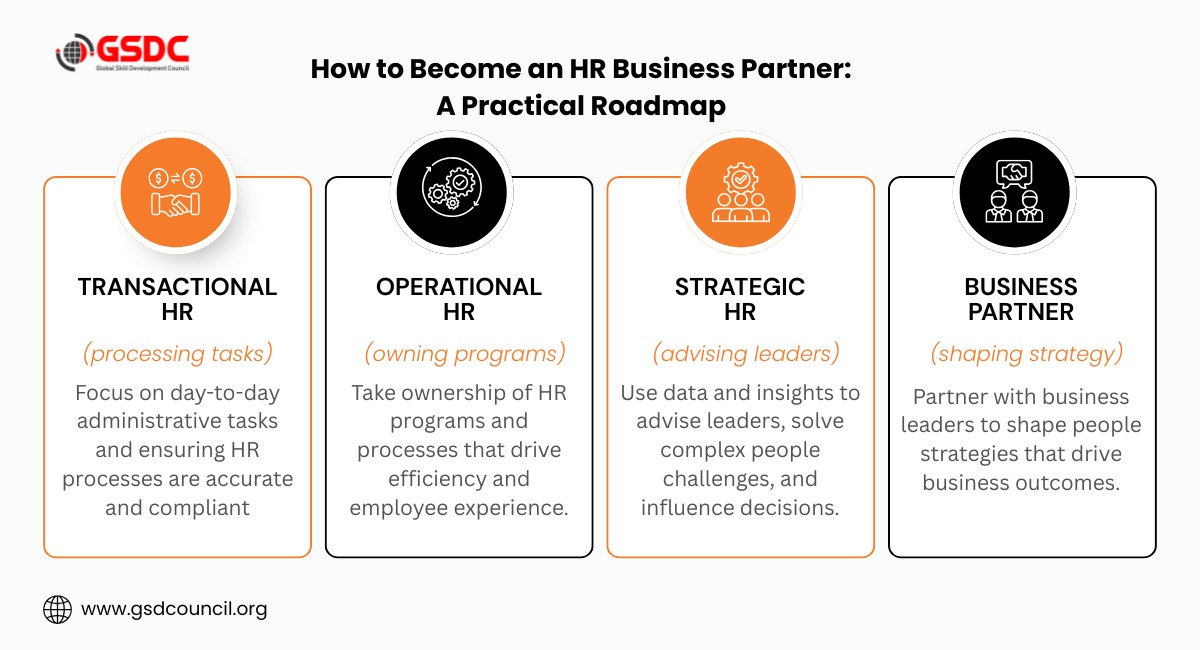
Now for the part you're really here for. Based on established HR career-development frameworks, here's a step-by-step path grounded in experiential learning - meaning you build the capability by doing, not just by studying.
1. Rotate to build breadth and depth
Volunteer for stretch assignments in coaching, organizational development, or change management. At the same time, go deep in one core discipline - compensation, recruiting, or HR strategy. Supporting more than one business unit sharpens how you see HR problems.
2. Learn the business, not just HR
This is the step most generalists skip. Understand how your company makes money - the product cycle, pricing, sales process. Sit in on a sales pipeline review. Take a short course in finance or supply chain basics if your industry calls for it.
Picture two HR professionals in the same budget meeting. One hears "cut costs by 12%" and thinks headcount. The other asks which roles drive revenue versus overhead - and protects the teams driving growth. That instinct is business fluency, and it's learnable.
3. Get inside strategic planning and special projects
Sit in on strategic planning sessions, even as an observer. Raise your hand for high-visibility projects - a reorg, a new performance rollout, a tech implementation. This is where you practice building a business case and living with the consequences of a recommendation.
4. Build the specific skills HRBPs are hired for
The core HRBP role rewards:
- Strategic and analytical thinking - connecting data to business outcomes
- Organizational consulting - diagnosing root causes, not symptoms
- Change management - driving adoption of new structures or systems
- Coaching - helping leaders decide, not deciding for them
- Stakeholder influence - earning trust with people who don't report to you
5. Find a mentor - ideally more than one
Reach out to current HRBPs and ask for 30 minutes of their time, with specific questions ready. A few trusted advisors across functions will teach you faster than any single course.
HR Business Partner Job Description and Core Responsibilities
If you're drafting a resume, prepping for interviews, or just want to know what to expect, here's a realistic HR business partner job description synthesized from typical postings:
Core HR business partner responsibilities:
- Partner with senior leaders on org design, workforce planning, and succession strategy
- Use HR metrics (attrition, engagement, time-to-fill) to advise on business decisions
- Lead change management for restructures, mergers, or process transformations
- Coach managers on performance, conflict resolution, and leadership development
- Collaborate with Centers of Excellence (comp, talent, L&D) to implement programs
- Monitor and improve employee experience within assigned business units
- Ensure people strategy stays aligned with commercial and compliance goals
Building Your HR Business Partner Resume
When you rewrite your HR business partner resume, the single biggest shift should be in language, not just job titles. Generalist resumes tend to list tasks ("processed onboarding for 200 new hires"). HRBP resumes need to show business impact:
- Lead with outcomes, not activities: "Redesigned performance review process, cutting manager cycle time by 30% across a 400-person division" beats "administered performance reviews"
- Quantify wherever you can - attrition reduced, cost saved, time-to-hire improved, engagement score change
- Name the business context - which unit, what commercial goal it supported
- Highlight cross-functional projects and any exposure to strategic planning or change initiatives
- If you don't have direct HRBP experience yet, reframe generalist projects to show strategic thinking: the business problem you noticed, the analysis you did, and the result
Common HR Business Partner Interview Questions
Expect interviewers to test both your technical HR knowledge and your business judgment. Common HR business partner interview questions include:
- "Tell me about a time you influenced a leader who initially disagreed with your recommendation."
- "How would you build a business case for reducing attrition in an underperforming team?"
- "Walk me through how you'd support a manager through a difficult restructuring."
- "How do you use data to identify a people problem before it becomes visible to leadership?"
- "Describe a situation where you had to balance an employee's interests against a business need."
Notice the pattern - these questions are rarely about policy knowledge. They're testing whether you can operate as a trusted advisor under pressure, which is exactly the muscle the roadmap above is designed to build.
HRBP Certification: Is It Worth Pursuing?
Certification isn't mandatory to land an HRBP role, but it does two useful things: it structures your learning, and it signals commitment to hiring managers comparing similar candidates. If you're evaluating HRBP certification or a broader HR business partner certification program, look for one that goes beyond theory and covers business acumen, HR analytics, and change leadership - not just policy and compliance, which is generalist territory you likely already know.
At the Global Skill Development Council (GSDC), our HR Business Partner certification track is built specifically for professionals making this exact transition - combining the strategic frameworks, business-facing skills, and applied case studies that hiring panels look for when they're deciding between an experienced generalist and a business-ready HRBP candidate.

Making the Move
The shift from HR Generalist to HR Business Partner isn't really about a title change - it's about a mindset shift, from executing HR processes well to shaping business decisions through people insight. The good news is that you don't need to wait for a promotion to start.
Every strategic project you volunteer for, every business metric you learn to interpret, and every leadership conversation you sit in on moves you closer to becoming the HRBP organizations rely on. In most cases, the title comes after you've already started doing the work - not before.

Related Certifications
Frequently Asked Questions
A generalist keeps HR running smoothly for everyone. An HRBP is attached to one business unit and is judged by whether leadership makes better people decisions because of their input. Same toolkit, different job.
Less paperwork, more conversations. Think leadership meetings, coaching managers through tough calls, and digging into why attrition spiked in one team but not another. It's less about running processes and more about being the person leaders call before a decision, not after.
No - many HRBPs get there through internal moves alone. But an HR business partner certification can help if you're breaking in from outside your company, since it's a faster way to prove you've got business-facing skills, not just HR ones.
Usually 3 to 5 years as a generalist or specialist, once you've worked across multiple HR functions and picked up real business exposure. It can happen faster if you seek out strategic projects early.
Entry-level HRBPs typically land in the mid-$70,000s to $90,000s. Experienced HRBPs at larger companies often clear six figures, with senior and global titles pushing past $150,000 in total pay. Check two or three sources before you negotiate - no single site tells the whole story.
Stay up-to-date with the latest news, trends, and resources in GSDC
If you like this read then make sure to check out our previous blogs: Cracking Onboarding Challenges: Fresher Success Unveiled
Not sure which certification to pursue? Our advisors will help you decide!