Train the Trainer Certification: Pros, Cons, and Career Value

Written by Matthew Hale
- What Is Train the Trainer?
- The Train-the-Trainer Model and Approach
- Why Train the Trainer Is Important
- Advantages of Train the Trainer Programs
- Disadvantages of Train-the-Trainer Programs
- Train the Trainer Course Formats: Which One Fits You?
- What Skills and Career Paths Open Up
- How to Decide If It's Right for You or Your Organisation
- Is Train the Trainer Certification Worth It?
- Ready to Build Your Training Skills?
- Final Thoughts
If you have ever sat through a workshop where the person at the front clearly knew the subject but couldn't hold the room, you already understand why the Train the Trainer certification exists. Knowing something and teaching it well are two different skills, and organisations are waking up to that gap. U.S. companies spent $102.8 billion on employee training in 2025 alone, a number that keeps climbing every year. A big share of that spend now goes toward internal trainer training instead of hiring outside consultants for every session, which is exactly what this kind of trainer development is designed to fix.
But is it actually the right move for your organisation, or for your own career? Like most L&D decisions, the honest answer is "it depends." This blog breaks down what train-the-trainer really means, how the model works, and where it helps or hurts, so you can make the call with your eyes open.
What Is Train the Trainer?
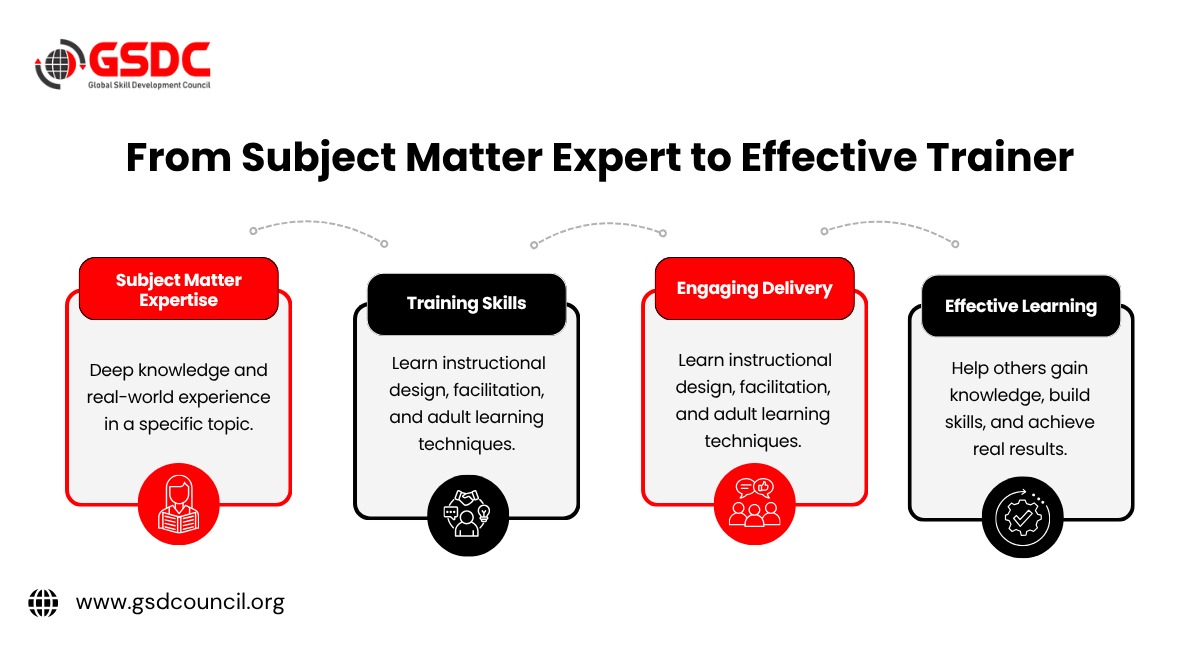
So, what is train-the-trainer, exactly? In simple terms, it's a program that teaches subject matter experts (people who already know a topic inside out) how to teach that topic to others. The meaning of train-the-trainer goes beyond just "training someone to train." It's about handing them the tools of instructional design, adult learning theory, presentation skills, and feedback techniques, so they can turn their expertise into a repeatable, structured learning experience for other people.
Think of it this way: a brilliant compliance officer knows every regulation by heart, but that doesn't mean they know how to keep a room of new hires engaged for three hours. A train-the-trainer course fixes that. It shifts the focus from "what do I know" to "how do I help someone else learn this."
The Train-the-Trainer Model and Approach
The train-the-trainer model usually follows a cascading structure:
- A small group of subject matter experts or team leads completes a Train-the-Trainer Certification or workshop.
- These newly certified trainers go back to their teams or departments and deliver the same material to a wider group.
- The organisation tracks outcomes, gathers feedback, and refines the content for the next round.
This approach is popular because it scales. Instead of flying in an external trainer every time ten new employees join, you have someone in-house who already knows the content, the culture, and the people.
A solid trainer development program typically covers:
- Adult learning principles (how grown-ups actually retain information, which is different from how children learn in school)
- Instructional design basics, including how to structure a session from opening to close
- Presentation and facilitation skills, such as reading the room and handling tough questions
- Assessment methods, so trainers know if the learning actually stuck
- Practice sessions with real feedback, usually the most valuable part of any train the trainer certificate program
Why Train the Trainer Is Important
Why train-the-trainer is important comes down to one simple fact: skills decay, and business needs change faster than most training budgets can keep up. When you rely only on outside trainers, every update, every new hire, and every policy change means booking another external session. When you build a bench of certified internal trainers, that knowledge lives within the company and moves at its pace.
According to the Association for Talent Development's 2025 State of the Industry data, more than a third of organisations increased their talent development headcount in 2024, with trainers and facilitators among the most commonly added roles. That's not a coincidence. Companies are actively choosing to grow their in-house training muscle rather than lean entirely on outside vendors, which is also why bodies like the Global Skill Development Council (GSDC) have seen steady interest in structured trainer development as organisations look to build this capability properly rather than leave it to chance.
Advantages of Train the Trainer Programs
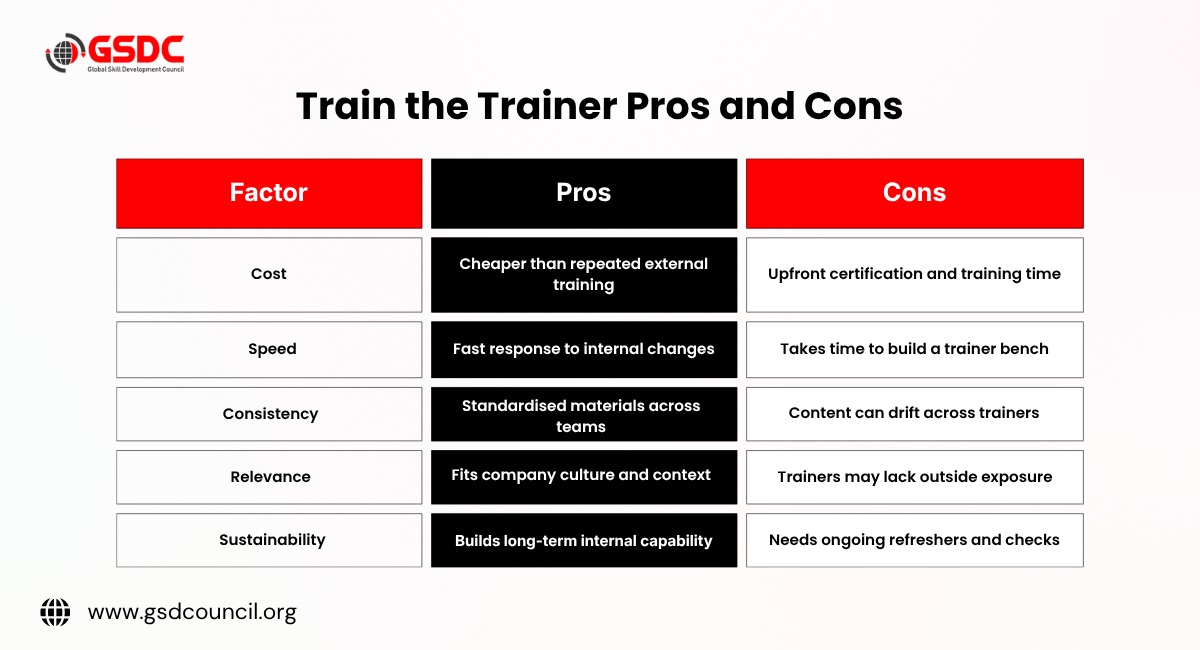
Here's where the model genuinely earns its reputation. The benefits of a train-the-trainer program show up in both cost and culture.
Cost savings over time.
Sending one or two people through a facilitator certification is far cheaper than repeatedly hiring an external trainer for every session, especially when the same content needs to be delivered to multiple groups across locations or shifts.
Faster response to change.
Internal trainers can react quickly when a new policy drops, a product changes, or a compliance requirement shifts. There's no waiting for a consultant's calendar to open up.
Content that fits your culture.
An internal trainer already understands the company's language, workflows, and quirks. That context makes training feel relevant instead of generic.
Consistency across teams.
When everyone learns from trainers using the same certified materials and approach, you get more uniform outcomes, which matters a lot for compliance-heavy industries.
Builds a learning culture.
Once employees see peers stepping up as trainers, it signals that growth and knowledge-sharing are valued, not just tolerated.
Career growth for the trainer.
For the individual, earning a train-the-trainer certificate opens doors. A train-the-trainer job or a "certified trainer" line on a resume signals leadership potential, and the train-the-trainer skill set (facilitation, coaching, public speaking) transfers well into people-management roles.
Disadvantages of Train-the-Trainer Programs
None of this means the model is perfect. A fair look at train-the-trainer advantages and disadvantages has to include the real trade-offs.
Upfront time and cost.
Training the trainers isn't free. There's the cost of the certification programs themselves, plus the time those employees spend away from their regular job while they learn to teach.
Uneven delivery quality.
Not every subject matter expert makes a great trainer, even after certification. Some people are naturally better communicators, and a rushed or poorly chosen candidate can water down the training's impact.
Risk of message drift.
As training gets passed down through multiple internal trainers, small details can get lost or altered, a bit like a game of telephone. Without strong materials and quality checks, the content delivered in month twelve might look quite different from what was taught in month one.
Ongoing investment required.
A train-the-trainer program isn't a one-time event. Trainers need refreshers, updated materials, and periodic evaluation, or their skills and content go stale.
Not ideal for highly specialised topics.
Some subjects (deep technical certifications, for example) genuinely benefit from an outside expert with broader exposure across many organisations. Internal trainers may not have that range.
Train the Trainer Course Formats: Which One Fits You?
If you're exploring options, you'll notice the market offers several formats:
- Train the trainer workshop: A short, intensive, in-person or virtual session, usually a few days long, focused on practical facilitation practice.
- Train the trainer online course: Self-paced or live virtual learning, ideal for people who need flexibility around a full-time job.
- Train the trainer certification programs: More structured, often ending in an exam or practical assessment, and resulting in a formal train the trainer certificate.
- In-house customised programs: Built specifically around one organisation's content and delivered only to that company's staff.
None of these formats is universally "better." A quick workshop might be enough for someone who just needs to run occasional onboarding sessions, while a full certification makes more sense for someone building a long-term career as a trainer or L&D professional.
What Skills and Career Paths Open Up
The train-the-trainer skill set is more transferable than people expect. Beyond the ability to run a workshop, certified trainers typically strengthen their:
- Public speaking and presentation confidence
- Curriculum and content design ability
- Coaching and one-on-one feedback skills
- Conflict handling and group facilitation
- Project and time management (since running a training calendar is its own logistics puzzle)
These skills show up in job postings well beyond a formal train-the-trainer job title. Team leads, HR business partners, product trainers, and even customer success managers increasingly list "training experience" or a train-the-trainer certificate as a preferred qualification.
How to Decide If It's Right for You or Your Organisation
Before signing up for a trainer development program, it helps to ask a few honest questions:
- Does the topic need to be taught repeatedly to different groups over time, or is it a one-off?
- Do you have people who are both subject matter experts and reasonably comfortable speaking in front of others?
- Can the organisation commit to refreshing materials and evaluating trainer performance regularly?
- Is the topic specialised enough that an external expert would genuinely add more value than an internal trainer could?
If most of your answers point toward "yes, we train this often" and "yes, we have the right people," the train-the-trainer approach is likely to pay off. If the topic is a one-time specialist deep-dive, it might make more sense to bring in outside expertise instead.
Is Train the Trainer Certification Worth It?
Given the title of this piece, this question deserves a direct answer rather than an implied one. The honest response is: it depends on who's asking and what they're trying to get out of it.
When it's worth it for individuals.
If you already spend part of your job explaining things, onboarding new hires, running demos, or coaching teammates, formal certification turns an informal skill into a documented one. It's especially worth it if you're eyeing a move into L&D, HR, or a team lead role, since "certified trainer" carries more weight on a resume than "good at explaining things."
When it's worth it for organisations.
The math works best when the same content needs to reach many people, repeatedly, over a long stretch of time. Think onboarding, compliance refreshers, or product training for a growing sales team. The more often you'd otherwise re-book an outside trainer, the faster this investment pays for itself.
When it may not be necessary.
If a topic only needs to be taught once, or to a handful of people, the overhead of building and maintaining an internal trainer program probably isn't worth it. The same goes for highly technical or fast-changing subjects where an outside specialist's broader exposure adds more value than internal familiarity does.
ROI and long-term value.
The return isn't always immediate. The first few cohorts trained internally may take longer to plan and deliver than expected, since new trainers are still finding their footing. But over a year or two, as the same trainers run repeat sessions and materials get refined, the cost per training hour usually drops well below what external delivery would have cost, while the organisation also keeps that instructional knowledge in-house instead of losing it when a contract ends.
Ready to Build Your Training Skills?
If any of this sounds like your situation, the next step is simple: look for a program that actually gives you practice, not just theory. A good trainer development program should leave you with templates, real feedback on a mock session, and the confidence to run a room, not just a certificate to frame. GSDC is one place to start looking, alongside its Train the Trainer Certification and other structured options worth comparing before you commit.

Final Thoughts
The train-the-trainer certification isn't a magic fix for every training challenge, but for organisations that need to teach the same material to many people, over and over, it's hard to beat on cost and consistency. The disadvantages are real too, and they mostly come down to one thing: a train-the-trainer program is only as good as the selection, preparation, and ongoing support behind it.
Whether you're an individual looking to add a valuable credential to your resume or a team lead trying to build a self-sufficient learning culture, understanding both sides of train-the-trainer advantages and disadvantages puts you in a much better position to choose the right path forward.

Related Certifications
Frequently Asked Questions
It's a program that teaches someone who already knows a subject how to teach that subject effectively to other people, covering everything from lesson planning to handling questions in the room
In companies, it usually refers to certifying internal staff, often subject matter experts or team leads, to deliver training to their colleagues instead of relying only on outside trainers.
If you want to move into learning and development, team leadership, or any role that involves onboarding and coaching others, yes. It's a practical, resume-friendly credential that shows you can both know and teach a subject.
It varies widely. A workshop might run two to five days, while a full certification program with assessments can take a few weeks, especially if delivered as a train-the-trainer online course alongside a full-time job.
The most common one is inconsistency. If trainer selection and ongoing quality checks are weak, the training content and delivery quality can vary a lot from group to group.
Stay up-to-date with the latest news, trends, and resources in GSDC
If you like this read then make sure to check out our previous blogs: Cracking Onboarding Challenges: Fresher Success Unveiled
Not sure which certification to pursue? Our advisors will help you decide!