AI Is Changing Instructional Designer Salaries: 2026 Data
Written by Matthew Hale
- What Is the Role of an Instructional Designer, Really?
- Instructional Designer Salary Range in 2026: The Real Numbers
- What Does a $120K Instructional Designer Actually Do Differently?
- Why AI Skills Are Rewriting the Instructional Designer Salary Range
- The Instructional Designer Skill Set That Actually Moves Salary
- ROI in Instructional Design: Does a Certification Actually Pay Off?
- Instructional Designer Jobs: Where the Openings Actually Are
- A Simple 2026 Action Plan
- Turning This Into a Credential: The GSDC Route
- Final Thoughts
Picture two instructional designers with exactly the same eight years of experience. One still storyboards in PowerPoint, chases subject matter experts for content, and rewrites the same compliance module for every new department. The other added one thing to her workflow this year - AI-assisted instructional design - and her next offer came in almost 30% higher.
That's not a fluke. According to the World Economic Forum, roughly 39% of workers' core skills are expected to change by 2030, and few roles illustrate that shift as clearly as instructional design. It's a pattern showing up across salary data from Glassdoor and industry benchmarking studies throughout 2026. The instructional designer salary conversation has quietly split into two tracks - one for people doing the job the way it's always been done, one for people doing it with AI in the workflow. Here's what the numbers actually say, where the money comes from, and whether an instructional design certification is worth the time and cost in 2026.
What Is the Role of an Instructional Designer, Really?
Before getting into numbers, it helps to be clear on what this job actually involves, because the title gets used loosely.
The role of an instructional designer is to turn subject matter, a compliance policy, a new software rollout, a leadership framework - into learning experiences that actually change behavior on the job. That means:
- Analyzing a performance gap to see if training is even the right fix
- Writing measurable learning objectives tied to real outcomes
- Structuring content using models like ADDIE or backward design
- Building assessments, scenarios, and interactive practice
- Working with SMEs, stakeholders, and increasingly AI tools to speed up development
In short, an instructional designer is part learning scientist, part project manager, part content strategist, touching L&D, HR, product training, healthcare education, and corporate onboarding, which is part of why demand has stayed steady even as other content-heavy roles have shrunk.
Instructional Designer Salary Range in 2026: The Real Numbers
Let's get to what most people searching this topic actually want - hard figures.
According to Glassdoor's 2026 salary data (based on more than 11,000 salary submissions from US-based instructional designers as of June 2026), the average salary for an instructional designer sits at roughly $92,670 per year, with the typical range falling between $74,000 at the 25th percentile and $117,000 at the 75th percentile. Top earners - typically senior or specialized roles - report total pay above $144,000.
Separately, GSDC's 2026 salary benchmark, built from nearly 11,000 verified records across Glassdoor, Indeed, Built In, and Payscale, shows a similar pattern when broken down by career stage:
Experience Level | Typical Salary Range | Midpoint |
Entry (0–2 yrs) | $58K – $72K | $65K |
Mid (3–6 yrs) | $78K – $95K | $87K |
Senior (6–10 yrs) | $95K – $120K | $108K |
Lead / LXD (10+ yrs) | $115K – $145K | $128K |
Director of L&D (12+ yrs) | $140K – $195K | $165K |
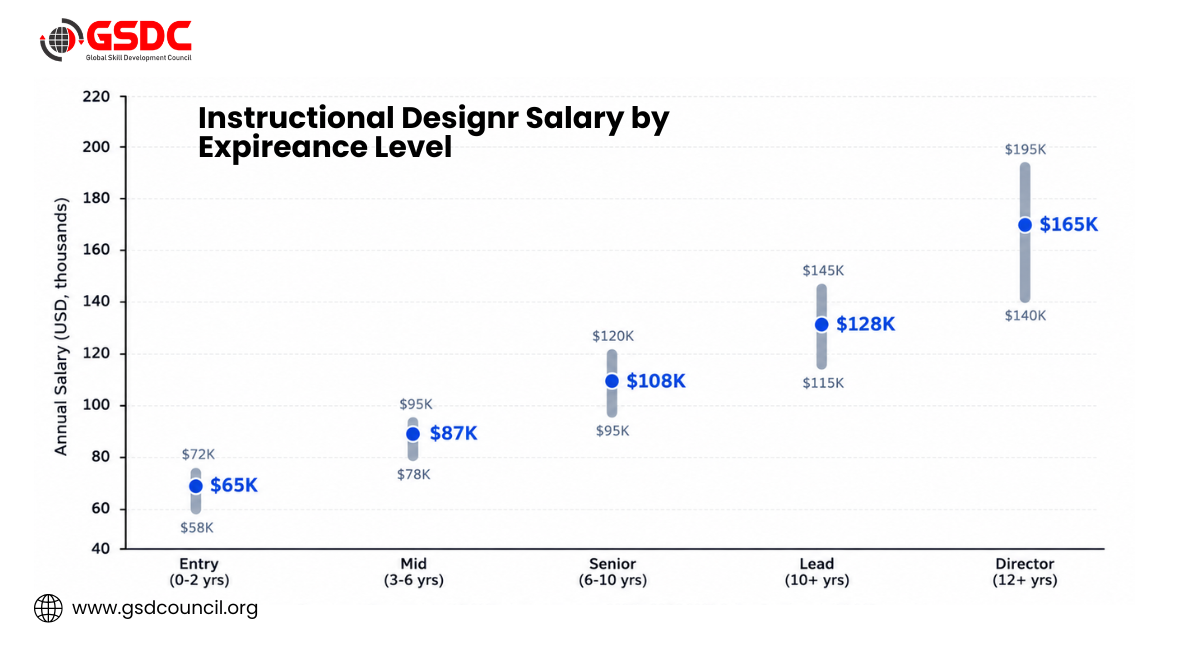
Data: Glassdoor US salary submissions (11,013 records, June 2026) and GSDC's 2026 Salary Benchmark (10,965 records).
Worth noting: senior instructional designer salary figures run even higher in certain industries. Senior roles in energy, aerospace, and IT reported median total pay above $130,000, compared to roughly $62,000 in education - a reminder that industry matters almost as much as title.
So if you're wondering what an average salary for an instructional designer actually looks like in practice, it depends heavily on experience, sector, and increasingly on whether you can back up your resume with a Certified Instructional Designer credential and real AI fluency.
What Does a $120K Instructional Designer Actually Do Differently?
The salary gap between a $70K instructional designer and a $120K one isn't really about years on the job. It's about what they're trusted to own.
(a composite picture, not a single data source)
$70K Instructional Designer | $120K Instructional Designer |
Builds courses on request | Diagnoses whether training is even the right fix |
Works mostly in PowerPoint and Word | Runs an AI-assisted design workflow end-to-end |
Creates quizzes to check completion | Measures whether behavior on the job actually changed |
Works independently on assigned modules | Partners directly with business stakeholders |
Knows ADDIE | Knows ADDIE plus AI tools, analytics, and LXD principles |
The comparison highlights an important shift: higher salaries increasingly reward strategic thinking and AI-enabled execution rather than experience alone.
"The biggest salary jump doesn't come from replacing ADDIE with AI - it comes from combining both."
Why AI Skills Are Rewriting the Instructional Designer Salary Range
Here's where 2026 looks different from even two or three years ago.
The rise of the AI instructional designer isn't about replacing the human - it's about doing three or four times the output in the same working week. Skills like prompt engineering are quickly becoming as core to the job as ADDIE itself. A few concrete examples:
- Drafting a full course storyboard in minutes instead of a full day
- Generating first-pass quiz banks and scenario branches for review, not from scratch
- Producing rough voice-over scripts and localization drafts for multilingual rollouts
- Summarizing learner analytics from an LMS into a plain-language stakeholder report
- Building adaptive practice paths that adjust difficulty based on learner performance
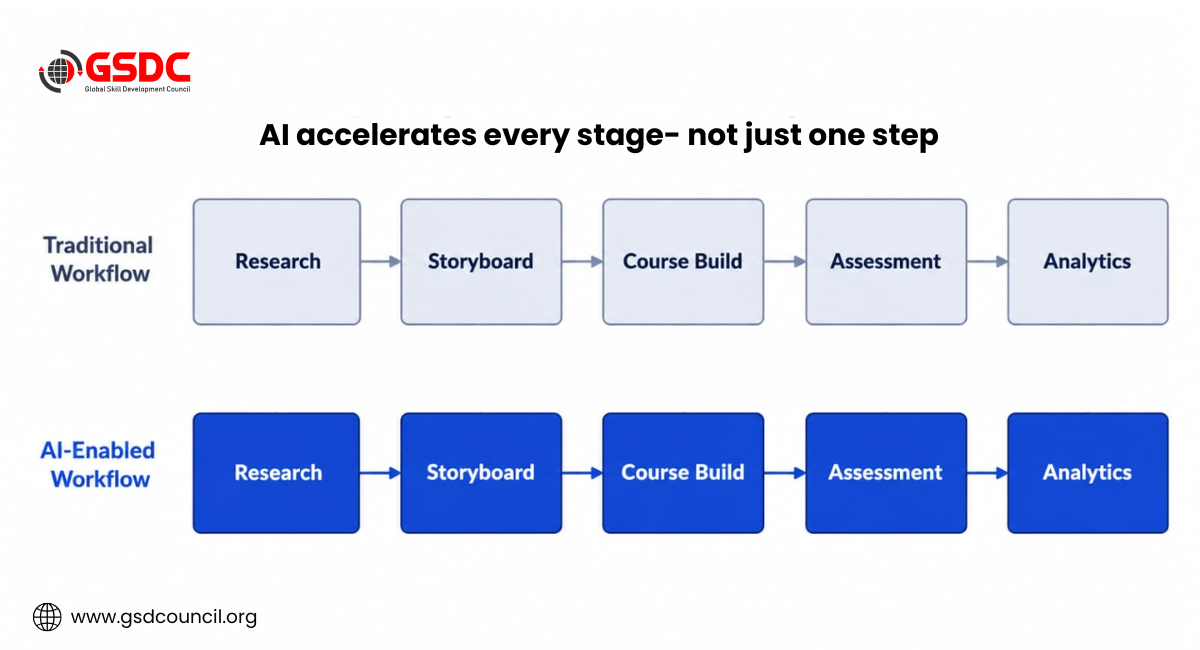
AI doesn't replace one step in the process - it compresses time at every stage, from research through analytics.
That shift is showing up directly in pay. Employers aren't just hiring instructional designers anymore - they're specifically posting for AI instructional designer jobs that expect comfort with prompt engineering, AI content review, and adaptive learning tools alongside traditional ADDIE knowledge. GSDC's benchmark data shows AI/GenAI fluency in the workflow correlating with a $15,000–$25,000 uplift on its own, independent of certification or seniority.
It's worth zooming out here too. The World Economic Forum's Future of Jobs Report 2025 found that employers expect roughly 39% of workers' core skills to change by 2030, with most planning to actively upskill their workforce around AI rather than simply cut roles. Instructional design sits right in the middle of that shift - it's one of the functions actually responsible for delivering that upskilling, which is part of why demand hasn't softened even as AI reshapes how the work gets done.
Two instructional designers with identical years of experience can sit $20,000-plus apart in salary purely based on whether one of them can operationalize AI tools inside a real design process.
The Instructional Designer Skill Set That Actually Moves Salary
Not every skill carries equal weight when it comes to pay. Across thousands of instructional designer profiles, five capabilities stand out consistently:
- A globally recognized instructional design certification - often worth $18,000–$28,000, mainly because it signals verified competency to recruiters screening at scale.
- AI/GenAI fluency applied to real design workflows - using the tools inside ADDIE-style processes, not just knowing they exist.
- Outcome measurement, particularly Kirkpatrick Level 3 and 4 - proving training changed behavior and business results, not just completion rates.
- LMS and learning-analytics fluency - platforms like Cornerstone, Workday Learning, or Docebo, especially reporting.
- UX and learning-experience design thinking - reframing training as an experience people choose to engage with.
As AI in corporate learning becomes standard rather than novel, understanding the AI governance side - keeping AI-assisted content accurate, unbiased, and compliant - is fast becoming part of the job too.
If you're mapping out your own instructional designer skill development for the next year, these five are the highest-leverage places to invest time.
ROI in Instructional Design: Does a Certification Actually Pay Off?
This is the question most people are really asking. Here's a straight answer, not a sales pitch.
A certification won't fix a weak portfolio. It won't replace real project experience either. But the data does show something real: certified instructional designers earn more than non-certified ones at the same experience level.
The typical gap: $18,000–$28,000 a year. That gap gets even bigger when the certification includes AI skills, not just traditional methods.
Here's the math, in simple terms:
- Certification cost: $400–$1,500
- Average salary bump: $20,000+ a year
- Time to earn back the cost: under a month
- Everything after that: pure upside
So why does an AI-focused certification matter more right now? Because employers aren't just hiring for ADDIE anymore. They want proof you can already do the AI-enabled version of the job. A program that pairs core ADDIE fundamentals with AI-assisted workflow training closes that gap - a generic, traditional-only credential doesn't.
One honest caveat: certification isn't a guaranteed raise. Think of it as a lever - it makes you easier to find, and gives you a stronger position in a salary negotiation. Most people who see the uplift report it within three to six months of certifying and actually using it.
Instructional Designer Jobs: Where the Openings Actually Are
Job volume tells its own story. Job board data through 2026 show instructional designer jobs remain one of the steadier categories inside L&D and corporate training, with tens of thousands of active listings at any given time.
A few patterns worth knowing if you're job hunting:
- Remote roles are a meaningful slice of the market, not a rarity - a large share of openings are explicitly remote or hybrid.
- Healthcare, finance, IT, and energy consistently post the highest-paying roles, well above education for equivalent experience. Healthcare organizations in particular now hire instructional designers to build compliance and clinical training at scale using AI-assisted workflows.
- Titles are fragmenting - "Learning Experience Designer" and "AI Learning Designer" postings are growing faster than the plain "Instructional Designer" title. A corporate trainer who picks up AI-assisted course development skills is often the one who moves into an LXD role rather than staying in pure delivery.
A Simple 2026 Action Plan
If you're trying to move your own instructional designer salary upward this year, here's a grounded, non-hypey sequence:
- Audit your current skill gaps against the five high-leverage skills above.
- Get hands-on with AI tools inside an actual instructional design project - not just experimenting casually.
- Consider a certification that explicitly covers AI-integrated design, rather than a purely traditional one, since that's where the salary data shows the clearest separation.
- Build a portfolio piece that shows outcome measurement, not just a finished course - recruiters increasingly want to see impact, not just output.
- Update your professional profile and resume with the specific AI tools and frameworks you've used, since applicant tracking systems and recruiters are actively searching for those terms now.
Start this week:
- Pick one AI tool you already have access to and commit to using it for a real task
- Redesign one existing learning module using AI assistance, start to finish
- Track the time saved compared to your usual process
- Add that redesigned module to your portfolio as a before-and-after example
- Update your resume and professional profile with the specific tools and outcomes
None of that requires a certification to start. But once you've done it, you'll have a real, demonstrable AI-assisted project to point to - and that's exactly the gap a structured credential is built to formalize. The right program takes the same instincts you just practiced and pairs them with a clear framework, a portfolio-ready capstone project, and a credential recruiters actually recognize. That's how a self-taught habit turns into something you can put a name to on a resume.
Turning This Into a Credential: The GSDC Route
Everything above works whether or not you ever get certified - the AI tools, the portfolio project, the resume update. But if you want a faster way to signal that skill set to employers, that's the specific gap the GSDC Certified Instructional Designer program is built for.
It pairs core ADDIE fundamentals with AI-assisted workflow training, rather than treating AI as a bolt-on module to an older curriculum. The program includes a portfolio-ready capstone project, and the credential is recognized by employers across 100+ countries - useful if you're job hunting outside your home market or trying to stand out in a crowded applicant pool.
It's not a shortcut around doing the work. It's a structured way to formalize the work once you've started doing it.

Final Thoughts
The instructional design field isn't shrinking - it's re-pricing. AI isn't replacing instructional designers; it's changing who gets paid the most. The professionals who combine solid instructional design fundamentals with real AI-enabled workflows are likely to hold the strongest position over the next few years, and the salary data across Glassdoor, GSDC's benchmark, and World Economic Forum workforce research all point the same direction. Whether you're weighing a first certification or adding AI skills to a decade-long career, the investment case is real - as long as it's backed by demonstrable application, not just a certificate on a wall.

Related Certifications
Frequently Asked Questions
Based on Glassdoor's 2026 data, the average sits around $92,000–$93,000 per year in the US, with a typical range of $74,000 to $117,000 depending on experience and industry.
Entry-level starts around $58,000–$72,000, mid-level around $78,000–$95,000, senior around $95,000–$120,000, and director-level L&D roles can reach $140,000–$195,000.
Certified instructional designers report a measurable salary uplift over non-certified peers at the same experience level, particularly when the certification includes AI-integrated methods - though results depend on how actively the credential is applied.
A traditional certification covers ADDIE, learning theory, and assessment design. An AI-focused credential adds AI-assisted content development, adaptive learning design, and AI-augmented evaluation - skills tied to a larger pay premium in current salary data.
Yes. A significant share of current postings are remote or hybrid, making it one of the more location-flexible roles in corporate L&D.
Career-changers and early-career professionals generally benefit most from a certification covering fundamentals alongside AI tool fluency, since that combination closes both the credibility gap and the skills gap at once.
Stay up-to-date with the latest news, trends, and resources in GSDC
If you like this read then make sure to check out our previous blogs: Cracking Onboarding Challenges: Fresher Success Unveiled
Not sure which certification to pursue? Our advisors will help you decide!