Agentic AI: How Autonomous Agents Will Drive $93B Workflow Value by 2030
Written by Matthew Hale
- What Is Agentic AI? Understanding the Core Concept
- Market Expansion: From $7B to $93B by 2032
- Enterprise Adoption: 80% Already Deployed AI Agents
- Performance Impact: 30–50% Faster Business Processes
- Economic Value and ROI: The Next Exponential Curve
- Types of AI Agents Shaping Enterprise Workflows
- Agentic AI and Digital Transformation
- Challenges and Considerations
- Looking Ahead: The Agentic Enterprise Era
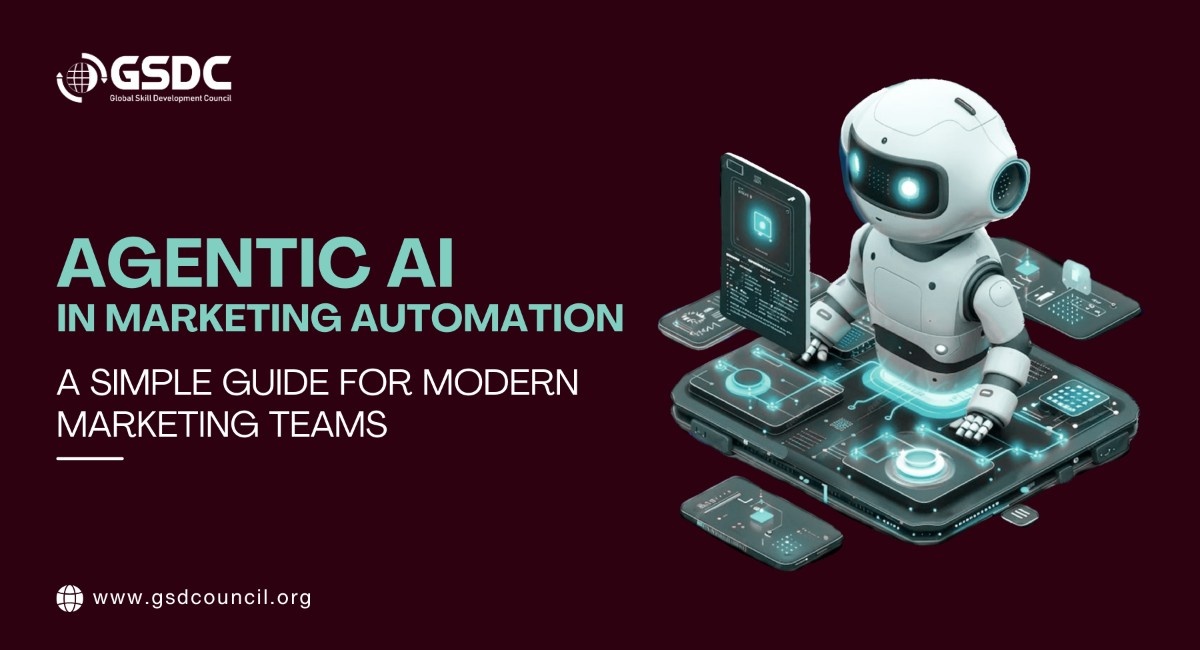
The trend toward workflow automation with AI adoption is entering a new decisive stage in the world, with the involvement of Agentic AI. In contrast to the old-fashioned rule-based bots, or narrow scope action executors, agentic systems are set to think, plan, and act on their own, and accomplish complex multi-step goals within digital environments.
MarketsandMarkets forecasts that the USD 7.06 billion Agentic AI market will grow in the coming years, to USD 93.2 billion in 2032, which is a growth rate of 44.6 per cent compound annual growth rate (CAGR), one of the highest growth rates in any AI domain in terms of rate of growth.
As these autonomous systems evolve beyond experimental pilots to embedded business engines, the workflow value of the systems will be accredited to the enterprises by more than $93 billion by 2030.
What Is Agentic AI? Understanding the Core Concept
At its foundation, Agentic AI refers to autonomous AI agents capable of reasoning, learning, and executing multi-step workflows without continuous human direction.
Agentic AI Definition:
Agentic AI is an evolution of artificial intelligence that enables self-directed software agents to perceive environments, make context-aware decisions, and act toward achieving defined goals.
Where generative AI agents specialize in producing creative outputs (like text or imagery), agentic AI systems go a step further; they interpret objectives, plan strategies, use multiple tools, and execute tasks automatically.
Agentic AI vs Generative AI:
|
Aspect |
Generative AI |
Agentic AI |
|
Function |
Creates content (text, image, code) |
Acts autonomously to complete objectives |
|
Control |
User-driven |
Goal-driven |
|
Application |
Creative production |
Workflow execution |
|
Examples |
ChatGPT, Midjourney |
AutoGPT, Devin, Microsoft Copilot Agents |
While generative models deliver productivity, Agentic AI introduces autonomy, closing the gap between intelligence and action. This is why enterprises are now embedding AI task automation into full-scale agentic workflows.
Market Expansion: From $7B to $93B by 2032
The market trajectory tells a clear story. In 2025, global spending on agentic systems stood at just over $7 billion. By 2032, it’s forecast to hit $93.2 billion, fueled by adoption in sectors like finance, logistics, customer service, and IT operations.
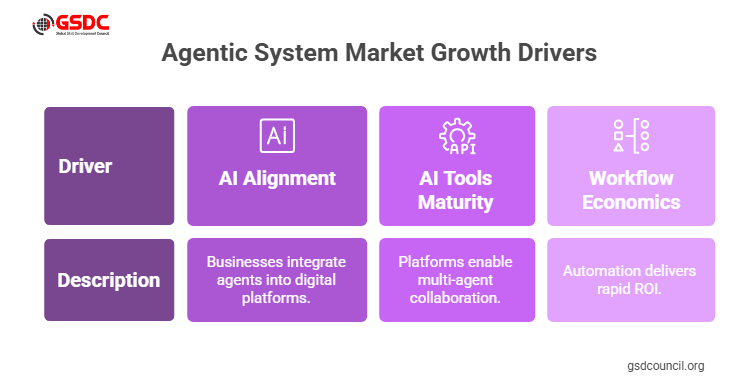
Three forces are driving this explosive growth:
- AI and Digital Transformation Alignment: Businesses are integrating autonomous agents into enterprise platforms as part of their broader digital reinvention.
- Agentic AI Tools Maturity: Platforms such as OpenAI’s API, Microsoft’s Azure AI Foundry, and Anthropic’s Claude SDK are enabling multi-agent collaboration and scalable deployment.
- Workflow Economics: Automating routine, decision-heavy workflows delivers rapid ROI and measurable cost efficiency.
By 2030, autonomous AI agents are expected to manage entire chains of business logic from data processing to customer engagement, creating measurable productivity gains across industries.
Enterprise Adoption: 80% Already Deployed AI Agents
Enterprise adoption has outpaced even optimistic forecasts. As of mid-2025, nearly 80% of organizations report using AI agents in at least one function, and 96% plan to expand usage by 2026.
Notably:
- 43% of enterprises dedicate over half their AI budgets specifically to agentic systems, highlighting confidence in these self-directed solutions.
- In platform-driven enterprises, such as Salesforce and ServiceNow, agentic orchestration is becoming a key competitive differentiator.
This adoption surge signals a shift in mindset from “AI as a tool” to AI as a collaborator. Instead of static automation, businesses now deploy autonomous AI agents capable of dynamic adaptation and cross-department coordination.
Performance Impact: 30–50% Faster Business Processes
According to the Boston Consulting Group (BCG), implementing AI workflow automation through agentic models leads to 30–50% faster processes across key enterprise functions.
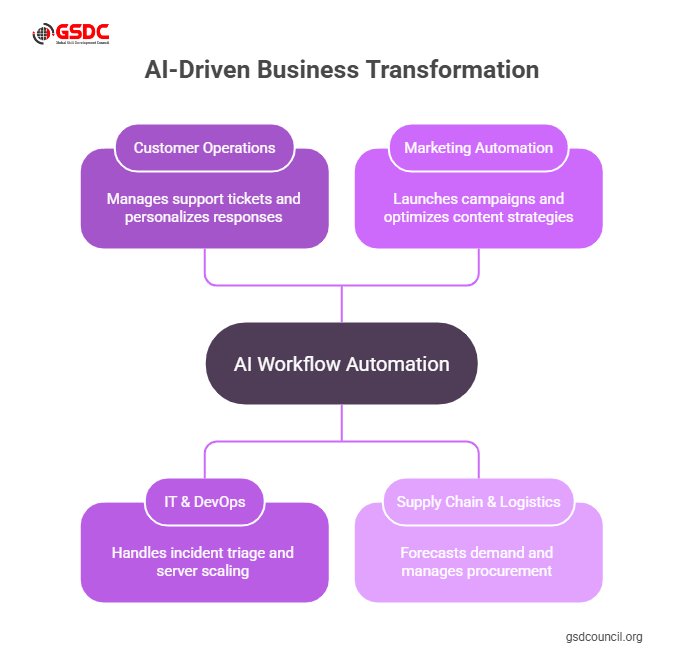
High-Impact Use Cases Include:
- Customer Operations: AI agents manage support tickets, escalate complex issues, and personalize responses using multimodal data.
- IT & DevOps: Agents handle incident triage, server scaling, and code deployment in real time.
- Marketing Automation: Generative and agentic hybrids autonomously launch campaigns, A/B test assets, and optimize content strategies.
- Supply Chain & Logistics: Multi-agent networks forecast demand, manage procurement, and adjust routing dynamically.
This fusion of reasoning and execution allows enterprises to orchestrate end-to-end operations autonomously, delivering speed, scale, and resilience.
Economic Value and ROI: The Next Exponential Curve
A joint survey by Multimodal and IBM (2025) found that 62% of agentic AI adopters expect returns exceeding 100% within the first year of deployment.
Such ROI mirrors the early cloud transformation curve, where automation unlocked compounding value through reduced human intervention and continuous optimization.
Key financial drivers include:
- Labor Augmentation: AI agents absorb repetitive and low-level decision-making tasks.
- Continuous Learning: Agents improve autonomously as they process feedback loops.
- Operational Agility: Agentic orchestration allows organizations to respond instantly to data changes or disruptions.
By 2030, the enterprise value of autonomous AI agents could exceed $93 billion, not just from cost reduction but from creating new digital productivity layers across organizations.
Types of AI Agents Shaping Enterprise Workflows
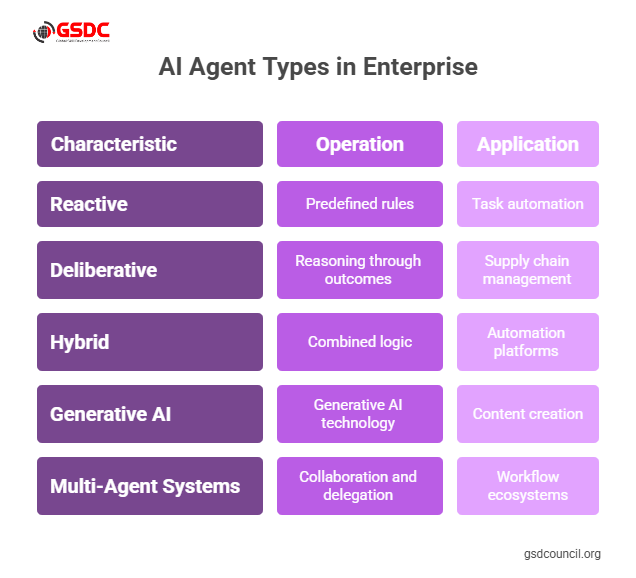
As enterprises scale, multiple types of AI agents collaborate in hybrid ecosystems.
1. Reactive Agents
Operate based on predefined rules or triggers. Common in AI task automation, they’re foundational for customer chatbots and system alerts.
2. Deliberative Agents
Reasoning through goals, constraints, and outcomes before taking action is essential in supply chain and risk management systems.
3. Hybrid Agents
Combine reactive and deliberative logic for balanced speed and intelligence, widely used AI Agents in the Enterprise automation platforms.
4. Generative AI Agents
Leverage Generative AI technology to produce original content and insights autonomously, bridging creativity and execution.
5. Multi-Agent Systems
Networks of specialized agents that collaborate, coordinate, and delegate form the core of agentic workflow ecosystems.
Together, these systems form the operational architecture of the future digital enterprise.
Agentic AI and Digital Transformation
The integration of agentic AI tools within corporate infrastructures represents the next phase of AI and digital transformation. Rather than just augmenting tasks, these systems redefine business operations entirely.
Modern enterprises now embed agentic systems into core technology stacks ERP, CRM, data analytics, and cybersecurity, achieving AI-powered automation that scales with complexity.
Forward-thinking leaders are prioritizing “agentic maturity,” the degree to which human, generative, and autonomous agents co-create value within workflows.
As agentic orchestration platforms emerge, companies gain full-stack intelligence that extends from task-level automation to strategic decision-making.
Challenges and Considerations
Despite its promise, Agentic AI presents challenges that organizations must address proactively:
- Data Governance: Autonomous systems must operate within strict compliance frameworks.
- Transparency: Explainability remains vital to prevent “black box” decision-making.
- Human Oversight: Successful deployment requires human-in-the-loop validation for mission-critical tasks.
- Integration Complexity: Seamless connection with legacy IT and API ecosystems is a common barrier.
Enterprises investing early in responsible frameworks and robust governance will be better positioned to scale Agentic AI safely and sustainably.
Looking Ahead: The Agentic Enterprise Era
In 2030, Agentic AI will cease to be an experimental innovation it will form the main working layer of enterprise ecosystems.
The McKinsey, Bain, and Capgemini reports state that organizations that integrate autonomous AI agents with AI workflow automation systems will achieve transformational efficiencies and competitive advantage.
Agents are not just automating work; they are redesigning work occurrences.
The next wave of business will be collaborative in nature, with people defining the vision and agents providing the scale of execution, pushing an estimated 93 billion dollars of workflow value in the next 10 years.

Related Certifications
Stay up-to-date with the latest news, trends, and resources in GSDC
If you like this read then make sure to check out our previous blogs: Cracking Onboarding Challenges: Fresher Success Unveiled
Not sure which certification to pursue? Our advisors will help you decide!