Agentic AI for Marketing Automation: A Practical Guide
Written by Matthew Hale
- What Is Agentic AI in Marketing?
- How Agentic AI Works in Marketing Workflows
- How Agentic AI Is Different from Traditional Marketing Automation
- How to Use Agentic AI in Marketing Workflows
- Agentic AI vs Generative AI in Marketing
- The Importance of Agentic AI Frameworks
- Key Benefits of Agentic AI in Marketing
- What Marketing Teams Need to Adopt Agentic AI
- Why Agentic AI Matters for the Future of Marketing
- Upskill for the Agentic AI Future
- Final Thoughts: Preparing Marketing Teams for the Agentic AI Era
Marketing automation has traditionally dealt with emails, leads, campaigns, and performance dashboards. However, AI has become mainstream in marketing, with about 60% of marketers using AI tools on a daily basis, which clearly indicates the rapid acceleration of adoption.
However, most traditional automation is still based on predefined rules, meaning that when customer behavior changes, marketers have to make changes manually.
This is where the application of agentic AI in marketing makes a clear difference. Agentic AI systems don’t operate through simple rules. They analyze the current context, determine the next action, and take steps to increase engagement, conversions, and cost savings.
For today’s marketing professionals, this means less focus on small, incremental changes and more time devoted to strategy, creativity, and the customer.
What Is Agentic AI in Marketing?
There are still lots of marketing professionals who keep asking what agentic AI in marketing is. Agentic AI basically means AI systems that are capable of functioning with a certain degree of autonomy to accomplish preset goals.
Traditional automation, which mechanically follows a set of static workflows, contrasts with agentic AI in that the latter:
- Tracks customer engagement and the effectiveness of marketing campaigns
- Determines the best business goal or intended step
- Takes the chosen steps without requiring human intervention
- Assesses the results and, based on this, improves decision-making in the future
This explains agentic AI how it works in real business environments. The system continuously improves its decisions based on data and results, rather than waiting for humans to make every adjustment.
In marketing, this allows AI to move from being only a support tool to becoming an active part of campaign management and optimization.
How Agentic AI Works in Marketing Workflows
To understand how to use agentic AI in marketing workflows, it helps to break the process into four simple steps:
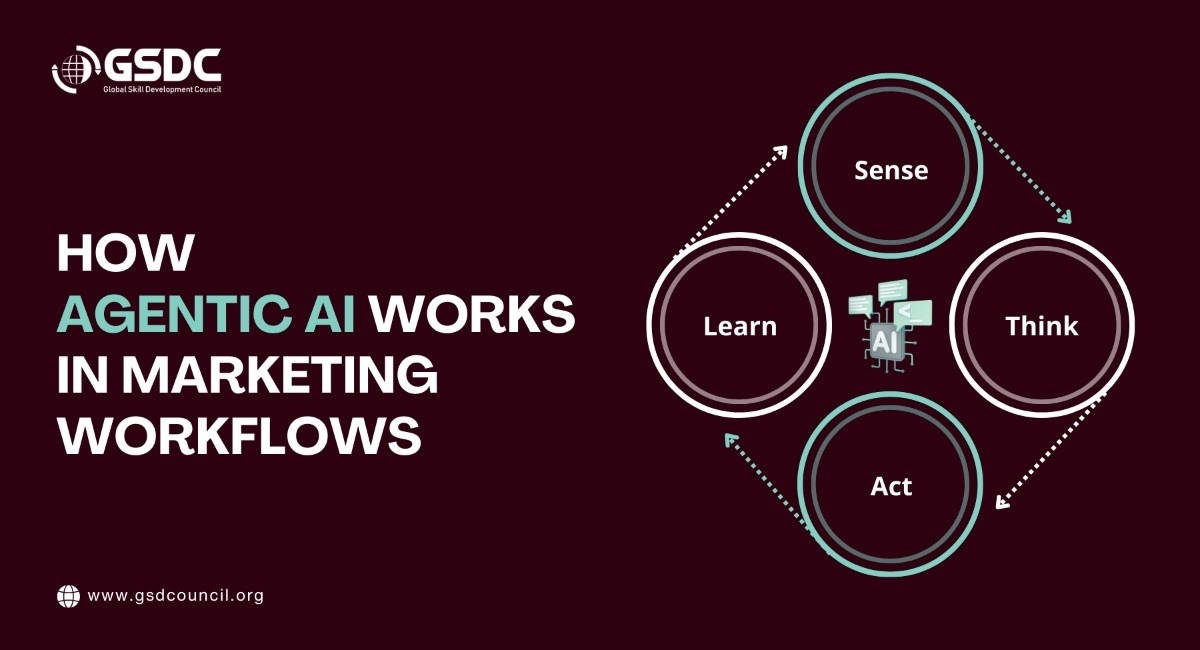
- Sense: It analyzes data from customer engagement, website interactions, email campaigns, social media, and ad campaigns.
- Think: It analyzes the data it has collected to identify what works and what doesn’t.
- Act: It takes action on what it has analyzed, adjusting timing, refining audience definitions, or recommending content modifications.
- Learn: It analyzes the outcome of its actions and uses that information to make better decisions in the future.
For instance, a retail business can allow agentic AI to make changes to ad spend on different platforms every day based on performance, without having to wait for a weekly human analysis.
Agentic AI can enable marketing operations to be more agile and responsive to customer behavior patterns, which is a domain GSDC is increasingly highlighting in its thought leadership on future-ready digital skills.
How Agentic AI Is Different from Traditional Marketing Automation
Traditional marketing automation is useful for repetitive tasks, but it depends heavily on predefined rules and manual updates. When customer behavior changes, marketers must step in to adjust workflows.
With agentic AI in marketing, systems become more adaptive. They can learn from performance data and optimize campaigns on their own. This makes marketing operations more responsive and efficient.
Here is a simple comparison:
|
Area |
Traditional Automation |
Agentic AI in Marketing |
|
Decision-making |
Fixed rules |
Goal-based decisions |
|
Adaptability |
Low |
High |
|
Optimization |
Reactive |
Proactive and continuous |
|
Learning |
Manual updates |
Learns from results |
|
Human input |
Frequent |
Reduced for daily tasks |
This shift explains how can agentic AI be used in marketing to move beyond rule-based systems and toward smarter, more flexible workflows.
How to Use Agentic AI in Marketing Workflows
Applying Agentic AI in marketing processes begins with identifying where improvement is needed.
- Campaign planning: Agentic AI can identify the best strategy for a campaign by analyzing business objectives and past experiences, rather than having to manually set up rules and assumptions.
- Content delivery: It does not have to follow a rigid schedule. It can modify the time of content delivery based on how the audience responds, so you can deliver engaging content when the audience is most receptive.
- Audience targeting: As customer data segment changes in real time, a marketing team can be more effective in the delivery of relevant and personalized content.
- Performance optimization: Agentic AI keeps track of the campaign results, and after each observation, it carries out one or two small changes to the campaign it is running, without having to wait for manual review.
- Reporting and insights: Instead of relying on a one-time static report, agentic systems deliver continuous insights and recommendations that speed up decision-making.
These examples demonstrate how the use of agentic AI in marketing can make the workflows faster, more adaptive, and more efficient.
For professionals seeking to develop their own expertise in this emerging space, learning programs such as the Agentic AI Professional Certification can help you develop the skills necessary to design, manage, and govern agentic AI systems responsibly in today’s marketing operations.
Agentic AI vs Generative AI in Marketing
Many marketers are already using generative AI to create emails, ads, and social media content. It’s useful for content creation, but its application doesn’t go beyond that.
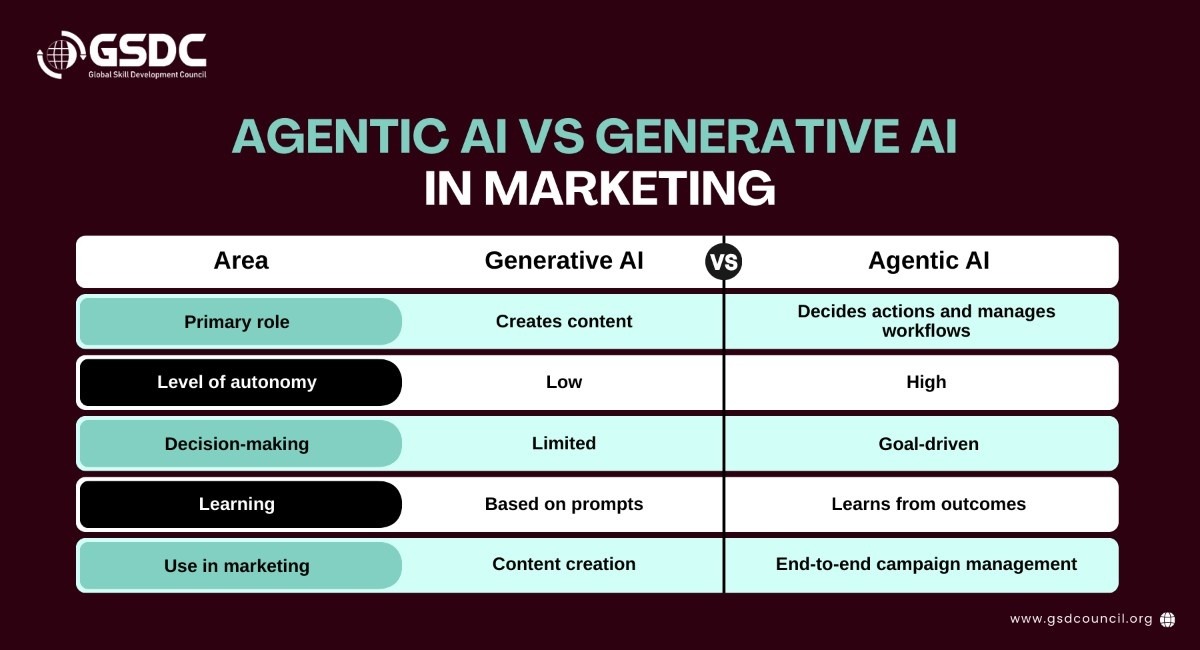
Agentic AI use cases go further. It determines what to do, when to do it, and how to adjust strategies based on the outcomes. This means you can still use generative AI to create content, but agentic AI also runs workflows and adjusts campaigns from start to finish.
This is why agentic AI has a larger footprint in modern marketing operations than other applications that are limited to content creation.
The Importance of Agentic AI Frameworks
Organizations that seek to use agentic AI in a responsible manner rely on frameworks that are well-structured and provide guidelines on how autonomous systems should be used in business, governance, and ethics.
A good framework should have the following:
- Business objectives that guide the actions of AI
- Guidelines on the data that the AI is supposed to access
- Guidelines on the actions that the AI is supposed to undertake
- Human intervention for decisions that have high consequences
- Guidelines on how to monitor the performance of the AI
Using well-structured agentic AI frameworks, marketing teams can harness the power of autonomy without losing control, accountability, or brand alignment.
Key Benefits of Agentic AI in Marketing
Organizations that have adopted agentic AI in their marketing activities are already seeing the benefits, including:
- Faster optimization of marketing campaigns without the need for continuous manual adjustments
- Improved personalization based on real-time customer behavior
- Better budget allocation through continuous optimization
- Reduced workload on marketing teams
- Faster time-to-market for the launch and optimization of marketing campaigns
Essentially, these advantages help teams work more productively while elevating customer experiences that are not only relevant but also captivating.
What Marketing Teams Need to Adopt Agentic AI
For marketing teams that want to integrate agentic AI into their processes, a few key foundations are most important:
- Integrated data: AI requires access to connected, reliable data from marketing platforms, CRM, and analytics software.
- Clear goals: Determine what success looks like-improved engagement, increased conversions, and more efficient campaigns.
- Governance and oversight: Create simple rules and human oversight for high-risk decisions.
- Skills and understanding: With the increasing adoption, professionals are seeking agentic AI certification opportunities to acquire know-how in managing and controlling self-driven AI systems.
With these basic principles laid down, agentic AI can be implemented in marketing processes.
Why Agentic AI Matters for the Future of Marketing
The future of marketing is going to be data-driven, fast-moving, and customer-focused-traditional, static automation is simply not going to be sufficient. Currently, 60% of marketers are using AI-based tools on a daily basis, so AI is already mainstream in the marketing world.
Agentic AI in marketing takes this to the next level by providing near-real-time feedback on shifting customer behavior, accelerating execution, improving decision-making, and scaling operations.
As marketing becomes more outcome-focused, teams that understand agentic AI frameworks and practical agentic AI use cases will be better positioned to lead digital transformation in 2026 and beyond.
Upskill for the Agentic AI Future
As agentic AI transitions from pilots to mainstream marketing applications, acquiring the appropriate skills is as important as selecting the appropriate tools. Marketing executives and professionals should have a good understanding of how agentic AI frameworks work and how to use agentic AI applications in a responsible manner in a business context.
The Global Skill Development Council (GSDC) provides the Certified Agentic AI Professional certification, enabling professionals to develop systematic and application-specific knowledge about agentic AI. The certification is based on how agentic AI systems work, how they are used in organizations, and how to use autonomous AI in a responsible manner for various tasks, such as marketing and digital transformation.
Structured learning of this type enables teams to adopt agentic AI systems with more confidence and clarity.
Final Thoughts: Preparing Marketing Teams for the Agentic AI Era
Agentic AI represents the next wave of marketing automation. It propels teams from rule-based solutions to intelligent, goal-oriented agents who are constantly sensing, deciding, acting, and learning.
For beginners, what is agentic AI in marketing can be understood simply as automation that can observe, decide, and improve on its own.
In the course of the journey, more companies will discover practical agentic AI examples and develop capability through established frameworks and skills training. Agentic AI will be a vital capability of the new marketing teams that will be able to compete in 2026 and later.

Related Certifications
Stay up-to-date with the latest news, trends, and resources in GSDC
If you like this read then make sure to check out our previous blogs: Cracking Onboarding Challenges: Fresher Success Unveiled
Not sure which certification to pursue? Our advisors will help you decide!