Agentic AI Trends for 2026: What Business Leaders Need to Know
Written by Matthew Hale
- Why 2026 Is a Turning Point for Agentic AI
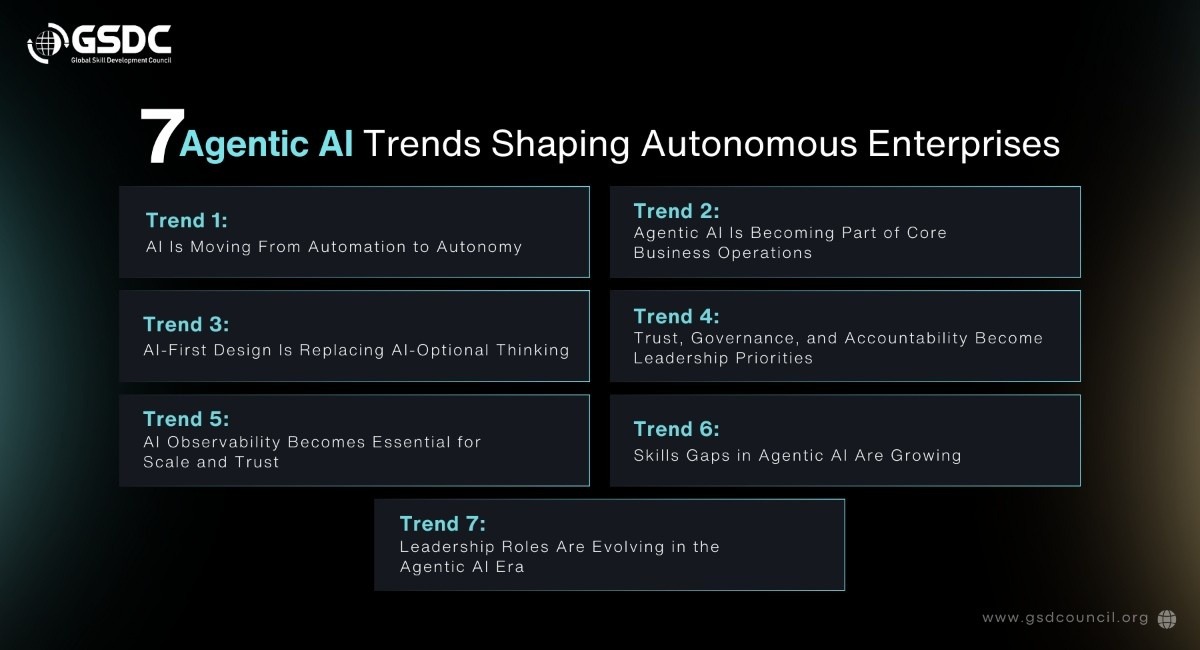
- Trend 1: AI Is Moving From Automation to Autonomy
- Trend 2: Agentic AI Is Becoming Part of Core Business Operations
- Trend 3: AI-First Design Is Replacing AI-Optional Thinking
- Trend 4: Trust, Governance, and Accountability Become Leadership Priorities
- Trend 5: AI Observability Becomes Essential for Scale and Trust
- Trend 6: Skills Gaps in Agentic AI Are Growing
- Trend 7: Leadership Roles Are Evolving in the Agentic AI Era
- What Business Leaders Should Do Now
- The Growing Role of Skills Validation
- Conclusion
In 2026, many of the day-to-day decisions in the organization are no longer made by humans. AI systems observe what is happening, decide what to do next, and take action. Decisions that were made by bouncing around through several handoffs or approvals are now being made automatically.
This is a new dawn for artificial intelligence. AI is no longer a decision-support system. It now has the capacity to plan, decide, and act on its own, changing the way teams work, risks are managed, and services are delivered.
To keep up with this change, professionals must understand what is agentic AI is and how the current trends of agentic AI in 2026 are transforming the way professionals work.
Agentic AI refers to self-governing AI systems, also known as AI agents, that are able to achieve goals, make decisions, and act with little to no human intervention.
Why 2026 Is a Turning Point for Agentic AI
2026 stands out as a turning point because several shifts are happening at the same time.
- AI models can now act autonomously, plan, decide, and respond with minimal human input.
- Enterprise adoption is accelerating, according to analyst forecasts; around 40% of enterprise applications are expected to include task-specific AI agents by the end of 2026, moving beyond pilots.
- AI use is spreading across the business, becoming part of everyday workflows rather than isolated projects.
- Expectations for transparency and accountability are rising as AI systems gain more autonomy.
AI agents' news increasingly reflects real deployments, not experimental use.
Together, these factors explain why agentic AI is becoming a practical reality for organizations in 2026 and why expectations are shifting from simple automation to true autonomy.
Trend 1: AI Is Moving From Automation to Autonomy
Traditional AI follows a set of instructions, adhering to pre-programmed rules and guidelines, and sometimes waiting for human input when things change.
Agentic AI works differently. It interprets the situation, considers the goals, and then chooses what to do next.
To explain agentic AI, how it works:
- Automation follows fixed rules
- Agentic AI follows goals
- Automation completes tasks
- Agentic AI plans, adjusts, and acts
You can witness this trend already in motion. Industry research indicates that over 70% of organizations using AI are now using real-time decision-making, not just simple automation. Amazon and Google have already indicated a shift from rule-based automation to goal-based systems in areas such as logistics and infrastructure.
With increased autonomy, humans remain responsible, but AI assumes more of the execution and prioritization tasks.
Trend 2: Agentic AI Is Becoming Part of Core Business Operations
By 2026, agentic AI isn’t just something pilots test; it’s weaving itself into ordinary day-to-day operations, supporting tasks that used to require nonstop human supervision.
In fact, more than 80% of companies now use AI in at least one critical business function, and it’s clear that it’s moved from a nice-to-have to a must-have.
Common agentic AI use cases include:
- AI agents supporting customer service
- IT systems that automatically identify and resolve problems
- Continuous monitoring of financial risk and regulatory issues
- AI agents supporting decision-making in the supply chain
Enterprise platforms like Salesforce and ServiceNow are embedding AI agents directly into the workflow
These agentic AI examples show how autonomy improves speed, consistency, and responsiveness across operations.
Trend 3: AI-First Design Is Replacing AI-Optional Thinking
Organizations have moved on from considering AI as something that comes after everything else. Surveys show that about 60- 70% of organizations are now developing their business processes with AI being a key element from the very beginning.
AI-first design doesn't imply removing humans:
- AI scales and takes care of repetitive tasks
- Humans make decisions and are responsible
Netflix and Uber are leading the way by building their business operations around both AI-based knowledge and human accountability.
The increased use of agentic AI frameworks, where people define the overall objective and the boundary conditions that govern how much AI can contribute to achieving that objective, goes along with this trend.
Trend 4: Trust, Governance, and Accountability Become Leadership Priorities
As AI agents become more autonomous, it falls to leaders to create an environment of trust in their ability to act in accordance with the business objectives, policies, and ethics of the organization.
Leaders require clarity in what can be expected with respect to:
- Who is responsible for decisions driven by AI?
- How decisions made by AI may be reviewed or explained
- What mechanisms are in place to prevent unintended consequences from occurring?
Microsoft and IBM, for example, have taken a leading role in promoting the responsible use of AI and the need for governance as organizations move toward greater autonomy of AI.
Trend 5: AI Observability Becomes Essential for Scale and Trust
As AI agents take on more responsibility, organizations need visibility into how decisions are made, why actions occur, and how systems behave over time.
AI observability focuses on:
- How decisions are made
- Why actions were taken
- How systems behave in real conditions
Teams at organizations such as Meta increasingly focus on monitoring AI behavior at scale. Without observability, agentic AI cannot be trusted or scaled safely.
Trend 6: Skills Gaps in Agentic AI Are Growing
While AI tools are widely available, agentic AI skills remain scarce. Recent research shows that 94% of leaders report shortages in AI-critical skills.
Organizations increasingly need people who understand:
- Autonomous decision-making logic
- Coordination between multiple AI agents
- Human–AI interaction
- Ethical and compliance considerations
Firms such as Accenture and Deloitte frequently highlight these gaps, reinforcing that the challenge is capability, not technology.
Trend 7: Leadership Roles Are Evolving in the Agentic AI Era
Agentic AI is changing how leaders operate. Leadership is shifting from making every decision to designing and overseeing AI-driven decision environments.
Success depends on:
- Setting clear goals
- Defining boundaries and guardrails
- Ensuring accountability
Organizations such as Unilever and JPMorgan Chase have discussed leadership and operating model changes that reflect this shift.
What Business Leaders Should Do Now
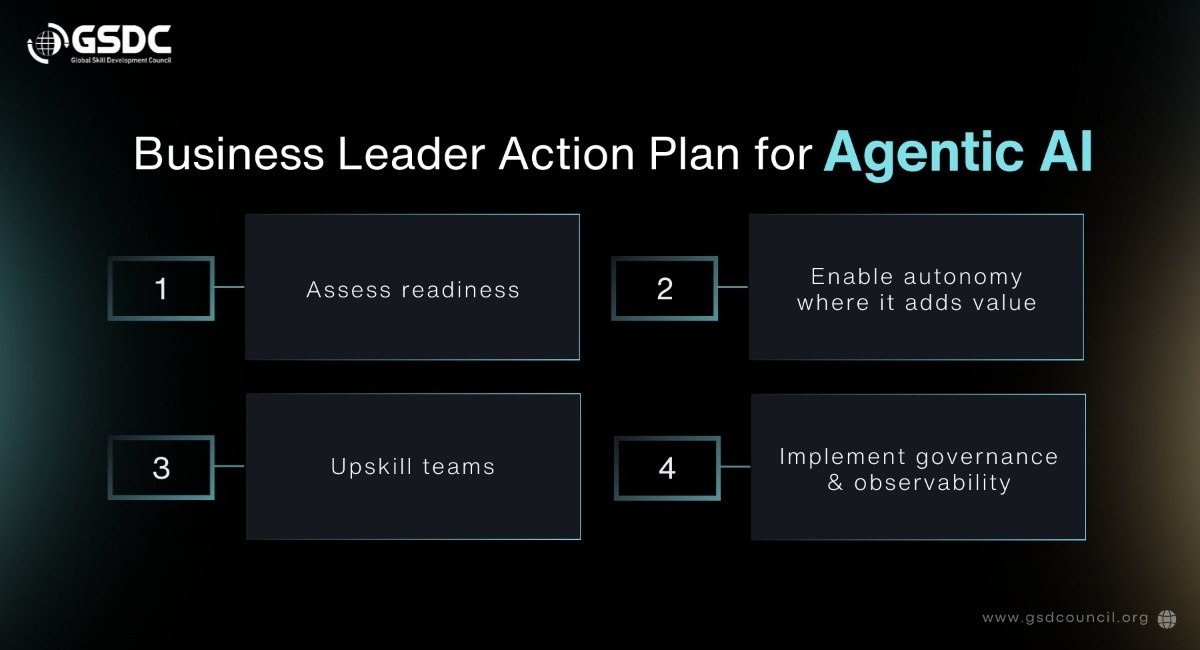
Leading the charge into agentic AI trends in 2026, business leaders should concentrate on a few practical steps:
- Evaluate the organization's AI readiness, including the areas where AI is utilized and how decisions are made.
- Find out which operations can be carried out autonomously, especially those that are high in volume or require quick turnaround.
- Develop internal knowledge of agentic AI not only for the technical teams but also for the business teams.
- Set up governance and observability right now, rather than waiting for the autonomy to extend even further.
The decision to act early with these moves is beneficial in that it helps to calmly manage the risk, not to mention the improved control and the establishment of a stronger base for the long-term benefits of agentic AI.
The Growing Role of Skills Validation
As agentic AI is being more adopted by the users, firms are increasingly focusing on how AI-related skills are checked and confirmed. Simply relying on informal knowledge is not enough anymore, as autonomous systems are being given more authority.
Agentic AI certification is becoming the norm for those who want to master the usage of autonomous agents, the governance thereof, and the management of risk in many sectors. Such developments on the part of formalizing agentic AI capabilities are in line with the general trend towards increased adoption of agentic AI.
Conclusion
Agentic AI will become a key driver in every sector by the end of 2026. The key to success will not be how quickly you adopt AI, but how well you can manage systems that can act independently.
Those who understand agentic AI and stay updated on the latest trends in the market and address the skills gap challenges effectively will be in a better position to manage autonomy and reduce risks.

Related Certifications
Stay up-to-date with the latest news, trends, and resources in GSDC
If you like this read then make sure to check out our previous blogs: Cracking Onboarding Challenges: Fresher Success Unveiled
Not sure which certification to pursue? Our advisors will help you decide!