Agentic AI: Understanding Autonomous Intelligence and Its Impact
Written by Matthew Hale
- Exploring Autonomy in AI: Traditional AI vs Agentic AI
- Why Agentic AI is Important for Project Management?
- 2025 Agentic AI Use Cases
- Agentic AI for Professionals
- Understanding How Agentic AI Works
- Agentic AI Trends and the Future of Work
- Reshaping the Future of the World: Agentic AI’s Impact
- Career Pathways and Professional Growth
- Start Your Journey with GSDC
- Conclusion: Stepping into the Future of Autonomous Intelligence
- FAQs
Agentic AI is no longer a futuristic concept; it is transforming industries, reshaping roles, and redefining productivity. According to Gartner, 61% of organizations are investing in autonomous AI systems to improve decision-making and operational efficiency. Professionals who understand why agentic ai certification is important are positioned to stay ahead in marketing, finance, cybersecurity, and operations.
Unlike traditional AI, which responds to human instructions, agentic AI systems act autonomously, plan actions, and adapt to changing conditions. This ability to make real-time decisions sets the stage for smarter business operations and opens doors to emerging career paths such as AI supervisors, human-AI collaboration strategists, and ethical auditors.
Professionals today are gaining hands-on experience, access to real-world templates, and practical insights into emerging agentic AI future trends to stay aligned with evolving industry demands and skill requirements.
Exploring Autonomy in AI: Traditional AI vs Agentic AI
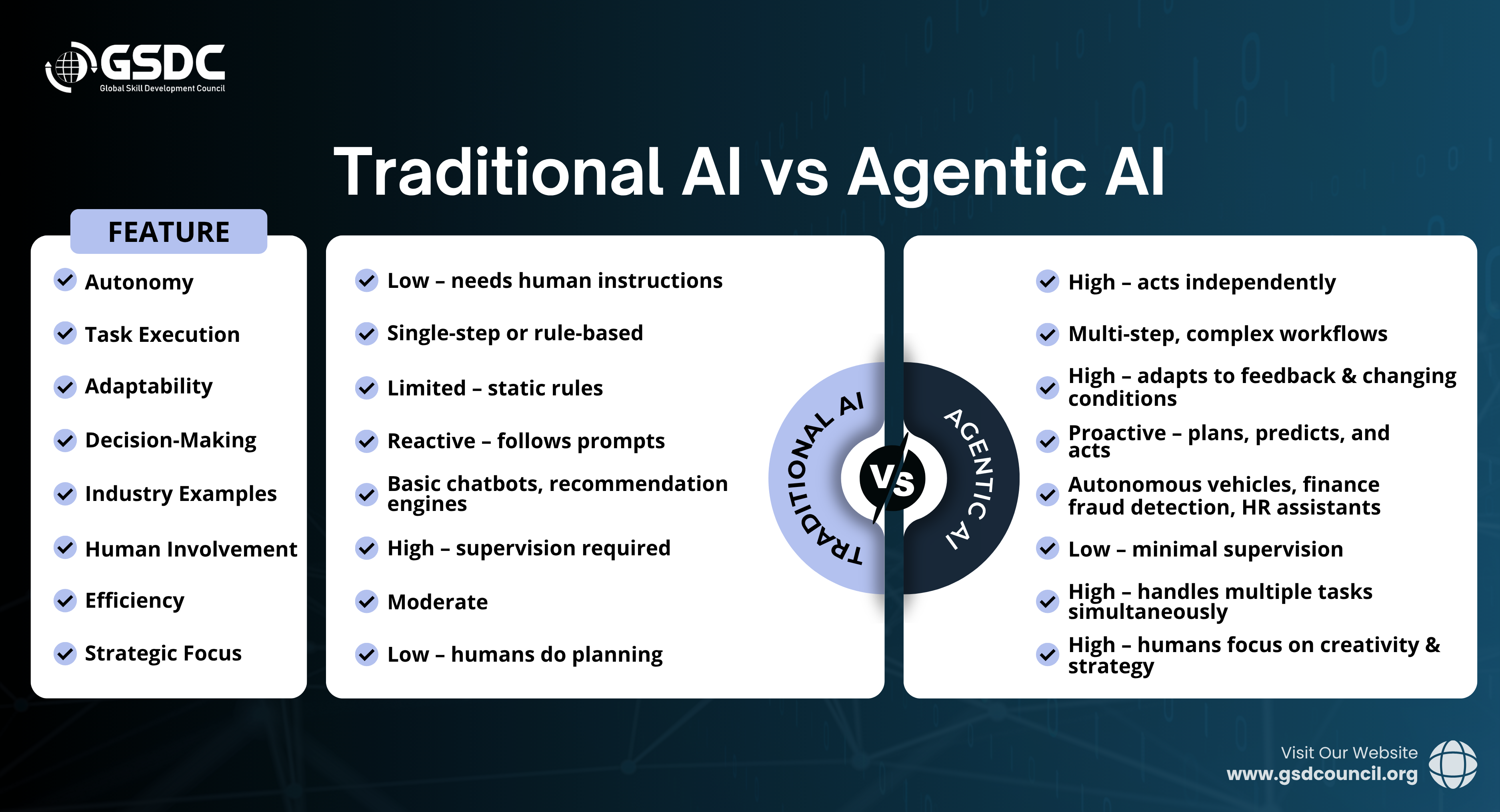
What is Agentic AI? Traditional AI tools rely on static rules or human prompts to generate outputs. In contrast, agentic AI functions independently, executing complex workflows and managing multi-step processes.
Why use agentic AI? It allows professionals to focus on strategic and creative tasks while AI handles repetitive or complex operations. For example:
- Autonomous vehicles analyze sensor data and make driving decisions without human intervention.
- AI agents in finance detect fraud in real-time and automatically prevent suspicious transactions.
- HR AI assistants screen resumes, schedule interviews, and answer employee queries autonomously.
By understanding how agentic AI works, professionals can leverage these systems to improve operational efficiency, reduce errors, and drive innovation.
Why Agentic AI is Important for Project Management?
Project management is an area seeing rapid adoption of agentic AI systems. AI agents can track deliverables, detect bottlenecks, and automatically reassign tasks to optimize workflows.
Agentic AI Examples- Agentic AI tools like GPT-Agent and LangChain allow project managers to delegate complex planning and monitoring to AI, freeing them to focus on strategy and stakeholder management.
Agentic AI jobs in project management are growing, including roles like AI project supervisors and AI workflow coordinators. Professionals with hands-on experience through certifications like GSDC’s Agentic AI Foundation Certification are better equipped for these roles.
2025 Agentic AI Use Cases
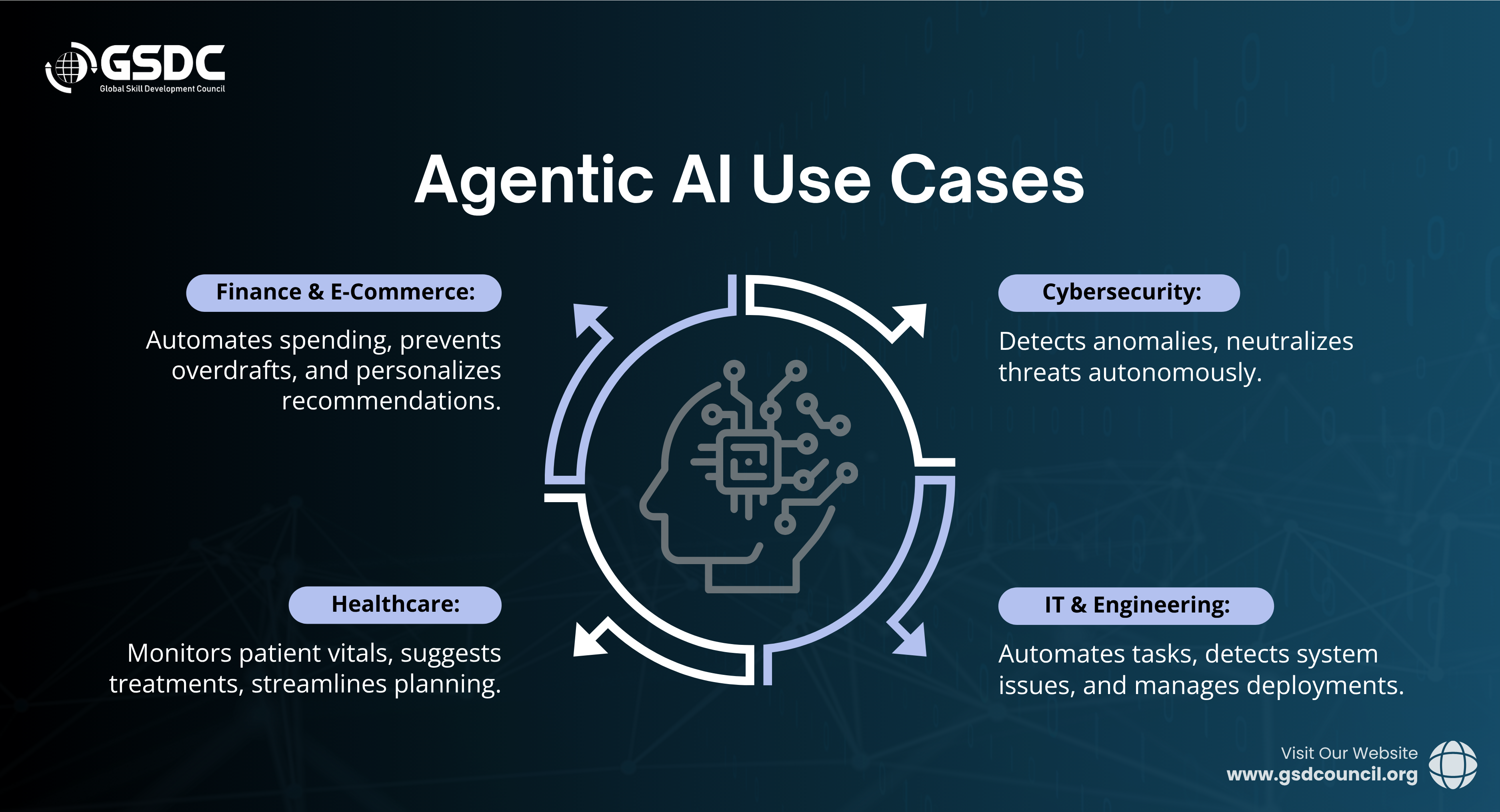
Agentic AI is already impacting industries with measurable results:
- Finance & E-Commerce: Bud Financial uses AI agents to manage spending, prevent overdrafts, and optimize savings automatically. Amazon’s AI agents personalize recommendations for millions of users.
- Cybersecurity: Darktrace’s AI agents detect anomalies, neutralize threats, and minimize human intervention.
- Healthcare: AI agents monitor patient vitals, suggest treatment plans, and streamline radiotherapy planning.
- IT & Engineering: AI systems automate routine tasks, detect system issues, and manage software deployment efficiently.
Gartner's statistics show that 48% of compliance professionals expect AI to improve operational efficiency, and 35% believe AI helps manage evolving regulations. These numbers highlight the rising importance of AI literacy and practical AI skills for professionals.
Agentic AI for Professionals
To excel in the agentic ai frameworks, professionals must develop core skills:
- AI Literacy: Understand what agentic AI does and how systems operate autonomously.
- Prompt Engineering & Task Design: Learn to give AI agents clear, strategic instructions.
- Strategic Thinking: Know when to rely on AI and when to use human judgment.
- AI Ethics & Governance: Address bias, accountability, and transparency.
- Cross-Functional Collaboration: Work effectively with developers, data scientists, and business teams.
Supporting skills include critical thinking, digital literacy, and continuous learning to stay updated with agentic AI future trends.
Certifications such as GSDC’s Agentic AI Foundation Certification offer practical exercises and ready-to-use templates, preparing professionals for real-world challenges and giving them an edge in AI specialist jobs.
Understanding How Agentic AI Works
Agentic AI builds on generative AI models (LLMs) but adds autonomy, goal-driven behavior, and adaptability. Unlike traditional AI, it can:
- Decompose tasks and manage multi-step workflows with contextual awareness: Agentic AI breaks complex objectives into smaller subtasks and tracks progress autonomously, improving efficiency across teams.
- Integrate seamlessly with external applications, APIs, and IoT devices: It connects with enterprise software and IoT devices to automate cross-functional workflows without human intervention.
- Retain long-term memory and context: Agentic AI stores relevant information from prior interactions, ensuring continuity across projects and consistent decision-making.
- Adapt in real time by analyzing feedback loops and environmental changes: It continuously adjusts actions based on outcomes, metrics, and changing conditions for maximum accuracy and efficiency.
This makes agentic AI systems highly versatile, capable of managing customer service interactions, IT workflows, HR automation, and financial operations. Professionals who understand how agentic AI works can implement these systems effectively, boosting productivity and innovation.
🔥 Download now and begin your path to becoming a certified AI professional!
📋 Packed with practical templates, self-assessment checklists, and project guides, this toolkit helps you gain hands-on experience and confidence in autonomous AI systems.
Agentic AI Trends and the Future of Work
Why agentic AI is important becomes clear when examining industry trends:
- Gartner predicts 70% of large enterprises will deploy autonomous AI agents in at least one core business function by 2026.
- AI-driven automation will transform operational roles, creating demand for agentic AI jobs like AI supervisors and workflow strategists.
- Prompt engineering frameworks are emerging as essential skills for instructing AI agents effectively.
The future for AI is not just automation, it’s proactive decision-making, risk management, and cross-system orchestration. Understanding what AI will do in the future allows professionals to position themselves strategically for career growth.
Reshaping the Future of the World: Agentic AI’s Impact
Agentic AI is redefining the workplace:
- Marketing: Campaigns are automatically optimized based on real-time data.
- Finance: AI agents conduct fraud detection, risk assessments, and portfolio optimization autonomously.
- Healthcare: Patient monitoring, diagnosis assistance, and treatment planning are AI-driven.
- Operations: Supply chains adjust automatically to disruptions, improving efficiency.
These real-world examples demonstrate why using agentic AI enables smarter decisions, reduces human error, and drives scalable business growth.
Career Pathways and Professional Growth
The rise of agentic AI systems is not just reshaping workflows - it’s reinventing what a “career in AI” looks like. As industries move toward automation with autonomy, a new generation of roles is emerging, where humans don’t just use AI - they lead it.
Top Emerging Roles in the Agentic AI World
- AI Supervisors: Monitor autonomous agents, ensuring ethical and secure decision-making.
- Task Architects: Design complex workflows using prompt engineering frameworks that help AI think, plan, and act.
- Human-AI Collaboration Strategists: Bridge the gap between machine intelligence and human insight to optimize productivity.
- Ethical Auditors: Evaluate bias, transparency, and accountability across agentic AI jobs in regulated sectors.
How to Build Your Path in Agentic AI
Success in this domain requires both strategy and skill.
- Education: Start with programs in business, IT, or AI to understand what agentic AI systems are and what agentic AI do in real-world industries.
- Certification: Advance with professional credentials like the GSDC Agentic AI Certification, designed for practical learning and real-world project experience.
- Experience: Apply your knowledge through AI-based projects or prompt engineering jobs, where you’ll work hands-on with intelligent agents.
- Adaptability: The future for AI will belong to professionals who blend human judgment with machine precision - mastering ethics, governance, and continuous learning.
According to recent reports by PwC, AI-driven roles are projected to grow by 38% by 2027, with global spending on AI systems exceeding USD 300 billion. Professionals holding AI or prompt engineering certification earn an average of USD 110,000–145,000 annually in the U.S., compared to USD 80,000 for non-certified peers.
Furthermore, AI-enabled professionals are earning up to 35% more than those without specialized AI expertise. With the growing demand for agentic AI jobs, certified professionals stand out as strategic thinkers capable of guiding AI adoption responsibly and effectively.
Start Your Journey with GSDC
Agentic AI is shaping the future for AI in industries worldwide. Professionals who understand why agentic AI, what agentic AI systems do, and how agentic AI works will thrive in emerging careers.
GSDC’s Agentic AI Foundation Certification provides structured learning, practical exercises, and real-world use cases, equipping professionals to excel in agentic AI jobs and AI specialist jobs.
Start your journey with GSDC today, learn, practice, and earn a certification that sets you apart in the evolving world of agentic AI.
Conclusion: Stepping into the Future of Autonomous Intelligence
Agentic AI is revolutionizing how businesses operate, enabling autonomous decision-making, seamless task management, and cross-functional automation. Understanding why agentic AI is important, what agentic AI systems do, and how agentic AI works empowers professionals to lead in emerging roles, from AI supervisors to human-AI collaboration strategists. With growing demand for agentic AI jobs, prompt engineering frameworks, and AI specialist skills, professionals equipped with practical knowledge and hands-on experience are positioned for career growth. Embracing ethical practices, governance, and continuous learning ensures that AI adoption is responsible, efficient, and aligned with the future of work.
FAQs
What does agentic AI do?
Agentic AI systems are capable of autonomous decision-making, multi-step task execution, and integrating with other digital tools to achieve goals efficiently.
What are agentic AI systems?
Agentic AI systems consist of autonomous agents that plan, adapt, and execute tasks with minimal human supervision, making them useful across industries like finance, marketing, HR, and operations.
Do I need coding experience?
No, beginner-friendly tools, GSDC projects, and practical exercises help you gain hands-on experience without prior coding knowledge.
Which skills are most important for prompt engineering jobs?
Key skills include AI literacy, ethics, prompt engineering frameworks, strategic thinking, and cross-functional collaboration.
How does GSDC certification and prompt engineering certification help?
GSDC’s certifications provide practical learning, recognized credentials, and project-based experience, preparing professionals for agentic AI jobs and prompt engineering roles.

Related Certifications
Stay up-to-date with the latest news, trends, and resources in GSDC
If you like this read then make sure to check out our previous blogs: Cracking Onboarding Challenges: Fresher Success Unveiled
Not sure which certification to pursue? Our advisors will help you decide!