Leading Workforce Transformation Initiatives as a Chief Learning Officer
Written by Pravena K
- Why Workforce Transformation Matters More Than Ever
- The Evolution of the Chief Learning Officer
- The Five Drivers of Workforce Transformation
- Building a Future-Ready Workforce
- Skills Are the New Currency
- Human Plus AI: The Future of Work
- Why Workforce Transformation Initiatives Fail
- Measuring Learning Impact
- The Future of the Chief Learning Officer
- Conclusion
Artificial Intelligence is rapidly transforming the way organizations create content, communicate with employees, and deliver learning experiences. From drafting HR policies and onboarding materials to designing training programs and internal communications, generative AI in HR is helping teams work faster and more efficiently while supporting digital workforce transformation initiatives.
However, one common challenge remains: AI can generate content in seconds, but it doesn't automatically understand your organization's unique tone, style, or brand voice. Without proper guidance, the output may sound generic, inconsistent, or disconnected from your company culture.
This is where prompt engineering becomes essential. By utilizing techniques such as Zero-Shot, One-Shot, and Few-Shot Prompting, organizations can train AI to communicate more effectively and align its responses with business expectations. These prompting methods help HR and Learning & Development teams create content that is not only accurate but also consistent with their organizational identity and broader corporate learning and development strategy.
In this article, we'll explore the fundamentals of Zero-Shot, One-Shot, and Few-Shot Prompting, understand how each approach works, and discover how they can help organizations teach AI their company voice while improving HR and L&D workflows as part of a modern learning and development strategy framework.
Why Workforce Transformation Matters More Than Ever
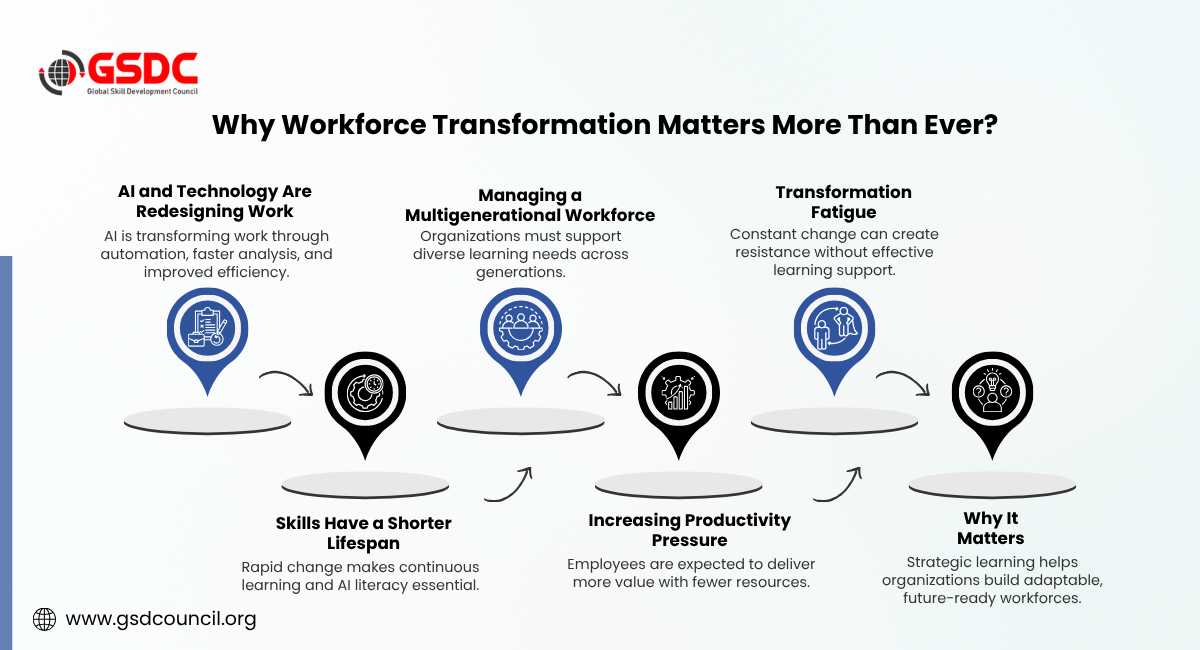
Many organizations continue to struggle with modern business challenges by relying on outdated workforce models. However, the pace of change has accelerated, making traditional approaches ineffective.
AI and Technology Are Redesigning Work
Artificial Intelligence is no longer a futuristic concept. It is actively reshaping how organizations operate by automating repetitive tasks, analyzing data more efficiently, generating reports, and enhancing customer interactions.
As technology changes the nature of work, job roles also evolve. Employees must continually develop new skills to remain relevant, while organizations must ensure their workforces are prepared for these changes.
Skills Have a Shorter Lifespan
The value of professional skills is changing rapidly. Capabilities that were considered advanced a few years ago are now basic expectations.
Skills such as digital literacy, critical thinking, collaboration, adaptability, and AI fluency have become essential across industries. Organizations that fail to invest in continuous learning, upskilling and reskilling the workforce risk falling behind their competitors.
Managing a Multigenerational Workforce
Today's workplace often features multiple generations working together, ranging from Baby Boomers to Generation Z. Each group brings distinct expectations, communication styles, and learning preferences.
This diversity creates opportunities for innovation but also requires learning leaders to design flexible development strategies through a strong corporate learning and development strategy that engages employees at every career stage.
Increasing Productivity Pressure
Business leaders are expected to achieve higher performance with leaner teams and tighter budgets. Organizations need employees who can adapt quickly, take ownership, and contribute effectively without lengthy adjustment periods.
Learning and development initiatives must therefore support business outcomes, not just employee education, through an effective learning and development strategy framework.
Transformation Fatigue
Employees have experienced constant change through digital initiatives, restructuring, policy updates, and the introduction of new technologies. Without a clear learning strategy, these changes can create confusion and resistance.
A strategic learning function helps employees understand, embrace, and successfully navigate transformation.
The Evolution of the Chief Learning Officer
Traditionally, CLOs were evaluated based on activity metrics such as:
- Number of training programs delivered
- Learning hours completed
- Attendance rates
- Courses uploaded to learning platforms
While these metrics remain useful, they no longer answer the questions executives are asking today:
- Does the organization have the skills needed for future growth?
- Are leaders prepared to manage change?
- Can employees use AI responsibly and effectively?
- Is learning improving business performance?
- Are internal talent pipelines strong enough?
These are business questions, not simply training questions.
As a result, the modern CLO has evolved into several strategic roles:
Capability Strategist
The CLO aligns workforce skills with future business priorities, ensuring employees are prepared for upcoming challenges and opportunities.
Change Enabler
Organizational transformation often succeeds or fails based on how well people adapt. CLOs help employees embrace new systems, technologies, and ways of working.
Talent Accelerator
Building internal talent pipelines and creating opportunities for career mobility reduces hiring costs and improves employee retention.
Business Partner
Modern CLOs contribute directly to productivity, resilience, innovation, and long-term growth, making them key partners in organizational strategy.
The Five Drivers of Workforce Transformation
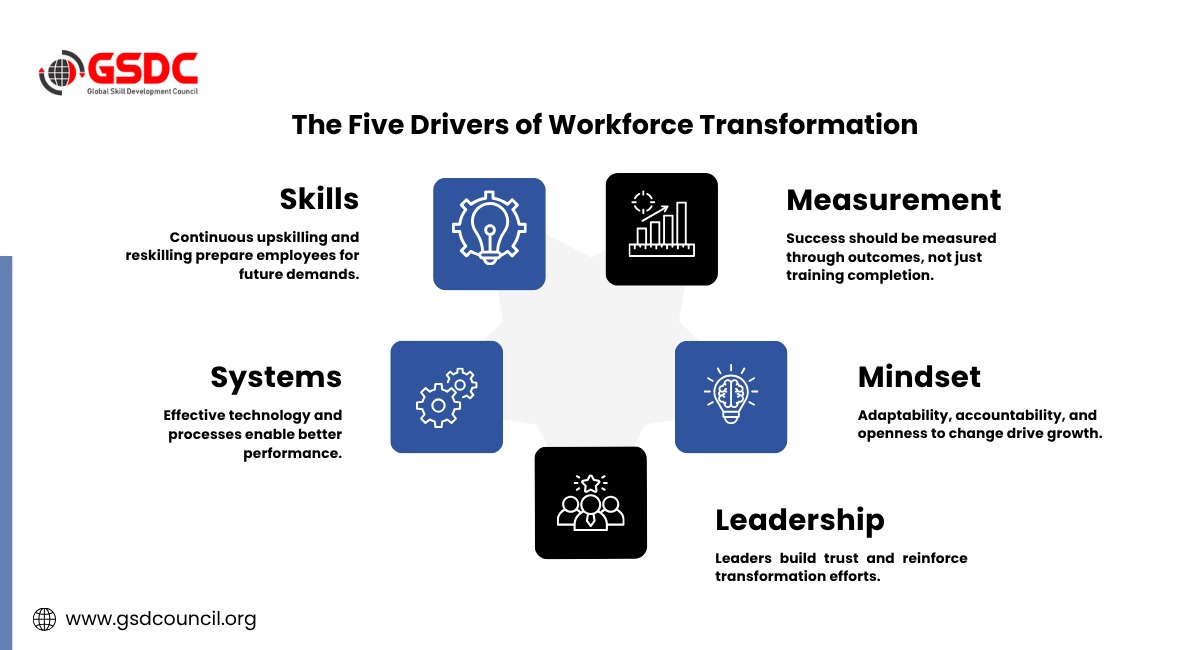
Sustainable workforce transformation requires multiple elements to work together. Focusing on only one area, such as technology or training, rarely produces lasting results.
1. Skills
Organizations must identify the capabilities employees need today and the skills they will need tomorrow. Continuous upskilling and reskilling are essential.
2. Systems
Technology, workflows, and processes should enable employees to perform effectively. Even the best training programs fail if organizational systems create obstacles.
3. Mindset
Employees need to demonstrate adaptability, learning agility, accountability, and openness to change. Developing the right mindset is as important as building technical skills.
4. Leadership
Leaders create trust, clarity, and alignment. They reinforce new behaviors and ensure transformation efforts become part of the organizational culture.
5. Measurement
Organizations must track progress and business outcomes rather than simply monitoring training completion rates.
When these five drivers work together, transformation becomes sustainable.
Building a Future-Ready Workforce
For CLOs, being busy is not the same as being strategic. To create meaningful workforce transformation, organizations should focus on several key priorities.
Skill Readiness
Learning initiatives should directly support business objectives instead of offering generic training programs. Capability building must align with organizational goals and future growth plans.
Leadership Readiness
Managers play a crucial role in reinforcing new behaviors. If leaders are not prepared for change, even the best learning strategies will struggle to succeed.
Digital and AI Fluency
Employees do not need to become technical experts, but they should understand how to use modern technologies responsibly and productively.
AI literacy is increasingly becoming a core business capability.
Change Adoption
Training alone does not create transformation. Employees need ongoing support to convert knowledge into daily practice and long-term behavioral change.
Performance Measurement
Learning functions should demonstrate measurable business impact through improved productivity, engagement, and operational performance.
Skills Are the New Currency
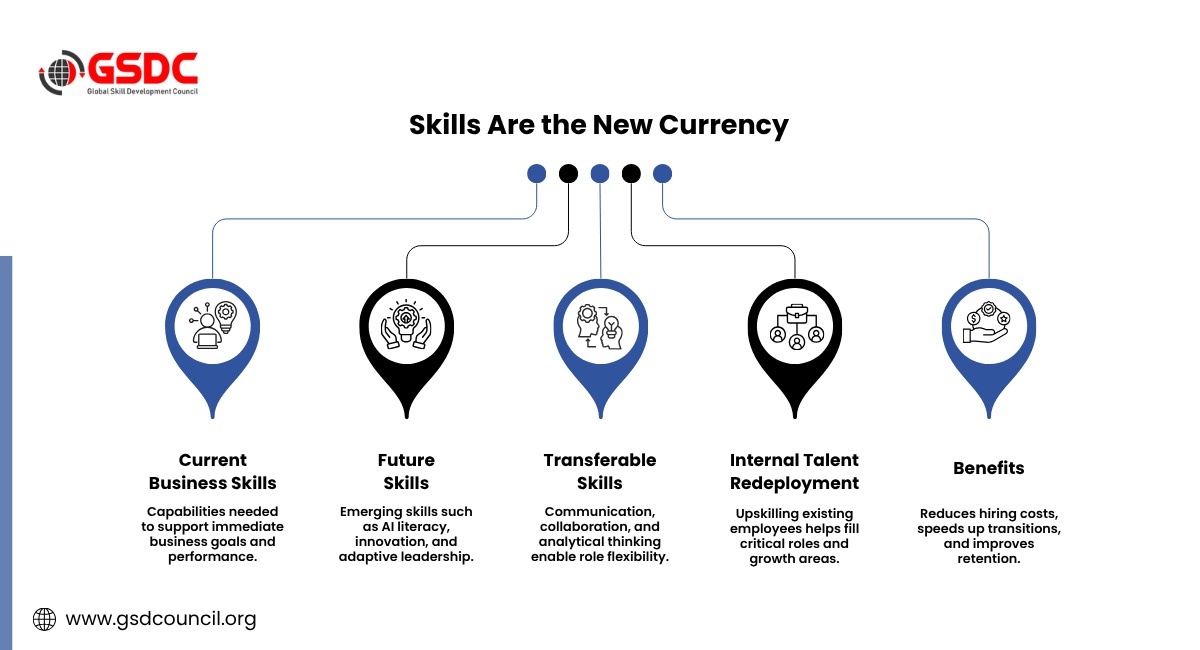
Organizations are moving away from job-based thinking toward a skills based organization approach.
Instead of asking, "What position does this employee hold?" companies are increasingly asking, "What capabilities does this employee have?"
A future-focused skills based organization strategy includes four important categories.
Current Business Skills
These are capabilities required to deliver immediate business priorities, such as customer service excellence, project management, and operational efficiency.
Future Skills
Emerging competencies like AI literacy, innovation, data interpretation, adaptive leadership, and stakeholder management will shape future competitiveness.
Transferable Skills
Employees with strong communication, analytical thinking, facilitation, and collaboration skills can transition across different roles and functions.
Internal Talent Redeployment
Organizations should identify employees who can move into growth areas through targeted upskilling and reskilling the workforce rather than relying solely on external hiring.
This approach reduces recruitment costs, shortens onboarding time, and improves employee retention while supporting a skills based organization.
Human Plus AI: The Future of Work
One of the most significant workforce trends is the integration of Artificial Intelligence into daily operations.
However, the future is not about humans competing with AI. It is about humans working alongside AI.
AI performs exceptionally well in areas such as:
- Repetitive administrative work
- Data processing
- Pattern recognition
- Report generation
- Document summarization
At the same time, humans remain essential for:
- Leadership
- Ethical decision-making
- Relationship building
- Trust development
- Contextual judgment
- Strategic thinking
For example, AI can help managers draft reports, but communicating sensitive information and making final business decisions still require human expertise.
Similarly, AI can assist HR teams in screening applications, but evaluating leadership potential and cultural fit remains a human responsibility.
The most successful organizations will adopt a Human + AI workforce model where technology provides speed and scale while people provide judgment and leadership.
Why Workforce Transformation Initiatives Fail
Many digital workforce transformation programs begin with enthusiasm but fail to create lasting change.
Common reasons include:
Training Without Adoption
Employees may complete workshops and learning modules, but if behaviors do not change, the initiative has little value.
Lack of Manager Ownership
Managers are the bridge between strategy and daily operations. Without their support, employees often see transformation efforts as optional.
Unclear Business Outcomes
People are more likely to embrace change when they understand how it improves their work, career growth, or customer experience.
New Tools with Old Habits
Organizations often introduce modern technologies while continuing outdated processes and approval systems, limiting the benefits of innovation.
No Long-Term Reinforcement
Strong launches are important, but sustainable transformation requires accountability, continuous support, and regular follow-up.
Transformation rarely fails because employees dislike change. It usually fails because systems and leadership continue rewarding old behaviors, highlighting the importance of a well-defined learning and development strategy framework.
Measuring Learning Impact
Traditional learning metrics such as attendance rates and training hours provide useful information, but do not prove business value.
Modern CLOs should focus on outcomes that demonstrate organizational impact.
Some of the most valuable metrics include:
- Time to proficiency for new employees
- Internal mobility and career progression
- Leadership capability development
- Employee engagement and motivation
- Productivity and performance improvement
When learning leaders connect development initiatives with measurable business results, they gain stronger executive support and long-term investment.
The Future of the Chief Learning Officer
The CLO role will continue expanding in strategic importance over the coming years. The GSDC Certified Chief Learning Officer Certification equips learning leaders with the skills to design corporate learning and development strategies, drive workforce transformation, and build future-ready organizations.

The Certified Chief Learning Officer Certification covers leadership development, learning strategy frameworks, AI-enabled learning, talent development, and upskilling initiatives, helping professionals align learning with business goals and organizational growth.
Future CLOs will play a leading role in:
- Aligning workforce capabilities with business strategy
- Supporting organizational transformation
- Driving internal talent mobility
- Building AI readiness across departments
- Strengthening business resilience during periods of disruption
Organizations often fail not because they lack ideas but because their people and systems cannot adapt quickly enough. This is why the Chief Learning Officer is becoming a critical driver of business success.
Conclusion
The future of organizational success will depend less on products or technology alone and more on the ability to learn, adapt, and execute faster than competitors.
Learning is no longer simply a support function; it is a growth function.
Modern Chief Learning Officers are responsible for building future-ready workforces through a strong corporate learning and development strategy, enabling digital workforce transformation, developing leaders, and creating cultures of continuous improvement.
Organizations that invest in strategic learning, a robust learning and development strategy framework, and workforce transformation will be better equipped to navigate uncertainty, embrace innovation, and achieve sustainable growth.
In a world where change is constant, the organizations that learn the fastest will ultimately lead the future, highlighting the Chief Learning Officer Future as a key driver of business success.

Related Certifications
Frequently Asked Questions
The modern business environment demands continuous learning and adaptability. CLOs now align workforce capabilities with business goals, support digital transformation, and help organizations stay competitive.
AI automates repetitive tasks and improves efficiency, allowing employees to focus on strategic work that requires creativity, leadership, and decision-making. Successful organizations combine human expertise with AI capabilities.
The five key drivers are skills, systems, mindset, leadership, and measurement. When these elements work together, organizations can achieve sustainable transformation.
Instead of focusing only on attendance or training hours, organizations should track metrics such as time to proficiency, internal mobility, leadership development, employee engagement, and business performance improvements.
One of the biggest challenges is ensuring that employees and leaders adopt new behaviors after training. Without manager support, clear business outcomes, and continuous reinforcement, transformation initiatives often fail.
Stay up-to-date with the latest news, trends, and resources in GSDC
If you like this read then make sure to check out our previous blogs: Cracking Onboarding Challenges: Fresher Success Unveiled
Not sure which certification to pursue? Our advisors will help you decide!