AI Certification Salary: A Before-and-After Breakdown
Written by Matthew Hale
- The Big Picture First
- Before Certification: The Baseline
- After Certification: Where the Numbers Actually Move
- AI Product Manager Salary: The Clearest Before-and-After
- Why Generative AI Certification Is the Fastest-Growing Segment
- Is AI Certification Worth It? A Grounded Answer
- What AI Program Is Everyone Using Right Now?
- Where a Structured Credential Fits In
- Final Thought
"I keep hearing AI skills pay more, but does a certificate actually move the needle, or is that just marketing?" It's a fair question, and one a lot of professionals are quietly asking right now.
There's a lot of noise around AI courses at the moment, and almost every training provider promises their program will "10x your salary." So instead of taking anyone's word for it - including ours - let's look at what the pay data actually says, before and after certification.
By the end of this piece, you'll have a grounded answer to is AI certification worth it, based on numbers you can check yourself.
The Big Picture First
Before getting into individual certifications, it's worth understanding the wage gap that's opened up between AI-skilled and non-AI-skilled workers doing otherwise similar jobs.
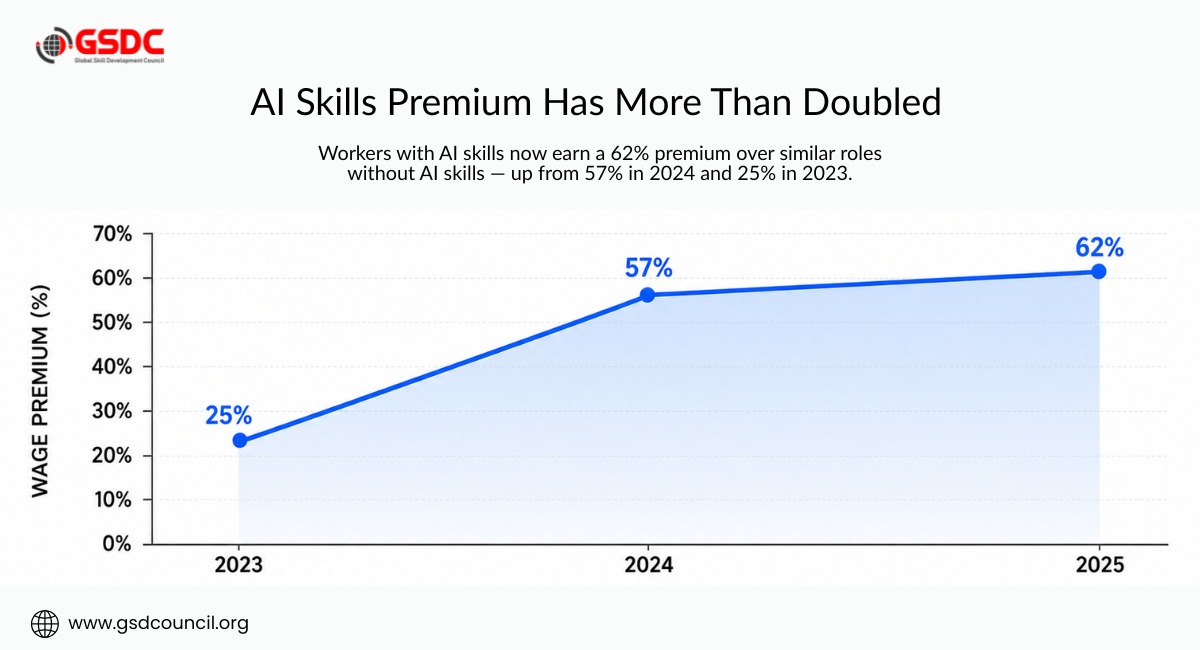
According to PwC's Global AI Jobs Barometer, which analysed over a billion job postings across six continents, workers with genuine AI skills now earn a 62% wage premium over colleagues in the same role without those skills - up from 57% the year before, and 25% the year before that. This is now the third straight annual jump PwC has recorded, which tells you this isn't a one-off spike. It's a sustained repricing of what "AI-literate" is worth to an employer.
That's the backdrop that makes certification worth taking seriously - not as a magic ticket, but as one of the fastest ways to prove that literacy to someone scanning a hundred resumes.
Before Certification: The Baseline
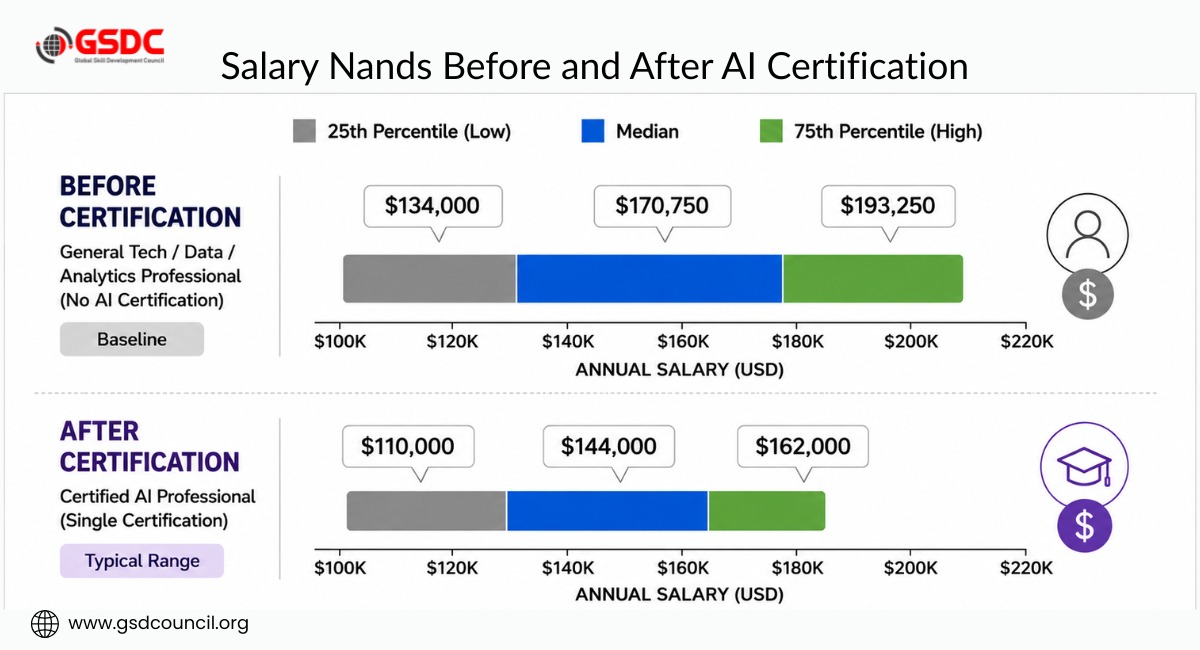
If you're a general software, data, or analytics professional without a formal AI credential, here's roughly where the market places you today: a starting median around $134,000, climbing to about $170,750 at the midpoint and $193,250 at the higher end, according to Robert Half's 2026 Salary Guide. That's a solid, capped trajectory - respectable, but nowhere near the numbers dominating LinkedIn headlines right now.
It's worth sitting with that baseline for a second, because it's the number everything else in this blog gets measured against.
After Certification: Where the Numbers Actually Move
This is the part people are really searching for - the AI certification salary jump once a recognised credential enters the picture.
Vendor-issued cloud and ML certifications are the case most training providers point to. Glassdoor's 2026 data puts the average AI/ML Engineer salary at $176,977, and industry ROI trackers report the following premiums for specific credentials:
Credential | Reported Salary Premium (job-posting based) |
~20% | |
~25% | |
Two or more vendor certifications (stacked) | 30–40% |
Here's the honest caveat, though: those figures come from analysing job postings, and other rigorous research lands lower. Foote Partners, an independent analyst firm that's tracked actual employer payroll data since 1997, surveys over 5,000 North American employers each quarter for its IT Skills and Certifications Pay Index. Their most recent release (May 2026) found the top-paying IT certifications earning premiums of 11% to 18% of base salary - with the highest of all, the Certified Artificial Intelligence Scientist credential, topping out at 18%. That's the ceiling for the best-performing certifications, not the average, and it's measurably below the 20-40% figures job-posting analyses report. Foote Partners also found top-paying non-certified skills (things like AI engineering and risk analytics, demonstrated rather than certified) earning premiums of 20% to 24% - higher than even the best certifications. Their reading of the market: employers are increasingly paying more for proof you can do the work than for proof you passed an exam.
So the honest version is this: certifications do move pay, but the size of that move depends heavily on whose data you trust and what it's measuring. Job-posting analyses tend to show larger premiums; payroll-based research tends to show smaller ones. Either way, credentials paired with real project experience consistently outperform credentials alone - a pattern that shows up in every data source we reviewed for this piece.
Zoom out to the certified workforce more broadly, and Payscale places the average certified AI professional's salary at roughly $144,000, with the typical band running $110,000 to $162,000 - a real but modest lift over the ~$134,000 non-certified baseline. That range is consistent with the more conservative payroll data above, even if it's less dramatic than the headline job-posting figures.
AI Product Manager Salary: The Clearest Before-and-After
If you want one case study that makes this whole trend concrete, it's product management. The "before" (general PM) and "after" (AI-specialised PM) roles are directly comparable, working the same seniority, in the same market.
Role (Senior Level) | Total Compensation |
Senior Product Manager (non-AI product) | ~$280,000 |
Senior AI Product Manager (real, shipped model work) | $320,000 – $520,000 |
Average AI PM base salary, industry-wide (Glassdoor) | $197,140 (up to $290,000 for top earners) |
KORE1's staffing data attributes that senior-level gap specifically to who owns real, shipped model work versus who's just added "AI" to an existing feature set. The takeaway isn't simply "AI PMs earn more" - it's that the premium tracks scope, not the title. Certification and demonstrable AI/ML fluency are what separate someone who can credibly own that scope from someone borrowing the label.
Why Generative AI Certification Is the Fastest-Growing Segment
If you've searched for generative AI certification lately, you've probably noticed the sheer volume of new programs launching. That's not accidental - it tracks a genuine shift in hiring demand, and organisations like the Global Skill Development Council (GSDC) have responded by building certification tracks aimed specifically at this newer, generative-AI-focused skill set rather than repurposing older machine learning curricula.
Understanding how generative AI works at a basic level helps explain why these systems are trained on massive datasets to generate human-like text, code, or images, then fine-tuned for specific business tasks like customer support, content, or coding assistance. Because that touches nearly every department, not just engineering, the pool of people who need to prove they can use it well has expanded far beyond software teams. Lightcast's labour-market analysis found that 51% of job postings requiring AI skills now sit outside IT and computer-science roles entirely - in marketing, finance, HR, and operations.
That's really why Certified Generative AI Professional earn more than uncertified peers even outside traditional tech departments: they're the ones who can operationalise the tool for their function, not just talk about it in a meeting. And looking at the future of generative AI at work, PwC's research linked heavier AI adoption to a 34% jump in productivity growth at the most AI-exposed companies since 2018 - which is a big part of why employers are willing to pay for proof of skill rather than assuming it.
Is AI Certification Worth It? A Grounded Answer
Here's the honest version, based on everything above.
Certification alone isn't a golden ticket. Every source we reviewed - Foote Partners, KORE1- makes the same point from different angles: a certificate without applied, demonstrable project work carries limited weight with hiring managers, and independent payroll data shows employers reward hands-on ability at least as much as the credential itself. It's the combination of certification, a portfolio, and real deployment experience that consistently moves salary numbers, not the certificate sitting alone on a resume.
But certification is still one of the fastest, cheapest proof points most people have access to. Google and AWS ML certifications now appear in roughly a third of relevant cloud ML job postings, which tells you employers are actively screening for them, not just tolerating them. And even at the more conservative end of the premium estimates - Foote Partners' 11% to 18% range for top certifications - the payback is fast: on a $120,000 base, even an 11% premium is worth over $13,000 a year, which recovers the cost of most exams and prep materials within weeks of the raise taking effect.
So: is it worth it? If you pair the right certified AI professional credential with real, hands-on project work in your field, the data says yes - just don't expect the certificate alone to do the heavy lifting. It's one input among several, not a shortcut around them.
What AI Program Is Everyone Using Right Now?
If you're wondering what AI program is everyone using to build these skills before certifying, the honest answer is: it depends on your target employer's tech stack, not on whatever's trending on social media. AWS and Google Cloud certifications currently dominate cloud ML job postings, with Azure close behind and especially strong in enterprise and government roles. The practical move is matching your certification path to whichever ecosystem your target industry actually runs on.
The Simple Before-and-After Snapshot
Stage | Typical Annual Salary Range (US) |
No AI certification (general tech/analyst role) | ~$134,000 (median band) |
Certified AI professional (single credential) | ~$110,000 – $200,000 |
Certified + stacked credentials | 11%–40% above single-cert peers, depending on source |
AI product manager (certified, AI-specialised) | ~$197,000 – $390,000 (total comp) |
Compiled from Glassdoor (2026), Payscale, Robert Half's 2026 Salary Guide, CertSelect's AI Certification ROI Report (2026), Foote Partners' IT Skills and Certifications Pay Index (2026), and KORE1's Compensation Data (2026)
Where a Structured Credential Fits In
The practical question for most professionals isn't "should I get certified," but "which certification actually matches what employers are screening for?" Bodies like the Global Skill Development Council (GSDC) have built certification tracks specifically around generative AI, rather than repackaging older ML curricula under a new name. GSDC's Certified Generative AI Professional credential focuses on the applied skill set this piece keeps returning to - understanding how generative AI works, evaluating outputs, and applying it to real business tasks, not just the theory.
As with any credential, it's one input, not a shortcut - most valuable when paired with a project or portfolio that shows the skill in use.

Final Thought
Certification isn't about collecting badges. It's about giving a hiring manager - scanning a hundred resumes for one role - an immediate, verifiable reason to trust you can do the work. In a market where the AI skills wage premium has climbed for three straight years, that verification is worth real money, even if reasonable sources disagree on exactly how much.
If you're weighing which path to take, the best AI certification for you isn't the one with the flashiest name. It's the one that matches the tools your target industry already runs on, backed by a project you can actually show.

Related Certifications
Frequently Asked Questions
Yes, with a caveat. The data shows certified AI professionals consistently out-earn non-certified peers, but the size of that gap depends on whose research you trust - job-posting analyses show larger premiums than payroll-based studies. Certification pays off most when it's paired with real, demonstrable project work, not held on its own.
Estimates range from roughly 11% to 40%, depending on the credential and the data source. Vendor-issued cloud certifications (AWS, Google Cloud) sit at the higher end of job-posting estimates, while independent payroll research like Foote Partners' index shows more conservative, single-digit-to-teens gains for top-performing certifications.
There's no single "best" credential - it depends on your target industry's tech stack. AWS Certified Machine Learning – Specialty and Google Cloud Professional ML Engineer dominate cloud ML job postings, while AI governance certifications like the AIGP are gaining ground fast due to regulatory deadlines such as the EU AI Act.
On average, yes. Certified AI professionals report salaries in the $110,000–$200,000 range, compared to a roughly $134,000 median for non-certified tech and analytics professionals. The gap widens further for professionals holding multiple, stacked credentials.
Industry data puts it around $197,000 in average base salary, with total compensation reaching $305,000 at the median and up to $390,000 at the higher percentiles for senior, AI-specialised roles. Standard (non-AI) senior product managers earn meaningfully less, often around $280,000 in total comp.
Generative AI systems are trained on massive datasets to generate human-like text, code, or images, then fine-tuned for specific tasks like customer support, content creation, or coding. Understanding this basic mechanism is increasingly expected across departments, not just engineering - which is part of why demand for AI-literate professionals has spread so widely.
Generative AI-skilled professionals earn a documented wage premium over uncertified colleagues in the same role, and that premium now extends well beyond IT - over half of job postings requiring AI skills sit outside traditional computer-science roles, spanning marketing, finance, HR, and operations.
Adoption is accelerating, not slowing. Research from PwC links heavier generative AI use to significantly higher productivity growth at the most AI-exposed companies, and the wage premium for AI-skilled workers has risen for three consecutive years, suggesting employers expect this trend to continue.
Generally, yes. Generative AI certifications focus specifically on large language models, prompt engineering, and generative tools, while broader AI/ML certifications (like AWS or Google Cloud credentials) cover machine learning engineering more widely. Many professionals now pursue both, since the skill sets increasingly overlap on the job.
There's no single universal answer - it depends on your target employer's ecosystem. AWS and Google Cloud tools currently dominate cloud ML job postings, with Microsoft Azure close behind, especially in enterprise and government roles. The most effective approach is matching your learning path to whichever platform your target industry actually runs on, rather than following whatever tool is trending.
Stay up-to-date with the latest news, trends, and resources in GSDC
If you like this read then make sure to check out our previous blogs: Cracking Onboarding Challenges: Fresher Success Unveiled
Not sure which certification to pursue? Our advisors will help you decide!