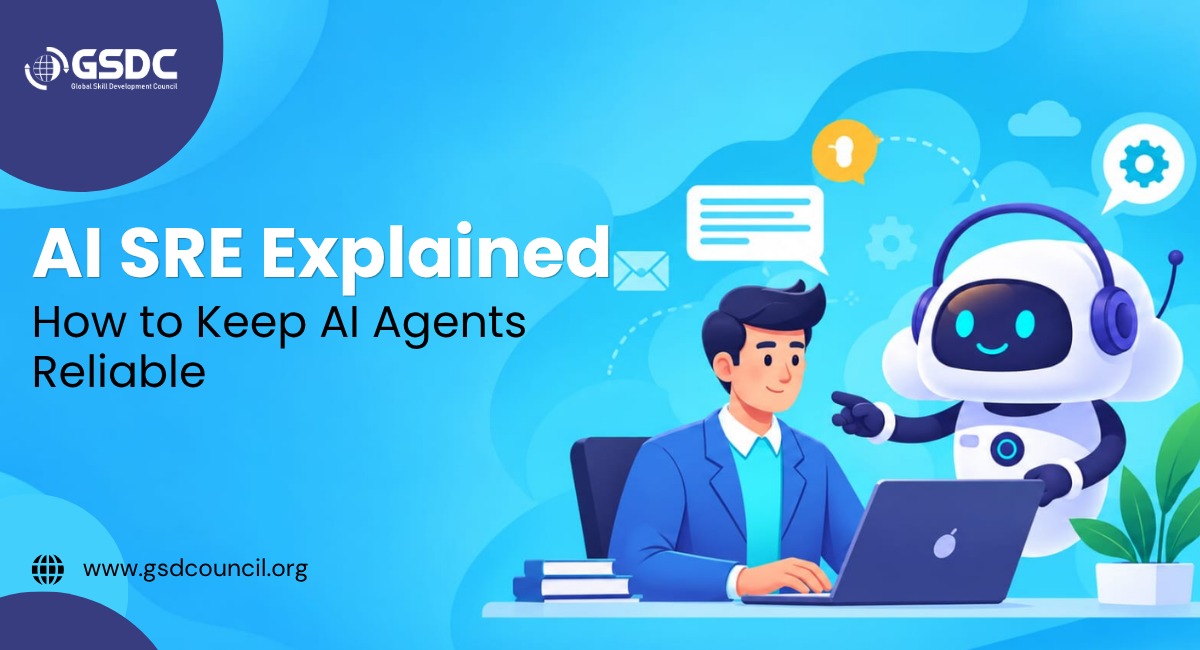
AI SRE Explained: How to Keep AI Agents Reliable
Written by Emily Hilton
- What Is SRE, Really?
- Why AI Agents Broke the Old Playbook
- Meet the AI SRE: A New Reliability Focus for AI Systems
- SRE Principles That Now Apply to AI Agents
- AI Agent Monitoring Tools and SRE Tools Worth Knowing
- SRE Skills You'll Need for This New World
- How to Become a Site Reliability Engineer (With an AI Focus)
- A Simple SRE Roadmap
- Is an SRE Certification Worth It?
- The Bottom Line
For years, a site reliability engineer's job was simple to describe, even if it was never simple to do: keep the website up, keep the app fast, and get paged when something breaks. That job hasn't gone away. It has just picked up a strange new roommate. Companies are now running AI agents that book meetings, approve refunds, write code, and talk to customers without a human in the loop, and somebody has to make sure those agents behave. That somebody, more often than not, is the SRE team.
This shift is not a side trend. Gartner has predicted that by 2027, 40% of enterprises will scale back or shut down autonomous AI agents because governance problems only surface after something has already gone wrong in production. In plain terms, a lot of companies are finding out their AI agents were never truly reliable, and they're finding out the hard way. That's exactly the gap this new reliability focus, call it AI SRE, exists to close.
In this blog, we'll break down what an AI SRE actually does, how it's different from traditional SRE work, the principles, tools, and skills involved, and how you can build a career around it. No jargon overload, just a clear, practical guide.
What Is SRE, Really?
Before we get into the AI part, let's answer the basic question: what is SRE?
Site Reliability Engineering (SRE) is a discipline that applies software engineering practices to IT operations. Instead of manually babysitting servers, SREs write code and build systems that keep applications available, fast, and stable, even as they scale. The idea started at Google and has since become standard practice at almost every tech-driven company.
A site reliability engineer typically owns things like:
- Uptime and system availability
- Incident response and root cause analysis
- Automation of repetitive operational tasks
- Capacity planning and performance tuning
- Building monitoring and alerting systems
Simply put, an SRE's job is to make sure that when something breaks, it breaks quietly, gets fixed fast, and doesn't happen the same way twice.
Why AI Agents Broke the Old Playbook
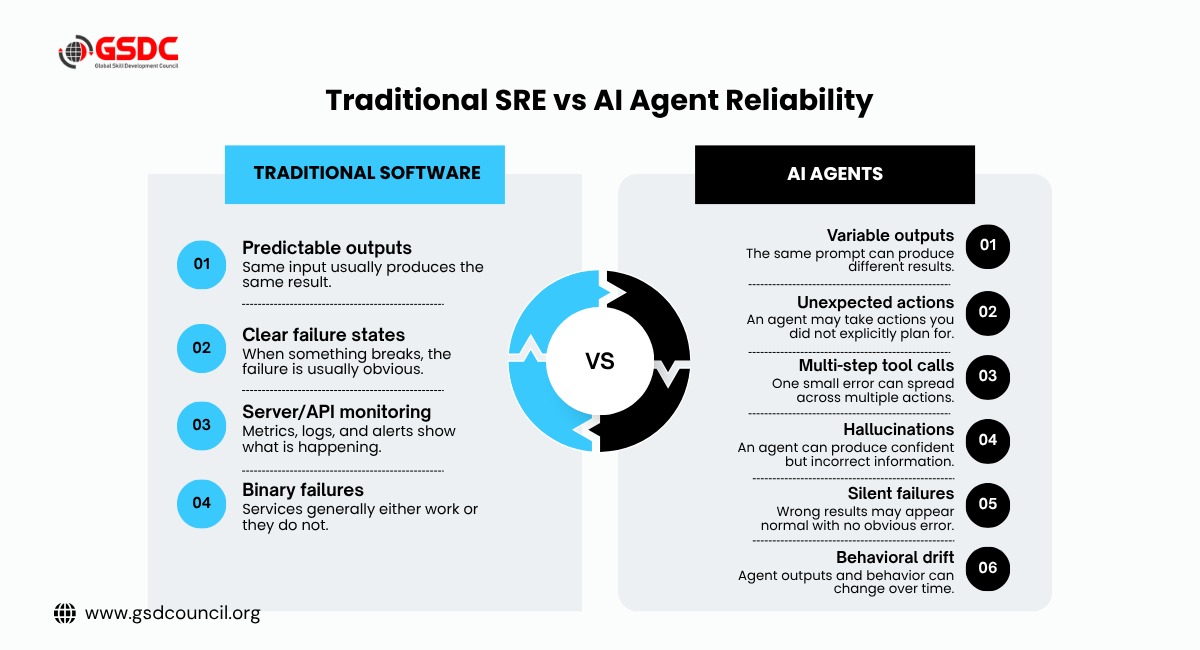
Traditional software is predictable. Give it the same input, and it gives you the same output every time. If a service goes down, you know exactly where to look.
AI agents don't play by those rules.
An AI agent can:
- Give a different answer to the same prompt on different days
- Take an unexpected action because it "decided" to
- Chain multiple tool calls together, so one small error snowballs into ten
- Fail silently, producing a confident but wrong result instead of an obvious crash
This is why AI reliability has become its own conversation. A traditional outage is loud. A server goes down, alerts fire, everyone knows. An AI agent quietly giving customers wrong refund amounts for three days straight is a very different kind of failure, and it's much harder to catch without the right systems in place.
This is exactly the pattern Gartner flagged when it warned that agent failures are usually spotted only after they've already caused damage in production, not before. That single sentence sums up why classic monitoring, built for servers and APIs, isn't enough anymore.
Meet the AI SRE: A New Reliability Focus for AI Systems
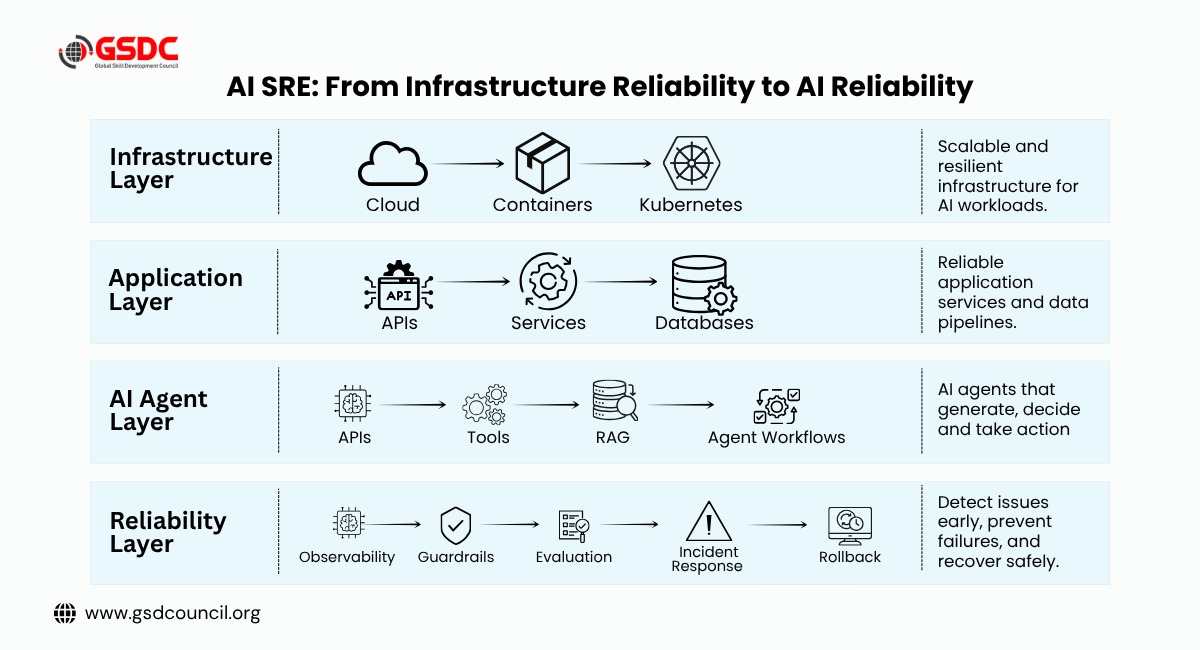
This isn't necessarily a brand new job title carved out of nowhere. In most companies right now, this work shows up under different names: SRE, AI Platform Engineer, MLOps Engineer, ML Platform Engineer, or AI Infrastructure Engineer. The title varies, but the underlying shift is the same: reliability engineering is evolving to cover AI systems, not just servers and services.
Think of it this way. Traditional SRE asks one question: is the system working? AI-focused SRE asks a second, harder question on top of that: is the system working, and can we trust what it's doing?
An AI SRE, whatever it ends up being called on the org chart, is a site reliability engineer whose scope now includes the behavior, outputs, and decision-making of AI agents, not just the infrastructure they run on. You're not only watching CPU usage and response times, you're also watching whether the AI agent is hallucinating, looping, ignoring guardrails, or quietly drifting away from its intended behavior.
This kind of role typically handles:
- Monitoring AI agent outputs for accuracy, drift, and hallucination rates
- Setting up guardrails so agents can't take irreversible actions without checks
- Building rollback systems for when an agent misbehaves
- Running incident response for AI-specific failures, not just server crashes
- Working closely with ML engineers to fix root causes, not just symptoms
It's the same reliability mindset the industry has trusted for over a decade, just pointed at a much less predictable target. And the pressure behind it is real: Gartner predicts that 40% of enterprise applications will be integrated with task-specific AI agents by the end of 2026, up from less than 5% in 2025. As that adoption curve climbs, someone has to be responsible for whether those agents can actually be trusted in production, and that's the gap this reliability focus exists to close.
SRE Principles That Now Apply to AI Agents
The classic SRE principles still hold up, they've just been stretched to cover a new kind of system. Here's how the old playbook maps onto AI agents:
Classic SRE Principle | How It Applies to AI Agents |
Service Level Objectives (SLOs) | Track accuracy, response quality, latency, and other AI-specific reliability targets |
Error budgets | Define acceptable levels of incorrect or off-task behavior |
Blameless postmortems | Analyze AI incidents to improve the system rather than blame individuals |
Automation over manual fixes | Automatically flag, restrict, or pause risky agent behavior |
Toil reduction | Automate repetitive checks such as output validation |
Observability | Track tool calls, traces, outputs, latency, and decision paths |
The mindset hasn't changed. What counts as "reliable" has just gotten a lot more nuanced. It's worth noting that these six principles aren't something we're inventing here, they're the same core framework organizations like the Global Skill Development Council (GSDC) teach in their SRE curriculum. What's shifting is simply where and how each principle gets applied.
AI Agent Monitoring Tools and SRE Tools Worth Knowing
If you're aiming for this career path, you'll need to get comfortable with two overlapping toolkits: classic SRE tools and newer AI agent monitoring tools.
Traditional SRE tools:
- Prometheus and Grafana for metrics and dashboards
- PagerDuty or Opsgenie for incident alerting
- Docker and Kubernetes for containers and orchestration
- Terraform for infrastructure as code
- Datadog or New Relic for full-stack observability
Emerging AI agent monitoring tools:
- LLM observability platforms that trace every step an agent takes, not just the final output
- Guardrail frameworks that block risky or out-of-policy actions before they execute
- Hallucination and drift detection tools that flag when an agent's answers stop matching ground truth
- Agent replay tools that let you re-run a failed session step by step to find the exact point it went wrong
- Evaluation pipelines that continuously test agents against known-good answers, similar to regression testing for code
The direction is clear: reliability teams are no longer just watching servers, they're watching decisions. If you're building this toolkit from scratch, a structured starting point like the SRE Foundation Certification can help, since it groups these tools around the principles they support instead of leaving you to figure out which ones matter on your own.
SRE Skills You'll Need for This New World
The SRE skills that mattered five years ago are still the foundation. You'll just need to add a layer on top.
Core skills that never go out of style:
- Linux and networking fundamentals
- Scripting or programming (Python and Go are common choices)
- Cloud platforms like AWS, Azure, or GCP
- Incident response and on-call discipline
- Monitoring, logging, and alerting setup
Newer skills that are becoming non-negotiable:
- Basic understanding of how LLMs and AI agents actually work
- Prompt and output evaluation methods
- Experience with vector databases and retrieval systems, since many agents rely on them
- Comfort reading agent execution traces to debug non-code failures
- An eye for probabilistic thinking, since AI systems can degrade gradually rather than simply work or fail
You don't need to become a machine learning researcher. You need to become someone who can debug a system that doesn't always behave the same way twice.
How to Become a Site Reliability Engineer (With an AI Focus)
If you're wondering how to become a site reliability engineer with this AI-focused edge, here's a practical path:
- Build the fundamentals first.
Learn Linux, networking basics, and at least one scripting language. This is non-negotiable groundwork.
- Get hands-on with cloud and containers.
Spin up your own projects on AWS or GCP, and learn Docker and Kubernetes by actually deploying something.
- Learn observability tools.
Set up Prometheus, Grafana, or Datadog on a personal project so you understand monitoring from the ground up.
- Work on an on-call mindset.
Practice writing runbooks and postmortems, even for your own small projects. It builds the habit early.
- Add AI fluency.
Understand how LLMs generate output, what hallucination actually means technically, and how agent frameworks chain tasks together.
- Experiment with an AI agent monitoring tool.
Even a free-tier LLM observability tool will teach you how agent failures look different from server failures.
- Apply for hybrid roles.
Look for SRE, platform engineering, or MLOps roles at companies that are actively deploying AI agents. That's where this skill set gets used daily.
A Simple SRE Roadmap
If you like a visual checkpoint system, here's a condensed SRE roadmap you can follow stage by stage:
Stage | Focus | Typical Timeframe |
Beginner | Linux, networking, scripting, Git | 3 to 6 months |
Intermediate | Cloud platforms, containers, CI/CD | 6 to 12 months |
Advanced | Observability, incident management, automation | 12 to 18 months |
Specialization | AI agent monitoring, LLM observability, agent guardrails | Ongoing |
Reliability careers aren't linear sprints, they're layered. Each stage builds on the one before it, and the AI layer is simply the newest addition on top of a solid base.
Is an SRE Certification Worth It?
An SRE certification can be a helpful signal, especially if you're switching careers or don't yet have production experience to point to. It won't replace hands-on skill, but it gives your learning structure and adds credibility when you don't have direct SRE job history.
The Global Skill Development Council (GSDC), a vendor-neutral certification body, offers one such credential through its SRE Foundation Certification, covering core principles like SLOs, error budgets, monitoring, and incident management without tying you to one vendor's toolset. That fits well here, since AI-focused reliability work spans cloud platforms, observability stacks, and AI monitoring tools rather than a single product ecosystem.
Certifications work best as a supplement, not a substitute. Employers hiring for AI-focused reliability roles usually care more about whether you can debug a real incident than whether you can pass a multiple-choice exam. Pair any certification with real projects, even small ones, and you'll stand out far more.
The Bottom Line
Reliability engineering used to mean keeping servers up. Now it means keeping decisions trustworthy. AI agents are moving from experiments to production systems fast, and the companies deploying them are learning, sometimes painfully, that "it works in a demo" is not the same as "it's reliable at scale."
AI SRE isn't a completely new profession showing up out of nowhere. It's the natural next chapter of a discipline that's been asking the same core question for over a decade, just pointed at systems that don't behave the same way twice. Whether you're a working SRE looking to future-proof your skills, or someone plotting a path into the field, the opportunity is real, and it's growing right now.
Ready to build your SRE skills for the AI era? Explore the Global Skill Development Council's SRE and AI-focused certification programs to develop the reliability, cloud, observability, and AI skills needed to work with modern production systems, from the fundamentals to the AI-specific skills employers are hiring for today.

Related Certifications
Frequently Asked Questions
SRE, or Site Reliability Engineering, is a discipline that uses software engineering practices to keep systems available, fast, and stable. Instead of manually fixing things when they break, SREs build automation and monitoring so problems get caught early and fixed quickly.
An AI SRE still owns uptime and incident response, but the scope extends to the AI agent's behavior too. That means watching for hallucinations, output drift, and agents taking actions outside their intended boundaries, not just watching servers and APIs.
Not always by that exact name. Right now, this work is often listed under titles like SRE, AI Platform Engineer, MLOps Engineer, or AI Infrastructure Engineer. The responsibilities are what matter most, so it helps to read job descriptions closely rather than search for the exact title.
No. You need to understand how AI agents behave and fail well enough to debug them, but you don't need to build or train models yourself. A strong SRE foundation plus some AI fluency covers most of what the role needs.
It can be, especially if you're switching careers or don't have production experience yet. A certification gives your learning structure and adds credibility on a resume, but it works best alongside real, hands-on projects rather than on its own.
Most people spend around 6 to 12 months on the fundamentals (Linux, networking, cloud, scripting) before they're ready for an entry-level role, then continue building observability and automation skills on the job. Adding AI-specific skills is usually a layer on top, built gradually while working.
Stay up-to-date with the latest news, trends, and resources in GSDC
If you like this read then make sure to check out our previous blogs: Cracking Onboarding Challenges: Fresher Success Unveiled
Not sure which certification to pursue? Our advisors will help you decide!