7 Myths About Agentic AI Every Beginner Should Unlearn
Written by Emily Hilton
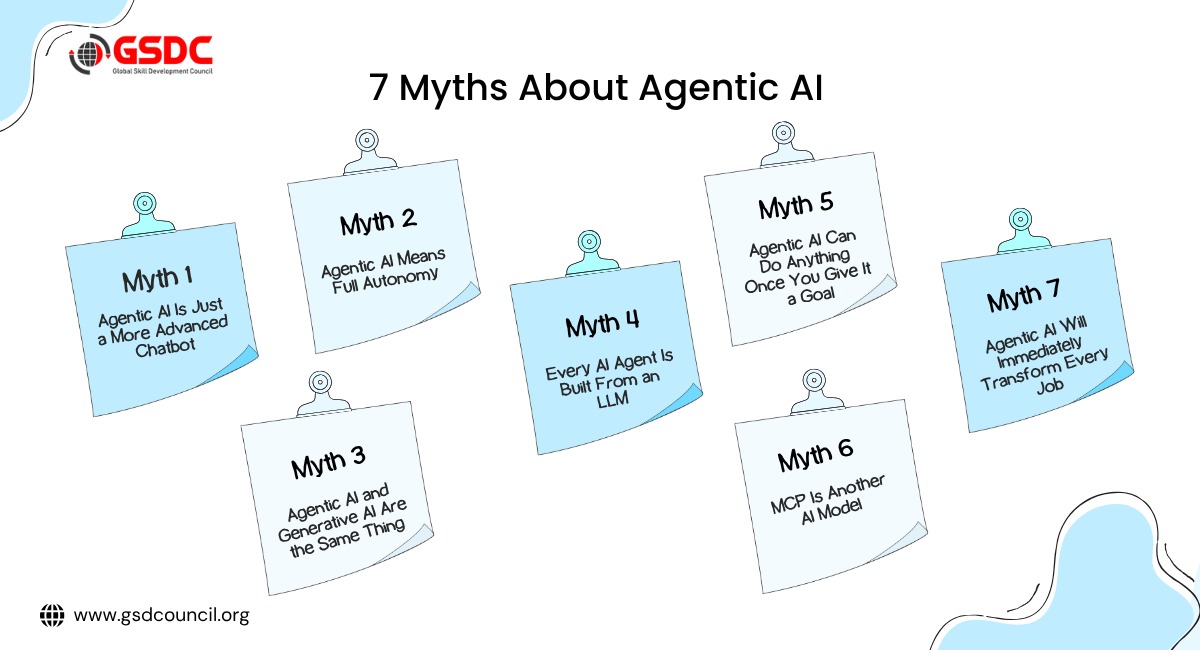
- Myth 1: Agentic AI Is Just a More Advanced Chatbot
- Myth 2: Agentic AI Means Full Autonomy
- Myth 3: Agentic AI and Generative AI Are the Same Thing
- Myth 4: Every AI Agent Is Built From an LLM
- Myth 5: Agentic AI Can Do Anything Once You Give It a Goal
- Myth 6: MCP Is Another AI Model
- Myth 7: Agentic AI Will Immediately Transform Every Job
- What Is Agentic AI in Simple Terms?
- Take Your Agentic AI Knowledge Further with Professional Certification
- What Is an Agentic AI Example?
- Final Thought
Agentic AI is quickly becoming one of the most discussed developments in artificial intelligence. But as the term becomes more popular, it is also becoming harder to separate what agentic AI actually is from what people assume it is.
Some descriptions make agentic AI sound like a fully autonomous digital employee that can think, decide, and do everything on its own. Others use “agentic AI” for almost any AI system that can call a tool.
The reality is more nuanced.
Current definitions generally describe agentic AI as systems that can interpret goals, plan and sequence actions, use tools, respond to feedback, and operate with varying degrees of autonomy. Stanford HAI, for example, distinguishes agentic systems from purely reactive chatbots by their ability to pursue ongoing tasks and adapt based on feedback.
So, what is agentic AI really? And which common assumptions should beginners stop believing?
Let’s break down seven of the biggest myths.
Myth 1: Agentic AI Is Just a More Advanced Chatbot
This is probably the easiest misconception to make.
You ask a chatbot a question, it generates an answer, and the interaction usually ends there. An agentic system can go further by pursuing a goal through multiple steps.
For example, imagine asking an AI:
“Find why our customer support response time increased last month and prepare a report.”
A conventional chatbot might explain possible reasons based on the information provided to it.
An agentic system could potentially retrieve support data, analyze response times, identify patterns, investigate relevant records, create a report, and return the findings depending on the tools and permissions available to it.
That difference helps explain what is agentic AI and how it works. An agent typically operates through a loop involving planning, tool use, observation, and adjustment rather than simply generating one response. Anthropic describes this as a self-directed process in which an agent can plan, act, observe results, and repeat until the task is completed or human input is required.
However, not every chatbot needs to become an agent. Sometimes a simple question-and-answer interaction is exactly what users need.
The myth to unlearn: Agentic AI is not simply “ChatGPT, but smarter.” It represents a different way of structuring AI-driven task execution.
Myth 2: Agentic AI Means Full Autonomy
The word agentic can make it sound as though AI systems operate completely independently.
That is not necessarily the case.
Agentic systems can operate across a spectrum of autonomy. One system might recommend an action and wait for approval. Another might execute routine actions automatically while requiring human approval for sensitive decisions. A more autonomous system may be allowed to complete an entire workflow within predefined boundaries.
This is particularly important in business environments.
Imagine an AI agent monitoring inventory. It could detect that stock is running low, identify the appropriate supplier, prepare a purchase order, and request human approval before placing the order.
The agent is autonomous in some parts of the workflow, but not all of it.
Current research and industry guidance also emphasize maintaining human control, transparency, security, and appropriate safeguards as agents take on more consequential tasks.
So, when someone asks an agentic AI what it is, the answer should not simply be “AI that works without humans.”
A better explanation is:
Agentic AI enables AI systems to pursue defined goals and take actions with a degree of autonomy determined by their design, permissions, and safeguards.
Myth 3: Agentic AI and Generative AI Are the Same Thing
This is where many beginners get confused.
If you are wondering what is agentic AI vs generative AI, the simplest distinction is this:
Generative AI primarily creates. Agentic AI primarily acts toward a goal.
Generative AI can produce text, images, code, audio, summaries, and other content. Its core capability is generating outputs based on learned patterns and the context provided.
Agentic AI can use generative models as part of a larger system. But it can also include tools, memory, planning mechanisms, APIs, databases, workflows, and other components.
Think of it this way:
Generative AI:
“Write an email to the customer.”
Agentic AI:
“Identify customers whose orders are delayed, check the latest order information, determine which customers need an update, draft appropriate messages, and send them if the workflow permits.”
That is why the question “what is gen AI and agentic AI?” does not necessarily have an either-or answer. Generative AI can be one of the technologies powering an agentic system.
IBM similarly describes agents as a progression beyond models that only generate content, with agents using tools and interactions with external systems to complete tasks.
Myth 4: Every AI Agent Is Built From an LLM
Large language models are central to many modern agentic systems, but they are not the entire foundation of agentic AI.
An agentic AI foundation can include several components:
- A foundation model or reasoning model
- Tools and APIs
- Memory
- Planning and orchestration
- Data sources
- Retrieval systems
- Security and permission controls
- Monitoring and evaluation
- Human approval mechanisms
The model may provide reasoning or language capabilities, while other components allow the system to interact with its environment.
For example, an AI agent responsible for IT operations might use a language model to interpret an incident, a monitoring platform to retrieve system information, a database to check previous incidents, and approved tools to restart a service.
The agent therefore isn't simply “the model.”
This distinction matters because an effective agentic system depends on the architecture around the model, not just the model itself. IBM's agent architecture guidance similarly describes orchestration, agents, tools, and external systems as components of an agentic system.
Myth 5: Agentic AI Can Do Anything Once You Give It a Goal
This sounds exciting but it is one of the most dangerous assumptions to make.
Giving an AI agent a goal does not magically give it unlimited knowledge, access, judgment, or authority.
An agent can only work with the tools, data, permissions, context, and operating boundaries available to it.
Suppose you tell an agent:
“Reduce our monthly operating costs.”
That objective is far too broad for an uncontrolled autonomous system.
Should it cancel software subscriptions? Change suppliers? Reduce staffing? Delay maintenance? None of these actions should be taken simply because they could reduce costs.
A production agent needs clearly defined objectives, constraints, permissions, escalation rules, and evaluation criteria.
This becomes even more important because agentic systems can interact with external tools and environments. Recent research highlights security risks associated with tool use, planning, memory, and autonomous execution.
In other words, autonomy without boundaries is not the goal.
Useful agentic AI is about controlled autonomy.
Myth 6: MCP Is Another AI Model
If you have started exploring agentic AI, you may have encountered another term: MCP.
So, what is MCP in agentic AI?
MCP stands for Model Context Protocol. It is a protocol designed to standardize how AI applications connect with external tools and sources of context.
It is not an AI model.
Think of MCP more like a common communication layer. An MCP-based system can expose resources and tools that an AI application can interact with through a standardized approach.
For example, an agent might need access to:
- A database
- Company documents
- A project-management system
- A code repository
- An external API
MCP can provide a standardized way for AI applications to interact with these capabilities. The MCP specification describes primitives including prompts, resources, and tools, while the protocol's architecture separates clients, hosts, and servers.
And MCP is evolving quickly. The official July 2026 specification introduced changes including a stateless protocol core, extensions, improved authorization, and support for long-running tasks.
So don't think:
MCP = AI agent.
Instead:
MCP can help an AI application connect to the tools and context an agent needs.
Myth 7: Agentic AI Will Immediately Transform Every Job
This is perhaps the most exaggerated assumption surrounding agentic AI.
The question “what is agentic AI and how will it change work?” is more useful when we stop thinking in terms of entire jobs disappearing overnight.
Most work consists of many different tasks.
An agent may be particularly useful for repetitive, multi-step, information-heavy activities while humans remain responsible for judgment, relationships, accountability, strategy, and decisions involving significant consequences.
For example, in marketing, an agent could research competitors, organize campaign data, identify trends, prepare drafts, and generate reports. A marketer could still define the strategy, review outputs, make creative decisions, and approve campaigns.
Similarly, in software development, an agent might investigate an issue, modify code, run tests, and prepare a proposed change. Human developers may still review and approve the final implementation.
The practical question is therefore not:
“Will AI replace this entire job?”
A better question is:
“Which parts of this workflow can AI safely perform, and where should humans remain involved?”
That shift from job replacement to task transformation makes the conversation about agentic AI much more useful.
What Is Agentic AI in Simple Terms?
If all of this still sounds complicated, here's the simplest explanation.
What is agentic AI in simple terms?
Imagine you have an extremely capable digital assistant.
Instead of asking it one question at a time, you give it a goal.
It can then:
Understand the goal → plan the work → use tools → take actions → check the results → adjust its approach → complete the task or ask for help.
That is the basic idea behind agentic AI.
The exact level of autonomy depends on how the system has been designed.
And that leads to an important point: there is no single universal architecture or definition that every organization uses. The field is still developing, and the term “agent” is sometimes applied to systems ranging from predefined workflows with LLMs to systems where models dynamically direct their own processes.
Take Your Agentic AI Knowledge Further with Professional Certification
GSDC’s Agentic AI Professional Certification helps professionals deepen their understanding of AI agents, agentic architectures, autonomous workflows, tools, integrations, governance, security, and responsible implementation.
Agentic AI Professional Certification provides practical knowledge for applying agentic AI in real-world environments and is valuable for AI professionals, developers, technology leaders, consultants, and business professionals seeking to build expertise in this rapidly evolving field.

What Is an Agentic AI Example?
Consider a customer-service agent.
A traditional generative AI system might answer:
“Your order is currently delayed.”
An agentic system could potentially:
- Retrieve the customer's order details.
- Check the shipment status.
- Identify the reason for the delay.
- Review the company's approved resolution policy.
- Decide whether the customer qualifies for a refund or replacement.
- Prepare the response.
- Escalate the case if it falls outside its authority.
The important part isn't that the AI generates a response.
It is that the system can work toward completing a task using information and tools.
Final Thought
Agentic AI is moving AI beyond content generation toward systems that can understand goals, plan tasks, use tools, and take action. Understanding what is agentic AI requires looking beyond the hype and focusing on how these systems actually work. From the agentic AI foundation to tools such as MCP, beginners should understand capabilities, limitations, permissions, and human oversight. The difference between gen AI and agentic AI is also important: generative AI creates, while agentic systems can use AI capabilities to pursue defined goals. As adoption grows, understanding what is agentic AI and how it will change work will become increasingly valuable.

Related Certifications
Frequently Asked Questions
Agentic AI refers to AI systems that can pursue a goal by planning tasks, using tools, taking actions, and adapting based on results.
Generative AI primarily creates content such as text, images, or code. Agentic AI can use generative models as part of a system that plans and executes multi-step tasks.
A customer-service agent that retrieves order information, checks policies, determines an appropriate action, drafts a response, and escalates unusual cases is one example.
MCP, or Model Context Protocol, is an open protocol that helps AI applications connect with external tools, resources, and context in a standardized way.
Agentic AI typically works through a cycle of understanding a goal, planning, using available tools, taking action, observing results, and adjusting its approach when necessary.
Stay up-to-date with the latest news, trends, and resources in GSDC
If you like this read then make sure to check out our previous blogs: Cracking Onboarding Challenges: Fresher Success Unveiled
Not sure which certification to pursue? Our advisors will help you decide!