How to Build an AI-Driven Learning Ecosystem for Enterprise Workforce Development
Written by Matthew Hale
- 1. Identify Workforce Skills and Learning Gaps
- 2. Connect Learning Platforms and Workforce Data
- 3. Use AI to Create Personalised Learning Paths
- 4. Add AI Assistants and Coaching
- 5. Connect Learning with Workforce Upskilling
- 6. Measure Learning Outcomes with Learning Analytics
- 7. Practical Example: Building an AI-Driven Learning Ecosystem for Enterprise Upskilling
- Develop Your Generative AI Knowledge with GSDC Certification
- 8. Conclusion
Today, organisations are dealing with rapidly changing job requirements, new technologies, and increasing demand for specialised workforce skills. Employees need to continuously learn new tools, develop relevant capabilities, and adapt to changing responsibilities. However, traditional corporate training often relies on standardised courses and separate learning platforms, making it difficult for enterprises to address individual skill gaps and track employee development effectively.
To manage these challenges, enterprises can use AI in Learning and Development to build a connected learning ecosystem. By combining employee skill data, learning platforms, AI-powered recommendations, virtual assistants, and learning analytics, organisations can deliver personalised training and support continuous workforce upskilling.
In this blog, we will explore how to build an AI-driven learning ecosystem for enterprise workforce development, including how to identify skill gaps, connect learning platforms, create personalized learning paths, add AI assistants and coaching, and measure learning outcomes through analytics.
1. Identify Workforce Skills and Learning Gaps
The first step in building a learning ecosystem is understanding the existing capabilities of the workforce. Enterprises need to identify what employees already know, which skills require improvement, and what capabilities will be needed for future business requirements.
Without accurate skill information, AI systems may recommend training that does not match an employee's actual development needs.
Organisations can start by:
- Collecting employee skill profiles: Gather information about job roles, technical skills, experience, certifications, and completed training programmes.
- Conducting skill assessments: Use assessments, practical exercises, and performance evaluations to understand employee capabilities.
- Identifying skill gaps: Compare current employee competencies with the requirements of their existing or future roles.
- Creating a skills inventory: Maintain a centralised record of employee capabilities that can be used to guide learning recommendations.
AI-powered skills intelligence platforms can analyse employee profiles and assessment results to identify recurring capability gaps across departments. For example, an organisation preparing to adopt cloud infrastructure may identify that its IT teams need additional training in cloud security, architecture, and deployment.
This information provides the foundation for designing targeted workforce development programmes.
2. Connect Learning Platforms and Workforce Data
An effective corporate learning ecosystem requires different platforms to exchange information. Employee profiles may be stored in an HR Information System (HRIS), training programmes may be managed through a Learning Management System (LMS), and personalised learning resources may be delivered through a Learning Experience Platform (LXP).
When these systems operate independently, employees and L&D teams may not have a complete view of learning activities and skill development.
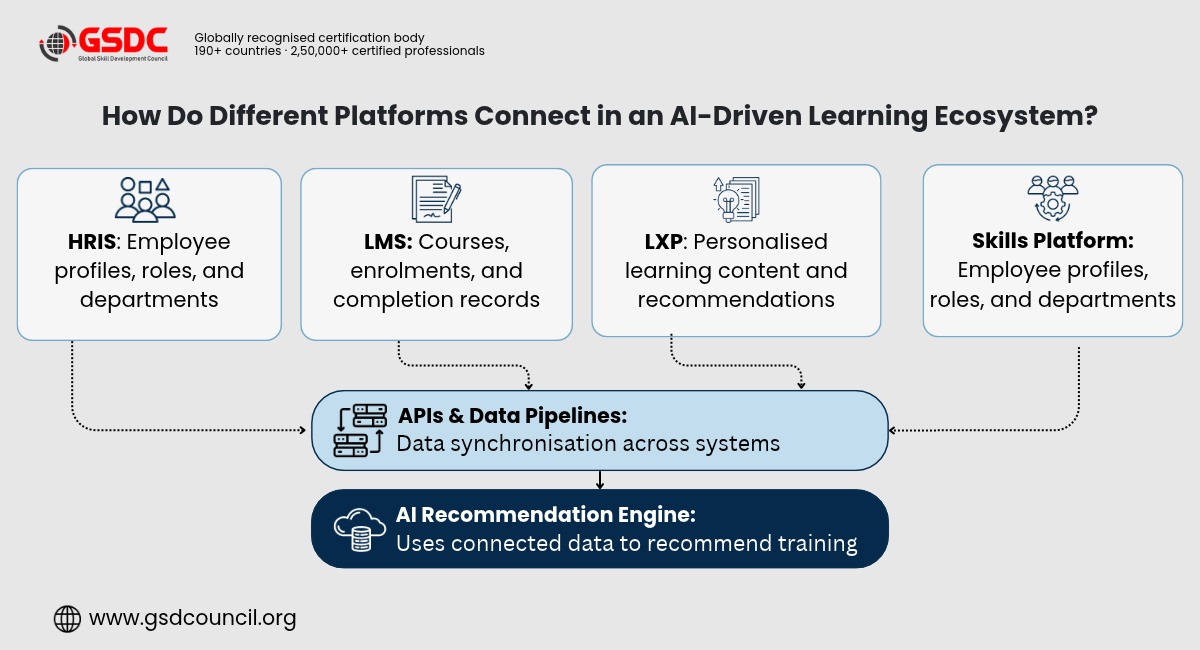
Enterprises should connect these platforms through integrations.
Important components include:
- Learning Management System (LMS): Manages training courses, assessments, enrolments, completion records, and certifications.
- Learning Experience Platform (LXP): Provides personalised learning content and recommendations based on employee interests and development requirements.
- Human Resource Information System (HRIS): Stores employee information, job roles, departments, and organisational records.
- Skills Management Platform: Maintains competency frameworks, employee skill profiles, and identified skill gaps.
- Learning Analytics Platform: Collects and analyses information about employee participation, assessment results, and learning progress.
APIs allow these systems to exchange information. For example, when an employee changes roles in the HRIS, the updated job information can be shared with the learning platform. The AI recommendation engine can then use the new role requirements to suggest relevant training.
Data pipelines can also synchronise information from multiple platforms into a centralised learning data layer. This gives AI systems access to consistent employee and learning information while maintaining appropriate access permissions.
3. Use AI to Create Personalised Learning Paths
Once workforce and learning data are connected, enterprises can use AI to recommend training based on individual employee requirements.
Traditional training programmes often assign the same courses to employees within a department. However, employees working in similar roles may have different experience levels, existing capabilities, and development needs.
AI learning and development systems can use employee profiles and learning history to create more relevant learning paths.
The process involves:
- Analysing employee profiles: The AI system reviews job roles, existing skills, completed courses, and assessment results.
- Matching skill gaps with learning resources: The recommendation engine compares identified gaps with available courses, training materials, and practical exercises.
- Generating personalised recommendations: Employees receive learning suggestions based on their development requirements.
- Adjusting learning paths: Recommendations are updated as employees complete training and demonstrate new capabilities.
Recommendation engines can use content-based filtering to match learning resources with employee skills and role requirements. Collaborative filtering can also identify learning resources that may be relevant based on patterns across similar learners.
Generative AI can further support this process by creating role-specific learning plans, summarising training materials, and suggesting additional practice activities.
For example, a software engineer moving into a cloud engineering role may receive a learning path covering cloud architecture, infrastructure management, security, and deployment. Another employee with existing cloud experience may receive more advanced training instead of repeating introductory courses.
4. Add AI Assistants and Coaching
Personalised learning paths help employees decide what to learn, but they may still need support while completing training. AI assistants and coaching systems can provide guidance throughout the learning process.
An AI learning assistant can interact with employees through a chat interface and answer questions related to training materials, workplace concepts, and assigned courses.
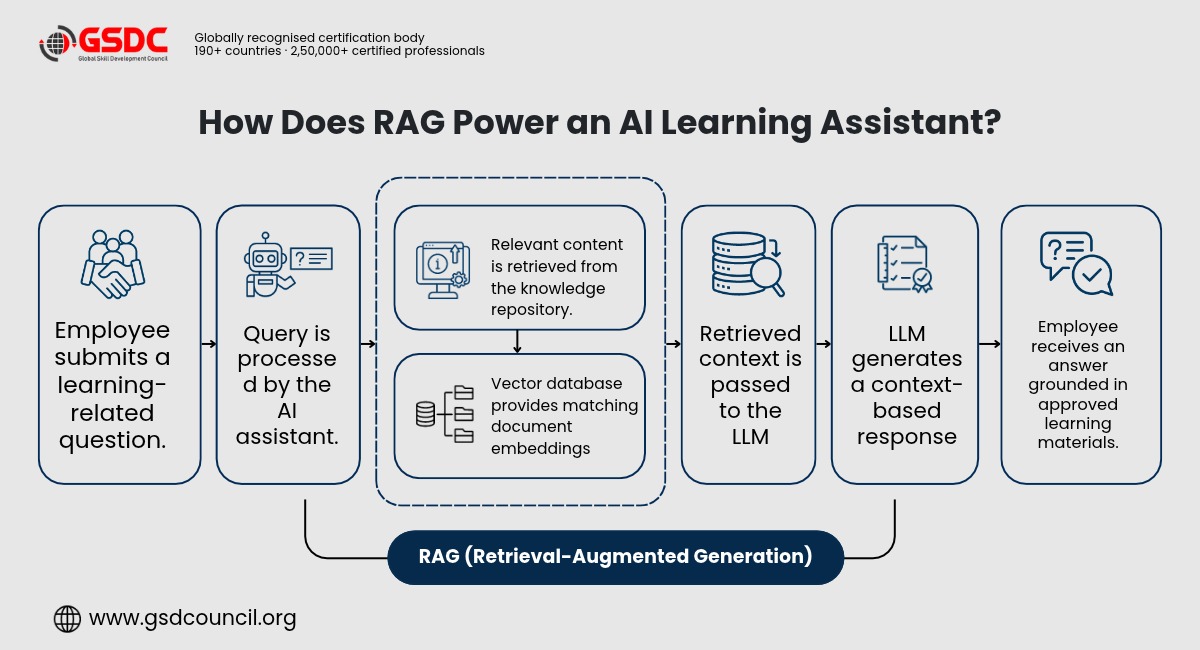
A practical implementation can use Retrieval-Augmented Generation (RAG).
The workflow involves:
- Storing approved training documents, course materials, internal guides, and learning resources in a searchable knowledge repository.
- Converting these documents into embeddings and storing them in a vector database.
- Receiving an employee's question through the AI assistant.
- Retrieving relevant information from the knowledge repository.
- Providing the retrieved context to a Large Language Model (LLM).
- Generating an answer based on the available learning resources.
This approach helps the assistant provide answers grounded in approved organisational content rather than relying entirely on general model knowledge.
AI assistants can support employees by:
- Explaining difficult concepts from training materials.
- Generating practice questions and knowledge checks.
- Recommending relevant learning resources.
- Providing summaries of lengthy documents.
- Supporting role-based learning scenarios.
AI coaching can also provide simulated workplace situations. For example, employees in customer-facing roles can practise handling customer complaints, while managers can work through leadership and decision-making scenarios.
Human trainers and subject matter experts should remain involved when employees require detailed feedback, practical evaluation, or guidance on complex topics.
5. Connect Learning with Workforce Upskilling
An AI-driven learning ecosystem should connect training activities with actual workplace requirements. Completing courses alone does not establish whether employees can apply the knowledge in their roles.
Enterprises need to design learning programmes around job-specific competencies and practical outcomes.
This can be achieved through:
- Role-based learning paths: Map training programmes to the skills required for specific job roles.
- Practical assignments: Give employees opportunities to apply new knowledge through workplace tasks and projects.
- Simulation-based training: Use realistic scenarios to assess how employees respond to job-related situations.
- Competency assessments: Evaluate whether employees have developed the required capabilities after completing training.
- Career development plans: Connect skill progression with future responsibilities, internal mobility, and professional development.
For example, an organisation introducing AI-powered business applications may need to upskill its operations teams in AI tools, data interpretation, workflow automation, and responsible AI use.
The learning ecosystem can identify these requirements, recommend suitable training, and track employee progress through assessments and practical activities.
This makes workforce upskilling a continuous process rather than a series of disconnected training programmes.
6. Measure Learning Outcomes with Learning Analytics
Learning analytics helps enterprises understand whether their learning ecosystem is delivering meaningful development outcomes. Without measurement, L&D teams may know how many employees completed training but have limited information about whether their skills improved.
AI-powered analytics can combine data from LMS platforms, assessments, employee skill profiles, and training activities to provide a more complete view of workforce development.
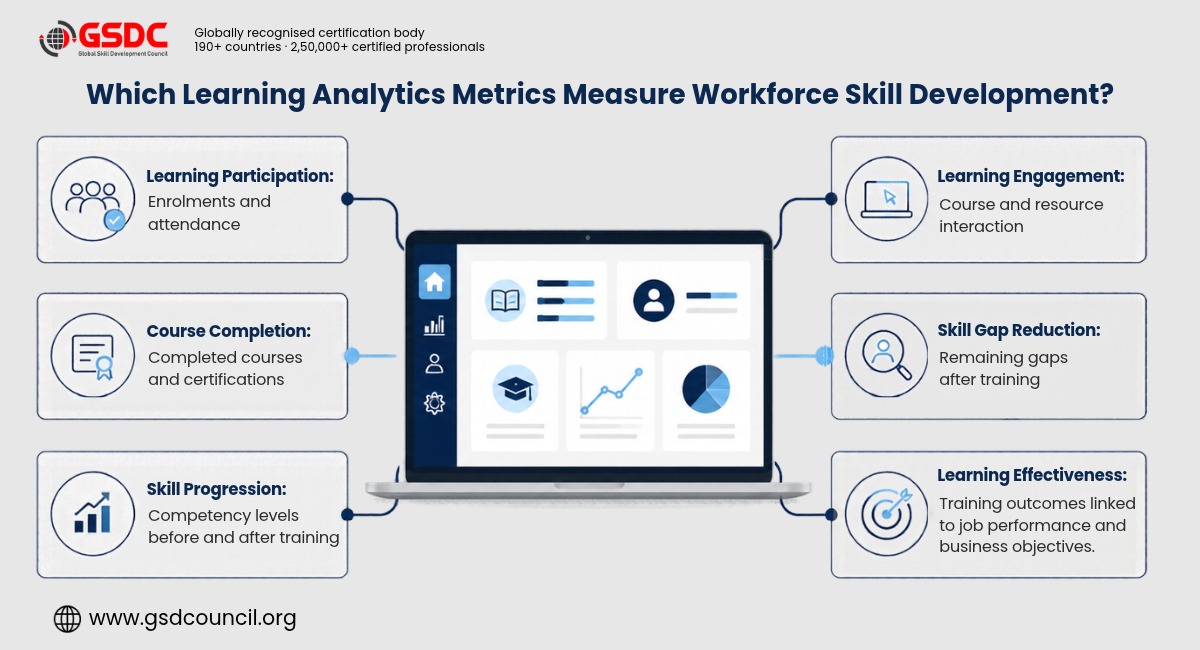
Important measurements include:
- Learning participation: Track employee enrolments, course attendance, and engagement with learning resources.
- Course completion: Monitor completed training programmes, assessments, and certifications.
- Skill progression: Compare employee assessment results and competency levels before and after training.
- Learning engagement: Identify which courses and learning formats receive consistent participation.
- Skill gap reduction: Review whether identified capability gaps have decreased after training.
- Learning effectiveness: Examine how learning outcomes relate to relevant job performance and business objectives.
For example, an analytics dashboard may show that employees in a particular department have completed cybersecurity training but continue to perform poorly in practical security assessments.
L&D teams can use this information to introduce additional simulations, targeted coaching, or advanced training.
Learning analytics should therefore support decisions about improving learning programmes, not simply report course completion figures.
7. Practical Example: Building an AI-Driven Learning Ecosystem for Enterprise Upskilling
Consider a technology company that wants to improve its employees' capabilities in cloud computing and artificial intelligence. Its workforce includes software developers, IT administrators, project managers, and business analysts.
The organisation has an LMS and HRIS, but employee skill information and training records are not fully connected.
It decides to build an AI-driven learning ecosystem through the following process:
Step 1: Identify skill gaps
The organisation analyses employee profiles, assessment results, and job requirements. It identifies gaps in cloud infrastructure, AI applications, data management, and security.
Step 2: Connect existing platforms
The HRIS, LMS, and skills management platform are integrated through APIs. Employee roles, training records, and competency information become available to the learning ecosystem.
Step 3: Generate personalised learning paths
The AI recommendation engine matches employee skill gaps with available courses. Software developers receive cloud development training, while IT administrators receive infrastructure and cloud security learning paths.
Step 4: Introduce AI learning assistants
Employees use an AI assistant to ask questions about course materials, receive explanations, and practise technical concepts. The assistant retrieves relevant information from approved internal learning resources.
Step 5: Conduct practical assessments
Employees complete cloud deployment exercises, AI application assignments, and technical assessments to demonstrate their understanding.
Step 6: Monitor learning progress
Learning analytics tracks course completion, assessment performance, and skill progression. L&D teams review the results and identify employees who need additional support.
Step 7: Update development plans
Based on assessment results and changing business requirements, the organisation updates employee learning paths and recommends further training.
This approach connects employee capabilities, learning resources, AI assistance, and performance assessments within one corporate learning ecosystem.
Develop Your Generative AI Knowledge with GSDC Certification
Generative AI is creating new opportunities for HR and L&D professionals to improve employee learning, personalise development programmes, and automate learning-related workflows.
The GSDC Certification in Generative AI in HR & L&D is designed for professionals who want to develop knowledge of generative AI applications across human resources and learning functions.
Through this certification, professionals can develop knowledge of:
- Generative AI applications in HR and talent management.
- AI-driven learning, training, and employee development.
- HR workflow automation and employee experience.
- AI applications in Learning and Development.
- Responsible AI adoption in HR and L&D.
Explore the GSDC Certification in Generative AI in HR & L&D.
8. Conclusion
Building an AI-driven learning ecosystem requires enterprises to connect workforce skill data, learning platforms, personalised recommendations, AI assistants, and learning analytics.
By integrating these components, organisations can identify capability gaps, deliver relevant training, support employees during learning, and measure skill development over time.
A well-designed learning ecosystem also allows L&D teams to continuously update development programmes as business requirements and workforce skills change.
The goal is to make learning a continuous part of enterprise workforce development, supported by connected systems, relevant learning experiences, and measurable outcomes.

Related Certifications
Frequently Asked Questions
An AI-driven learning ecosystem is a connected environment that uses AI, learning platforms, employee data, and analytics to manage and personalise workforce development. It helps organisations identify skill gaps, recommend relevant training, support employees during learning, and monitor development progress.
AI supports enterprise workforce development by analysing employee skills, identifying capability gaps, recommending personalised training, and providing learning assistance. It also helps L&D teams monitor skill progression and update development programmes based on workforce requirements.
AI analyses employee job roles, existing skills, assessment results, and learning history to recommend relevant courses and development activities. Learning paths can be updated as employees complete training and demonstrate new capabilities.
AI assistants help employees understand training materials, answer learning-related questions, generate practice exercises, and recommend relevant resources. They can use RAG to retrieve information from approved internal knowledge repositories.
Organisations can use learning analytics to track course completion, employee engagement, assessment results, and skill progression. These measurements help L&D teams identify learning gaps and evaluate whether training programmes are supporting workforce development.
An AI-driven learning ecosystem may include LMS and LXP platforms, HRIS integrations, AI recommendation engines, LLMs, RAG, vector databases, APIs, skills management platforms, and learning analytics dashboards. The required components depend on the organisation's existing infrastructure and workforce development objectives.
Stay up-to-date with the latest news, trends, and resources in GSDC
If you like this read then make sure to check out our previous blogs: Cracking Onboarding Challenges: Fresher Success Unveiled
Not sure which certification to pursue? Our advisors will help you decide!