From Certified to Strategic: Advanced Career Paths After Your Generative AI PM Credential

Written by Emily Hilton
- Why Generative AI Project Management Skills Are Becoming More Valuable
- Skills Professionals Need to Move From Certification to Strategic Leadership
- Understanding AI Product Management Career Opportunities and Salary
- How to Build Your Career Roadmap After Certification
- How GSDC's Certification in Generative AI in Project Management Supports Career Growth
- Conclusion
Generative AI is changing how organizations plan projects, develop products, manage teams, and make business decisions. As companies integrate AI into their operations, they increasingly need professionals who can connect AI capabilities with business objectives. This shift is creating new opportunities for project managers who understand both traditional project management principles and generative AI applications.
Earning a Certification In Generative AI In Project Management is a valuable step toward developing this expertise. It helps professionals understand how generative AI can support project planning, risk assessment, resource allocation, reporting, and decision-making. However, certification is not the final destination. It can be the starting point for more advanced responsibilities in AI-driven organizations.
Professionals who combine project management experience with AI knowledge can explore opportunities in AI product management, AI governance, strategic leadership, and enterprise AI transformation.
The next step is to move beyond using AI tools and develop the ability to guide how organizations adopt, manage, and scale AI solutions.
Why Generative AI Project Management Skills Are Becoming More Valuable
Traditional project management focuses on managing scope, timelines, budgets, resources, and stakeholders. Generative AI is expanding these responsibilities by introducing new ways to automate workflows, analyze information, and support project decisions.
For example, project managers can use AI to generate project documentation, summarize meetings, identify potential risks, and prepare progress reports. More advanced applications can connect multiple AI systems to support complex project workflows.
However, successful AI adoption requires more than technical implementation. Organizations need professionals who can evaluate AI-generated outputs, manage associated risks, maintain accountability, and ensure that AI initiatives deliver measurable business value.
This creates opportunities for professionals who understand both project delivery and AI applications.
A generative AI credential can help establish this foundation, while practical experience and continuous learning can support progression into strategic roles.
1. Move Into AI Product Management
One of the most promising career paths after earning a generative AI project management credential is becoming an AI product manager.
AI product managers work at the intersection of business strategy, technology, and customer needs. Their responsibility is to identify opportunities where AI can solve business problems and guide the development of products that deliver measurable value.
Unlike traditional product management, AI product management also involves understanding model capabilities, data requirements, AI limitations, and performance evaluation.
Professionals with project management experience already understand important responsibilities such as coordinating teams, managing priorities, tracking deliverables, and communicating with stakeholders. These capabilities provide a useful foundation for transitioning into AI product roles.
Key responsibilities include:
- Identifying business opportunities for AI-powered products.
- Defining product requirements and development priorities.
- Coordinating engineering, design, and business teams.
- Evaluating AI product performance and user feedback.
- Managing product risks and improvement strategies.
Professionals exploring AI product manager jobs can strengthen their profiles by learning AI fundamentals, product strategy, model evaluation, and responsible AI practices.
A project management background combined with AI expertise can help professionals move from coordinating AI-related projects to shaping the products and solutions themselves.
2. Specialize in AI Governance and Responsible AI
As organizations adopt generative AI across business functions, managing its risks becomes increasingly important. This creates opportunities in AI governance, a field focused on establishing policies, controls, accountability, and oversight for AI systems.
Professionals with project management experience can build on their understanding of risk management, compliance, stakeholder coordination, and organizational processes to explore this specialization.
AI governance professionals help organizations ensure that AI systems are developed and used responsibly. They also work with technical and business teams to establish processes that support transparency, security, fairness, and accountability.
Important areas of responsibility include:
- Developing AI usage policies and governance frameworks.
- Identifying risks associated with AI adoption.
- Establishing human oversight and accountability.
- Monitoring AI system performance and compliance.
- Coordinating responsible AI implementation across teams.
This career path is particularly relevant for professionals interested in enterprise transformation, risk management, and responsible technology adoption.
Understanding AI governance can also help project managers lead AI initiatives with better risk awareness and stronger organizational controls.
3. Prepare for the Chief AI Officer Role
For professionals interested in executive-level responsibilities, the Chief AI Officer (CAIO) role represents a potential long-term career direction.
A Chief AI Officer is responsible for guiding an organization's overall AI strategy. This includes identifying business opportunities, overseeing AI adoption, managing investments, and ensuring that AI initiatives align with organizational goals.
Project managers who gain experience leading AI transformation initiatives can gradually develop the strategic and operational knowledge required for this role.
Key responsibilities include:
- Developing an organization-wide AI strategy.
- Identifying opportunities to integrate AI into business operations.
- Managing AI investments and implementation priorities.
- Coordinating technology, business, and leadership teams.
- Establishing AI governance and risk management practices.
- Measuring the business impact of AI initiatives.
Moving toward this position requires more than understanding generative AI tools. Professionals need experience in enterprise strategy, technology leadership, organizational change, and business transformation.
A generative AI project management credential can provide an initial foundation, while leadership experience and advanced AI knowledge can support further career growth.
4. Progress Toward a Chief Product Officer Position
Another advanced career direction is becoming a Chief Product Officer (CPO).
A CPO oversees an organization's product vision, strategy, development, and overall performance. The role involves connecting customer expectations with business objectives and ensuring that products remain competitive.
As AI becomes part of product development, CPOs must understand how emerging technologies can improve customer experiences, introduce new product capabilities, and create business opportunities.
Professionals with experience in project management and AI product management can develop relevant capabilities by working on AI-powered product initiatives.
Their responsibilities may gradually expand to include:
- Defining long-term product strategies.
- Leading product management teams.
- Identifying AI-driven market opportunities.
- Managing product portfolios and investments.
- Connecting product innovation with business growth.
- Evaluating product performance and customer satisfaction.
Moving into a CPO position generally requires substantial product leadership experience. However, understanding generative AI can help professionals prepare for the changing expectations of executive product roles.
5. Explore AI Transformation and Program Leadership
Professionals who enjoy managing complex initiatives can also explore AI transformation leadership.
Organizations often implement AI across multiple departments rather than limiting it to individual projects. These initiatives require coordination between technology teams, business leaders, operations, and external partners.
An AI transformation manager or program leader helps organizations plan and execute these changes.
Typical responsibilities include:
- Identifying opportunities for AI adoption.
- Managing multiple AI implementation projects.
- Coordinating cross-functional teams.
- Tracking implementation costs and business outcomes.
- Supporting employee training and change management.
- Ensuring AI initiatives align with organizational priorities.
This career path allows experienced project managers to apply their existing delivery knowledge while developing expertise in enterprise AI adoption.
Skills Professionals Need to Move From Certification to Strategic Leadership
Earning a credential is an important milestone, but advancing into strategic positions requires continuous skill development.
Professionals should focus on building a combination of technical understanding, business knowledge, and leadership capabilities.
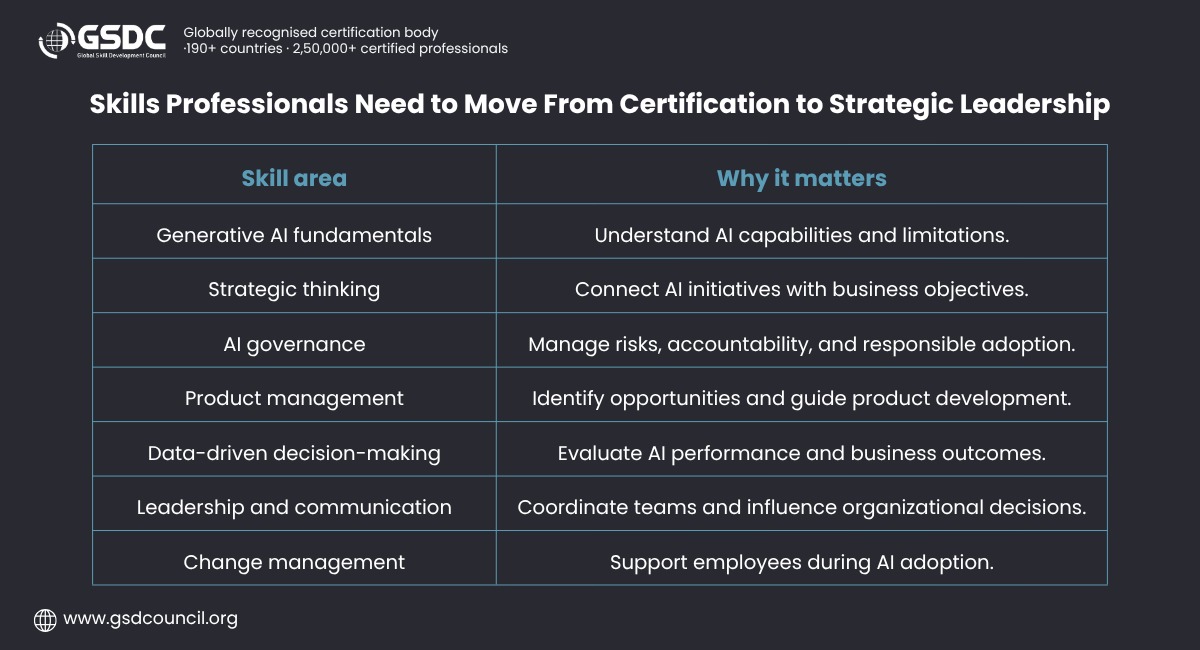
These capabilities help professionals move beyond managing individual AI projects toward influencing broader organizational decisions.
Understanding AI Product Management Career Opportunities and Salary
As AI adoption expands, demand for professionals who understand AI products, business requirements, and technology implementation is creating new career opportunities.
An AI product manager can work across industries such as healthcare, finance, education, software development, retail, and enterprise technology.
However, compensation depends on several factors, including experience, location, industry, technical knowledge, and organizational responsibilities.
The AI product manager salary can vary significantly between entry-level, mid-level, and senior leadership positions. Professionals with experience in AI product strategy, model evaluation, stakeholder management, and successful product launches may qualify for more advanced opportunities.
Rather than focusing only on salary, professionals should evaluate the responsibilities, learning opportunities, and long-term growth potential associated with each role.
How to Build Your Career Roadmap After Certification
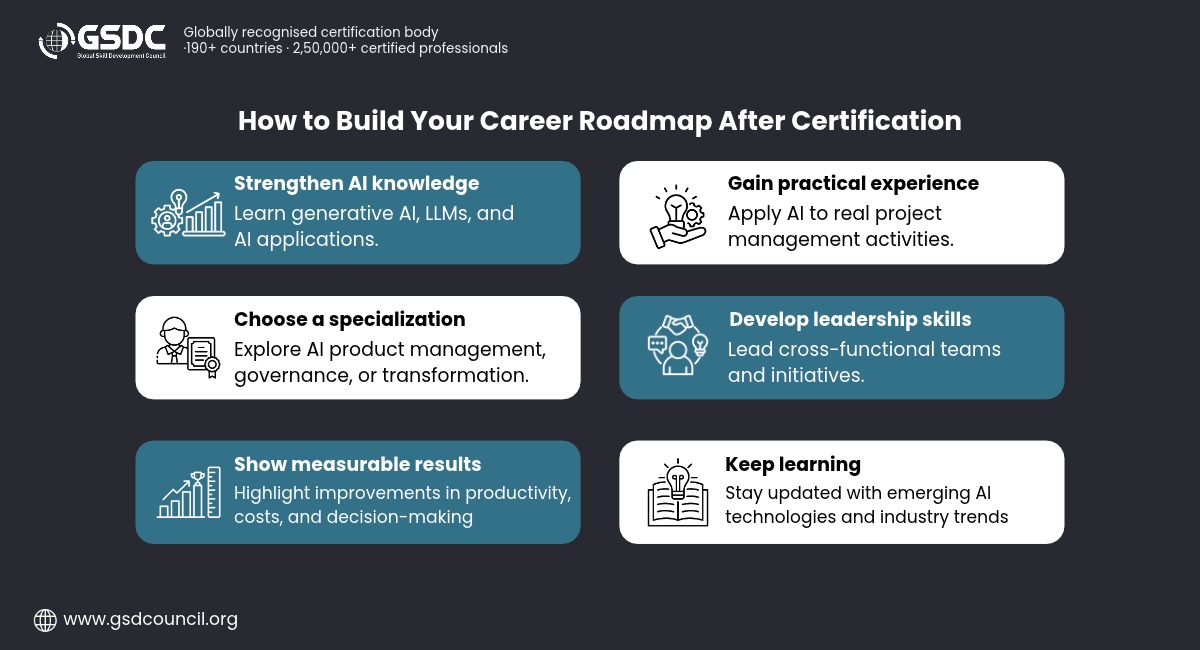
Moving from certification to strategic leadership requires a planned approach. Professionals can follow these steps to make their career progression more structured.
1. Strengthen your AI foundation: Understand generative AI, large language models, AI applications, and their limitations.
2. Apply AI in real projects: Gain practical experience using AI for planning, reporting, risk identification, and workflow automation.
3. Develop a specialization: Explore AI product management, AI governance, or enterprise AI transformation based on your career interests.
4. Build leadership experience: Take responsibility for cross-functional initiatives and collaborate with senior stakeholders.
5. Demonstrate measurable results: Document how your AI initiatives improve productivity, reduce costs, or support better decisions.
6. Continue professional development: Pursue relevant learning opportunities and stay informed about emerging AI technologies and industry practices.
This approach helps professionals turn their certification knowledge into practical capabilities that support long-term career growth.
How GSDC's Certification in Generative AI in Project Management Supports Career Growth
GSDC's Certification In Generative AI In Project Management helps professionals understand how generative AI can be applied across different project management activities. It introduces concepts that support AI-assisted planning, risk management, resource allocation, reporting, and decision-making.

Certification In Generative AI In Project Management can help project managers build a foundation for working with AI-powered project environments and understanding how intelligent technologies influence project delivery. For professionals looking to move into AI product management, governance, or leadership roles, this knowledge can serve as a starting point for developing broader AI expertise and connecting technological capabilities with business objectives.
Conclusion
The journey from earning a generative AI project management credential to taking on strategic responsibilities involves more than learning new AI tools. It requires professionals to understand how AI influences products, business operations, organizational decisions, and long-term growth.
Whether the goal is to become an AI product manager, specialize in AI governance, progress toward a Chief AI Officer position, or eventually lead product strategy as a Chief Product Officer, the opportunities are expanding.
The key is to combine certification knowledge with practical experience, leadership capabilities, and continuous learning. Professionals who take this approach can move beyond managing AI-assisted projects and become valuable contributors to their organization's AI-driven future.

Related Certifications
Stay up-to-date with the latest news, trends, and resources in GSDC
If you like this read then make sure to check out our previous blogs: Cracking Onboarding Challenges: Fresher Success Unveiled
Not sure which certification to pursue? Our advisors will help you decide!