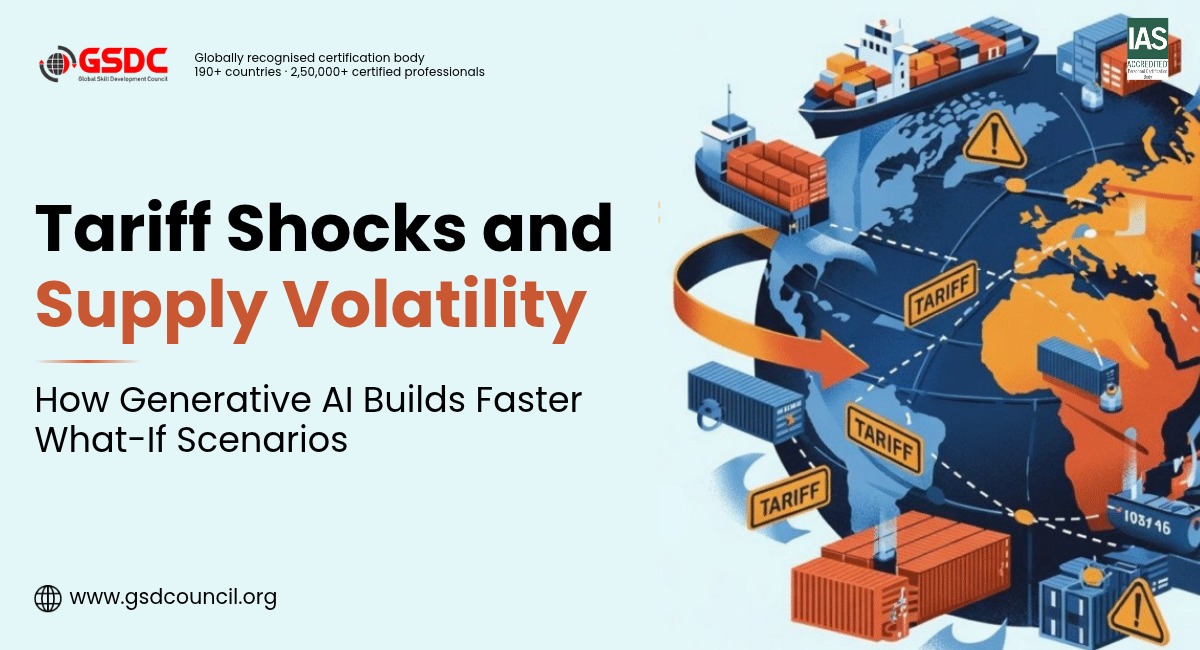
Tariff Shocks and Supply Volatility: How Generative AI Builds Faster What-If Scenarios
Written by Emily Hilton
- 1. Why Tariff Changes and Supply Chain Volatility Are Difficult to Manage
- 2. What Is Supply Chain Scenario Planning?
- 3. How Generative AI Makes What-If Analysis Faster
- 4. Using Generative AI for Tariff Impact Analysis
- 5. The Role of Digital Twins in AI Scenario Planning
- 6. Practical Example: How a Manufacturer Can Respond to Tariff Shocks
- 7. Connecting AI Demand Planning With Supply Chain Risk Management
- 8. Build Your Skills With GSDC's Generative AI for Supply Chain Management Certification
- Conclusion
Imagine your company depends on raw materials imported from another country. Suddenly, the government announces a new import tariff. The cost of materials increases, suppliers revise their prices, and delivery schedules become uncertain.
What would you do next?
Would you increase product prices, find another supplier, reduce production, or absorb the additional cost?
These decisions are not always easy, especially when supply chains operate across multiple countries and involve several suppliers, manufacturers, and distributors. A small change in one part of the supply chain can affect the entire business.
This is where generative AI in supply chain management can make a difference. Instead of spending days collecting data and manually preparing different business scenarios, companies can use AI to explore possible outcomes, compare alternatives, and understand potential risks much faster.
With the help of AI-powered scenario planning, businesses can prepare for tariff changes, supplier disruptions, rising transportation costs, and unexpected demand fluctuations.
In this blog, we will explore how generative AI supports faster what-if analysis, improves supply chain decision-making, and helps businesses respond to changing market conditions.
1. Why Tariff Changes and Supply Chain Volatility Are Difficult to Manage
Global supply chains are connected to several external factors, including government policies, international trade agreements, transportation costs, currency fluctuations, and supplier availability.
When one of these factors changes, businesses may experience supply chain volatility.
For example, a manufacturer importing electronic components may face higher costs after a new tariff is introduced. If the company depends on a limited number of international suppliers, finding alternatives may take time.
Similarly, a sudden increase in shipping costs or a delay at a major port can affect production schedules and customer deliveries.
Some common challenges include:
- Higher procurement costs: New tariffs can increase the cost of imported raw materials and finished goods.
- Supplier uncertainty: Businesses may need to find alternative suppliers when existing partners become expensive or unreliable.
- Demand fluctuations: Changes in product prices can influence customer purchasing decisions.
- Production delays: Shortages of essential materials can interrupt manufacturing activities.
- Inventory challenges: Companies may struggle to decide whether to increase stock or reduce purchasing.
Traditional planning methods often depend on spreadsheets, historical reports, and manual calculations. Although these methods are useful, they may not be fast enough when businesses need to evaluate several possible situations at once.
This makes effective supply chain risk management increasingly important.
2. What Is Supply Chain Scenario Planning?
Supply chain scenario planning is the process of examining different possible situations that could affect business operations and preparing suitable responses.
Instead of making decisions based on a single expected outcome, businesses evaluate multiple possibilities.
For example, imagine a company importing raw materials from three countries. It wants to understand how its operations might change if import tariffs increase.
The company could create different what if scenarios:
- What if import tariffs increase by 10%?
- What if the main supplier increases prices by 15%?
- What if transportation costs rise by 20%?
- What if demand increases while material availability decreases?
- What if the company shifts part of its purchasing to a local supplier?
Each scenario helps the business understand possible financial and operational consequences.
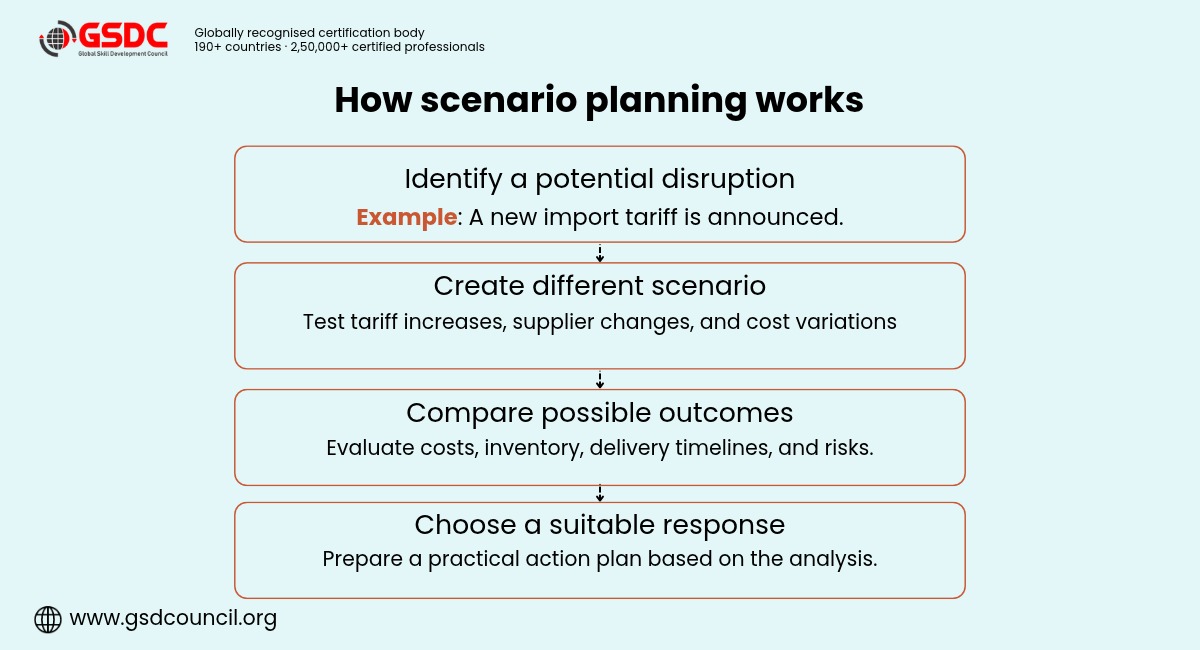
The purpose is not to predict exactly what will happen. It is to help businesses understand what could happen and prepare before disruptions affect their operations.
3. How Generative AI Makes What-If Analysis Faster
Traditional what-if analysis can require significant time and coordination. Teams may need to collect supplier information, update cost estimates, compare demand forecasts, and calculate the impact of different decisions.
Generative AI supply chain solutions can simplify this process by helping teams analyse large amounts of information and develop multiple scenarios.
Here is how they help:
1. Faster scenario creation
Generative AI can help create different what-if scenarios using business data, market information, supplier records, and operational assumptions.
For example, a manager can ask an AI system to evaluate what might happen if import duties increase by 10%, 15%, or 20%.
2. Comparing multiple business decisions
Instead of examining one option at a time, teams can compare alternatives such as changing suppliers, increasing inventory, or adjusting production volumes.
3. Identifying possible risks
AI systems can help identify relationships between supplier costs, delivery delays, demand changes, and inventory levels. This gives teams a broader understanding of potential supply chain risk.
4. Supporting faster decision-making
Generative AI can summarise scenario results, highlight important cost changes, and explain possible trade-offs in simple language.
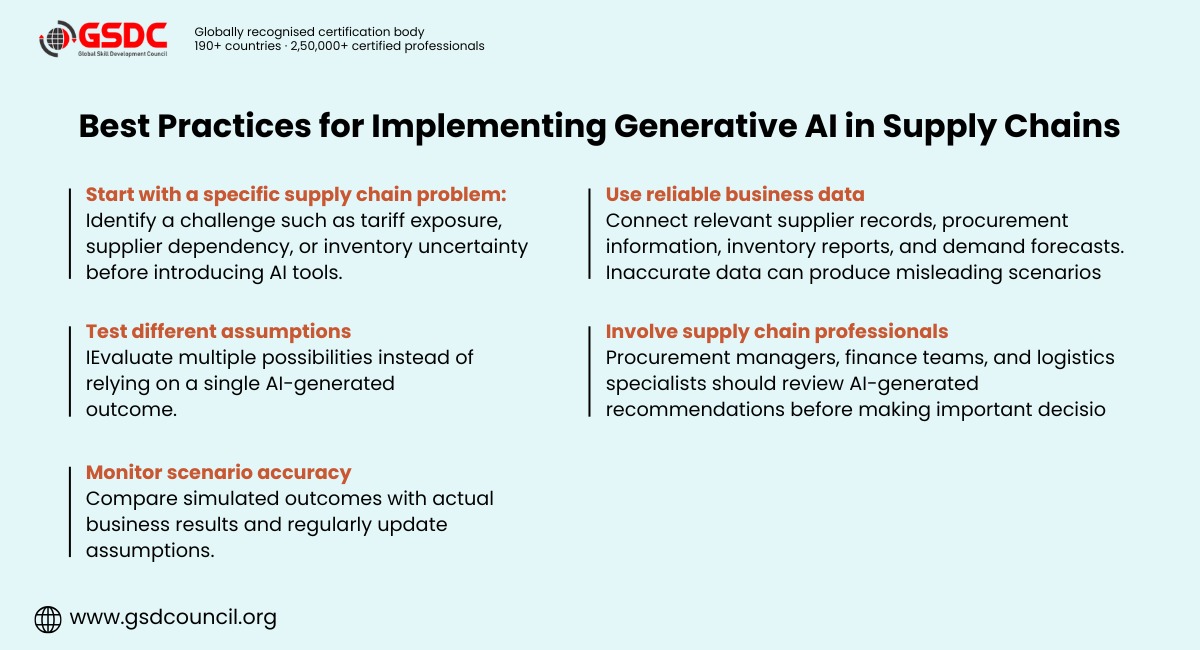
However, AI-generated scenarios should not be treated as guaranteed predictions. Their accuracy depends on the quality of available data, assumptions, and business validation.
4. Using Generative AI for Tariff Impact Analysis
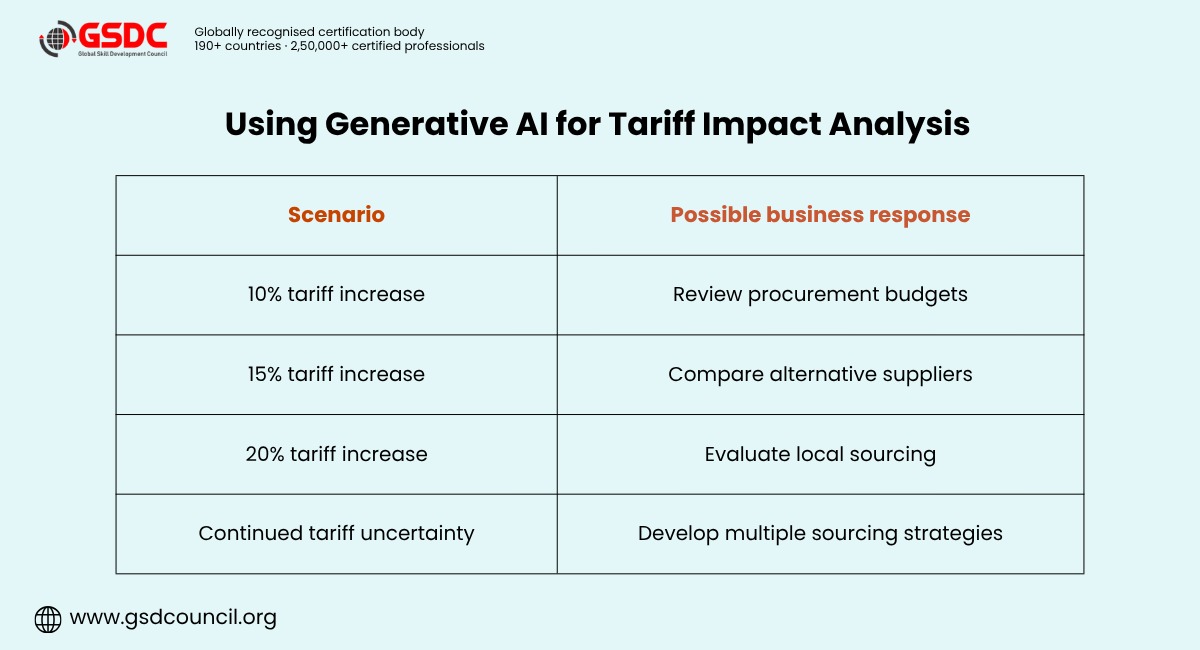
One of the most useful applications of generative AI is tariff impact analysis.
When governments introduce new tariffs, businesses need to understand how these changes affect procurement expenses, production costs, product pricing, and profit margins.
For example, consider an electronics manufacturer that imports components worth ₹50 lakh every month. If a new tariff increases the applicable import cost by 10%, the company needs to understand whether it can absorb the additional expense or should explore other options.
Generative AI can help evaluate different possibilities.
Scenario | Possible business response |
10% tariff increase | Review procurement budgets |
15% tariff increase | Compare alternative suppliers |
20% tariff increase | Evaluate local sourcing |
Continued tariff uncertainty | Develop multiple sourcing strategies |
AI-powered tariff impact on supply chain analysis can help businesses examine questions such as:
- Which imported materials contribute most to increased costs?
- Which suppliers offer more cost-effective alternatives?
- How would higher procurement costs affect product pricing?
- Should the company increase inventory before further tariff changes?
- Which sourcing strategy offers better cost stability?
By evaluating these questions, businesses can make more informed decisions instead of reacting only after costs increase.
5. The Role of Digital Twins in AI Scenario Planning
A digital twin supply chain is a virtual representation of a company's supply chain operations. It uses data from different business activities to represent how materials, products, suppliers, and transportation networks work together.
When combined with AI scenario planning, digital twins allow businesses to examine how changes in one area could influence the rest of their operations.
For example, a company can use a digital twin to simulate what happens when:
- A major supplier stops delivering materials.
- Import tariffs increase in a particular country.
- Transportation routes become unavailable.
- Customer demand suddenly rises.
- Production capacity becomes limited.
Generative AI can help users explore these situations by creating scenarios, summarising possible outcomes, and supporting comparisons between different responses.
This combination makes scenario modeling more useful because businesses can examine potential disruptions in a connected operational environment rather than evaluating individual problems separately.
However, digital twins require reliable and regularly updated operational data. Generative AI can support analysis, but it does not automatically make an incomplete digital model accurate.
6. Practical Example: How a Manufacturer Can Respond to Tariff Shocks
Let's understand this with a simple example.
Imagine an automobile manufacturer that imports essential components from another country. A sudden tariff increase raises procurement costs, creating pressure on its production budget.
Instead of immediately changing suppliers or increasing vehicle prices, the company uses generative AI for supply chain scenario planning.
The AI system helps the team examine three possible situations:
Scenario 1: Continue with the existing supplier
The company maintains its current supplier relationship but experiences higher procurement expenses. This option avoids immediate supplier transition challenges but may reduce profit margins.
Scenario 2: Shift to an alternative supplier
The company explores another supplier in a different country. Although this may reduce tariff exposure, the team must evaluate product quality, delivery timelines, and onboarding costs.
Scenario 3: Increase local sourcing
The company considers purchasing more components from domestic suppliers. This could reduce dependence on international trade conditions, although local suppliers may have different pricing and production capabilities.
After comparing these scenarios, the company can identify which option offers the most suitable balance between cost, quality, and supply reliability.
This is how AI supply chain risk management can support business decisions. Rather than automatically selecting an option, AI helps decision-makers understand the possible consequences before taking action.
7. Connecting AI Demand Planning With Supply Chain Risk Management
Tariff changes are not the only challenge businesses need to prepare for. Demand fluctuations can make supply chain decisions even more complicated.
For example, if product prices increase because of higher import costs, customers may reduce their purchases. On the other hand, customers may increase orders before an expected price revision.
This is where AI demand planning becomes useful.
Generative AI can work alongside forecasting systems to help businesses examine different demand conditions and understand how they may affect inventory and procurement decisions.
Businesses can use this approach to:
- Compare expected demand with alternative demand scenarios.
- Identify products that may experience sudden demand changes.
- Evaluate whether current inventory levels are sufficient.
- Understand how pricing changes could influence purchasing behaviour.
- Prepare procurement plans for different market conditions.
Combining demand planning with supply chain risk management gives businesses a more complete view of their operations.
It helps teams consider both sides of the problem: whether materials will be available and whether customers will actually need the products.
8. Build Your Skills With GSDC's Generative AI for Supply Chain Management Certification
As businesses increasingly explore AI-driven supply chain operations, professionals need to understand how generative AI can support planning, forecasting, risk evaluation, and operational decision-making.
Developing knowledge of AI applications in supply chain management can help professionals understand how to work with emerging technologies and apply them to real business challenges.
GSDC’s Certified Generative AI for Supply Chain Management (CGAISCM) certification can help professionals build their understanding of generative AI concepts and their applications in modern supply chain environments.

A certification in Generative AI for Supply Chain Management can also support professionals looking to strengthen their knowledge of AI demand planning, scenario analysis, supply chain risk management, and technology-driven decision-making.
For supply chain managers, procurement professionals, logistics specialists, and aspiring AI professionals, developing these skills can be a valuable step towards preparing for increasingly AI-enabled business operations.
Conclusion
Tariff changes, supplier disruptions, and unpredictable customer demand have made supply chain planning more challenging. Businesses can no longer depend only on historical reports or traditional forecasting methods to prepare for every possible disruption.
Generative AI offers a faster way to explore what-if scenarios, compare business decisions, and understand potential supply chain risks. When combined with digital twins, demand planning, and reliable business data, it can help organisations build more flexible and informed supply chain strategies.
The goal is not to predict every disruption perfectly. It is to help businesses prepare for different possibilities and respond with greater confidence. As supply chain volatility continues, organisations that combine AI capabilities with human expertise will be better positioned to manage uncertainty.

Related Certifications
Stay up-to-date with the latest news, trends, and resources in GSDC
If you like this read then make sure to check out our previous blogs: Cracking Onboarding Challenges: Fresher Success Unveiled
Not sure which certification to pursue? Our advisors will help you decide!