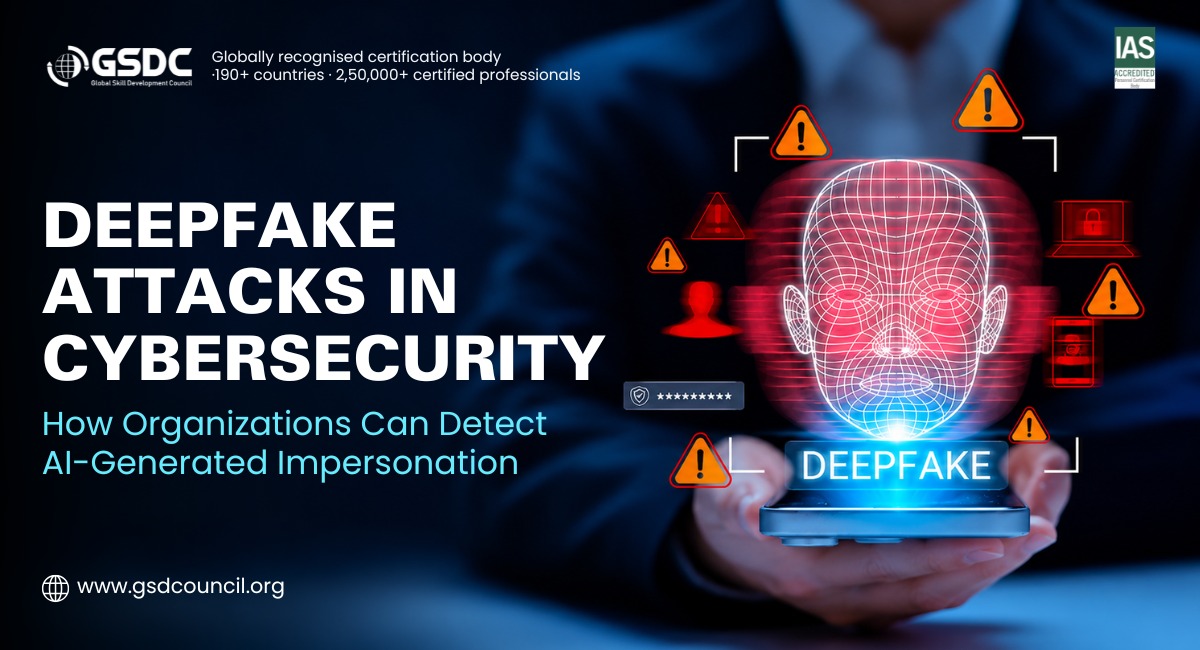
Deepfake Attacks in Cybersecurity: How Organizations Can Detect AI-Generated Impersonation
Written by Matthew Hale
- How Deepfake Attacks Target Organizational Systems
- How Organizations Can Detect AI-Generated Impersonation
- How to Prevent Deepfake Attacks in Organizations
- What Should Organizations Do When a Deepfake Attack Is Detected?
- Building a Multi-Layer Deepfake Protection Strategy
- Develop Your Generative AI Cybersecurity Knowledge with GSDC Certification
- Conclusion
Deepfake attacks are creating new challenges for identity verification and cybersecurity teams. Attackers can use AI-generated voices, manipulated videos, and synthetic identities to impersonate executives, employees, customers, or business partners.
These attacks can target financial approvals, corporate communications, account recovery processes, and remote meetings. A convincing voice message or video call may appear to come from a trusted person, even when the person has no involvement in the interaction.
Traditional security controls such as passwords and email authentication may not be enough when an attacker manipulates the identity signals used to establish trust. Organisations need to combine media analysis, identity verification, behavioural monitoring, and transaction controls to detect AI impersonation.
In this blog, we explore how deepfake attacks are used in cybercrime, the technical methods organisations can use to detect AI-generated impersonation, and the security measures that help prevent and respond to these attacks.
How Deepfake Attacks Target Organizational Systems
A deepfake attack uses AI-generated or manipulated audio, video, or images to make someone appear or sound like another person. In cybersecurity, attackers use these techniques to deceive employees, bypass identity checks, or influence business decisions.
Common attack scenarios include:
- Executive impersonation: An attacker uses a cloned executive voice to request an urgent payment or confidential information.
- Video conference impersonation: A manipulated video or real-time face-swap makes an attacker appear to be a senior employee during a virtual meeting.
- Employee account fraud: Synthetic voice recordings are used to impersonate employees during helpdesk calls or password recovery requests.
- Vendor payment fraud: Attackers impersonate suppliers or business partners to change payment instructions.
- Customer identity fraud: AI-generated faces or voices are used to manipulate remote identity verification processes.
A deepfake may be only one part of a larger impersonation attack. Attackers can combine it with phishing emails, compromised accounts, stolen personal information, and social engineering to make the request appear legitimate.
How Organizations Can Detect AI-Generated Impersonation
Detecting deepfakes requires more than checking whether a video or voice recording looks artificial. Organisations need to examine the media, verify the identity behind the communication, and assess whether the requested action matches normal business behaviour.
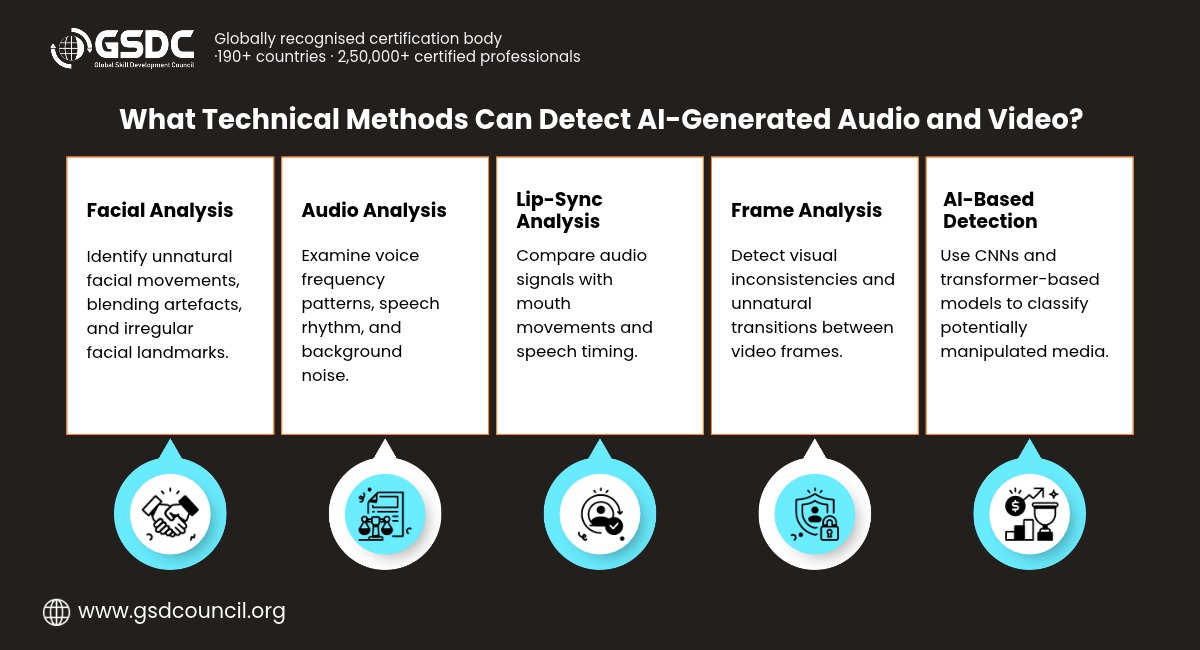
1. Analyse Audio and Video Inconsistencies
AI-generated media can contain technical inconsistencies that help investigators identify possible manipulation. These may appear in facial movements, speech patterns, audio signals, lighting, or the relationship between sound and video.
Security teams can examine:
- Lip-sync mismatches: Check whether mouth movements align with spoken words, particularly during rapid speech.
- Facial movement inconsistencies: Look for unnatural blinking, facial expressions, or transitions between expressions.
- Audio irregularities: Examine unusual changes in voice tone, background noise, pronunciation, and speech rhythm.
- Lighting and visual inconsistencies: Review shadows, reflections, skin textures, and facial boundaries.
- Frame-level abnormalities: Inspect transitions between video frames for unnatural changes or visual artefacts.
For technical analysis, media forensics tools can examine audio spectrograms, video frames, facial landmarks, and temporal consistency.
However, these indicators are not conclusive proof of a deepfake. Video compression, poor lighting, network delays, and low-quality microphones can also create similar irregularities.
2. Use AI-Based Deepfake Detection Systems
AI-based deepfake detection systems analyse media for patterns associated with synthetic or manipulated content.
Depending on the system, detection models may examine:
- Facial texture and blending artefacts.
- Irregularities in facial landmarks and movement.
- Audio frequency patterns and voice characteristics.
- Synchronisation between speech and facial movements.
- Temporal inconsistencies across video frames.
- Differences between natural and synthetic media patterns.
Some systems use deep learning models, convolutional neural networks, and transformer-based architectures to classify media as potentially manipulated.
Organisations can integrate these detection capabilities into identity verification platforms, video review workflows, and security operations.
However, detection models have limitations. Their accuracy can vary depending on the generation technique, training data, compression, and media quality. A detector's confidence score should not be treated as proof that a person is genuine or that a recording is fake.
3. Verify Identity Through Independent Channels
Media analysis alone cannot reliably establish who is participating in a conversation. Identity verification should therefore use a separate trusted channel.
For example, if an employee receives a video call from someone claiming to be the CFO and requesting an urgent fund transfer, the employee should verify the request through an independently registered phone number or an approved internal communication platform.
Organisations should implement:
- Callback verification using trusted contact directories.
- Multi-factor authentication for sensitive account actions.
- Pre-approved verification procedures for financial requests.
- Secondary approval for changes to payment instructions.
- Challenge-response checks for high-risk interactions.
The verification channel must be independent of the suspicious communication. Calling back the number provided in the same message does not provide reliable verification.
4. Detect Unusual Behaviour During Communication
A deepfake may look convincing, but the request or behaviour behind it may differ from normal business activity.
Organisations should examine communication context and behavioural patterns, including:
- Unexpected requests for urgent payments or confidential files.
- Requests to bypass established approval procedures.
- Changes in communication style or unusual working hours.
- Unfamiliar devices or locations used to access business accounts.
- Requests to change bank details or account recovery information.
- Unusual access to sensitive systems following a suspicious call.
Security teams can correlate communication-related alerts with identity logs, endpoint activity, account access records, and transaction monitoring.
For example, a voice message requesting a payment followed by an unusual login to the finance system should trigger additional verification.
5. Check Media Provenance and Digital Credentials
Media provenance can help organisations understand where a file came from and whether its history has been altered.
Technologies such as the Coalition for Content Provenance and Authenticity (C2PA) support the attachment of cryptographically verifiable provenance information to digital content.
Security teams can examine:
- Content credentials attached to supported media.
- Digital signatures and certificate validity.
- Available creation and editing history.
- Metadata consistency.
- Whether the media has been modified after signing.
However, provenance checks have limitations. Metadata can be removed, credentials may not be present, and valid provenance does not automatically prove that the person shown or heard is trustworthy.
Organisations should use provenance as one verification signal rather than a standalone deepfake detection method.
How to Prevent Deepfake Attacks in Organizations
Detection identifies suspicious communication, but prevention reduces the chances of an attacker successfully using AI-generated impersonation.
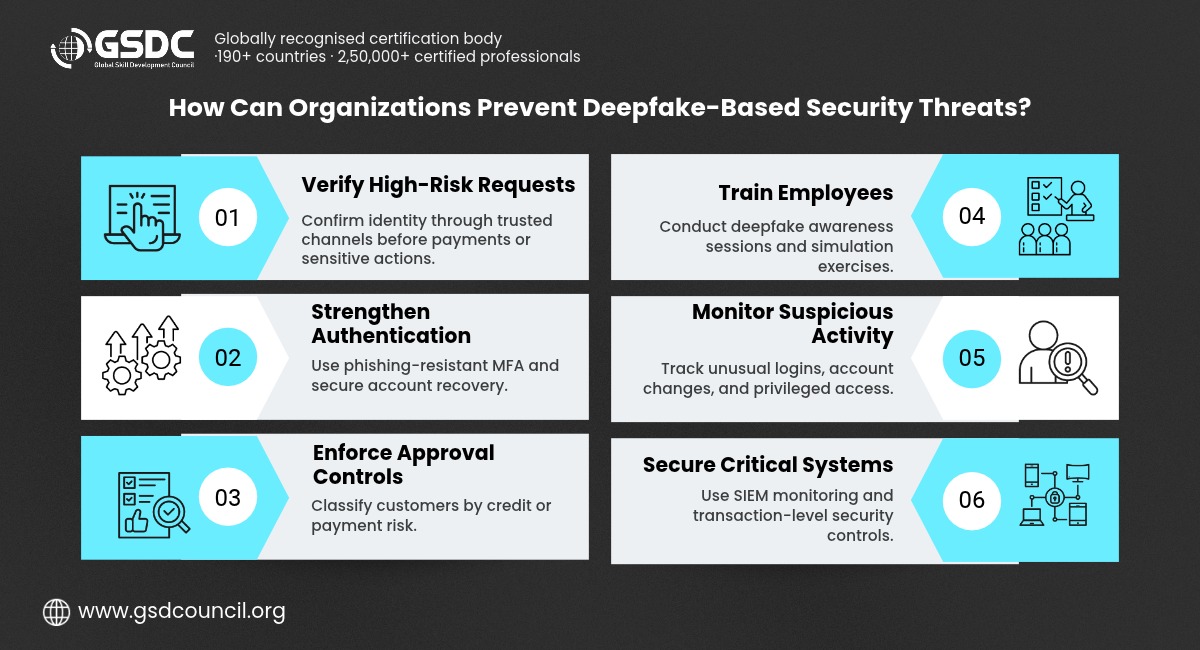
1. Strengthen Identity Verification for High-Risk Actions
Deepfake attacks often target actions that depend on trust, such as approving payments, sharing confidential documents, or resetting employee accounts.
Organisations should establish additional verification requirements for these activities.
For example:
- Require multi-person approval for high-value transactions.
- Use phishing-resistant authentication for privileged accounts.
- Verify payment changes through registered contact details.
- Apply additional identity checks during account recovery.
- Restrict sensitive actions based on user roles and permissions.
A voice or video request should never replace an established approval process.
2. Secure Helpdesk and Account Recovery Processes
Attackers may use cloned voices to convince support teams that they are legitimate employees who have lost access to their accounts.
Helpdesk teams should not rely on voice recognition or personal information alone to verify identity.
Recommended controls include:
- Strong identity verification before password resets.
- Approval workflows for privileged account recovery.
- Device and session risk checks.
- Verification through registered authentication methods.
- Logging and review of unusual recovery requests.
These controls reduce the risk of AI impersonation being used to gain access to corporate systems.
3. Establish Deepfake Awareness Training
Employees are often the first people to encounter an impersonation attempt. Deepfake awareness training should teach them how to recognise suspicious requests and follow verification procedures.
Training should cover:
- Identifying unusual voice and video behaviour.
- Recognising urgent or unexpected requests.
- Verifying executive and vendor communications.
- Reporting suspicious audio and video messages.
- Following payment and information-sharing approval procedures.
Organisations can conduct simulated voice-cloning and video impersonation exercises to test whether employees follow the correct verification process.
4. Monitor High-Risk Accounts and Transactions
Deepfake attacks may be followed by attempts to access business systems or move money.
Security teams should monitor:
- Unusual authentication attempts.
- Privileged account activity.
- Unexpected changes to payment details.
- Suspicious account recovery requests.
- Unusual access to financial and customer databases.
- New devices or sessions accessing sensitive systems.
Correlating these events through a Security Information and Event Management (SIEM) platform can help identify suspicious activity that may not be visible from a single alert.
What Should Organizations Do When a Deepfake Attack Is Detected?
When a suspected deepfake impersonation attempt is identified, organisations should follow a structured response process.
Step 1: Stop the requested action. Pause payments, account changes, data transfers, or other sensitive activities associated with the suspicious communication.
Step 2: Verify the identity independently. Contact the person through a known and trusted communication channel.
Step 3: Preserve evidence. Retain the original audio or video file, message headers, timestamps, call records, relevant logs, and transaction details. Avoid modifying the original media.
Step 4: Investigate related activity. Check whether the attacker also attempted phishing, account access, credential theft, or unauthorised financial transactions.
Step 5: Secure affected accounts. Revoke suspicious sessions, reset compromised credentials, and review access permissions where account compromise is suspected.
Step 6: Escalate and document the incident. Inform the cybersecurity and relevant privacy teams, record the incident, assess potential data exposure, and follow applicable reporting requirements.
Building a Multi-Layer Deepfake Protection Strategy
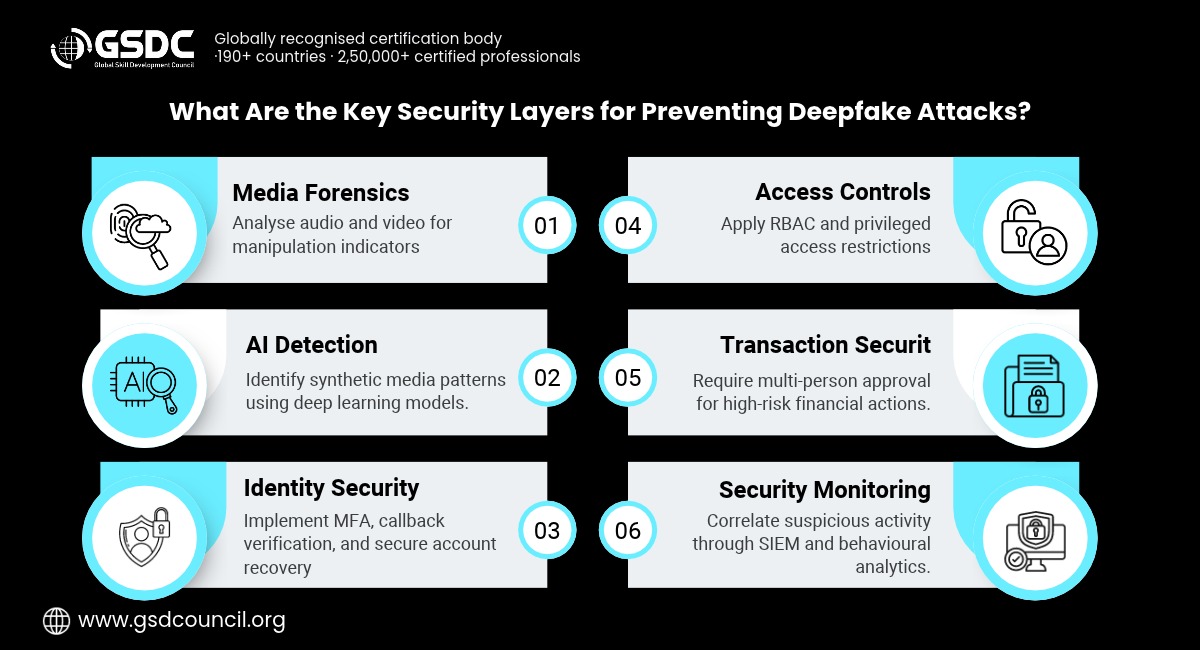
No single detection tool can identify every deepfake attack. Organisations should combine different controls to verify identity and protect sensitive business activities.
Security layer | Recommended control | Purpose |
| Media analysis | Audio and video forensics | Identify possible manipulation |
| AI detection | Deepfake detection models | Analyse synthetic media patterns |
| Identity verification | MFA and independent callbacks | Confirm the identity behind a request |
| Access security | RBAC and privileged access controls | Restrict unauthorised system access |
| Transaction security | Multi-person approvals | Prevent fraudulent financial actions |
| Monitoring | SIEM and behavioural analytics | Identify suspicious activity |
| Employee readiness | Deepfake awareness training | Improve recognition and reporting |
These controls should work together. For example, an AI detection system may flag a suspicious executive video, but an independent identity check and transaction approval workflow provide additional protection against financial fraud.
Develop Your Generative AI Cybersecurity Knowledge with GSDC Certification
As generative AI creates new security challenges, cybersecurity professionals need to understand how AI-generated content can be misused in impersonation, fraud, phishing, and social engineering attacks.
The GSDC Generative AI in Cybersecurity Certification is designed for professionals who want to develop knowledge of generative AI applications and their cybersecurity implications.

Through this certification, professionals can develop an understanding of:
- Generative AI applications: Understand how generative AI technologies are used in modern cybersecurity environments.
- AI-driven security threats: Explore risks associated with deepfakes, AI-generated phishing, impersonation, and social engineering.
- AI security risks: Understand potential vulnerabilities, misuse scenarios, and security challenges associated with generative AI systems.
- Security practices: Develop knowledge of approaches to identifying AI-related threats, assessing risks, and strengthening security controls.
- Responsible AI use: Understand the importance of applying generative AI with appropriate security, governance, and risk management practices.
Build your understanding of emerging AI security challenges with the GSDC Generative AI in Cybersecurity Certification.
Conclusion
Deepfake attacks are challenging traditional identity verification because attackers can manipulate the audio and video signals people use to recognise trusted individuals. Organisations should not depend on visual inspection or AI detection scores alone.
A stronger approach combines media forensics, AI-based detection, independent identity verification, behavioural monitoring, and secure approval workflows. Regular employee training and clear incident response procedures also help reduce the impact of AI-generated impersonation.
The objective is to ensure that important business decisions are based on verified identity and trusted processes, not simply on a convincing voice or video.

Related Certifications
Frequently Asked Questions
Organisations can use audio and video forensics, AI-based deepfake detection systems, media provenance checks, and independent identity verification. They should also monitor unusual communication patterns and suspicious requests for sensitive actions.
Look for possible lip-sync mismatches, unnatural facial movements, inconsistent lighting, unusual visual transitions, and audio irregularities. These signs are not conclusive, so verify the participant through an independent trusted channel before approving sensitive requests.
AI-based systems can analyse voice characteristics, frequency patterns, speech features, and other audio signals to identify potentially synthetic speech. However, detection accuracy varies, and results should be combined with identity verification.
Organisations can use multi-factor authentication, independent callback verification, payment approval controls, secure account recovery procedures, employee awareness training, and monitoring of privileged accounts.
Deepfake awareness training helps employees recognise suspicious audio and video communications, question unexpected requests, follow identity verification procedures, and report potential impersonation attempts.
Stay up-to-date with the latest news, trends, and resources in GSDC
If you like this read then make sure to check out our previous blogs: Cracking Onboarding Challenges: Fresher Success Unveiled
Not sure which certification to pursue? Our advisors will help you decide!