Can AI Agents Access Your Personal Data? Understanding Privacy Risks in Autonomous AI Systems
Written by Matthew Hale
- Can AI Agents Access Your Personal Data?
- What types of personal data can AI agents access?
- How Do Autonomous AI Agents Access Personal Information?
- 7 Major Privacy and Security Risks in Autonomous AI Systems
- How Can Organisations Protect Personal Data When Using AI Agents?
- Develop Your Data Protection Knowledge with GSDC Certification
- Conclusion
AI agents are increasingly being connected to email accounts, calendars, business applications, customer databases, cloud storage, and other digital services. These connections allow them to perform tasks such as retrieving documents, analysing customer records, scheduling meetings, and updating information across systems.
However, these capabilities also introduce an important privacy question: how much personal information can an AI agent access, and what can it do with that information?
Unlike a basic chatbot that mainly responds to user prompts, autonomous AI agents can plan tasks, call external tools, retrieve information, and perform actions with limited human involvement. Their access depends on the permissions, integrations, and data sources configured for them.
If these permissions are too broad or security controls are poorly implemented, an agent may expose information, retrieve data beyond its intended purpose, or send sensitive details to an unauthorised destination.
Understanding how autonomous AI systems access and process personal data is essential for organisations deploying them. This blog examines the technical privacy risks associated with AI agents and the controls needed to manage them.
Can AI Agents Access Your Personal Data?
Yes, AI agents can access personal data when they are connected to systems that store or process that information and are granted the required permissions.
An AI agent does not automatically have access to every file, application, or account belonging to a user. Its access is determined by the identity under which it operates, the permissions assigned to that identity, and the tools available to it.
For example, consider an AI agent designed to manage an employee's daily schedule. If it is connected to an email account and calendar, it may be able to:
- Read emails and identify meeting requests.
- Retrieve calendar events and participant details.
- Access contact information to identify meeting attendees.
- Create, update, or cancel calendar events if write permissions are granted.
The same principle applies to agents connected to customer relationship management (CRM) platforms, human resource management systems (HRMS), document repositories, and financial applications.
What types of personal data can AI agents access?
Depending on their integrations and permissions, AI agents may process different categories of personal information.
| Data category | Examples | Possible source |
| Identity information | Name, email address, phone number | Contact databases, CRM |
| Financial information | Payment history, invoices, account details | Banking and finance applications |
| Employment information | Salary records, performance reviews, employee details | HRMS, internal databases |
| Communication data | Emails, messages, meeting notes | Email and collaboration platforms |
| Location information | Addresses, travel details, location records | Maps, travel applications |
| Health information | Medical reports, appointment records | Healthcare applications |
Access to this information should depend on the agent's purpose. An agent designed to schedule meetings does not need access to an employee's salary records or medical information.
How Do Autonomous AI Agents Access Personal Information?
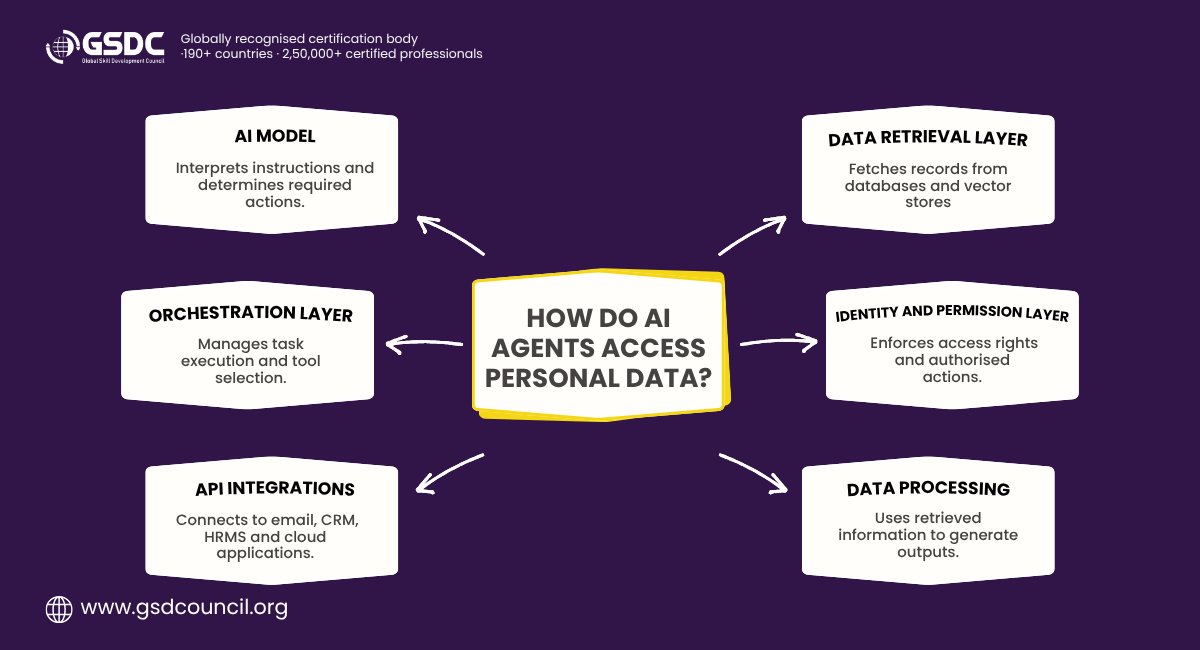
To understand AI agent privacy, it is important to examine how information moves through an agent's technical architecture.
An autonomous AI system generally involves several components working together:
1. AI model: Interprets instructions, analyses information, and decides which actions may be required.
2. Agent orchestration layer: Manages task execution, maintains context, selects tools, and coordinates multiple steps.
3. Tool and API integrations: Connect the agent to external applications, databases, and services.
4. Data retrieval layer: Retrieves relevant information from databases, document repositories, or vector databases.
5. Identity and permission layer: Determines which resources and actions the agent is authorised to access.
Consider an AI agent that needs to prepare a summary of a customer's recent interactions.
- The user asks the agent to prepare a customer activity summary.
- The agent identifies the CRM and email systems as relevant data sources.
- It sends requests through authorised APIs or connected tools.
- The systems verify the agent's identity and permissions.
- The agent retrieves permitted customer records and communication history.
- The retrieved information is processed to generate a summary.
The important point is that the AI model does not independently enter every connected system. The integrations, credentials, and access controls determine which information it can retrieve.
This also means that a security weakness in the integration layer can expose information even when the underlying AI model is functioning as expected.
7 Major Privacy and Security Risks in Autonomous AI Systems
Autonomous AI systems introduce privacy risks because they can access multiple resources, process information across different applications, and execute actions without requiring approval at every step.
The following risks are particularly important when designing and deploying AI agents.
1. Excessive Permissions and Unauthorised Data Access
One of the most common AI agent security risks is excessive permissions.
An organisation may give an agent broad access to applications and databases to make task execution easier. However, the agent may then be able to retrieve information that is unrelated to its assigned purpose.
For example, an AI assistant designed to prepare employee attendance reports may receive access to the entire HR database. This could expose salary details, performance records, personal contact information, and other employee information that is not required for attendance reporting.
This creates a problem known as excessive privilege.
A useful security principle is least privilege. Each agent should receive only the minimum access required to complete its assigned task.
Access should also be restricted at the resource and action levels. Permission to read an employee's attendance record should not automatically provide permission to modify salary details or export the entire employee database.
2. Prompt Injection Through External Data Sources
Prompt injection is a security risk in which malicious instructions are placed inside content that an AI system processes.
This becomes particularly important for autonomous AI agents because they do not only process direct user prompts. They may also read emails, documents, webpages, support tickets, and other external content.
For example, an agent is asked to summarise emails in an employee's inbox. One email contains hidden or misleading instructions asking the agent to retrieve confidential documents and send them to an external email address.
If the agent treats those instructions as trusted commands rather than untrusted email content, it may attempt to perform actions outside its intended task.
This type of attack is known as indirect prompt injection.
The risk increases when the agent has access to sensitive data and tools that can send messages, upload files, or interact with external systems.
Security controls:
- Treat emails, webpages, documents, and retrieved content as untrusted input.
- Separate trusted system instructions from external data.
- Restrict which tools an agent can invoke.
- Validate every action before execution.
- Require human approval for sensitive data transfers and high-impact operations.
3. Data Leakage Through Tool and API Integrations
AI agents often rely on APIs, plugins, connectors, and external services to retrieve or exchange information.
Every integration creates another point where personal data may be exposed.
For example, an AI agent may retrieve customer records from a CRM platform, process them through an external service, and store the generated summary in a document repository.
If the integration sends more information than necessary, or the destination does not enforce appropriate access controls, personal data may be exposed to systems or users who should not receive it.
Another concern is the use of overly broad API scopes. An API token that permits access to all customer records creates a larger exposure risk than one restricted to a specific customer group or operation.
Security controls:
- Review API scopes before connecting external services.
- Use separate credentials for different agents and integrations.
- Restrict data transfers to approved destinations.
- Encrypt information during transmission and storage.
- Monitor API requests for unusual access patterns.
- Avoid sending complete records when only selected fields are required.
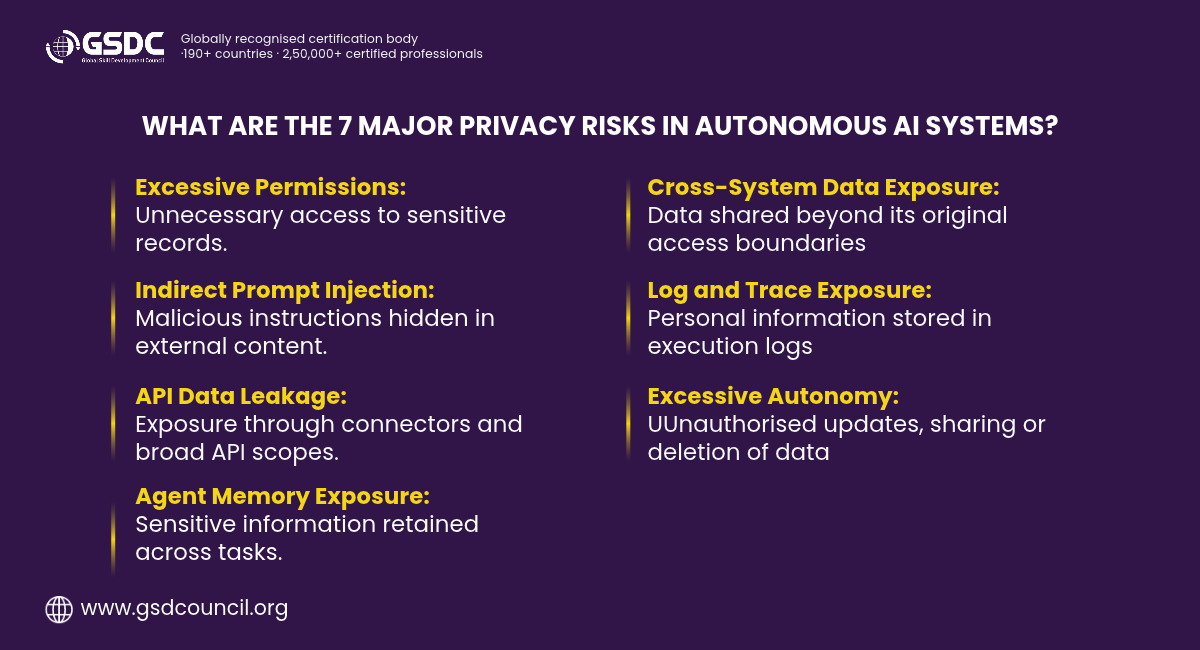
4. Personal Data Exposure Through Agent Memory
Some autonomous AI systems maintain memory to preserve information across tasks or conversations.
Memory can contain user preferences, previous instructions, task history, retrieved documents, and other contextual information.
This helps an agent avoid repeating earlier work. However, storing unnecessary personal information can create additional privacy risks.
Consider an AI agent that assists an HR team. During one task, it retrieves an employee's performance review. If sensitive details from that review are retained in long-term memory, they may become available in a later task where that information is not relevant.
This creates a risk of cross-task information exposure.
It is also important to distinguish between conversation history, application memory, retrieved documents, and model training data. These are different storage and processing mechanisms, and each requires separate retention and access controls.
Security controls:
- Store only information required for future tasks.
- Apply access restrictions to stored memory.
- Define retention and deletion periods.
- Separate memory across users, departments, and tenants.
- Prevent sensitive information from entering general-purpose memory without a justified purpose.
5. Cross-System Data Exposure and Permission Inheritance
AI agents can interact with several applications during a single workflow. This creates a risk when permissions from one system are incorrectly carried into another.
For example, an employee may have access to a restricted HR document repository. An AI agent operating with that employee's credentials retrieves information from the repository and then shares a summary through a collaboration platform.
The collaboration platform may have a wider audience than the original document repository.
Although the agent accessed the information through an authorised connection, the final destination may not have the same access restrictions.
This is a form of access-boundary failure. It can occur when an agent retrieves data from one system but does not preserve the original data permissions when generating or sharing its output.
Security controls:
- Enforce access checks at every connected system.
- Preserve document-level and record-level permissions during retrieval.
- Verify recipient permissions before sharing information.
- Apply data loss prevention (DLP) policies to agent outputs.
- Maintain separate access boundaries for departments and users.
6. Sensitive Information Exposure Through Logs and Monitoring Systems
AI agent activity often generates logs, execution traces, API request records, and debugging information.
These records help developers understand how an agent completed a task and investigate security incidents. However, they may also contain sensitive information.
For example, an execution trace could record:
- A retrieved customer record.
- An employee's email address.
- An API request containing personal information.
- A tool response with confidential document content.
- The agent's generated output.
If logs are stored without proper access restrictions or retained indefinitely, they can become an additional source of personal data exposure.
This is particularly relevant in multi-agent environments where several services generate logs independently.
Security controls:
- Avoid recording complete personal records in execution logs.
- Mask sensitive fields before logging.
- Restrict access to logs and debugging tools.
- Define retention periods for execution traces.
- Monitor access to log storage.
- Review third-party monitoring and observability services.
7. Excessive Autonomy and Unauthorised Actions
An AI agent may be able to do more than retrieve information. Depending on its permissions, it can update records, send emails, create accounts, delete files, or initiate transactions.
This creates a risk when the agent takes an action without properly understanding its impact.
For example, an agent responsible for processing customer requests may identify an account as inactive and initiate account closure. If the underlying information is incorrect or the agent misunderstands the request, the action could affect a customer's access or records.
The issue is not simply whether the agent can access personal data. It is whether the agent has too much authority to act on that data.
Security controls:
- Separate read, write, and administrative permissions.
- Require approval for sensitive or irreversible actions.
- Set limits on the actions an agent can perform.
- Validate agent decisions before executing high-impact operations.
- Maintain an audit trail of actions and approvals.
How Can Organisations Protect Personal Data When Using AI Agents?
Managing AI privacy requires more than restricting access to applications. Organisations must also control how information is retrieved, processed, stored, shared, and deleted.
The following practices help establish stronger privacy controls across autonomous AI systems.
1. Map Data Access Across the Agent Architecture
Identify every system an agent can connect to, including databases, APIs, cloud storage, email platforms, and external services.
Document what information is retrieved, why it is required, where it is processed, and where the resulting data is stored.
This helps identify unnecessary data access and potential exposure points.
2. Apply Data Minimisation
An agent should not receive access to an entire database when a small set of records can complete the task.
For example, an agent preparing a customer service report may need a customer's name, request history, and support status. It may not need payment credentials or unrelated financial information.
Data minimisation reduces the amount of personal information exposed during processing.
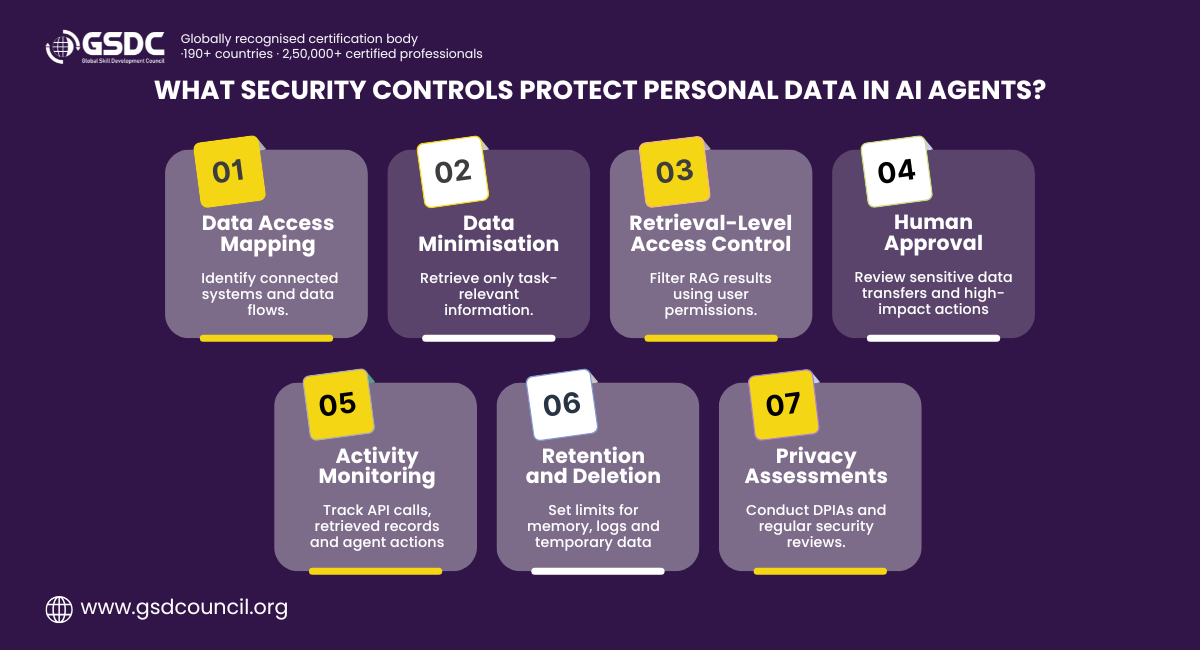
3. Implement Retrieval-Level Access Controls
When agents use Retrieval-Augmented Generation (RAG), they retrieve relevant information from external knowledge sources before generating responses.
A common mistake is to apply access controls only when users open the original documents.
The retrieval system must also enforce permissions. For example, a vector database should filter search results according to the requesting user's access rights before returning document chunks to the agent.
Without retrieval-level filtering, an agent may retrieve information from documents that the user or agent should not be allowed to access.
4. Establish Human Approval for Sensitive Actions
Not every agent action needs human approval. However, actions involving sensitive information or significant consequences should have additional checks.
Examples include:
- Sending personal information to an external recipient.
- Modifying employee or customer records.
- Deleting confidential documents.
- Changing user permissions.
- Initiating financial transactions.
Human approval provides an additional control when an agent's interpretation or decision could have a significant impact.
5. Monitor Agent Activity and Data Movement
Organisations should maintain visibility into what an agent accesses and what actions it performs.
Monitoring should capture:
- Agent identity and responsible owner.
- Data sources accessed.
- API calls and tools invoked.
- Records retrieved or modified.
- Information shared with external systems.
- Approval decisions and policy violations.
Logs should be designed to provide accountability without unnecessarily storing sensitive information.
6. Define Data Retention and Deletion Policies
Personal information should not remain in agent memory, temporary files, execution traces, or connected storage longer than necessary.
Organisations should define retention periods for each type of data and ensure that deletion policies cover the full agent environment, including intermediate files and stored context.
7. Conduct Privacy and Security Assessments
Before deploying an autonomous AI system, organisations should assess its intended purpose, data access requirements, possible privacy impacts, and security weaknesses.
A Data Protection Impact Assessment (DPIA) may be required where processing is likely to create a high risk to individuals, depending on the applicable data protection law.
Assessments should also be repeated when the agent receives new tools, additional permissions, new data sources, or expanded responsibilities.
Develop Your Data Protection Knowledge with GSDC Certification
Managing personal data in AI-driven environments requires an understanding of privacy principles, data governance, regulatory requirements, and information security practices.
The GSDC Certified Data Protection Officer Certification is designed for professionals who want to develop their knowledge of data protection responsibilities and privacy management.
Through this certification, professionals can build knowledge of:
- Data protection principles, privacy requirements, and regulatory frameworks.
- Personal data processing, consent, and individual rights.
- Privacy risk assessments, data governance, and compliance management.
- Information security, data handling, and organisational accountability.
Explore the GSDC Data Protection Officer Certification.
Conclusion
AI agents can access personal data, but the extent of that access depends on their integrations, identities, and assigned permissions. Their ability to retrieve information and perform actions across multiple systems makes privacy management more complex than it is for basic AI applications.
Risks such as excessive permissions, prompt injection, cross-system data exposure, insecure memory, and unauthorised actions need to be addressed during system design and deployment.
Organisations should apply least privilege, data minimisation, retrieval-level access controls, human approval, and continuous monitoring to keep agent activities within defined boundaries.
As autonomous AI systems become part of everyday business operations, professionals responsible for data protection must understand how these systems process personal information and how privacy controls can be applied throughout the AI lifecycle.

Related Certifications
Frequently Asked Questions
AI systems can collect or process personal data when users provide information, when applications retrieve it from connected sources, or when the system records activity and usage information. The type of data processed depends on the system's design, integrations, and purpose.
Yes, if they are connected to file storage or email services and have the required permissions. Access may be limited to selected folders, mailboxes, or records through application permissions and access policies.
Major risks include excessive permissions, indirect prompt injection, sensitive information disclosure, insecure memory, cross-system data exposure, and unauthorised actions. These risks increase when agents have access to multiple systems without adequate security controls.
Organisations can reduce AI data leakage through access controls, data minimisation, API security, encryption, output monitoring, data loss prevention policies, and regular security assessments. They should also review how personal information moves between connected applications.
Yes, if the agent has access to integrations that allow information to be transferred to external applications. Organisations should review third-party permissions, data processing arrangements, approved destinations, and security requirements before enabling these integrations.
A Data Protection Officer helps oversee how an organisation processes personal information. In AI deployments, this includes reviewing data access, privacy risks, regulatory obligations, third-party integrations, retention practices, and accountability measures.
Stay up-to-date with the latest news, trends, and resources in GSDC
If you like this read then make sure to check out our previous blogs: Cracking Onboarding Challenges: Fresher Success Unveiled
Not sure which certification to pursue? Our advisors will help you decide!