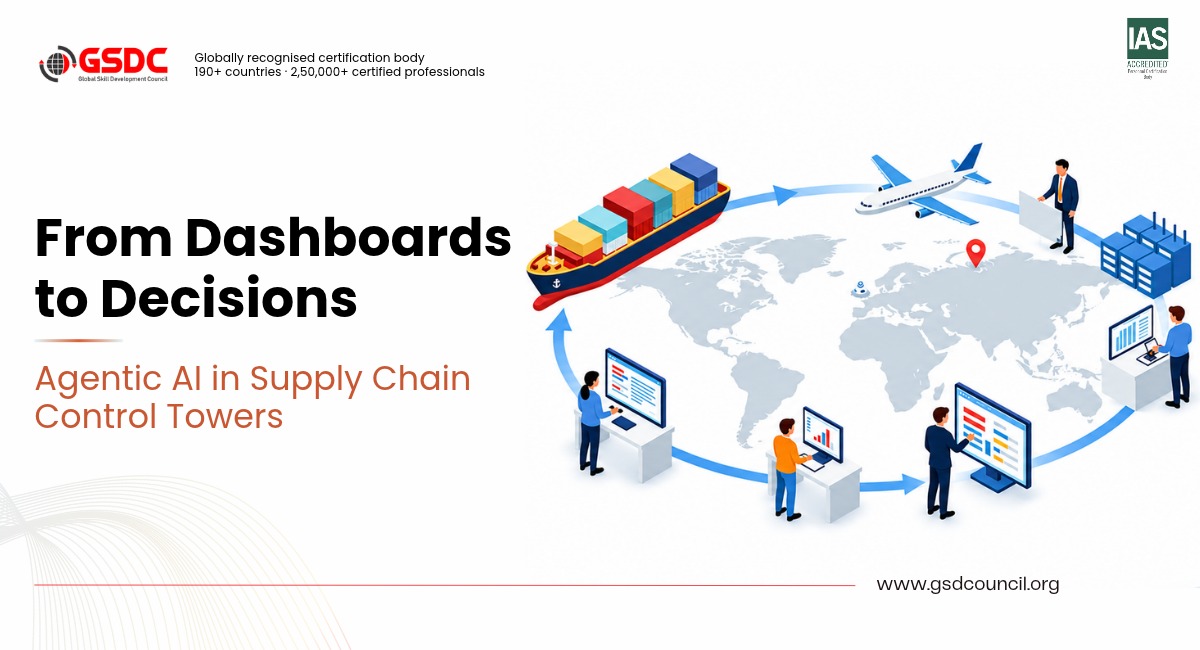
From Dashboards to Decisions: Agentic AI in Supply Chain Control Towers
Written by Emily Hilton
- What Is a Supply Chain Control Tower?
- Why Traditional Supply Chain Dashboards Are No Longer Enough
- How Agentic AI Is Transforming Supply Chain Control Towers
- 5 Ways AI Agents Improve Supply Chain Control Towers
- Important Supply Chain KPIs to Monitor in an AI Control Tower
- Moving Towards an Autonomous Supply Chain
- Build Your Expertise with GSDC’s Agentic AI Supply Chain Professional Certification
- Conclusion
Supply chains generate a huge amount of data every day. From inventory levels and warehouse operations to supplier updates, shipment tracking, and customer orders, businesses need to monitor multiple activities to keep everything running smoothly.
Traditionally, companies have relied on dashboards to understand what is happening across their supply chains. A supply chain dashboard helps teams track deliveries, identify delays, monitor inventory, and review important performance indicators. However, knowing what is happening is not always enough. Businesses also need to understand why something is happening and what they should do next.
This is where agentic AI is changing the role of supply chain control towers. Instead of simply displaying information, AI-powered systems can analyse situations, recommend actions, and even execute certain decisions with appropriate permissions. The shift is taking businesses from monitoring supply chain activities to actively managing them.
What Is a Supply Chain Control Tower?
A supply chain control tower is a centralized system that brings information from different supply chain operations into one place. It helps businesses monitor activities across procurement, manufacturing, warehousing, transportation, and delivery.
Think of it as a central monitoring centre where supply chain managers can see what is happening across different locations and business functions.
A traditional control tower uses data from multiple systems to provide end to end supply chain visibility. For example, it can show whether a shipment has left the warehouse, whether it is delayed in transit, or whether inventory is running low at a particular distribution centre.
A control tower logistics platform can also help teams monitor supplier performance, transportation costs, and delivery schedules.
However, traditional systems mostly depend on human intervention. They can highlight problems, but employees still need to investigate the situation, compare available options, and decide what action to take.
Why Traditional Supply Chain Dashboards Are No Longer Enough
Dashboards have made supply chain monitoring easier, but they also have limitations.
A typical supply chain KPI dashboard displays important supply chain metrics such as delivery performance, inventory turnover, order fulfilment time, transportation costs, and supplier reliability.
These insights help managers understand operational performance. However, when something goes wrong, the dashboard may not explain the best way to resolve it.
Consider this example:
A company is expecting a shipment of raw materials, but the delivery is delayed due to unexpected weather conditions. The dashboard highlights the delay and updates the expected arrival time.
The supply chain manager now needs to:
- Identify which production schedules will be affected.
- Check available inventory across warehouses.
- Contact alternative suppliers if necessary.
- Evaluate transportation options.
- Decide whether to adjust production schedules.
By the time these decisions are made, the delay may already have affected production.
This is the gap between visibility and action. Businesses need systems that do more than display information. They need systems that can interpret changing conditions and help teams respond faster.
How Agentic AI Is Transforming Supply Chain Control Towers
Agentic AI introduces intelligent systems that can work towards specific goals, analyse information, make decisions, and perform tasks with varying levels of autonomy.
Unlike traditional automation, which follows predefined rules, agentic AI in supply chain operations can evaluate different situations and adjust its approach based on available information.
For example, if a shipment is delayed, an AI agent can:
- Detects the delay using live shipment updates.
- Analyse its impact on inventory and production schedules.
- Check alternative suppliers or transportation routes.
- Compare the cost and delivery time of available options.
- Recommend or execute an approved action.
- Notify relevant teams about the changes.
This makes an AI control tower more proactive. Instead of waiting for employees to identify and resolve every issue, AI agents can continuously monitor operations and coordinate responses.
The goal of agentic AI supply chain solutions is not simply to automate individual tasks. It is to connect different decisions and make supply chain operations more responsive.
5 Ways AI Agents Improve Supply Chain Control Towers
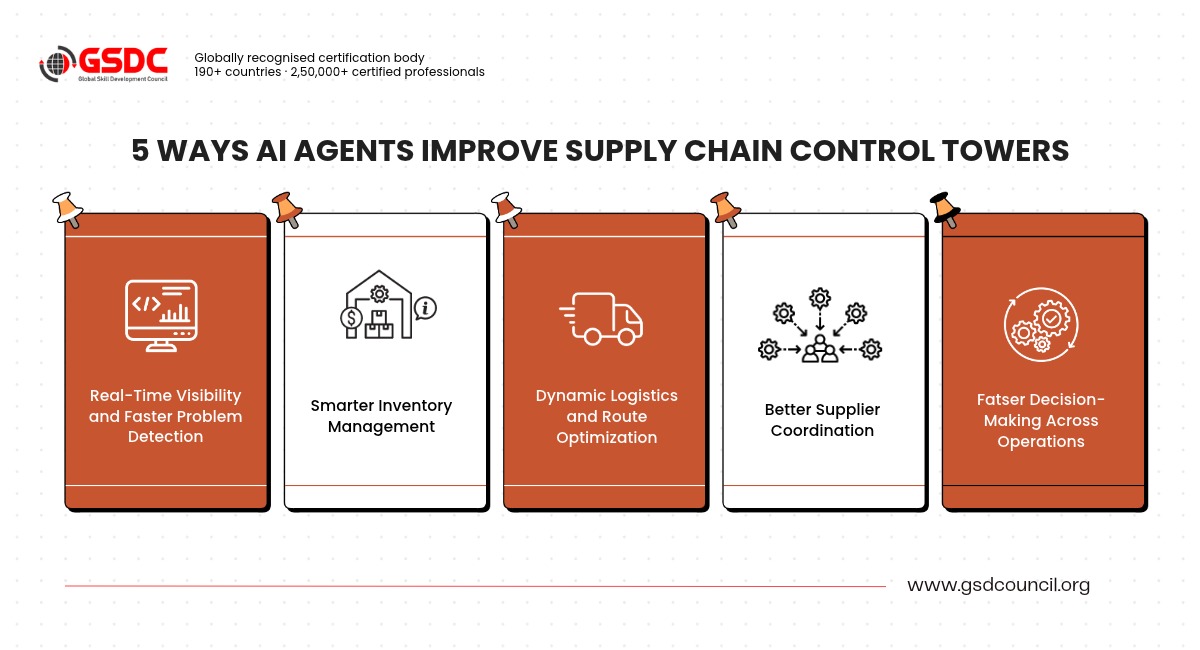
1. Real-Time Visibility and Faster Problem Detection
One of the biggest advantages of AI-powered control towers is improved real time supply chain visibility.
Traditional systems may depend on scheduled reports or periodic data updates. AI-enabled platforms can analyse incoming information from connected systems, IoT devices, GPS trackers, suppliers, and logistics partners.
For example, if a delivery vehicle is delayed due to traffic, an AI agent can identify the disruption and assess which customer orders may be affected.
This gives businesses a clearer picture of the real time supply chain and helps them respond before minor disruptions become major problems.
2. Smarter Inventory Management
Maintaining the right inventory level is a constant challenge. Excess inventory increases storage costs, while insufficient stock can interrupt production and delay customer orders.
AI agents can analyse historical sales, current demand, supplier lead times, and inventory levels to identify potential shortages.
For example, if an AI agent detects that a particular product is selling faster than expected, it can recommend increasing replenishment quantities or transferring stock from another warehouse.
With appropriate permissions, it can also initiate replenishment requests.
This approach supports better inventory planning and reduces the chances of stockouts and overstocking.
3. Dynamic Logistics and Route Optimization
Transportation disruptions can affect delivery schedules and increase operating costs.
With AI agents in supply chain operations, businesses can continuously evaluate traffic conditions, weather updates, fuel costs, vehicle availability, and delivery priorities.
If a particular route becomes unavailable, an AI agent can compare alternative routes and recommend the most suitable option.
For example, a logistics company delivering products across multiple cities may use AI agents to adjust delivery routes based on changing traffic conditions.
This improves transportation planning and supports overall supply chain optimization.
4. Better Supplier Coordination
Supply chains depend on multiple suppliers, and even a small delay from one supplier can affect several downstream activities.
AI agents can monitor supplier delivery records, purchase orders, inventory availability, and communication updates to identify potential risks.
If a supplier repeatedly misses delivery deadlines, the system can flag the issue and suggest evaluating alternative suppliers.
It can also help coordinate purchase order updates and notify procurement teams when action is required.
This makes supplier management more proactive and improves coordination across the supply chain.
5. Faster Decision-Making Across Operations
One of the most valuable capabilities of agentic AI is its ability to connect information across different departments.
For instance, a delayed shipment may affect inventory availability, production schedules, warehouse planning, and customer commitments.
Instead of analysing each issue separately, an AI agent can evaluate how these activities are connected and suggest a coordinated response.
This helps managers make decisions based on the overall business impact rather than focusing on individual operational problems.
Important Supply Chain KPIs to Monitor in an AI Control Tower
An intelligent control tower needs the right performance indicators to understand whether supply chain operations are improving.
A supply chain KPI dashboard can help managers track important measurements, while AI agents can analyse changes and identify potential issues.
Some important supply chain KPIs include:
| Supply Chain KPI | What It Measures |
| Perfect Order Rate | Percentage of orders delivered on time, complete, damage-free, and with accurate documentation |
| Order Fulfilment Cycle Time | Time taken from receiving an order to delivering it |
| Inventory Turnover | How frequently inventory is sold and replenished |
| On-Time Delivery Rate | Percentage of deliveries completed within the promised timeframe |
| Supply Chain Cost | Total expenses involved in supply chain operations |
| Supplier Lead Time | Time taken by suppliers to fulfil orders |
Monitoring these supply chain metrics helps businesses understand operational efficiency and identify areas that require improvement.
For example, if the perfect order rate starts declining, an AI agent can investigate whether the problem is related to supplier delays, warehouse errors, or transportation disruptions.
This turns performance monitoring into actionable intelligence.
Moving Towards an Autonomous Supply Chain
The long-term goal of agentic AI is to help businesses build a more autonomous supply chain, where systems can independently manage routine decisions while keeping humans involved in important business matters.
However, autonomy does not mean removing people from the decision-making process.
Businesses need clear rules about which decisions AI agents can make independently and which require human approval.
For example:
- Low-risk decisions, such as updating delivery notifications, can be automated.
- Medium-risk decisions, such as changing delivery routes, may follow predefined approval rules.
- High-impact decisions, such as changing major suppliers or approving significant purchases, should involve human review.
This approach helps organisations benefit from automation without losing control over critical operations.
As agentic AI supply chain solutions mature, companies will be able to coordinate multiple AI agents across procurement, inventory, manufacturing, and logistics.
Build Your Expertise with GSDC’s Agentic AI Supply Chain Professional Certification
As businesses increasingly adopt intelligent automation, professionals need to understand how agentic AI can transform supply chain operations. Learning how AI agents support procurement, inventory planning, logistics, supplier coordination, and real-time decision-making is becoming an important skill for the future of supply chain management.
GSDC’s Agentic AI Supply Chain Professional Certification helps professionals strengthen their understanding of agentic AI applications in supply chain environments. It supports the development of knowledge required to explore AI-driven workflows, understand intelligent automation, and identify opportunities to improve operational efficiency.
The Agentic AI Supply Chain Professional Certification also includes practical learning through hands-on demonstrations, a capstone project, and expert-led sessions. Professionals can explore how to build demand-forecasting agents, configure supplier-risk monitoring, and design intelligent supply chain control towers. It is particularly relevant for supply chain managers, procurement specialists, logistics professionals, demand planners, and operations leaders looking to strengthen their AI capabilities.
Conclusion
Supply chain control towers are evolving from simple monitoring platforms into intelligent decision-making environments. Traditional dashboards help businesses understand what is happening, while agentic AI helps them determine what needs to happen next.
By combining real-time data, intelligent analysis, and automated actions, businesses can improve visibility, respond to disruptions faster, and make better operational decisions.
The future of supply chain management will not depend only on having more data. It will depend on how effectively businesses turn that data into meaningful action. Agentic AI is helping make that transition possible.

Related Certifications
Stay up-to-date with the latest news, trends, and resources in GSDC
If you like this read then make sure to check out our previous blogs: Cracking Onboarding Challenges: Fresher Success Unveiled
Not sure which certification to pursue? Our advisors will help you decide!