AI Costs Are Rising: How GenAI Professionals Cut Token Spend Without Losing Quality
Written by Emily Hilton
- 1. Why Are Generative AI Costs Increasing?
- 2. Understanding Token Optimization and LLM Cost Optimization
- 3. 7 Practical Ways GenAI Professionals Can Reduce Token Spend
- 4. A Practical Example: Reducing Generative AI Costs Without Losing Quality
- 5. Build Your Expertise With GSDC's Certified Generative AI Professional Certification
- Conclusion
Imagine your company has introduced a generative AI tool to automate customer support, generate reports, and help employees with everyday tasks. Initially, everything works well. Employees save time, productivity improves, and the technology delivers promising results.
But after a few months, you notice something unexpected: the AI usage bill keeps increasing.
More employees are using the tool, conversations are getting longer, and every request requires processing more information. Suddenly, the cost of running AI applications becomes a concern.
This is a challenge many businesses are beginning to face. While generative AI can improve productivity, using it at scale also introduces expenses related to tokens, model inference, APIs, and infrastructure.
Does reducing AI costs mean compromising the quality of AI-generated responses? Not necessarily.
With the right strategies, GenAI professionals can reduce token consumption, improve model efficiency, and manage AI spending without affecting the user experience.
In this blog, we will explore why generative AI costs are increasing, what contributes to token expenses, and how professionals can optimize AI applications while maintaining response quality.
1. Why Are Generative AI Costs Increasing?
Generative AI applications depend on large language models (LLMs) to understand user instructions and generate responses. These models process information in units called tokens.
A token can represent a complete word, part of a word, or even punctuation. Whenever someone sends a prompt or receives an AI-generated response, tokens are processed.
Most commercial AI services charge based on the number of input and output tokens used, although pricing structures vary between providers and models.
As businesses introduce AI into more workflows, their overall AI spend can increase quickly.
Here are some common reasons behind rising AI costs:
- Longer prompts: Detailed instructions and unnecessary background information increase input token consumption.
- Large responses: Asking AI models to generate lengthy explanations, reports, or summaries increases output token usage.
- Repeated requests: Poorly designed applications may send the same information to an AI model multiple times.
- Expensive models: Using advanced models for simple tasks can increase inference expenses unnecessarily.
- Growing user activity: More employees and customers using AI applications can increase overall consumption.
- Inefficient workflows: Applications that repeatedly call multiple models can increase the cost of AI operations.
The important thing to understand is that AI costs are not determined only by which model a company selects. How that model is used also plays a major role.
2. Understanding Token Optimization and LLM Cost Optimization
Before exploring cost-saving techniques, it is important to understand two concepts: token optimization and LLM cost optimization.
Token optimization focuses on reducing the number of tokens an AI application processes while maintaining the usefulness and accuracy of its responses.
For example, imagine an AI application receives a 1,000-token prompt containing repeated instructions and unnecessary background information. After reviewing the prompt, a GenAI professional reduces it to 600 tokens without removing important details.
The application can now process the request using fewer input tokens.
LLM cost optimization takes a broader approach. It focuses on reducing the overall expense of running large language models through better model selection, efficient prompts, caching, and workflow improvements.
Both approaches work together.
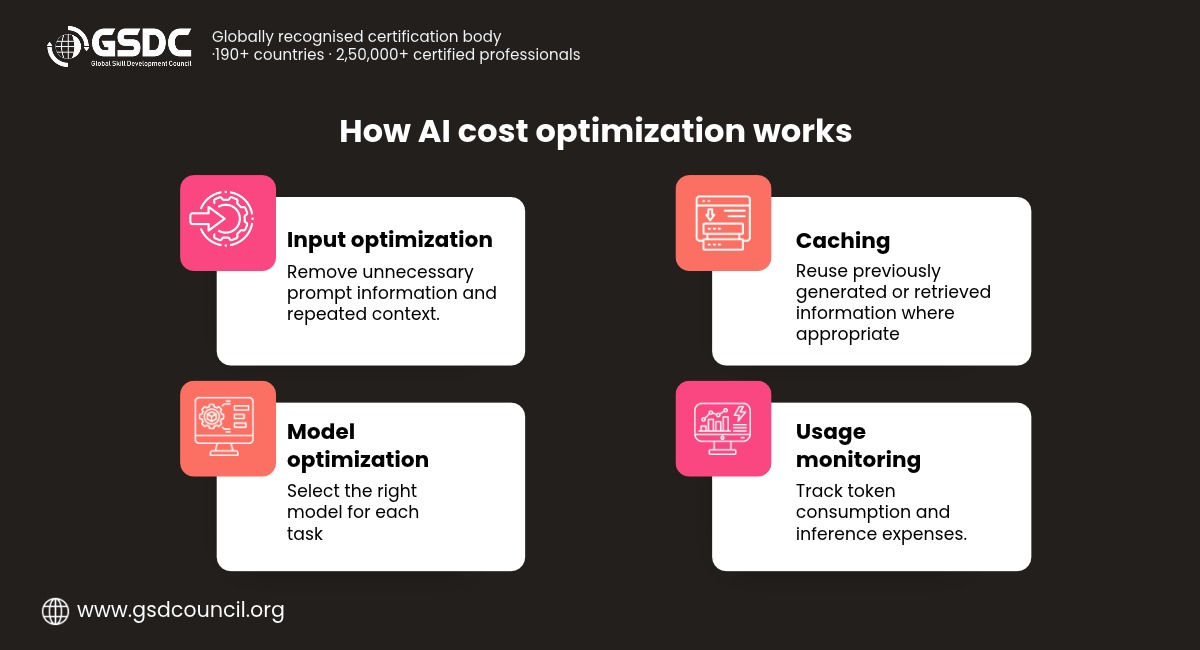
The objective is simple: spend less on unnecessary AI processing while preserving the quality users expect.
3. 7 Practical Ways GenAI Professionals Can Reduce Token Spend
Reducing AI expenses does not always require expensive infrastructure changes or switching to a different AI provider. Sometimes, small improvements in application design can make a noticeable difference.
Here are seven practical techniques professionals can use.
1. Write Shorter and More Focused Prompts
One of the easiest ways to reduce AI token cost is to improve prompt design.
Many applications send lengthy instructions to models, even when a task requires only a simple response.
For example, instead of providing several paragraphs of repeated instructions, developers can create a structured prompt containing only the essential requirements.
A well-designed prompt should clearly explain:
- What the AI needs to do.
- What information it should use.
- What format the response should follow.
- What limitations it should respect.
Removing unnecessary instructions reduces token consumption and can make responses more focused.
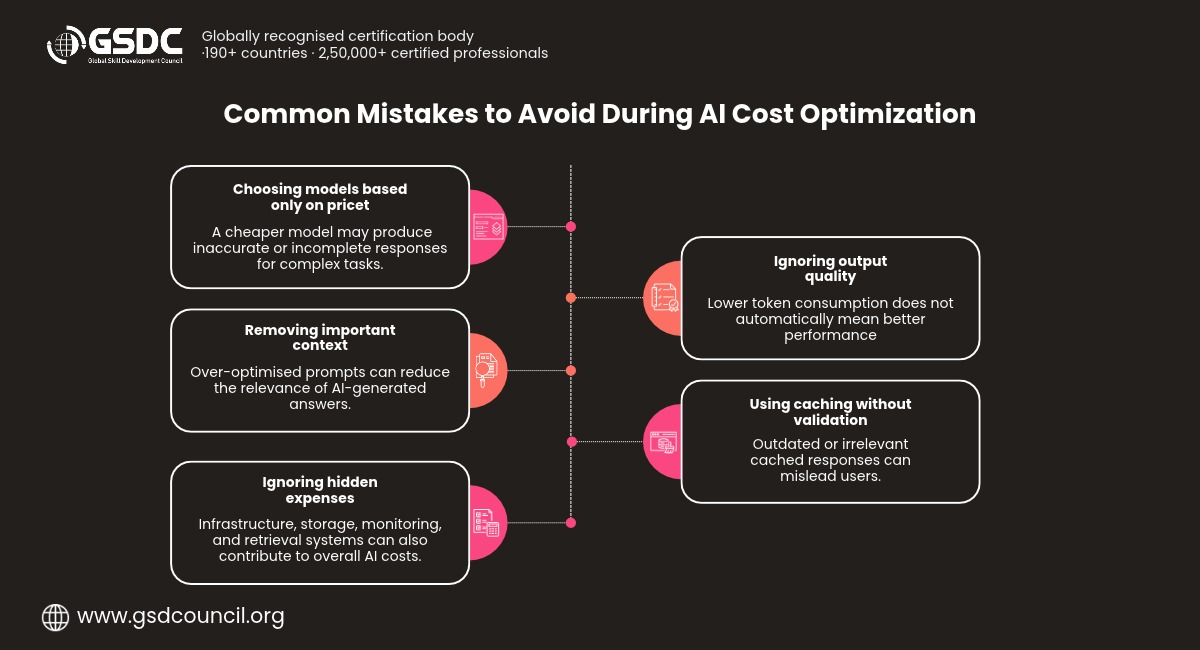
However, professionals should avoid removing important context simply to make prompts shorter.
2. Choose the Right Model for Each Task
Not every AI task requires the most advanced language model.
For example, an application that categorises customer feedback does not necessarily need the same model used for complex financial analysis or advanced reasoning.
GenAI professionals can use a model-routing strategy to assign tasks based on their complexity.
Consider the following examples:
AI task | Suitable approach |
Basic text classification | Smaller, lower-cost model |
Simple content summaries | Efficient model |
Complex reasoning | Advanced model |
Technical analysis | Model suited to deeper reasoning |
This approach helps businesses avoid paying higher inference costs for tasks that simpler models can handle.
The key is to test different models and compare their accuracy, response quality, speed, and cost before making a decision.
3. Use Prompt Caching to Avoid Repeated Processing
Imagine a customer support chatbot receives hundreds of questions about the same company policies.
Every conversation includes the same background information, such as return policies, shipping rules, and product details.
Sending all this information repeatedly can increase token consumption.
Prompt caching helps address this problem by allowing supported systems to reuse previously processed prompt content.
For example, frequently used system instructions or shared context may be cached rather than processed from scratch every time, depending on the provider and implementation.
This can reduce repeated processing costs and improve response speed.
Professionals should understand that caching behaviour and pricing benefits vary across providers. Dynamic information must also be refreshed when it changes.
4. Reduce Unnecessary Context in RAG Applications
Retrieval-Augmented Generation (RAG) allows AI applications to retrieve relevant information from external knowledge sources before generating an answer.
It is useful when businesses want AI systems to answer questions using company documents, reports, product information, or internal databases.
However, retrieving too many documents can increase token consumption.
For example, if an employee asks a chatbot about a leave policy, the system does not need to send 20 unrelated HR documents to the language model.
GenAI professionals can improve efficiency by:
- Retrieving only relevant document sections.
- Improving search accuracy.
- Removing duplicate information.
- Limiting unnecessary context.
- Adjusting the number of retrieved results.
This makes the AI application more efficient while helping it generate answers based on relevant information.
5. Control the Length of AI-Generated Responses
Input tokens are only one part of the expense. Output tokens also contribute to the overall cost of generative AI.
Consider an employee asking an AI assistant to explain a simple company policy.
If the application generates a 1,500-word explanation when a short paragraph would be sufficient, it consumes unnecessary output tokens.
Professionals can manage this by setting appropriate response-length limits and defining output formats.
For example:
- Use short summaries for basic questions.
- Generate detailed explanations only when requested.
- Use structured JSON for machine-readable outputs.
- Avoid repeating information already provided.
The goal is not to make every response short. It is to generate the amount of information the task actually requires.
6. Use Semantic Caching for Repeated Questions
Traditional caching works well when requests are identical. However, users often ask the same question using different words.
For example:
- What is the company's refund policy?
- Can I get my money back?
- How do I request a refund?
These questions may have the same underlying intent.
Semantic caching uses similarity-based matching to identify questions with similar meanings and retrieve previously generated responses when appropriate.
This can reduce repeated model calls.
However, professionals must consider whether cached responses are still accurate, relevant, and permitted for the current user. Sensitive or personalised requests should not receive responses from an unsuitable cache entry.
7. Monitor AI Usage and Set Cost Limits
AI cost optimization should not be a one-time activity.
As more employees and customers use AI applications, token consumption can change. Businesses need regular monitoring to understand where their money is going.
Professionals should track:
- Input and output tokens per request.
- Cost per user or application.
- Model usage across different workflows.
- Average inference cost.
- Frequency of repeated requests.
- Cost per successful task.
They can also establish usage alerts and spending limits to identify unexpected increases.
Monitoring makes it easier to identify expensive workflows and improve them before they create larger financial challenges.
4. A Practical Example: Reducing Generative AI Costs Without Losing Quality
Let's consider an organisation that uses an AI-powered customer support assistant.
Initially, the application uses an advanced language model for every customer query. It also sends large amounts of company information with each request and generates lengthy responses.
As usage increases, the company notices that its generative AI cost is becoming difficult to manage.
The team decides to improve its application using three changes:
- Prompt optimization: Removes repeated instructions and unnecessary context.
- Model routing: Uses a smaller model for basic questions and reserves advanced models for complex requests.
- Caching: Reuses suitable responses for frequently asked questions.
The team then evaluates the updated system using the same test questions and quality criteria.
Illustrative optimization example
Hypothetical figures for explanation, not measured industry results.
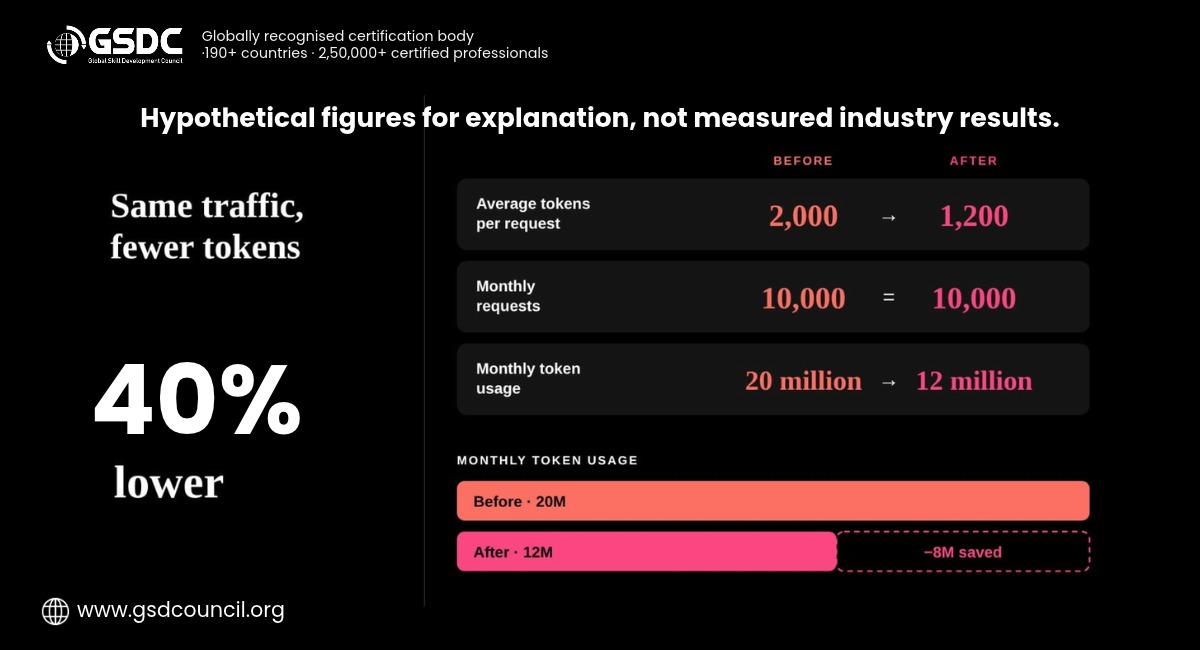
Source: Illustrative calculation based on token usage. The example assumes 10,000 monthly requests, with average token consumption decreasing from 2,000 to 1,200 per request. OpenAI's token documentation provides further information on token measurement and usage.
The organisation now processes fewer tokens while maintaining its required response quality.
This example shows why AI spend management should focus on improving application efficiency rather than simply choosing the cheapest available model.
5. Build Your Expertise With GSDC's Certified Generative AI Professional Certification
As organisations continue to adopt generative AI, professionals need more than basic knowledge of how to use AI tools. They must also understand how to develop efficient AI workflows, manage model performance, and optimize the resources required to run AI applications.
GSDC’s Certified Generative AI Professional certification can help professionals strengthen their understanding of generative AI concepts, applications, and practical implementation approaches.

Pursuing a Generative AI Professional certification can also help learners build knowledge relevant to prompt engineering, LLM applications, AI workflows, and responsible AI adoption.
For developers, AI enthusiasts, technology professionals, and individuals looking to expand their generative AI knowledge, this certification can be a valuable step towards developing skills for an AI-driven workplace.
Conclusion
Generative AI is creating new opportunities for businesses, but increasing usage also brings the challenge of managing costs.
The solution is not to stop using advanced AI models or compromise the quality of responses. Instead, businesses need smarter ways to manage how their AI applications process information.
Through prompt optimization, model routing, caching, efficient RAG implementation, and regular usage monitoring, GenAI professionals can reduce unnecessary token consumption and improve overall application efficiency.
As generative AI adoption continues to grow, professionals who understand both AI capabilities and cost optimization will play an important role in building applications that are not only powerful but also practical and sustainable.

Related Certifications
Stay up-to-date with the latest news, trends, and resources in GSDC
If you like this read then make sure to check out our previous blogs: Cracking Onboarding Challenges: Fresher Success Unveiled
Not sure which certification to pursue? Our advisors will help you decide!